
ECON 211 Midterm, Spring 2003
American University of Beirut · Elementary Microeconomics Theory · 12 pages
Showing the first 10 of 12 pages. Download the PDF to see all of it.
More ECON 211 files
- Midterm · Spring 2019ExamView
- Exam 2 · Spring 2003ExamView
- Exam 2 · Spring 2003ExamView
- Exam 2 · Spring 2003ExamView
- Exam · Fall 1995ExamView
- Useful File Previouses · Fall 2018FileView
- Notes COURSE SUMMARY ECON 211 FOR FINAL · Fall 2017Final examView
- Useful File Test Banks Version 1 · Spring 2016FileView
Show the text of this exam
MERICA ONTVERSINR
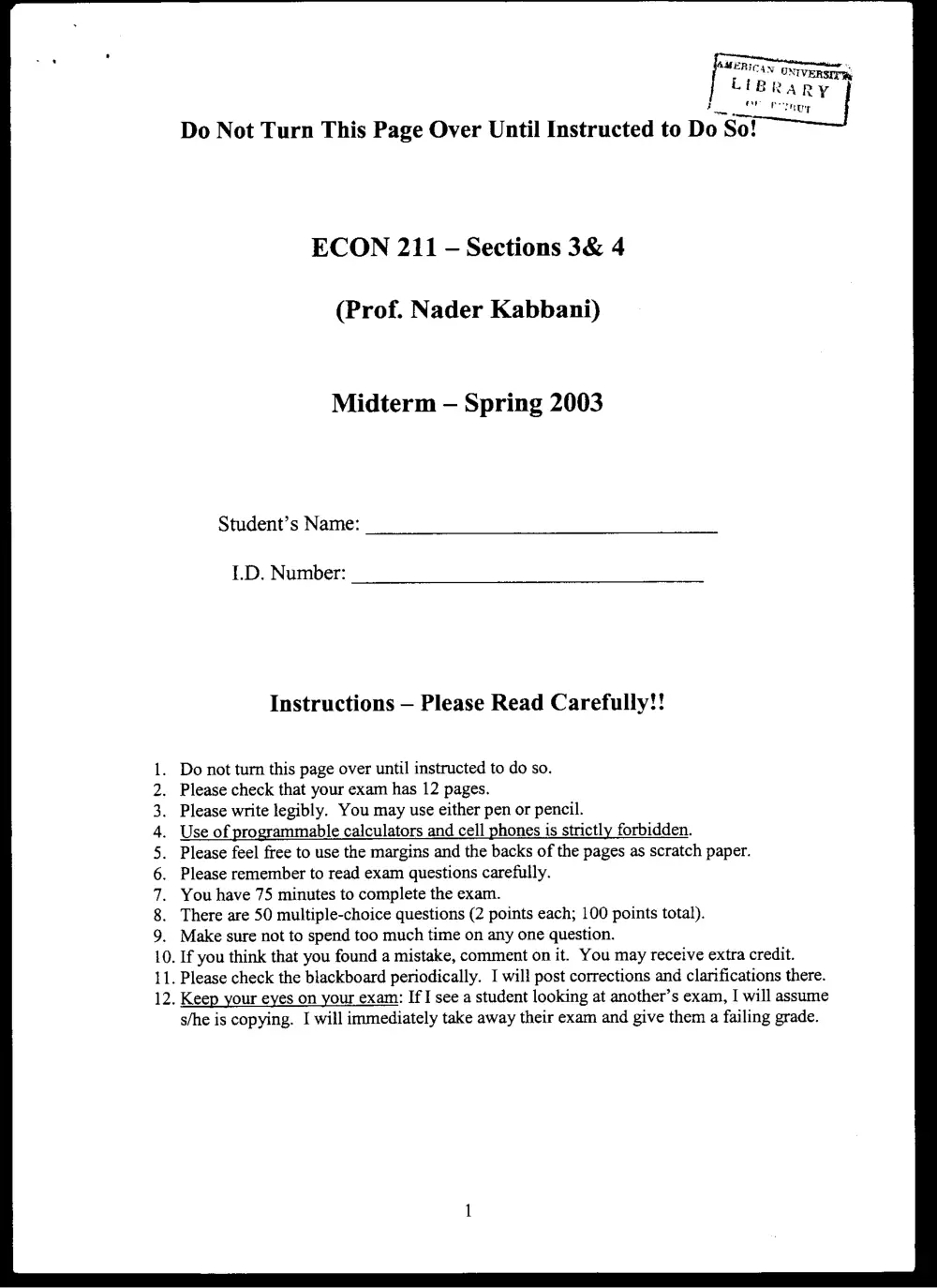
Do Not Turn This Page Over Until Instructed to Do So! -
ECON 211 - Sections 3& 4
(Prof. Nader Kabbani)
Midterm — Spring 2003
Student’s Name:
LD. Number:
Instructions — Please Read Carefully!!
Do not turn this page over until instructed to do so.
Please check that your exam has 12 pages.
Please write legibly. You may use either pen or pencil.
Use of programmable calculators and cell phones is strictly forbidden.
Please feel free to use the margins and the backs of the pages as scratch paper.
Please remember to read exam questions carefully.
You have 75 minutes to complete the exam.
There are 50 multiple-choice questions (2 points each; 100 points total).
. Make sure not to spend too much time on any one question.
10. If you think that you found a mistake, comment on it. You may receive extra credit.
11. Please check the blackboard periodically. I will post corrections and clarifications there.
12. Keep your eyes on your exam: If] see a student looking at another’s exam, I will assume
s/he is copying. I will immediately take away their exam and give them a failing grade.
COIN YN S
ERICAN ONIVERSIT
LIBRARY
OF REPRO
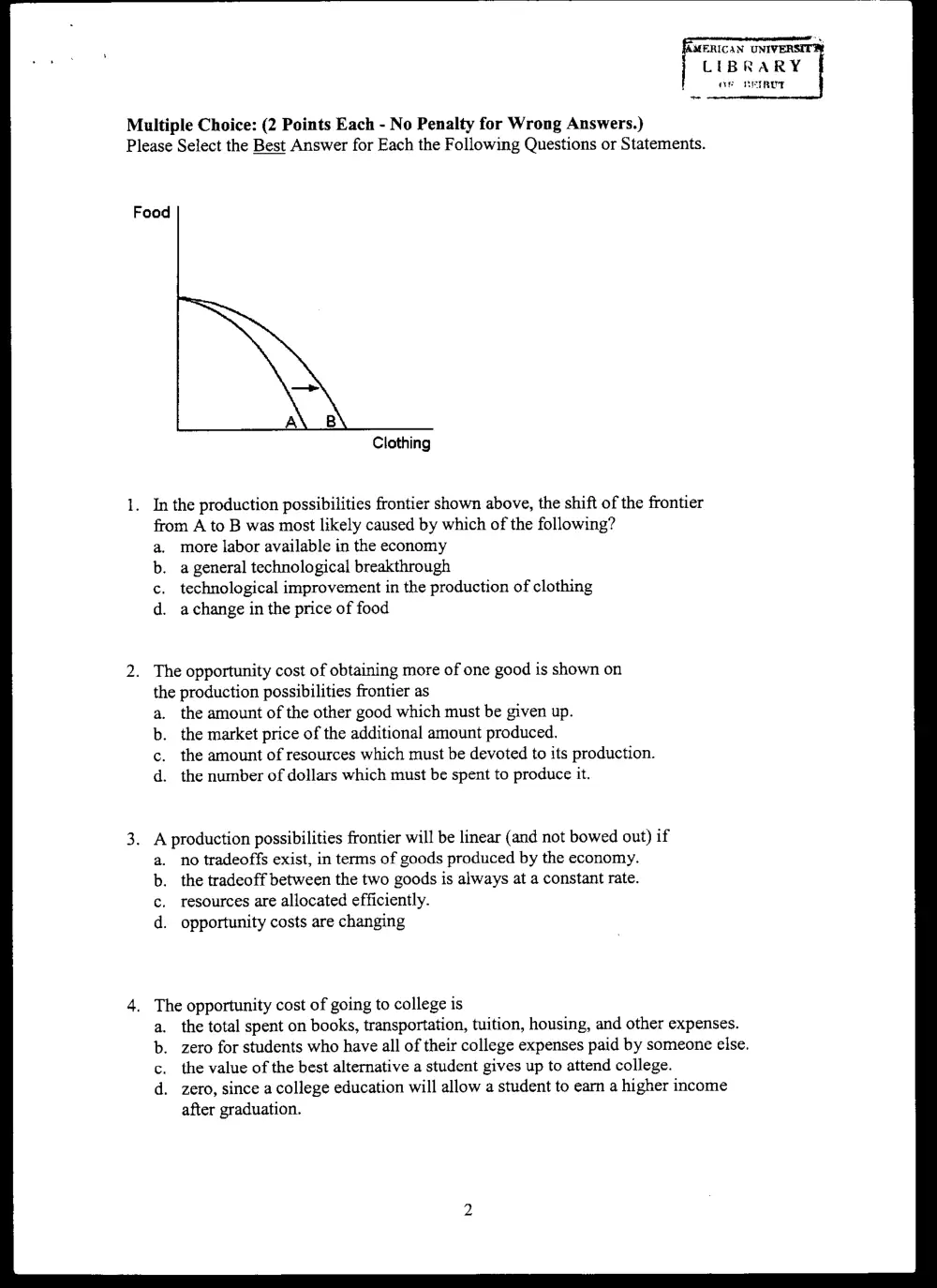
Multiple Choice: (2 Points Each - No Penalty for Wrong Answers.)
Please Select the Best Answer for Each the Following Questions or Statements.
Clothing
. Inthe production possibilities frontier shown above, the shift of the frontier
from A to B was most likely caused by which of the following?
a. more labor available in the economy
b. a general technological breakthrough
c. technological improvement in the production of clothing
d
a change in the price of food
. The opportunity cost of obtaining more of one good is shown on
the production possibilities frontier as
the amount of the other good which must be given up.
the market price of the additional amount produced.
the amount of resources which must be devoted to its production.
the number of dollars which must be spent to produce it.
. A production possibilities frontier will be linear (and not bowed out) if
no tradeoffs exist, in terms of goods produced by the economy.
the tradeoff between the two goods is always at a constant rate.
resources are allocated efficiently.
opportunity costs are changing
The opportunity cost of going to college is
the total spent on books, transportation, tuition, housing, and other expenses.
zero for students who have all of their college expenses paid by someone else.
the value of the best alternative a student gives up to attend college.
zero, since a college education will allow a student to earn a higher income
after graduation.
AMERICAN UNTVERSITS
LIBRARY
or BEIRUT
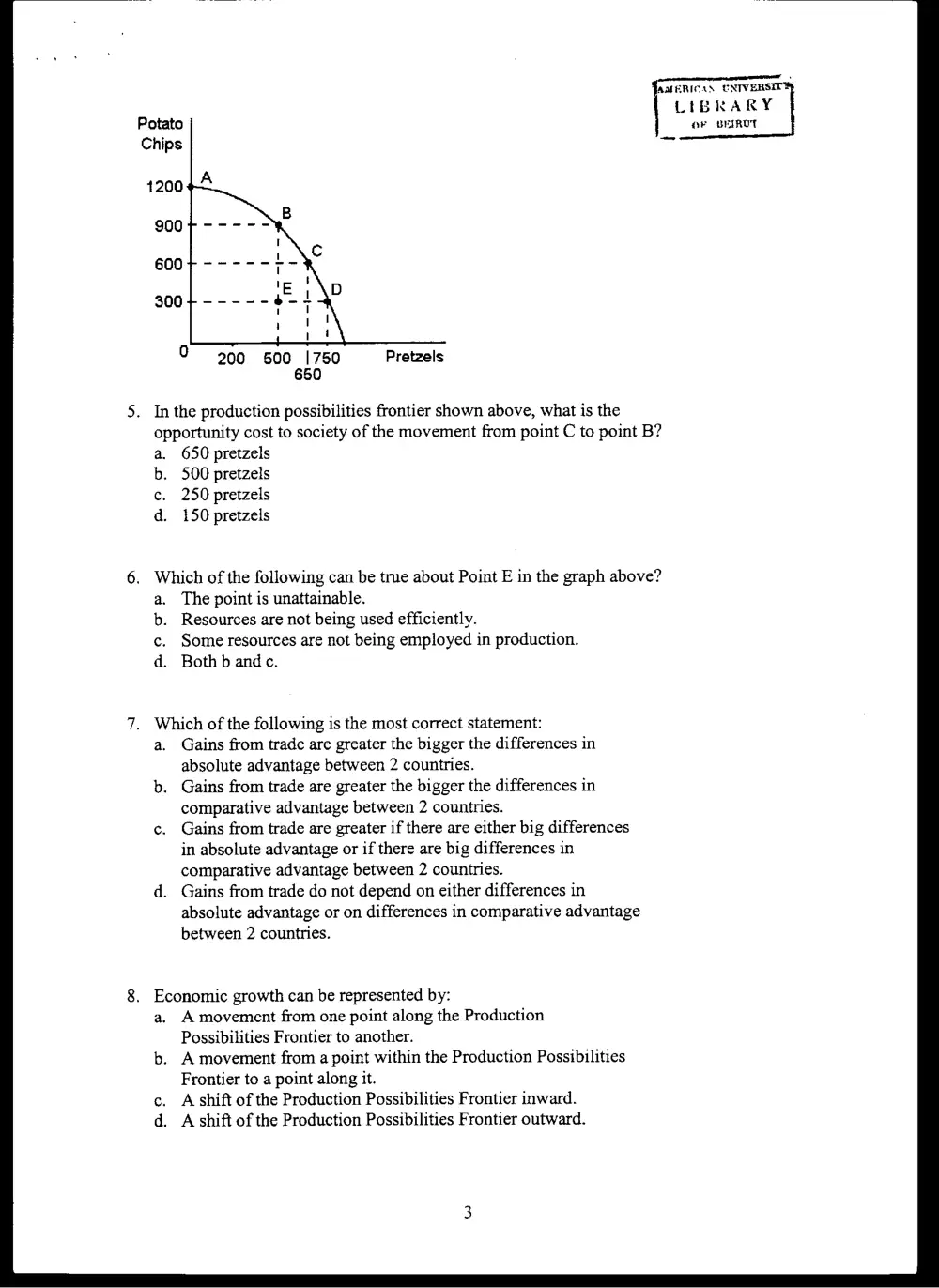
200 500 1750 Pretzels
650
. In the production possibilities frontier shown above, what is the
opportunity cost to society of the movement from point C to point B?
a. 650 pretzels
b. 500 pretzels
c. 250 pretzels
d. 150 pretzels
. Which of the following can be true about Point E in the graph above?
a. The point is unattainable.
b. Resources are not being used efficiently.
c. Some resources are not being employed in production.
d. Both b andc.
. Which of the following is the most correct statement:
a. Gains from trade are greater the bigger the differences in
absolute advantage between 2 countries.
b. Gains from trade are greater the bigger the differences in
comparative advantage between 2 countries.
Gains from trade are greater if there are either big differences
in absolute advantage or if there are big differences in
comparative advantage between 2 countries.
Gains from trade do not depend on either differences in
absolute advantage or on differences in comparative advantage
between 2 countries.
. Economic growth can be represented by:
a. A movement from one point along the Production
Possibilities Frontier to another.
b. A movement from a point within the Production Possibilities
Frontier to a point along it.
A shift of the Production Possibilities Frontier inward.
A shift of the Production Possibilities Frontier outward.
AMERICAN OD
LIBRARY
OF BEIRUT
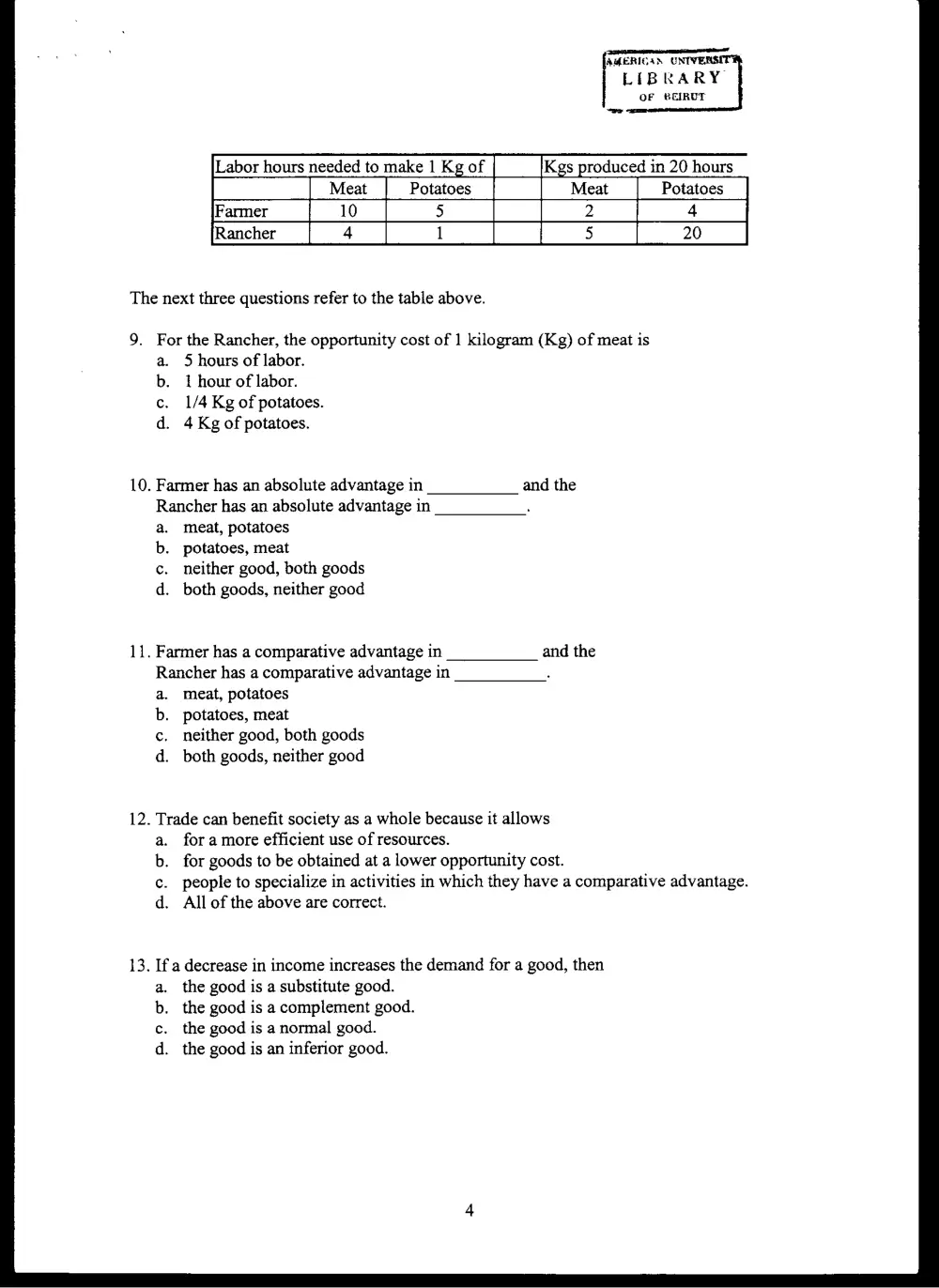
Labor hours needed to make 1 Kg of Kgs produced in 20 hours
Potatoes Meat Potatoes
3 2 4
1 5 20
The next three questions refer to the table above.
9.
10.
11.
12.
13.
For the Rancher, the opportunity cost of 1 kilogram (Kg) of meat is
a. 5 hours of labor.
b. t hour of labor.
c. 1/4Kg of potatoes.
d. 4 Kg of potatoes.
Farmer has an absolute advantage in and the
Rancher has an absolute advantage in
a. meat, potatoes
b. potatoes, meat
c. neither good, both goods
d. both goods, neither good
Farmer has a comparative advantage in and the
Rancher has a comparative advantage in
meat, potatoes
potatoes, meat
neither good, both goods
both goods, neither good
aooPp
Trade can benefit society as a whole because it allows
for a more efficient use of resources.
for goods to be obtained at a lower opportunity cost.
people to specialize in activities in which they have a comparative advantage.
All of the above are correct.
Be op
If a decrease in income increases the demand for a good, then
the good is a substitute good.
the good is a complement good.
the good is a normal good.
the good is an inferior good.
aoe oP
RatENICAN UNIVERSITS
LIBRARY
OF BEIRUT
100 200 300 400 500 600 700 800
Quantity
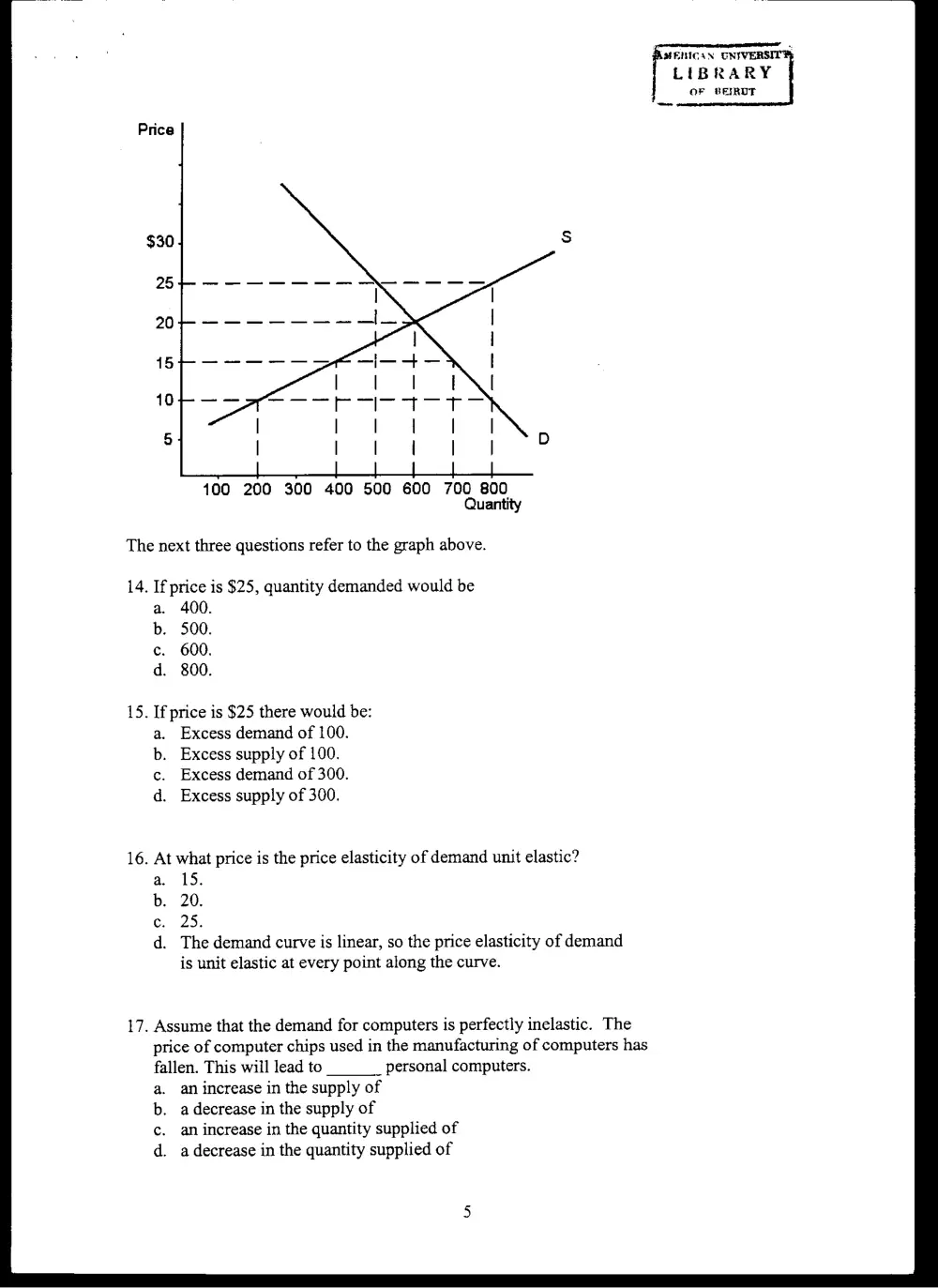
The next three questions refer to the graph above.
14. If price is $25, quantity demanded would be
a. 400.
b. 500.
c. 600.
d. 800.
15. If price is $25 there would be:
a. Excess demand of 100.
b. Excess supply of 100.
c. Excess demand of 300.
d.
Excess supply of 300.
16. At what price is the price elasticity of demand unit elastic?
. 15.
. 20.
. 25.
. The demand curve is linear, so the price elasticity of demand
is unit elastic at every point along the curve.
17. Assume that the demand for computers is perfectly inelastic. The
price of computer chips used in the manufacturing of computers has
fallen. This will lead to personal computers.
an increase in the supply of
. adecrease in the supply of
. an increase in the quantity supplied of
. adecrease in the quantity supplied of
ERICAN UNIVER:
LIBRARY
7 OF BemRUT
18. Suppose that lettuce and spinach are substitutes. During the
winter, about 20% of the lettuce crop was destroyed by flooding.
The floods would have caused the equilibrium price of spinach to
and the equilibrium quantity of spinach to
decrease; decrease
decrease; increase
increase; increase
increase; decrease
Ro TP
19, Which of the following will unambiguously occur when there is a
simultaneous decrease in demand and a decrease in supply? (You
may assume the usual slopes of the demand and supply schedules.)
An increase in equilibrium price
A decrease in equilibrium price
An increase in equilibrium quantity
A decrease in equilibrium quantity
ae gp
20. The market price for apartments is initially $500 per month.
If the government sets a price ceiling of $400 for an
apartment, which of the following will happen?
a. Demand must eventually decrease so that the market
will come into equilibrium at a price of $400.
b. Supply must eventually increase so that the market
will come into equilibrium at a price of $400.
c. Demand will decrease and supply will increase until
the market comes into equilibrium at a price of $400.
d. Anon-price rationing system such as queuing must be
used to ration the available supply of apartments.
21. A perfectly inelastic supply signifies that
change in price will have no effect on quantity supplied.
change in price will change quantity supplied in the opposite direction.
an infinite quantity will be supplied at a given price.
the relationship between price and quantity supplied is inverse.
peop
22. Suppose the demand for newspapers goes up when the price
of coffee goes down. We can say that these two goods are
a. complements.
b. substitutes.
c. unrelated goods.
d. perfect substitutes.
AMERICAN
ON ‘
LIBRaRy
~ OF SeRoOT
Suppose that the supply and the demand for umbrellas can be characterized by:
Supply: Qs = 100 + 2P
Demand: Qd = 160 — 2P + 20W
Qs is the supply of umbrellas. Qd is the demand for umbrellas. P is the market price for
umbrellas. W is the season: where W=1 when it is winter and W=0 when it is summer. Use
the information above to answer the next five questions.
23. What is the equilibrium price during summer?
a. $15
b. $20
c. $30
d. $100
24. What is the equilibrium price during winter?
a. $15
b. $20
c. $30
d. $100
25. Ifa tax of $5 per umbrella is imposed, then the price that
producers get per umbrella (after taxes) will:
a. Increase by $5
b. Increase by less than $5
c. Decrease by $5
d. Decrease by less than $5
. Compared to consumers, producers will pay a higher share of the tax:
a. During the summer.
b. During the winter.
c. The share of the tax paid by producers will be the same in both seasons.
d. There is not enough information to answer the question.
. Total tax revenue collected by the government will be
a. Higher during the summer.
. Higher during the winter.
b
c. The same in both seasons.
d. There is not enough information to answer the question.
Guenicas oN 4
LIBRARY §
oF REIRUT
i Person A
12+----- :
» ap---4 2
g a
= &
|! &
| | a
1 2, ae
by
0 t—t ad od
3.05 Q
Compact disks Compact disks
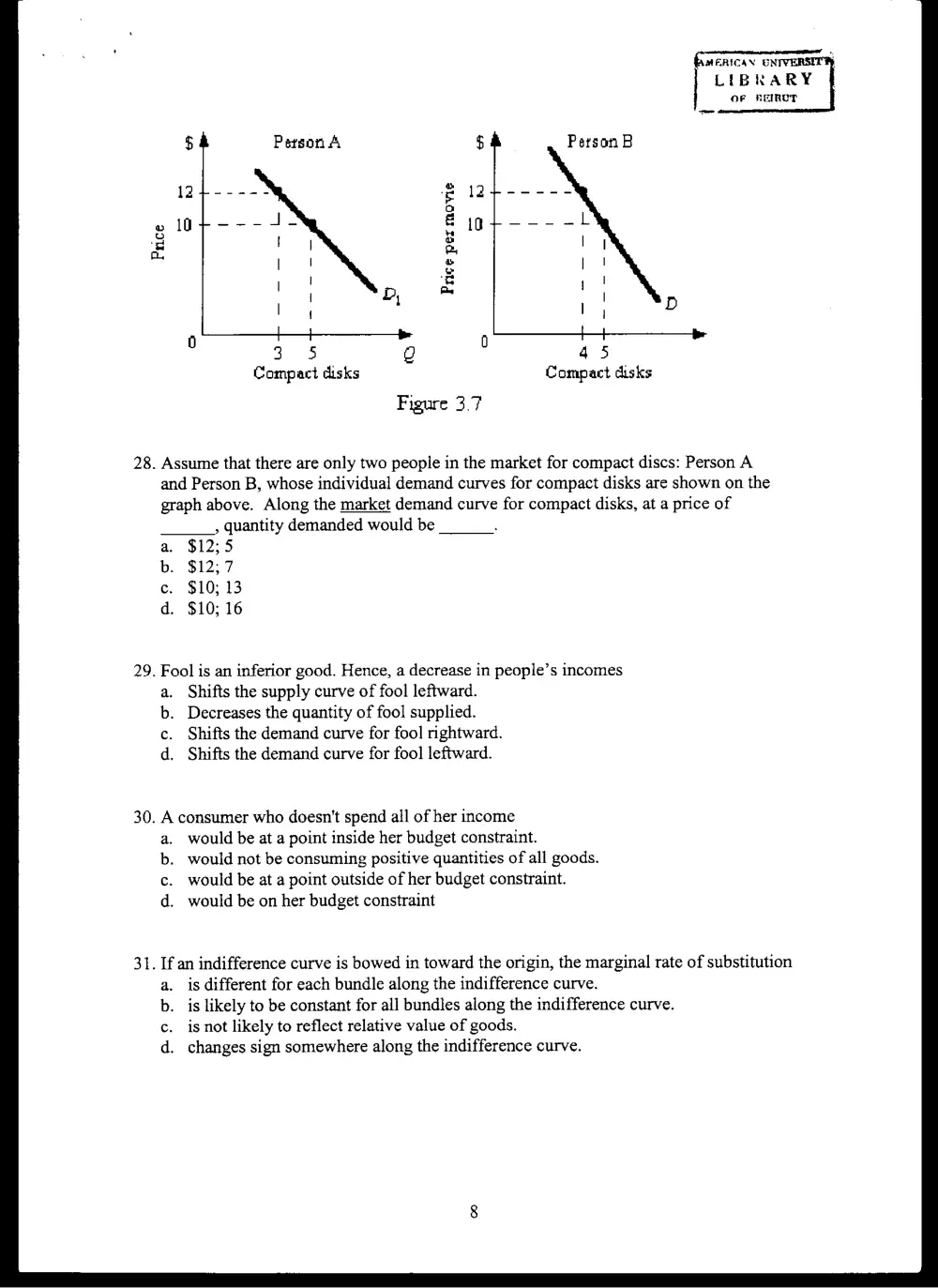
Figure 3.7
28. Assume that there are only two people in the market for compact discs: Person A
and Person B, whose individual demand curves for compact disks are shown on the
graph above. Along the market demand curve for compact disks, at a price of
, quantity demanded would be
a. $12;5
b. $12;7
c. $10; 13
d. $10; 16
29. Fool is an inferior good. Hence, a decrease in people’s incomes
a. Shifts the supply curve of fool leftward.
b. Decreases the quantity of fool supplied.
c. Shifts the demand curve for fool rightward.
d. Shifts the demand curve for fool leftward.
30. A consumer who doesn't spend all of her income
would be at a point inside her budget constraint.
would not be consuming positive quantities of all goods.
would be at a point outside of her budget constraint.
would be on her budget constraint
a.
b.
c.
d.
31. If an indifference curve is bowed in toward the origin, the marginal rate of substitution
is different for each bundle along the indifference curve.
is likely to be constant for all bundles along the indifference curve.
is not likely to reflect relative value of goods.
changes sign somewhere along the indifference curve.
aorP
»
Purenicas onvEnsir sy
LIBRARY
OF BEIROT
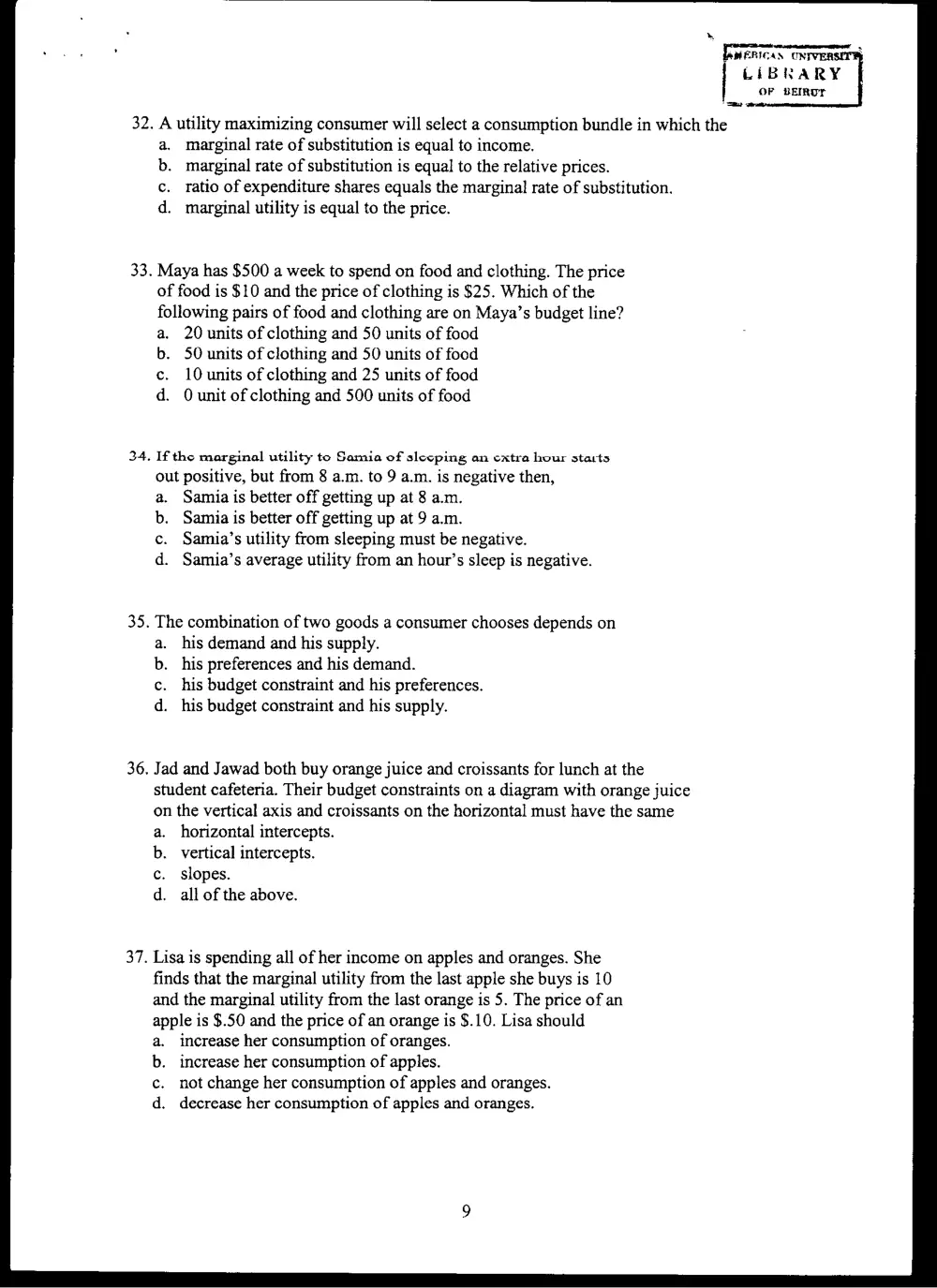
. A utility maximizing consumer will select a consumption bundle in which the
marginal rate of substitution is equal to income.
. Marginal rate of substitution is equal to the relative prices.
. Tatio of expenditure shares equals the marginal rate of substitution.
. marginal utility is equal to the price.
. Maya has $500 a week to spend on food and clothing. The price
of food is $10 and the price of clothing is $25. Which of the
following pairs of food and clothing are on Maya’s budget line?
20 units of clothing and 50 units of food
50 units of clothing and 50 units of food
10 units of clothing and 25 units of food
0 unit of clothing and 500 units of food
. If the marginal utility to Samia of slecping an extra hour starts
out positive, but from 8 a.m. to 9 a.m. is negative then,
Samia is better off getting up at 8 a.m.
Samia is better off getting up at 9 a.m.
Samia’s utility from sleeping must be negative.
Samia’s average utility from an hour’s sleep is negative.
. The combination of two goods a consumer chooses depends on
his demand and his supply.
. his preferences and his demand.
. his budget constraint and his preferences.
. his budget constraint and his supply.
. Jad and Jawad both buy orange juice and croissants for lunch at the
student cafeteria. Their budget constraints on a diagram with orange juice
on the vertical axis and croissants on the horizontal must have the same
horizontal intercepts.
. vertical intercepts.
slopes.
all of the above.
. Lisa is spending all of her income on apples and oranges. She
finds that the marginal utility from the last apple she buys is 10
and the marginal utility from the last orange is 5. The price of an
apple is $.50 and the price of an orange is $.10. Lisa should
a. increase her consumption of oranges.
b. increase her consumption of apples.
c. not change her consumption of apples and oranges.
d. decrease her consumption of apples and oranges.
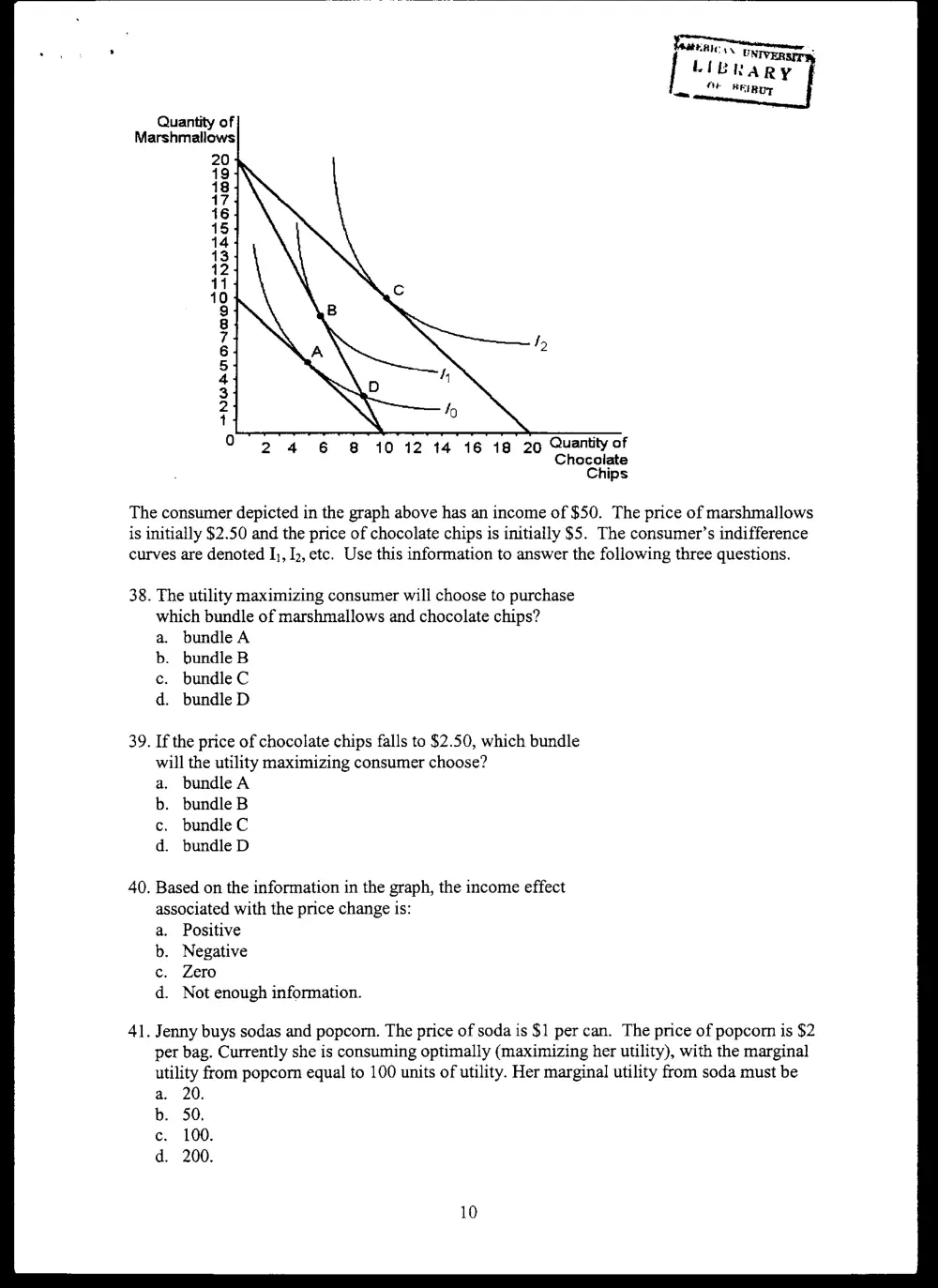
Quantity of
Marshmallows
en ee ee eereny
Ny
o ANWOATHNVODOO=2NWAMANDOD
2 4 6 8 10 12 14 16 18 20 Quantity of
Chocolate
Chips
The consumer depicted in the graph above has an income of $50. The price of marshmallows
is initially $2.50 and the price of chocolate chips is initially $5. The consumer’s indifference
curves are denoted I), 2, etc. Use this information to answer the following three questions.
38. The utility maximizing consumer will choose to purchase
which bundle of marshmallows and chocolate chips?
a. bundle A
b. bundle B
c. bundle C
d. bundle D
39. If the price of chocolate chips falls to $2.50, which bundle
will the utility maximizing consumer choose?
a. bundle A
b. bundle B
c. bundle C
d. bundle D
40. Based on the information in the graph, the income effect
associated with the price change is:
a. Positive
b. Negative
c. Zero
d. Not enough information.
41. Jenny buys sodas and popcorn. The price of soda is $1 per can. The price of popcorn is $2
per bag. Currently she is consuming optimally (maximizing her utility), with the marginal
utility from popcorn equal to 100 units of utility. Her marginal utility from soda must be
a. 20.
b. 50.
c. 100.
d. 200.
10