
ECON 211 Midterm, Spring 2019
American University of Beirut · Elementary Microeconomics Theory · 11 pages



Showing the first 10 of 11 pages. Download the PDF to see all of it.
More ECON 211 files
- Exam 2 · Spring 2003ExamView
- Exam 2 · Spring 2003ExamView
- Exam 2 · Spring 2003ExamView
- Midterm · Spring 2003ExamView
- Exam · Fall 1995ExamView
- Useful File Previouses · Fall 2018FileView
- Notes COURSE SUMMARY ECON 211 FOR FINAL · Fall 2017Final examView
- Useful File Test Banks Version 1 · Spring 2016FileView
Show the text of this exam
Exam
Name___________________________________
MULTIPLE CHOICE. Choose the one alternative that best completes the statement or answers the question.
1) The market price of a basketball is $35 and the full cost of producing it is $20, then a basketball
producing firm gets producer surplus of
1)
A) 1 basketball.
B) $35.
C) $20.
D) $15.
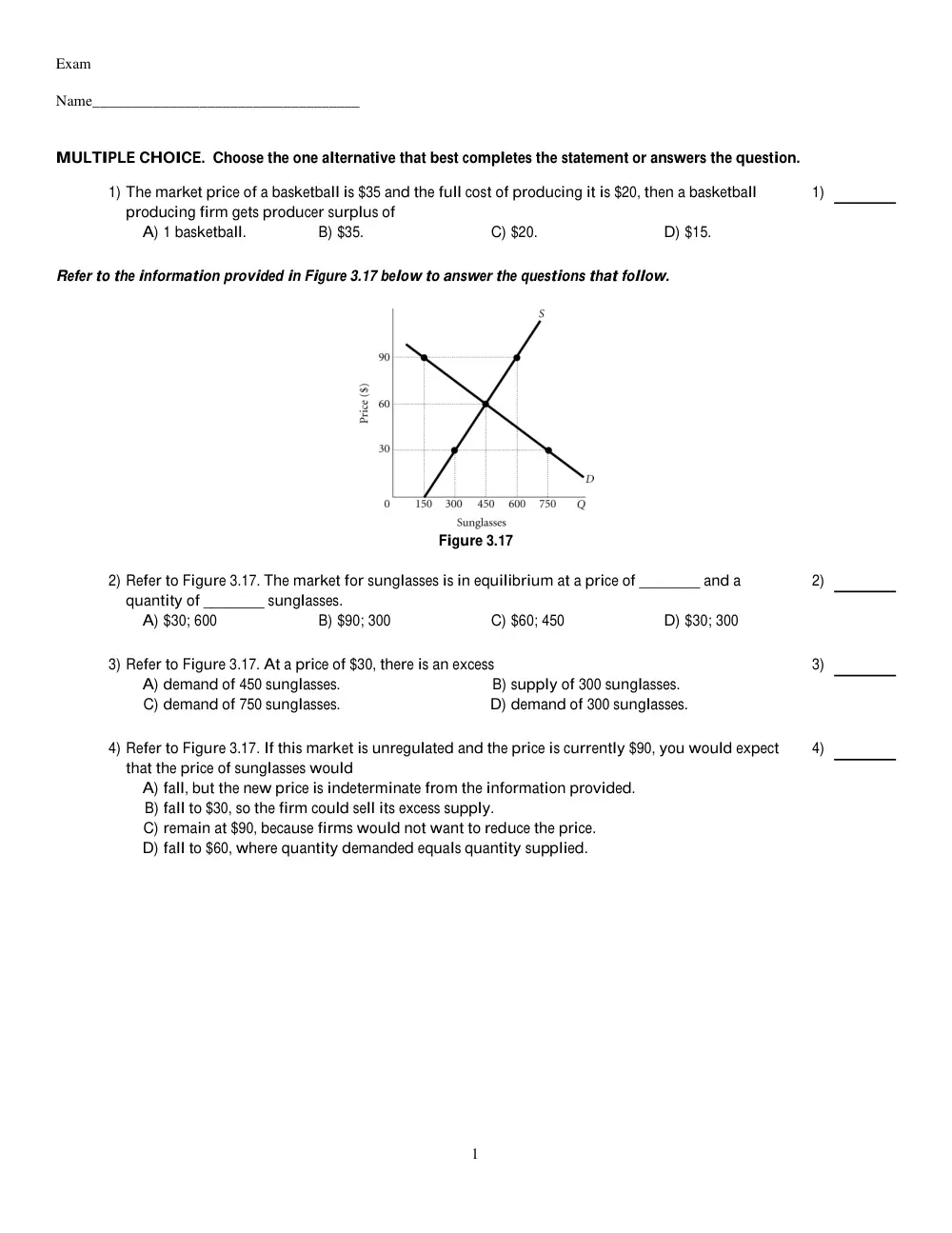
Refer to the information provided in Figure 3.17 below to answer the questions that follow.
Figure 3.17
2) Refer to Figure 3.17. The market for sunglasses is in equilibrium at a price of ________ and a
quantity of ________ sunglasses.
2)
A) $30; 600
B) $90; 300
C) $60; 450
D) $30; 300
3) Refer to Figure 3.17. At a price of $30, there is an excess
3)
A) demand of 450 sunglasses.
B) supply of 300 sunglasses.
C) demand of 750 sunglasses.
D) demand of 300 sunglasses.
4) Refer to Figure 3.17. If this market is unregulated and the price is currently $90, you would expect
that the price of sunglasses would
4)
A) fall, but the new price is indeterminate from the information provided.
B) fall to $30, so the firm could sell its excess supply.
C) remain at $90, because firms would not want to reduce the price.
D) fall to $60, where quantity demanded equals quantity supplied.
1
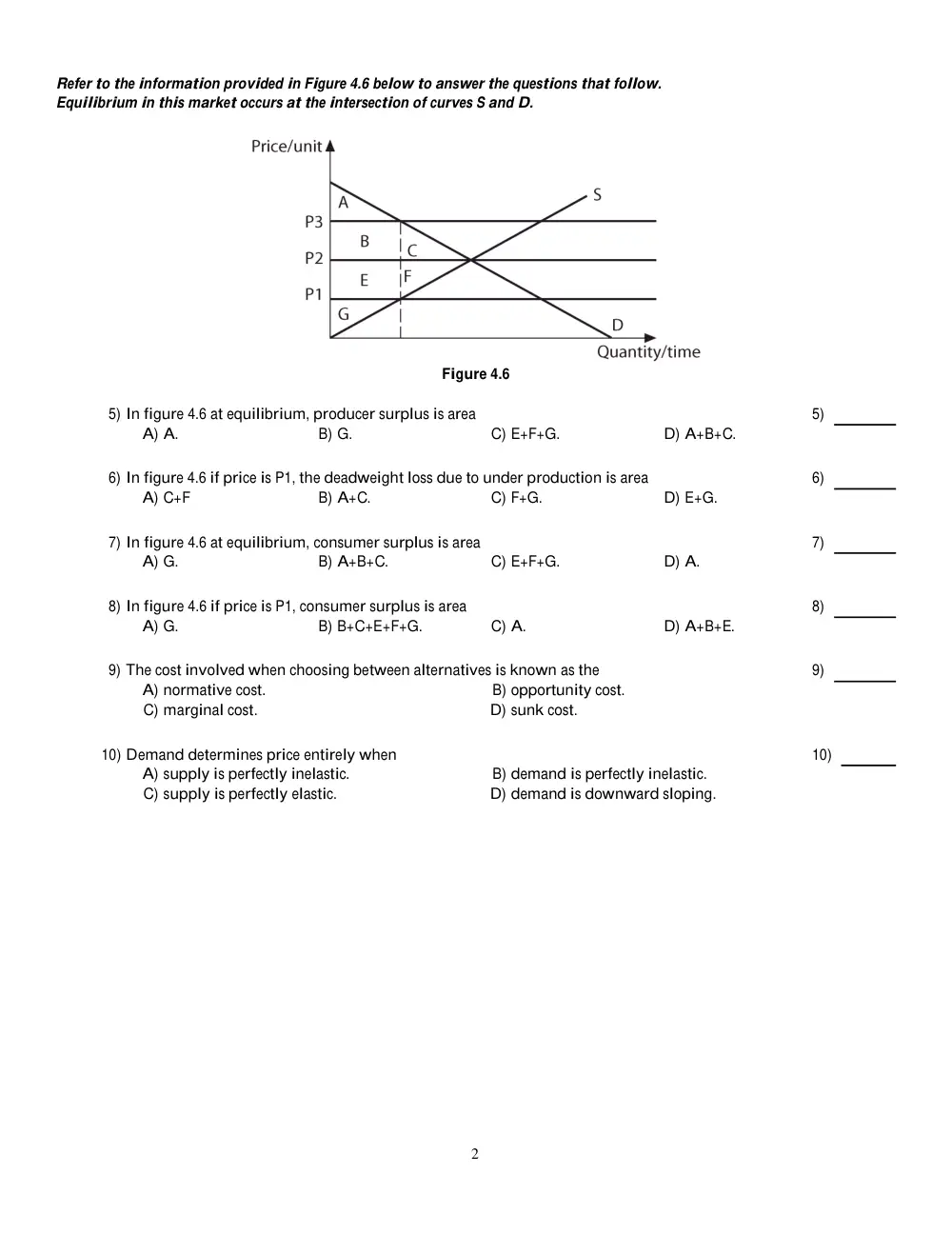
Refer to the information provided in Figure 4.6 below to answer the questions that follow.
Equilibrium in this market occurs at the intersection of curves S and D.
Figure 4.6
5) In figure 4.6 at equilibrium, producer surplus is area
5)
A) A.
B) G.
C) E+F+G.
D) A+B+C.
6) In figure 4.6 if price is P1, the deadweight loss due to under production is area
6)
A) C+F
B) A+C.
C) F+G.
D) E+G.
7) In figure 4.6 at equilibrium, consumer surplus is area
7)
A) G.
B) A+B+C.
C) E+F+G.
D) A.
8) In figure 4.6 if price is P1, consumer surplus is area
8)
A) G.
B) B+C+E+F+G.
C) A.
D) A+B+E.
9) The cost involved when choosing between alternatives is known as the
9)
A) normative cost.
B) opportunity cost.
C) marginal cost.
D) sunk cost.
10) Demand determines price entirely when
10)
A) supply is perfectly inelastic.
B) demand is perfectly inelastic.
C) supply is perfectly elastic.
D) demand is downward sloping.
2
Refer to the information provided in Figure 2.6 below to answer the questions that follow.
Figure 2.6
11) Refer to Figure 2.6. Economic growth is represented by a
11)
A) movement along ppf2
B) movement along ppf1.
C) shift from ppf2 to ppf1.
D) shift from ppf1 to ppf2.
12) Refer to Figure 2.6. An improvement in technology may be represented by a
12)
A) movement along ppf1.
B) shift from ppf2 to ppf1.
C) movement along ppf2.
D) shift from ppf1 to ppf2.
13) A perfectly price elastic supply curve will be a(n) ________ line.
13)
A) vertical
B) horizontal
C) downward sloping
D) upward sloping
Refer to the information provided in Figure 2.4 below to answer the questions that follow.
Figure 2.4
14) According to Figure 2.4, which point cannot be produced with the current state of technology?
14)
A) A
B) B
C) C
D) F
15) According to Figure 2.4, the point where only motorcycles are produced is
15)
A) A.
B) B.
C) C.
D) E.
16) According to Figure 2.4, a decrease in unemployment may be represented by the movement from
16)
A) A to C.
B) B to A.
C) C to D.
D) B to D.
3
Refer to the information provided in Figure 4.4 below to answer the questions that follow.
Figure 4.4
17) Refer to Figure 4.4. At the world price of $125 per barrel of oil, the United States imports ________
million barrels of oil per day.
17)
A) 4
B) 6
C) 8
D) 10
18) Refer to Figure 4.4. If the United States levies no taxes on imported oil, which of the following
would occur?
18)
A) The price of oil in the United States would fall to $100 per barrel, and the United States would
import 10 million barrels of oil per day.
B) The price of oil in the United States would be $125 per barrel, and the United States would
import 6 million barrels of oil per day.
C) The price of oil in the United States would be $150 per barrel, and the United States would
import 2 million barrels of oil per day.
D) The price of oil in the United States after the U.S. government eliminated all taxes on
imported oil cannot be determined from this information.
19) The government should extend the duration of unemployment benefits to those workers who lost
their jobs due to outsourcing. This statement is best described as
19)
A) an example of marginalism.
B) an example of the fallacy of composition.
C) a positive statement.
D) a normative statement.
4
Refer to the information provided in Figure 5.2 below to answer the questions that follow.
Figure 5.2
20) Refer to Figure 5.2. If the price of a hamburger is increased from $2 to $4, the price elasticity of
demand equals ________. Use the midpoint formula.
20)
A) -0.33
B) -2.0
C) -3.0
D) -5.0
21) Refer to Figure 5.2. At Point C the price elasticity of demand is -1. Along line segment AB of the
demand curve, the demand is
21)
A) unit elastic.
B) elastic.
C) inelastic.
D) either elastic or inelastic, depending on whether price increases or decreases.
22) The income elasticity of demand for education is 3.5. Thus, a 4% increase in income will
22)
A) increase the quantity of education demanded by 14%.
B) increase the quantity of education demanded by 4%.
C) decrease the quantity of education demanded by 14%.
D) decrease the quantity of education demanded by 3.5%.
23) When the price of fresh fish increases 10%, quantity demanded is unchanged. The price elasticity of
demand for fresh fish is
23)
A) unitary elastic.
B) elastic.
C) perfectly inelastic.
D) inelastic.
24) The determinants of elasticity include
24)
A) time.
B) availability of substitutes.
C) price relative to income.
D) all of the above
25) If the quantity of bagels demanded decreases by 8% when the price of croissants decreases by 16%,
the cross-price elasticity of demand between bagels and croissants is
25)
A) 2.
B) 0.5.
C) -2.
D) -5.
5
26) The amount of education that one has is an important factor in the determination of his or her wage
rate. This is best described as
26)
A) an example of marginalism.
B) an example of the fallacy of composition.
C) a normative statement.
D) a positive statement.
27) A government wants to reduce electricity consumption by 10%. The price elasticity of demand for
electricity is -5. The government must ________ the price of electricity by ________.
27)
A) lower; 0.5%
B) raise; 0.5%
C) raise; 2.0%
D) raise; 1.25%
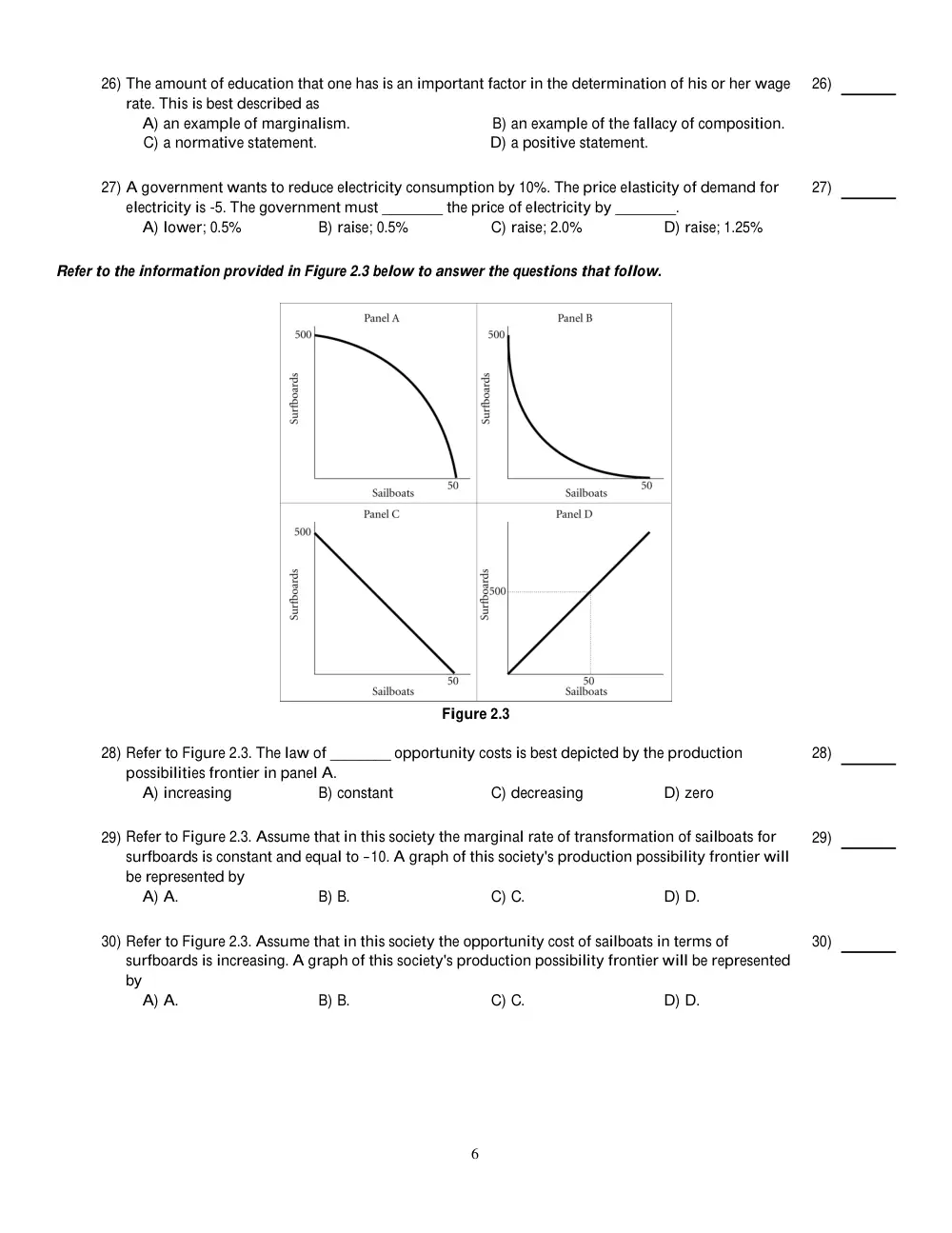
Refer to the information provided in Figure 2.3 below to answer the questions that follow.
Figure 2.3
28) Refer to Figure 2.3. The law of ________ opportunity costs is best depicted by the production
possibilities frontier in panel A.
28)
A) increasing
B) constant
C) decreasing
D) zero
29) Refer to Figure 2.3. Assume that in this society the marginal rate of transformation of sailboats for
surfboards is constant and equal to -10. A graph of this society's production possibility frontier will
be represented by
29)
A) A.
B) B.
C) C.
D) D.
30) Refer to Figure 2.3. Assume that in this society the opportunity cost of sailboats in terms of
surfboards is increasing. A graph of this society's production possibility frontier will be represented
by
30)
A) A.
B) B.
C) C.
D) D.
6
31) Producer surplus is
31)
A) the difference between the maximum a person is willing to pay and current market price.
B) the difference between willingness to sell and full costs of productions for the firm.
C) the difference between current market price and full costs of production for the firm.
D) current market price.
32) Capital, as economists use the term,
32)
A) is money the firm raises from selling stock.
B) refers to things that have already been produced that are in turn used to produce other goods
and services.
C) is the money the firm spends to hire resources.
D) refers to the process by which resources are transformed into useful forms.
33) When the price of radios decreases 5%, quantity demanded increases 5%. The price elasticity of
demand for radios is ________ and total revenue from radio sales will ________.
33)
A) inelastic; decrease
B) unit elastic; not change
C) elastic; increase
D) elastic; decrease
34) Which of the following statements is false?
34)
A) In command economies, consumers still exercise choice.
B) Command economies operate the most efficiently because the government makes all the
production decisions.
C) In a command economy, the government answers the questions of what to produce, how to
produce it, and how to distribute it.
D) Many planned economies have not fared very well in recent years; many of these economies
have almost completely collapsed.
Refer to the information provided in Figure 4.3 below to answer the questions that follow.
Figure 4.3
35) Refer to Figure 4.3. If the government will not allow the retailers to charge more than $0.40 for a
pencil, which of the following will happen?
35)
A) A nonprice rationing system such as queuing must be used to ration the available supply of
pencils.
B) Demand must eventually decrease so that the market will come into equilibrium at a price of
$0.40.
C) Supply must eventually increase so that the market will come into equilibrium at a price of
$0.40.
D) The market will be in equilibrium at a price of $0.40.
7
36) If the supply of oranges is unit elastic, the price elasticity of supply of oranges is
36)
A) 1.0.
B) 0.0.
C) -1.0.
D) -100.0.
37) The owner of a local hot dog stand has estimated that if he lowers the price of hot dogs from $2.00
to $1.50, he will increase sales from 400 to 500 hot dogs per day. Using the midpoint formula, the
demand for hot dogs is
37)
A) unit elastic.
B) perfectly elastic.
C) elastic.
D) inelastic.
38) At a price of $20, a store can sell 24 picture frames a day. At a price of $18 the store can sell 33
picture frames a day. Since total revenue ________ by the price decrease, demand must be
________.
38)
A) is decreased; elastic
B) is increased; unit elastic
C) is increased; inelastic
D) is increased; elastic
39) Total revenue increases if price ________ and demand is ________.
39)
A) falls; elastic
B) rises; elastic
C) rises; unit elastic
D) falls; inelastic
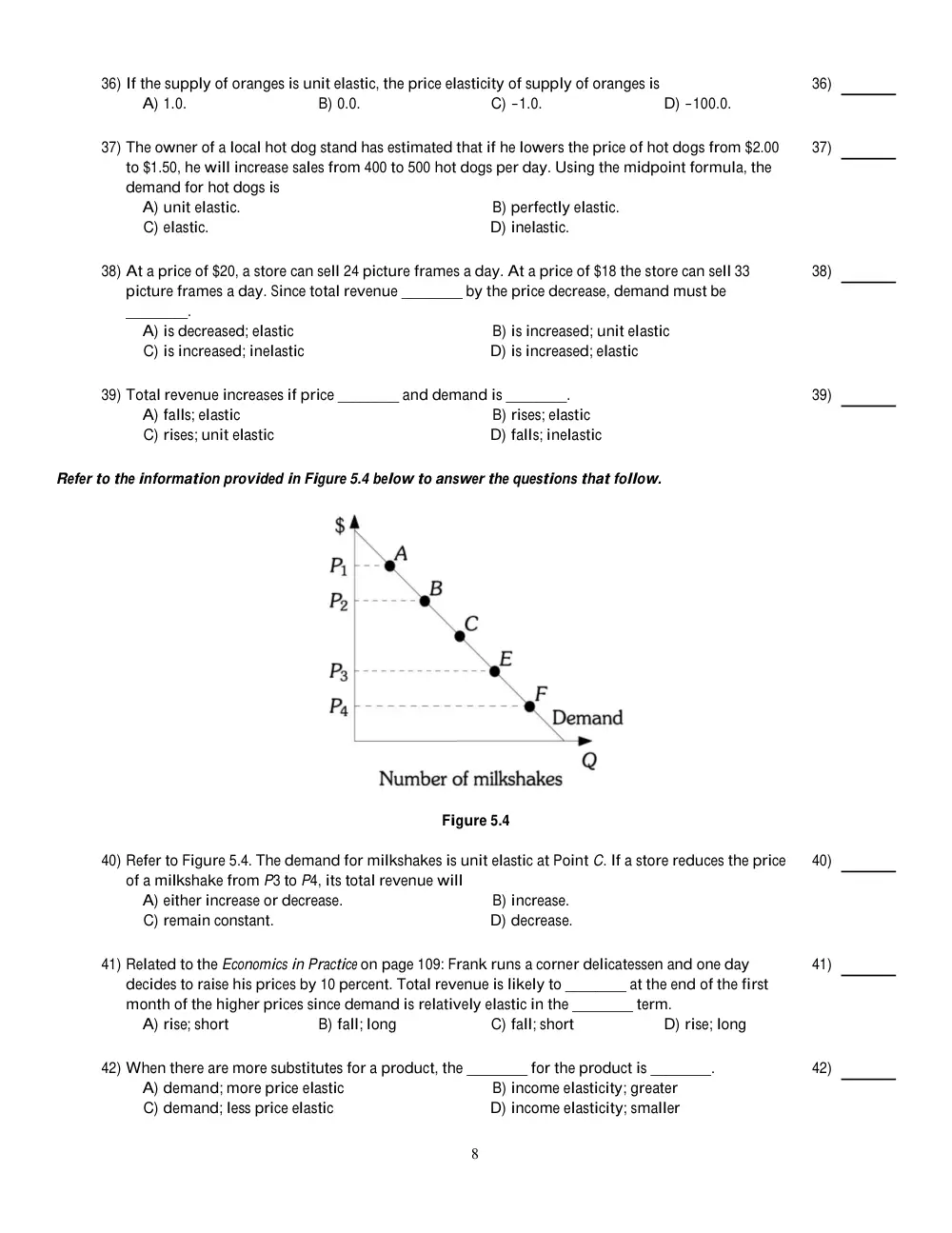
Refer to the information provided in Figure 5.4 below to answer the questions that follow.
Figure 5.4
40) Refer to Figure 5.4. The demand for milkshakes is unit elastic at Point C. If a store reduces the price
of a milkshake from P3 to P4, its total revenue will
40)
A) either increase or decrease.
B) increase.
C) remain constant.
D) decrease.
41) Related to the Economics in Practice on page 109: Frank runs a corner delicatessen and one day
decides to raise his prices by 10 percent. Total revenue is likely to ________ at the end of the first
month of the higher prices since demand is relatively elastic in the ________ term.
41)
A) rise; short
B) fall; long
C) fall; short
D) rise; long
42) When there are more substitutes for a product, the ________ for the product is ________.
42)
A) demand; more price elastic
B) income elasticity; greater
C) demand; less price elastic
D) income elasticity; smaller
8
43) An increase in demand caused no change in the equilibrium price. Thus, supply must be
43)
A) inelastic.
B) perfectly inelastic.
C) perfectly elastic.
D) elastic.
44) If the supply of oranges is unit elastic, the price elasticity of supply of oranges is
44)
A) 1.0.
B) 0.0.
C) -1.0.
D) -100.0.
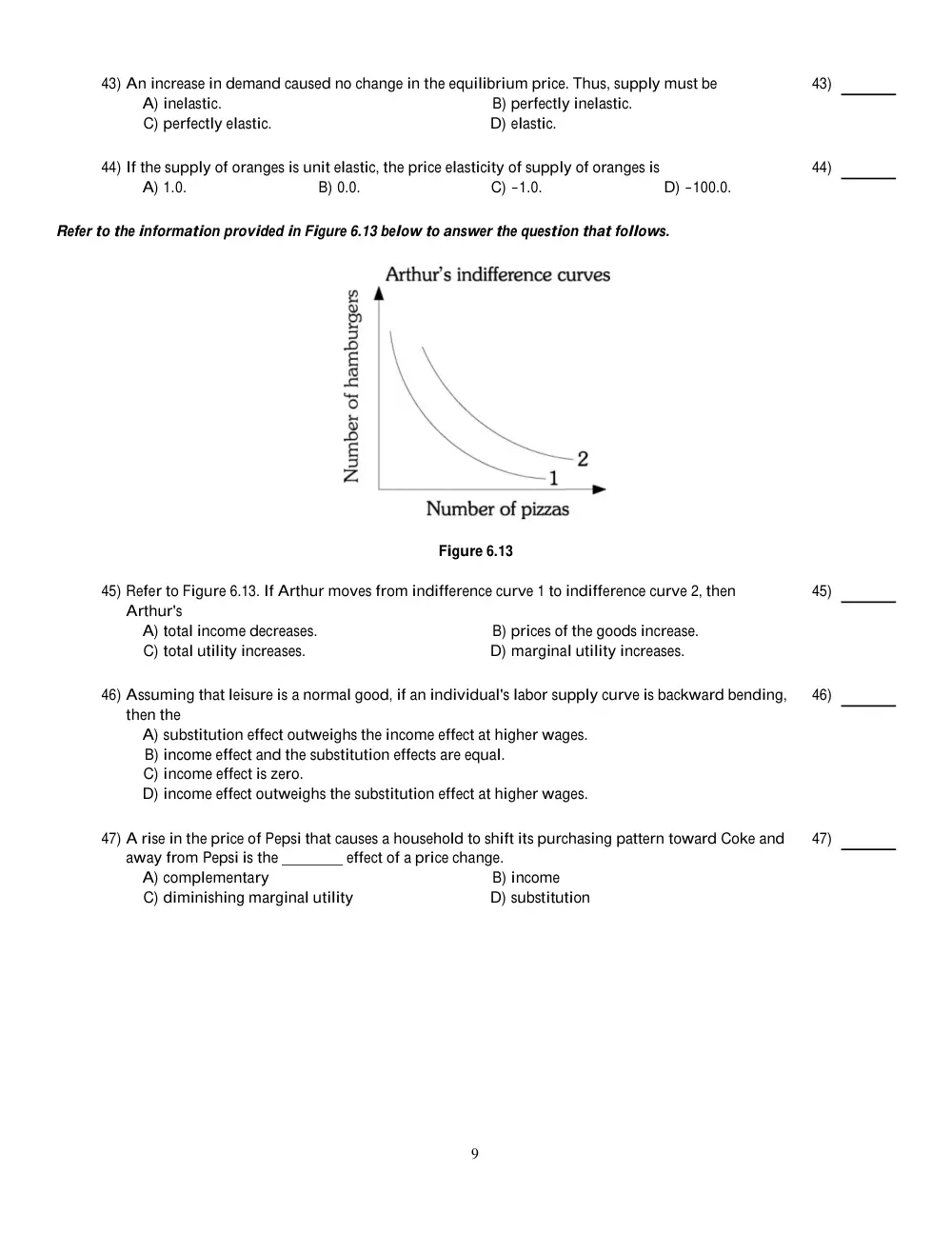
Refer to the information provided in Figure 6.13 below to answer the question that follows.
Figure 6.13
45) Refer to Figure 6.13. If Arthur moves from indifference curve 1 to indifference curve 2, then
Arthur's
45)
A) total income decreases.
B) prices of the goods increase.
C) total utility increases.
D) marginal utility increases.
46) Assuming that leisure is a normal good, if an individual's labor supply curve is backward bending,
then the
46)
A) substitution effect outweighs the income effect at higher wages.
B) income effect and the substitution effects are equal.
C) income effect is zero.
D) income effect outweighs the substitution effect at higher wages.
47) A rise in the price of Pepsi that causes a household to shift its purchasing pattern toward Coke and
away from Pepsi is the ________ effect of a price change.
47)
A) complementary
B) income
C) diminishing marginal utility
D) substitution
9
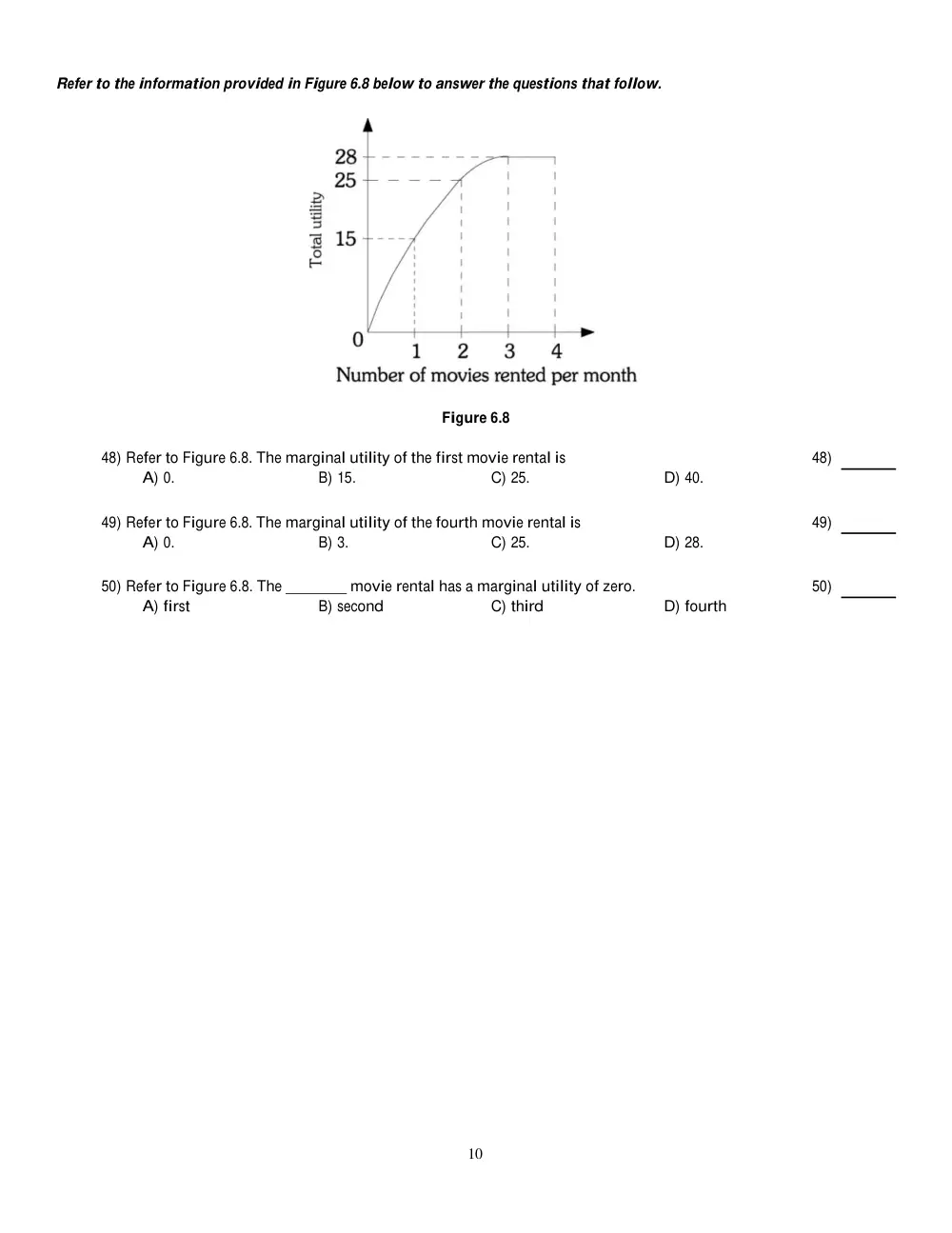
Refer to the information provided in Figure 6.8 below to answer the questions that follow.
Figure 6.8
48) Refer to Figure 6.8. The marginal utility of the first movie rental is
48)
A) 0.
B) 15.
C) 25.
D) 40.
49) Refer to Figure 6.8. The marginal utility of the fourth movie rental is
49)
A) 0.
B) 3.
C) 25.
D) 28.
50) Refer to Figure 6.8. The ________ movie rental has a marginal utility of zero.
50)
A) first
B) second
C) third
D) fourth
10
Answer Key
Testname: 211-AUB
1) D
2) C
3) A
4) D
5) C
6) A
7) B
8) D
9) B
10) A
11) D
12) D
13) B
14) D
15) D
16) C
17) B
18) B
19) D
20) A
21) B
22) A
23) C
24) D
25) B
26) D
27) C
28) A
29) C
30) A
31) C
32) B
33) B
34) B
35) A
36) A
37) D
38) D
39) A
40) D
41) B
42) A
43) C
44) A
45) C
46) D
47) D
48) B
49) A
50) D
11