
ECON 227 Final, Fall 2010
American University of Beirut · Intermediate Macroeconomics · 9 pages

More ECON 227 files
- Final · Spring 2011Final examView
- Useful File Book 8th Edition · Summer 2018FileView
- Midterm · Spring 2011ExamView
- Problems 1 Answers · Spring 2011Problems · with solutionView
- Problems 1 · Spring 2011ProblemsView
- Problems 2 Answers · Spring 2011Problems · with solutionView
- Problems 2 · Spring 2011ProblemsView
- Problems 3 Answers · Spring 2011Problems · with solutionView
Show the text of this final exam
Economics 227: Intermediate Macroeconomics
Final Exam
Fall 2010-2011
Multiple Choice / Fill in the Blanks
65 points (25 questions, 2.6 points each)
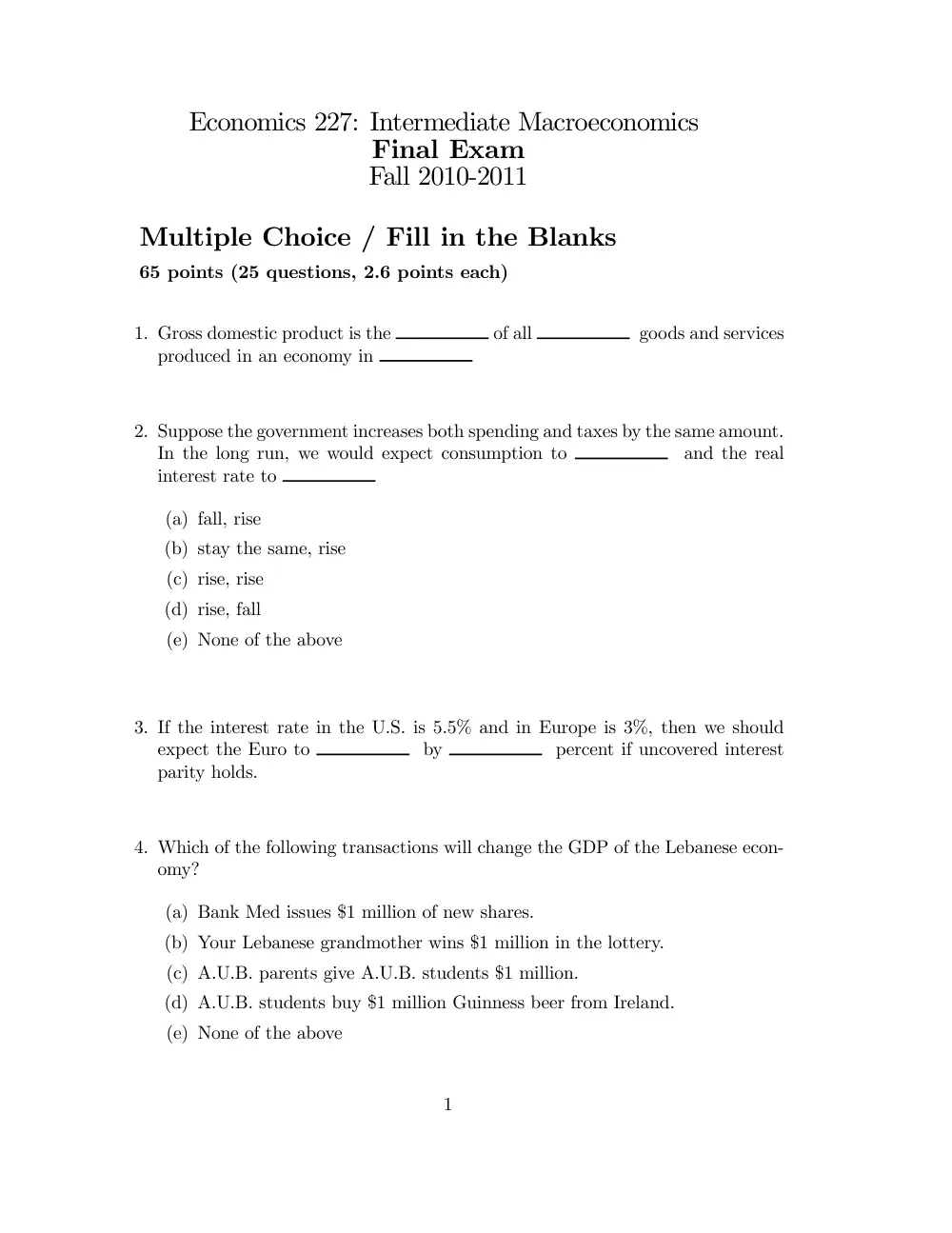
1. Gross domestic product is the
of all
goods and services
produced in an economy in
2. Suppose the government increases both spending and taxes by the same amount.
In the long run, we would expect consumption to
and the real
interest rate to
(a) fall, rise
(b) stay the same, rise
(c) rise, rise
(d) rise, fall
(e) None of the above
3. If the interest rate in the U.S. is 5.5% and in Europe is 3%, then we should
expect the Euro to
by
percent if uncovered interest
parity holds.
4. Which of the following transactions will change the GDP of the Lebanese econ-
omy?
(a) Bank Med issues $1 million of new shares.
(b) Your Lebanese grandmother wins $1 million in the lottery.
(c) A.U.B. parents give A.U.B. students $1 million.
(d) A.U.B. students buy $1 million Guinness beer from Ireland.
(e) None of the above
1
5. Fiscal and monetary policy are both effective in:
(a) An open economy with fixed exchange rates
(b) The classical case
(c) The long run
(d) None of the above
6. In the Solow Model with α = 0.6, s = 0.3, n = 0.05, g = 0.02, and δ = 0.01,
what is the very-long run capital to output ratio K
Y ?
(a) 5
(b) 8.33
(c) 3.75
(d) 11.18
(e) 25
7. If the Central Bank increases the money supply, then the
curve
shifts
(a) Short run aggregate supply, right
(b) Long run aggregate supply, left
(c) Aggregate demand, right
(d) Aggregate demand, left
(e) None of the above
8. In the endogenous growth model, Y = F (K, (1 − u) LE) where u represents
(a) The unemployment rate
(b) Research intensity
(c) The level of technology
(d) The effectiveness of capital.
(e) Capital per effective worker.
2
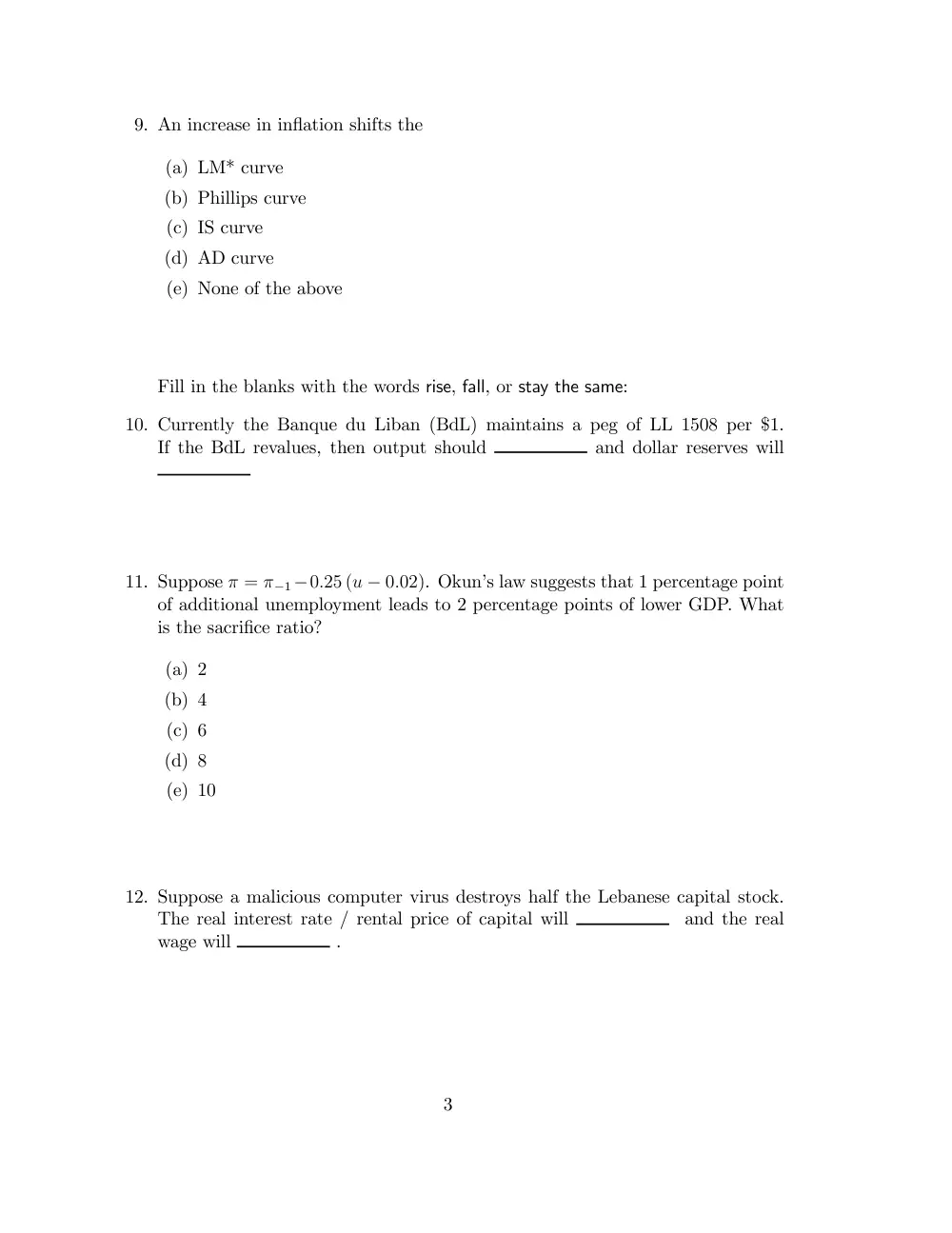
9. An increase in inflation shifts the
(a) LM* curve
(b) Phillips curve
(c) IS curve
(d) AD curve
(e) None of the above
Fill in the blanks with the words rise, fall, or stay the same:
10. Currently the Banque du Liban (BdL) maintains a peg of LL 1508 per $1.
If the BdL revalues, then output should
and dollar reserves will
11. Suppose π = π−1−0.25 (u − 0.02). Okun’s law suggests that 1 percentage point
of additional unemployment leads to 2 percentage points of lower GDP. What
is the sacrifice ratio?
(a) 2
(b) 4
(c) 6
(d) 8
(e) 10
12. Suppose a malicious computer virus destroys half the Lebanese capital stock.
The real interest rate / rental price of capital will
and the real
wage will
.
3
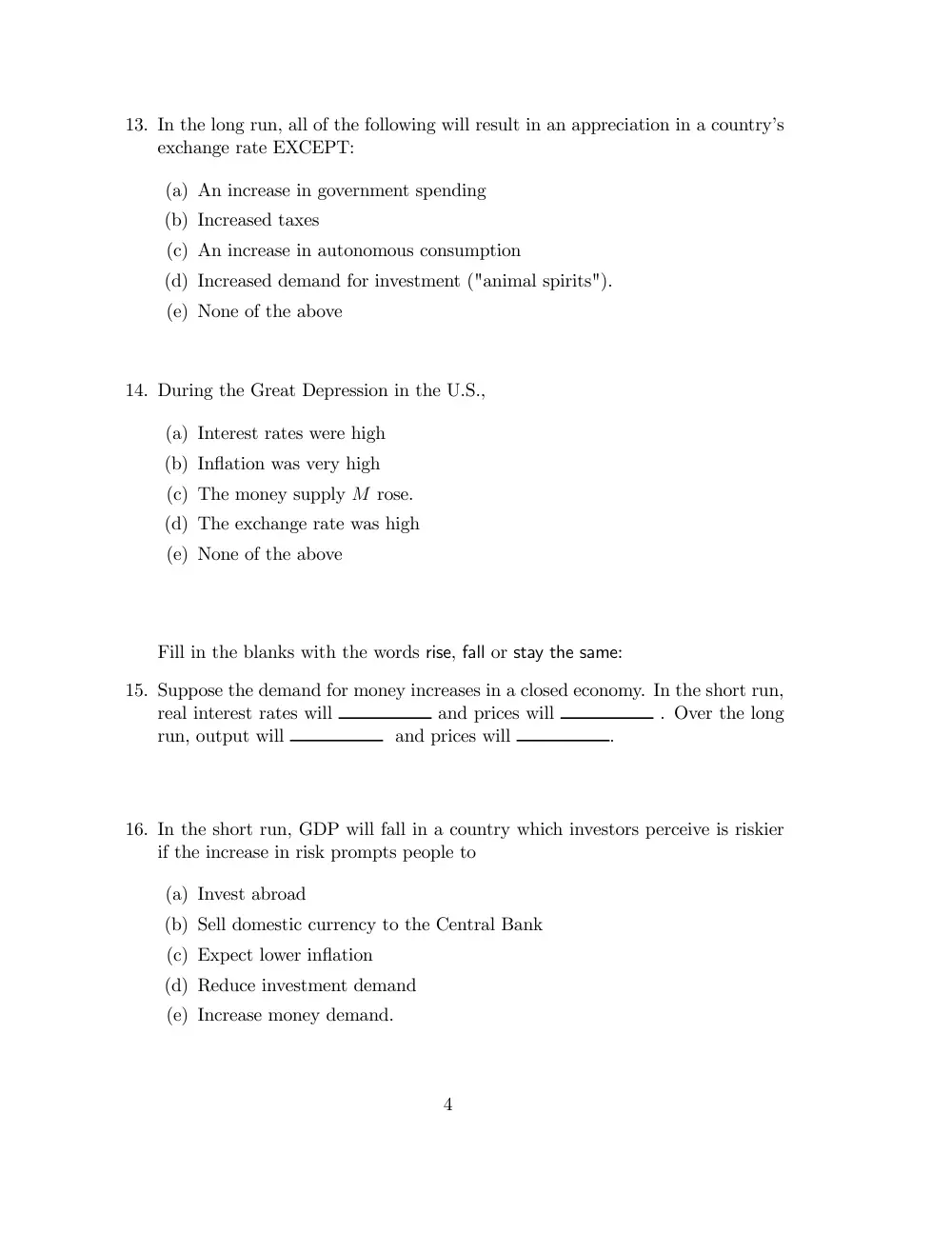
13. In the long run, all of the following will result in an appreciation in a country’s
exchange rate EXCEPT:
(a) An increase in government spending
(b) Increased taxes
(c) An increase in autonomous consumption
(d) Increased demand for investment ("animal spirits").
(e) None of the above
14. During the Great Depression in the U.S.,
(a) Interest rates were high
(b) Inflation was very high
(c) The money supply M rose.
(d) The exchange rate was high
(e) None of the above
Fill in the blanks with the words rise, fall or stay the same:
15. Suppose the demand for money increases in a closed economy. In the short run,
real interest rates will
and prices will
. Over the long
run, output will
and prices will
.
16. In the short run, GDP will fall in a country which investors perceive is riskier
if the increase in risk prompts people to
(a) Invest abroad
(b) Sell domestic currency to the Central Bank
(c) Expect lower inflation
(d) Reduce investment demand
(e) Increase money demand.
4
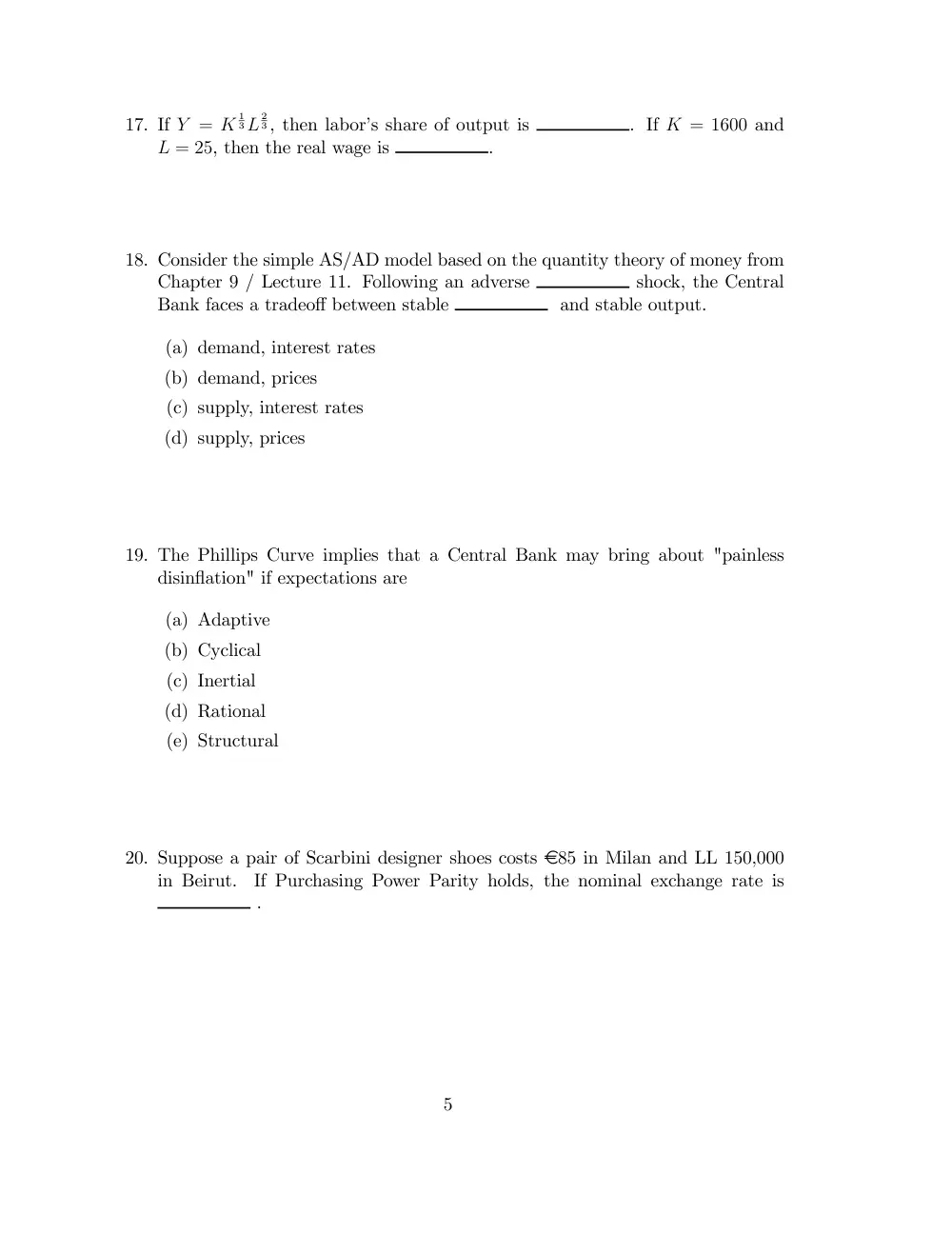
17. If Y = K
1
3L
2
3, then labor’s share of output is
. If K = 1600 and
L = 25, then the real wage is
.
18. Consider the simple AS/AD model based on the quantity theory of money from
Chapter 9 / Lecture 11. Following an adverse
shock, the Central
Bank faces a tradeoff between stable
and stable output.
(a) demand, interest rates
(b) demand, prices
(c) supply, interest rates
(d) supply, prices
19. The Phillips Curve implies that a Central Bank may bring about "painless
disinflation" if expectations are
(a) Adaptive
(b) Cyclical
(c) Inertial
(d) Rational
(e) Structural
20. Suppose a pair of Scarbini designer shoes costs €85 in Milan and LL 150,000
in Beirut.
If Purchasing Power Parity holds, the nominal exchange rate is
.
5
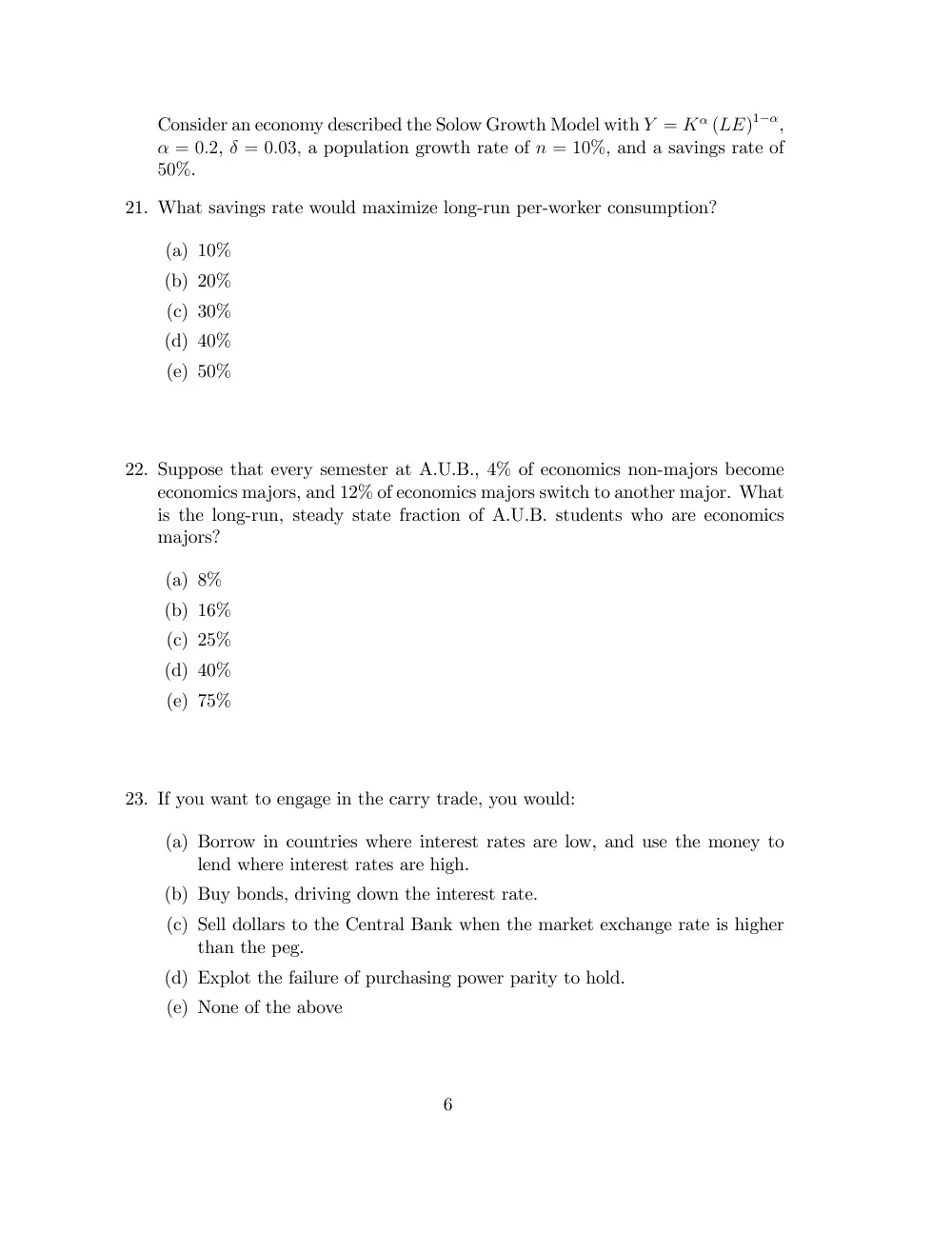
Consider an economy described the Solow Growth Model with Y = Kα (LE)1−α,
α = 0.2, δ = 0.03, a population growth rate of n = 10%, and a savings rate of
50%.
21. What savings rate would maximize long-run per-worker consumption?
(a) 10%
(b) 20%
(c) 30%
(d) 40%
(e) 50%
22. Suppose that every semester at A.U.B., 4% of economics non-majors become
economics majors, and 12% of economics majors switch to another major. What
is the long-run, steady state fraction of A.U.B. students who are economics
majors?
(a) 8%
(b) 16%
(c) 25%
(d) 40%
(e) 75%
23. If you want to engage in the carry trade, you would:
(a) Borrow in countries where interest rates are low, and use the money to
lend where interest rates are high.
(b) Buy bonds, driving down the interest rate.
(c) Sell dollars to the Central Bank when the market exchange rate is higher
than the peg.
(d) Explot the failure of purchasing power parity to hold.
(e) None of the above
6
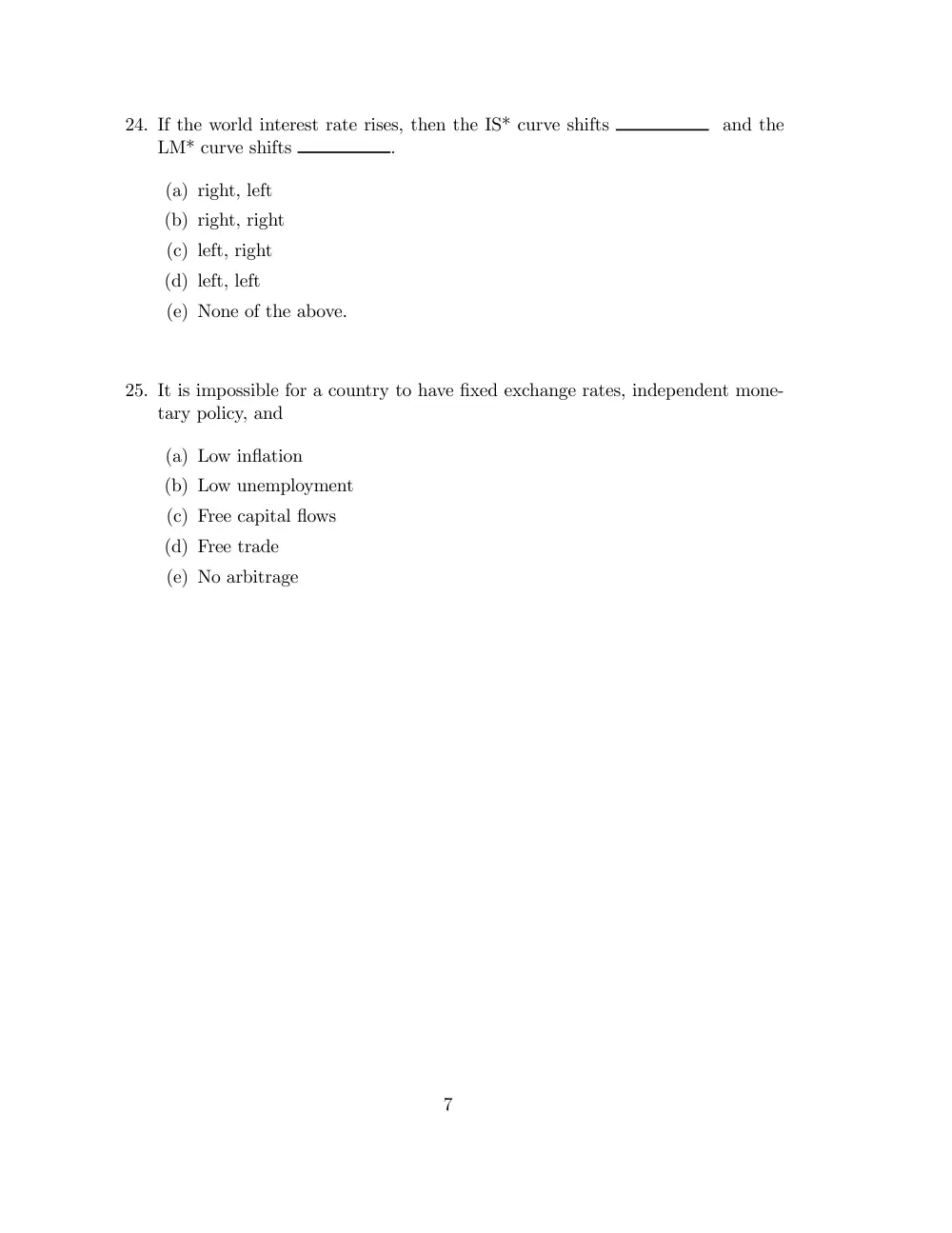
24. If the world interest rate rises, then the IS* curve shifts
and the
LM* curve shifts
.
(a) right, left
(b) right, right
(c) left, right
(d) left, left
(e) None of the above.
25. It is impossible for a country to have fixed exchange rates, independent mone-
tary policy, and
(a) Low inflation
(b) Low unemployment
(c) Free capital flows
(d) Free trade
(e) No arbitrage
7
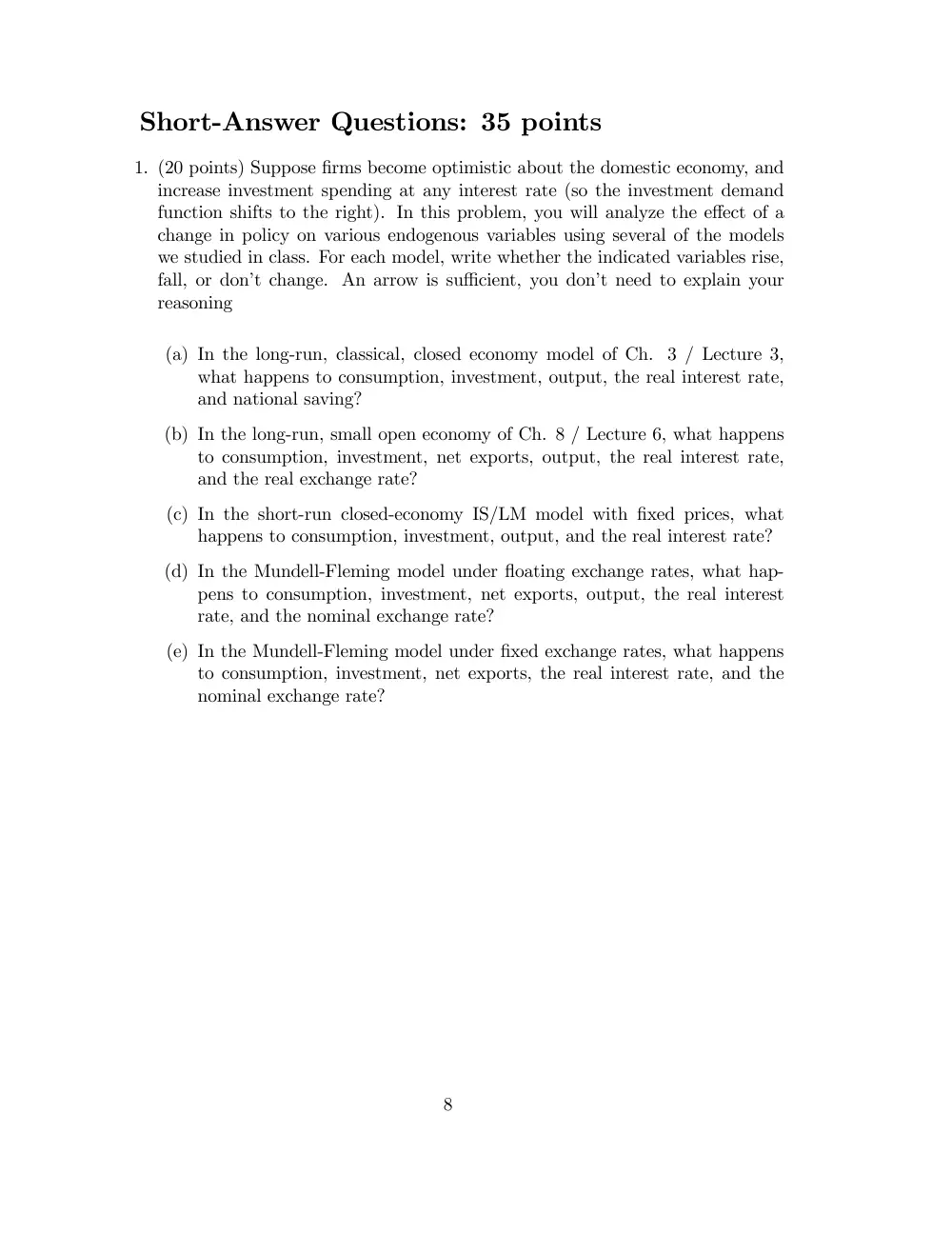
Short-Answer Questions: 35 points
1. (20 points) Suppose firms become optimistic about the domestic economy, and
increase investment spending at any interest rate (so the investment demand
function shifts to the right). In this problem, you will analyze the effect of a
change in policy on various endogenous variables using several of the models
we studied in class. For each model, write whether the indicated variables rise,
fall, or don’t change. An arrow is sufficient, you don’t need to explain your
reasoning
(a) In the long-run, classical, closed economy model of Ch. 3 / Lecture 3,
what happens to consumption, investment, output, the real interest rate,
and national saving?
(b) In the long-run, small open economy of Ch. 8 / Lecture 6, what happens
to consumption, investment, net exports, output, the real interest rate,
and the real exchange rate?
(c) In the short-run closed-economy IS/LM model with fixed prices, what
happens to consumption, investment, output, and the real interest rate?
(d) In the Mundell-Fleming model under floating exchange rates, what hap-
pens to consumption, investment, net exports, output, the real interest
rate, and the nominal exchange rate?
(e) In the Mundell-Fleming model under fixed exchange rates, what happens
to consumption, investment, net exports, the real interest rate, and the
nominal exchange rate?
8
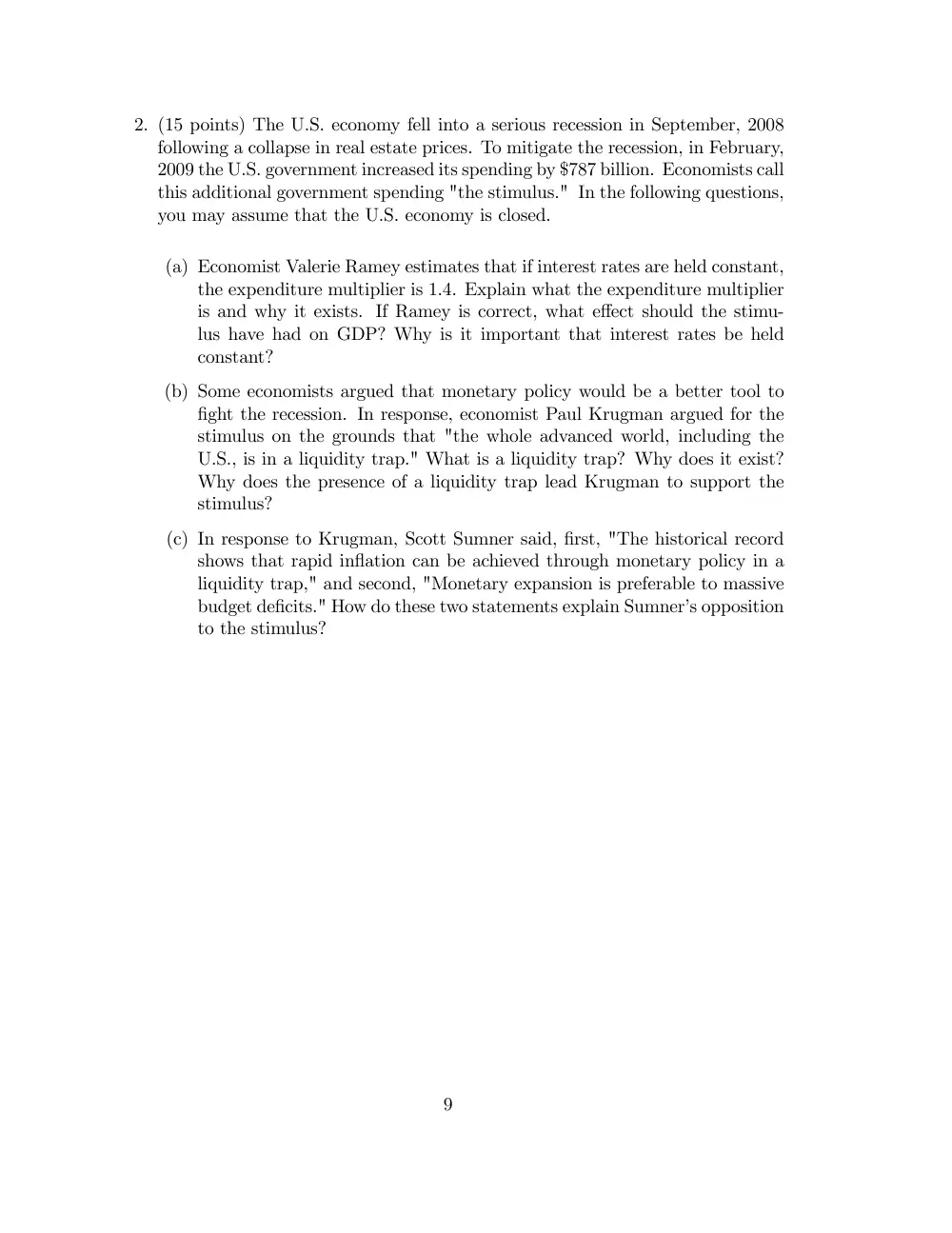
2. (15 points) The U.S. economy fell into a serious recession in September, 2008
following a collapse in real estate prices. To mitigate the recession, in February,
2009 the U.S. government increased its spending by $787 billion. Economists call
this additional government spending "the stimulus." In the following questions,
you may assume that the U.S. economy is closed.
(a) Economist Valerie Ramey estimates that if interest rates are held constant,
the expenditure multiplier is 1.4. Explain what the expenditure multiplier
is and why it exists. If Ramey is correct, what effect should the stimu-
lus have had on GDP? Why is it important that interest rates be held
constant?
(b) Some economists argued that monetary policy would be a better tool to
fight the recession. In response, economist Paul Krugman argued for the
stimulus on the grounds that "the whole advanced world, including the
U.S., is in a liquidity trap." What is a liquidity trap? Why does it exist?
Why does the presence of a liquidity trap lead Krugman to support the
stimulus?
(c) In response to Krugman, Scott Sumner said, first, "The historical record
shows that rapid inflation can be achieved through monetary policy in a
liquidity trap," and second, "Monetary expansion is preferable to massive
budget deficits." How do these two statements explain Sumner’s opposition
to the stimulus?
9