
EECE 200 Homework 1 with Solution, Fall 2014
American University of Beirut · Introduction to Electrical and Computer Engineering · 4 pages · with solution

More EECE 200 files
- Homework 2 Sol · Fall 2014Homework · with solutionView
- Homework 1 · Fall 2014HomeworkView
- Homework 1 Sol · Fall 2014Homework · with solutionView
- Homework 2 · Fall 2014HomeworkView
- Homework 2 with Solution · Fall 2014Homework · with solutionView
- Homework 1 · Fall 2013HomeworkView
- Homework 2 Solution · Fall 2013Homework · with solutionView
- Homework 1 Solution (Fall 2013 · Fall 2013Homework · with solutionView
Show the text of this homework
American University of Beirut
Faculty of Engineering and Architecture
Department of Electrical and Computer Engineering
EECE200 – Introduction to Engineering– Fall 2014
Homework 1 Solution
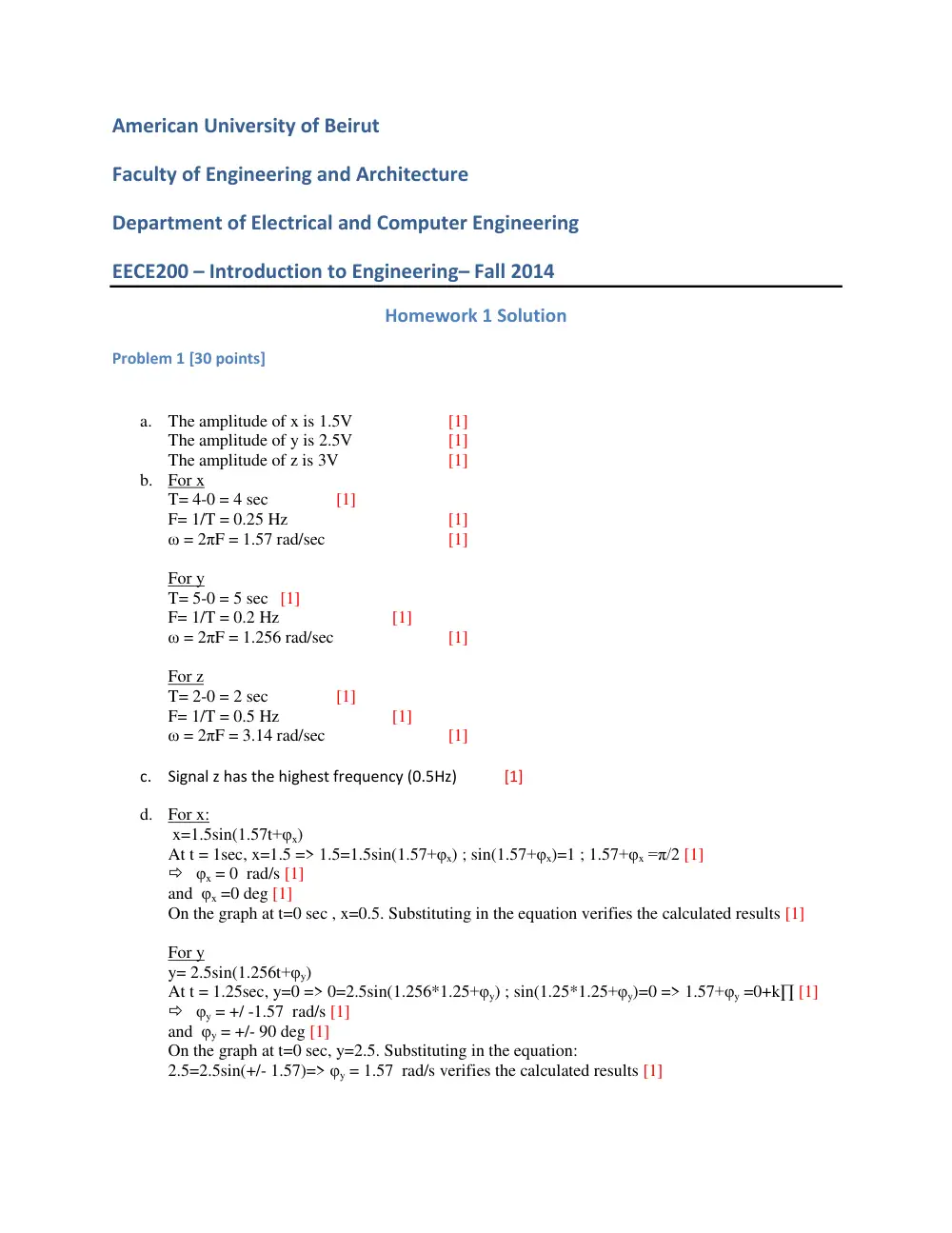
Problem 1 [30 points]
a. The amplitude of x is 1.5V
[1]
The amplitude of y is 2.5V
[1]
The amplitude of z is 3V
[1]
b. For x
T= 4-0 = 4 sec
[1]
F= 1/T = 0.25 Hz
[1]
ω = 2πF = 1.57 rad/sec
[1]
For y
T= 5-0 = 5 sec [1]
F= 1/T = 0.2 Hz
[1]
ω = 2πF = 1.256 rad/sec
[1]
For z
T= 2-0 = 2 sec
[1]
F= 1/T = 0.5 Hz
[1]
ω = 2πF = 3.14 rad/sec
[1]
c. Signal z has the highest frequency (0.5Hz)
[1]
d. For x:
x=1.5sin(1.57t+φx)
At t = 1sec, x=1.5 => 1.5=1.5sin(1.57+φx) ; sin(1.57+φx)=1 ; 1.57+φx =π/2 [1]
φx = 0 rad/s [1]
and φx =0 deg [1]
On the graph at t=0 sec , x=0.5. Substituting in the equation verifies the calculated results [1]
For y
y= 2.5sin(1.256t+φy)
At t = 1.25sec, y=0 => 0=2.5sin(1.256*1.25+φy) ; sin(1.25*1.25+φy)=0 => 1.57+φy =0+k∏ [1]
φy = +/ -1.57 rad/s [1]
and φy = +/- 90 deg [1]
On the graph at t=0 sec, y=2.5. Substituting in the equation:
2.5=2.5sin(+/- 1.57)=> φy = 1.57 rad/s verifies the calculated results [1]
For z
z= 3sin(3.14t+φz)
At t = 2.25sec, z=3 => 3=3sin(3.14t+φz) ; sin(3.14*2.25+φz)=1 ; 7.065+ φz =π/2 [1]
φz = 0.785 rad/s [1]
and φz =45 deg [1]
On the graph at t=0 sec , z=2.2. Substituting in the equation verifies the calculated results [1]
e. 1 point for each correct column (total 3) and one point for labeling each axis (total 2) [5 points].
Problem 2 [10 points]
a. Analogue: black and white TV, video tape, volume control of old radio, LANDLINE TELEPHONE,
microphone.
Digital: HDMI, electric guitar amplification board, USB connection, image processing MRI
scanning modem, CPU signals, DVB TV, serial connection cable. [0.5point each]
b. Total bandwidth of FM radio is 87.5 to 108.0 MHz , 400kHz being allocated to each
station.(please consider the answer of 88-108MHZ and bandwidth of 200KHz to be correct as
well) [0.5 each]
c. Any 3 of the below [1 point each, total 3points]:
1.
The amplitude of an FM wave remains constant. This provides the system designers an opportunity to remove the noise
from the received signal. This is not possible in AM systems because the baseband signal is carried by the amplitude
variations it self and the envelope of the AM signal cannot be altered.
2.
Most of the power in an FM signal is carried by the side bands. For higher values of the modulation index, mc, the major
portion of the total power is contained is side bands, and the carrier signal contains less power. In contrast, in an AM system,
only one third of the total power is carried by the side bands and two thirds of the total power is lost in the form of carrier
power.
3.
In FM systems, the power of the transmitted signal depends on the amplitude of the unmodulated carrier signal, and hence
it is constant. In contrast, in AM systems, the power depends on the modulation index ma. Therefore, the power usage is
optimum in an FM system.
4.
In an AM system, the only method of reducing noise is to increase the transmitted power of the signal. This operation
increases the cost of the AM system. In an FM system, you can increase the frequency deviation in the carrier signal to
reduce the noise.
5.
In an FM signal, the adjacent FM channels are separated by guard bands. In an FM system there is no signal transmission
through the spectrum space or the guard band. Therefore, there is hardly any interference of adjacent FM channels.
0
0.5
1
1.5
2
2.5
3
3.5
0.2
0.25
0.5
Amplitude
Frequency
Amplitude
However, in an AM system, there is no guard band provided between the two adjacent channels. Therefore, there is always
interference of AM radio stations unless the received signalis strong enough to suppress the signal of the adjacent channel.
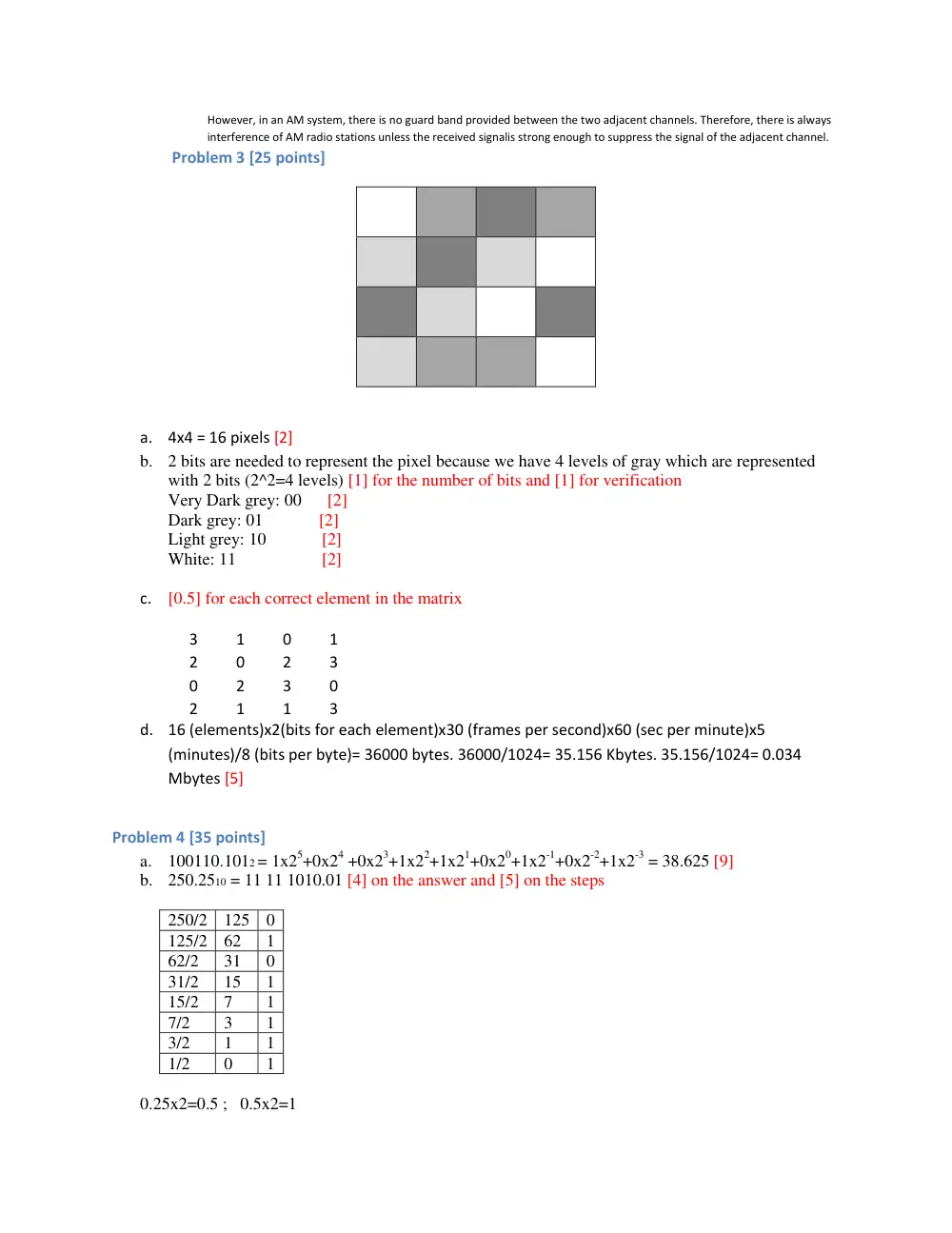
Problem 3 [25 points]
a. 4x4 = 16 pixels [2]
b. 2 bits are needed to represent the pixel because we have 4 levels of gray which are represented
with 2 bits (2^2=4 levels) [1] for the number of bits and [1] for verification
Very Dark grey: 00 [2]
Dark grey: 01 [2]
Light grey: 10 [2]
White: 11 [2]
c. [0.5] for each correct element in the matrix
3
1
0
1
2
0
2
3
0
2
3
0
2
1
1
3
d. 16 (elements)x2(bits for each element)x30 (frames per second)x60 (sec per minute)x5
(minutes)/8 (bits per byte)= 36000 bytes. 36000/1024= 35.156 Kbytes. 35.156/1024= 0.034
Mbytes [5]
Problem 4 [35 points]
a. 100110.1012 = 1x25+0x24 +0x23+1x22+1x21+0x20+1x2-1+0x2-2+1x2-3 = 38.625 [9]
b. 250.2510 = 11 11 1010.01 [4] on the answer and [5] on the steps
250/2 125 0
125/2 62
1
62/2
31
0
31/2
15
1
15/2
7
1
7/2
3
1
3/2
1
1
1/2
0
1
0.25x2=0.5 ; 0.5x2=1
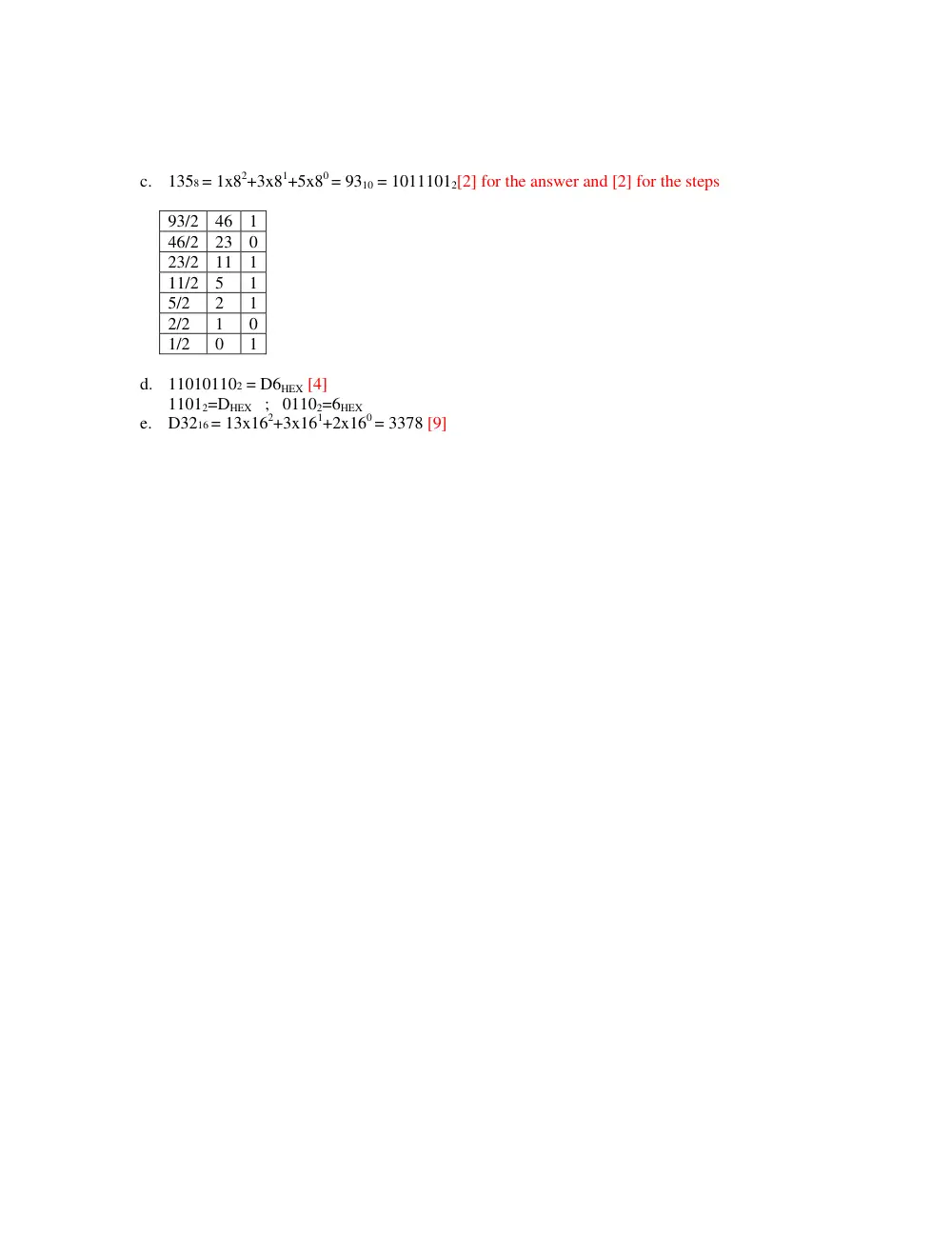
c. 1358 = 1x82+3x81+5x80 = 9310 = 10111012[2] for the answer and [2] for the steps
93/2 46 1
46/2 23 0
23/2 11 1
11/2 5
1
5/2
2
1
2/2
1
0
1/2
0
1
d. 110101102 = D6HEX [4]
11012=DHEX ; 01102=6HEX
e. D3216 = 13x162+3x161+2x160 = 3378 [9]