
EECE 200 Homework 2 with Solution, Fall 2014
American University of Beirut · Introduction to Electrical and Computer Engineering · 6 pages · with solution


More EECE 200 files
- Homework 2 · Fall 2014HomeworkView
- Homework 1 · Fall 2014HomeworkView
- Homework 1 Sol · Fall 2014Homework · with solutionView
- Homework 1 with Solution · Fall 2014Homework · with solutionView
- Homework 2 Sol · Fall 2014Homework · with solutionView
- Homework 2 Solution · Fall 2013Homework · with solutionView
- Homework 1 · Fall 2013HomeworkView
- Homework 1 Solution (Fall 2013 · Fall 2013Homework · with solutionView
Show the text of this homework
American University of Beirut
Faculty of Engineering and Architecture
Department of Electrical and Computer Engineering
EECE 200-Introduction to Engineering – Fall 2014
Homework 2
Homework2 consists of two parts:
Part 1 is questions related to topics covered during the
lectures.
Part 2 is based on LabVIEW, and the concepts covered will
help you with the project later on.
Part 1:
Problem 1 (Circuits and Electronics): [15 points]
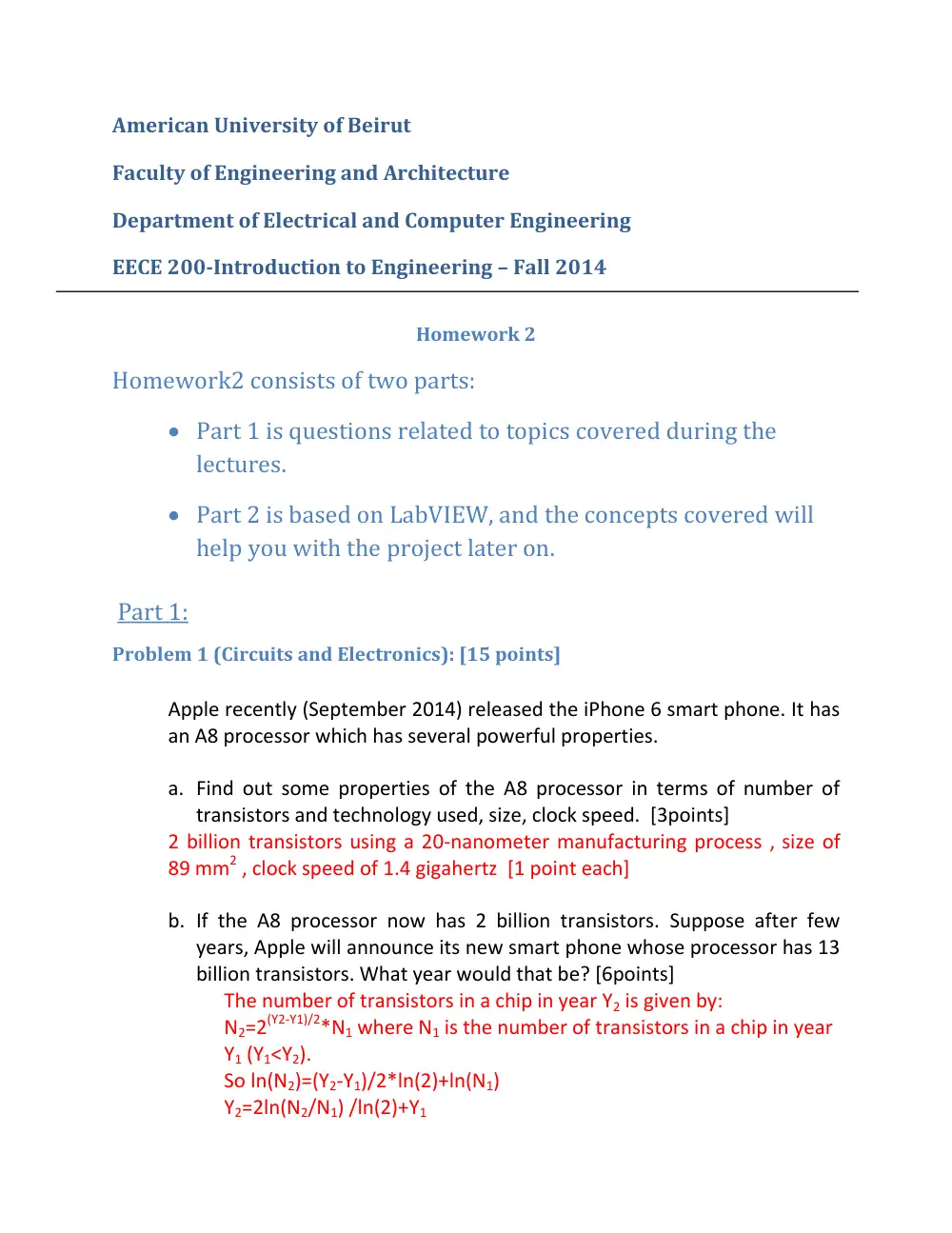
Apple recently (September 2014) released the iPhone 6 smart phone. It has
an A8 processor which has several powerful properties.
a. Find out some properties of the A8 processor in terms of number of
transistors and technology used, size, clock speed. [3points]
2 billion transistors using a 20-nanometer manufacturing process , size of
89 mm2 , clock speed of 1.4 gigahertz [1 point each]
b. If the A8 processor now has 2 billion transistors. Suppose after few
years, Apple will announce its new smart phone whose processor has 13
billion transistors. What year would that be? [6points]
The number of transistors in a chip in year Y2 is given by:
N2=2(Y2-Y1)/2*N1 where N1 is the number of transistors in a chip in year
Y1 (Y1<Y2).
So ln(N2)=(Y2-Y1)/2*ln(2)+ln(N1)
Y2=2ln(N2/N1) /ln(2)+Y1
Y2=2[ln(13/2) ]/ln(2)+2014
Y2=2019.4
c. Suppose Moore’s Law said that the number of transistors would triple
every two years, how many transistors would be on this chip in the year
2025? [6points]
N2=3(Y2-Y1)/2*N1
Y2-Y1=2025-2014=11, then N2=35.5*2 billion
In 2025 we will have about 841.7 billion transistors on a single chip.
Problem 2 (Computer Hardware): [16 points]
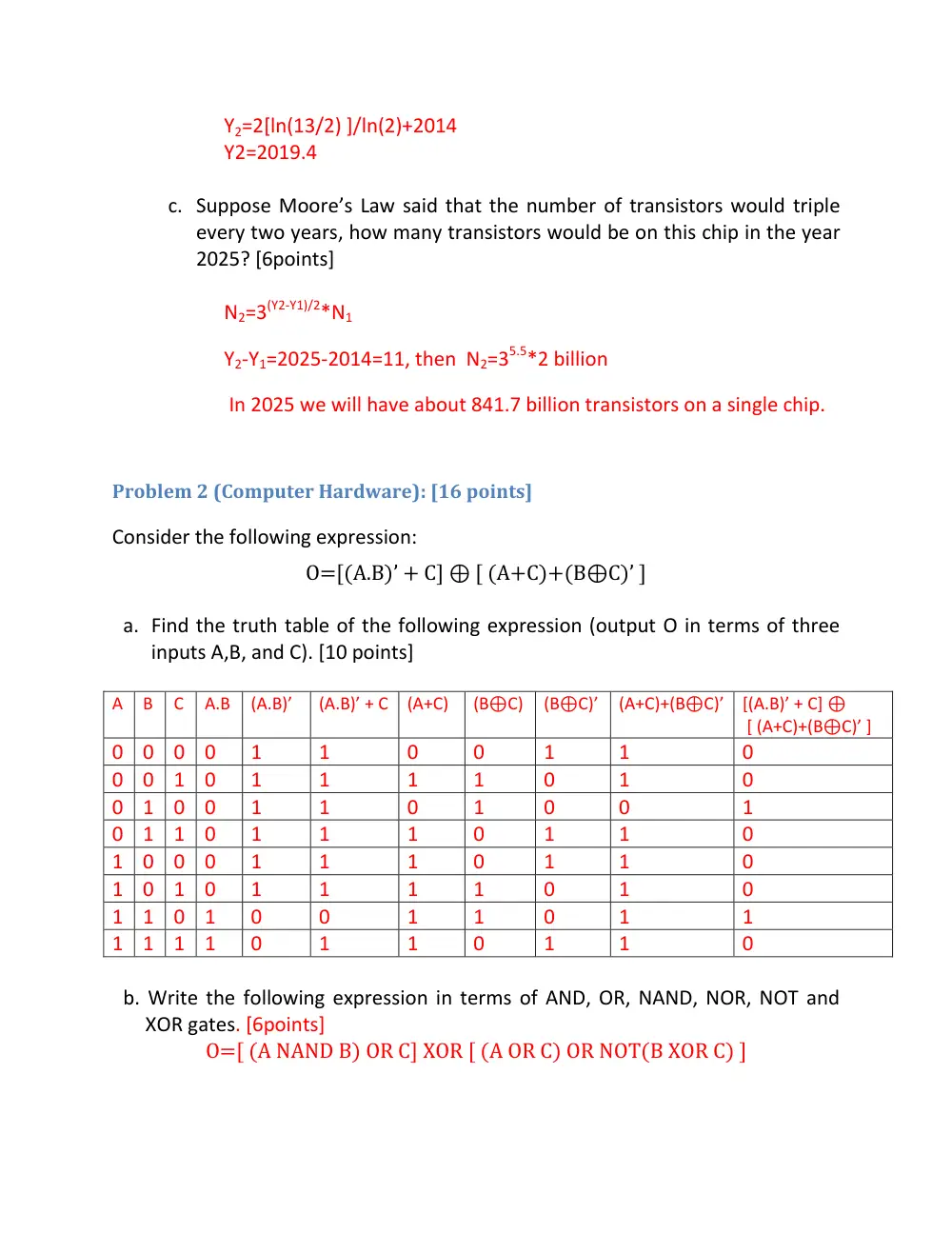
Consider the following expression:
O=[(A.B)’ + C] ⊕ [ (A+C)+(B⊕C)’ ]
a. Find the truth table of the following expression (output O in terms of three
inputs A,B, and C). [10 points]
A
B
C
A.B
(A.B)’
(A.B)’ + C (A+C)
(B⊕C)
(B⊕C)’
(A+C)+(B⊕C)’ [(A.B)’ + C] ⊕
[ (A+C)+(B⊕C)’ ]
0 0 0 0
1
1
0
0
1
1
0
0 0 1 0
1
1
1
1
0
1
0
0 1 0 0
1
1
0
1
0
0
1
0 1 1 0
1
1
1
0
1
1
0
1 0 0 0
1
1
1
0
1
1
0
1 0 1 0
1
1
1
1
0
1
0
1 1 0 1
0
0
1
1
0
1
1
1 1 1 1
0
1
1
0
1
1
0
b. Write the following expression in terms of AND, OR, NAND, NOR, NOT and
XOR gates. [6points]
O=[ (A NAND B) OR C] XOR [ (A OR C) OR NOT(B XOR C) ]
Problem 3 (Communications and Signals): [19 points]
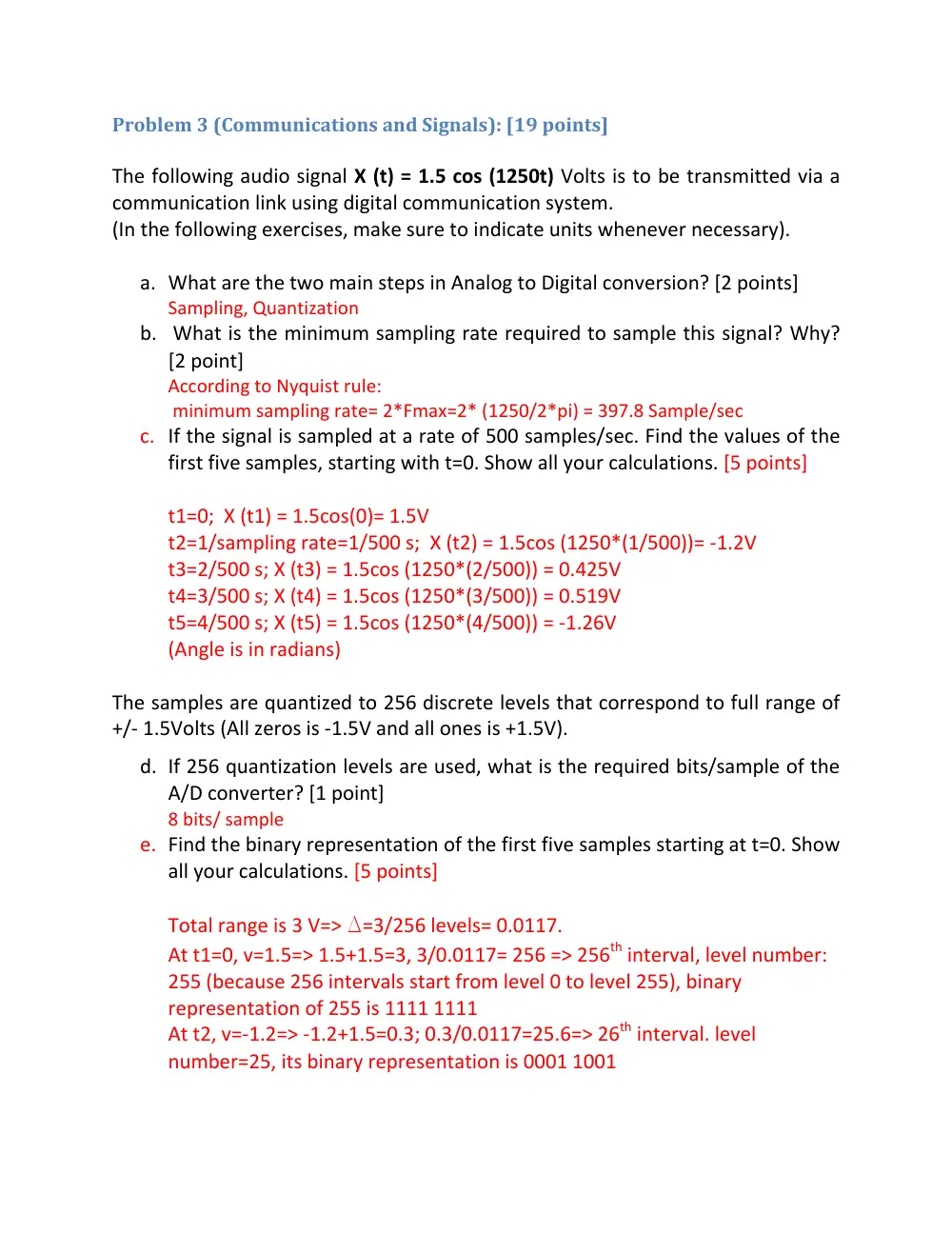
The following audio signal X (t) = 1.5 cos (1250t) Volts is to be transmitted via a
communication link using digital communication system.
(In the following exercises, make sure to indicate units whenever necessary).
a. What are the two main steps in Analog to Digital conversion? [2 points]
Sampling, Quantization
b. What is the minimum sampling rate required to sample this signal? Why?
[2 point]
According to Nyquist rule:
minimum sampling rate= 2*Fmax=2* (1250/2*pi) = 397.8 Sample/sec
c. If the signal is sampled at a rate of 500 samples/sec. Find the values of the
first five samples, starting with t=0. Show all your calculations. [5 points]
t1=0; X (t1) = 1.5cos(0)= 1.5V
t2=1/sampling rate=1/500 s; X (t2) = 1.5cos (1250*(1/500))= -1.2V
t3=2/500 s; X (t3) = 1.5cos (1250*(2/500)) = 0.425V
t4=3/500 s; X (t4) = 1.5cos (1250*(3/500)) = 0.519V
t5=4/500 s; X (t5) = 1.5cos (1250*(4/500)) = -1.26V
(Angle is in radians)
The samples are quantized to 256 discrete levels that correspond to full range of
+/‐ 1.5Volts (All zeros is ‐1.5V and all ones is +1.5V).
d. If 256 quantization levels are used, what is the required bits/sample of the
A/D converter? [1 point]
8 bits/ sample
e. Find the binary representation of the first five samples starting at t=0. Show
all your calculations. [5 points]
Total range is 3 V=> Δ=3/256 levels= 0.0117.
At t1=0, v=1.5=> 1.5+1.5=3, 3/0.0117= 256 => 256th interval, level number:
255 (because 256 intervals start from level 0 to level 255), binary
representation of 255 is 1111 1111
At t2, v=-1.2=> -1.2+1.5=0.3; 0.3/0.0117=25.6=> 26th interval. level
number=25, its binary representation is 0001 1001
T
Value of the
sample(V)
interval
Level number
Binary
representation
of the level
t1=0
1.5
256th
255
1111 1111
t2=1/500
-1.2
26th
25
0001 1001
t3=2/500
0.425
165th
164
1010 0100
t4=3/500
0.519
173nd
172
1010 1100
t5=4/500
-1.26
21st
20
0001 0100
f. How can we improve sampling of a signal? Does it have any drawbacks? [2
points]
Increase the sampling rate which will give us a better quality of the digital signal.
[1 point] Drawback: a larger size of the file or needs more memory (due to a
larger number of samples with the same number of bits) [1 point]
g. How can quantization be improved? What is the disadvantage of this
improvement? [2 points]
Increase the number of quantized levels or the number of bits. [1 point]
Disadvantage: will also make the file larger or needs more memory (due to an
increase in the number of bits used to store the data digitally, while the number
of samples remains the same). [1 point]
Problem 4 (Project Management): [35 points]
Consider the following list of activities for an engineering project along with the
expected duration in days. The activities are shown in the table below:
Activity
Predecessor Duration
in days
A
None
2
B
None
4
C
A
8
D
C
6
E
C
4
F
B
6
G
E,F
2
H
D,E
1
I
G
4
J
H,I
8
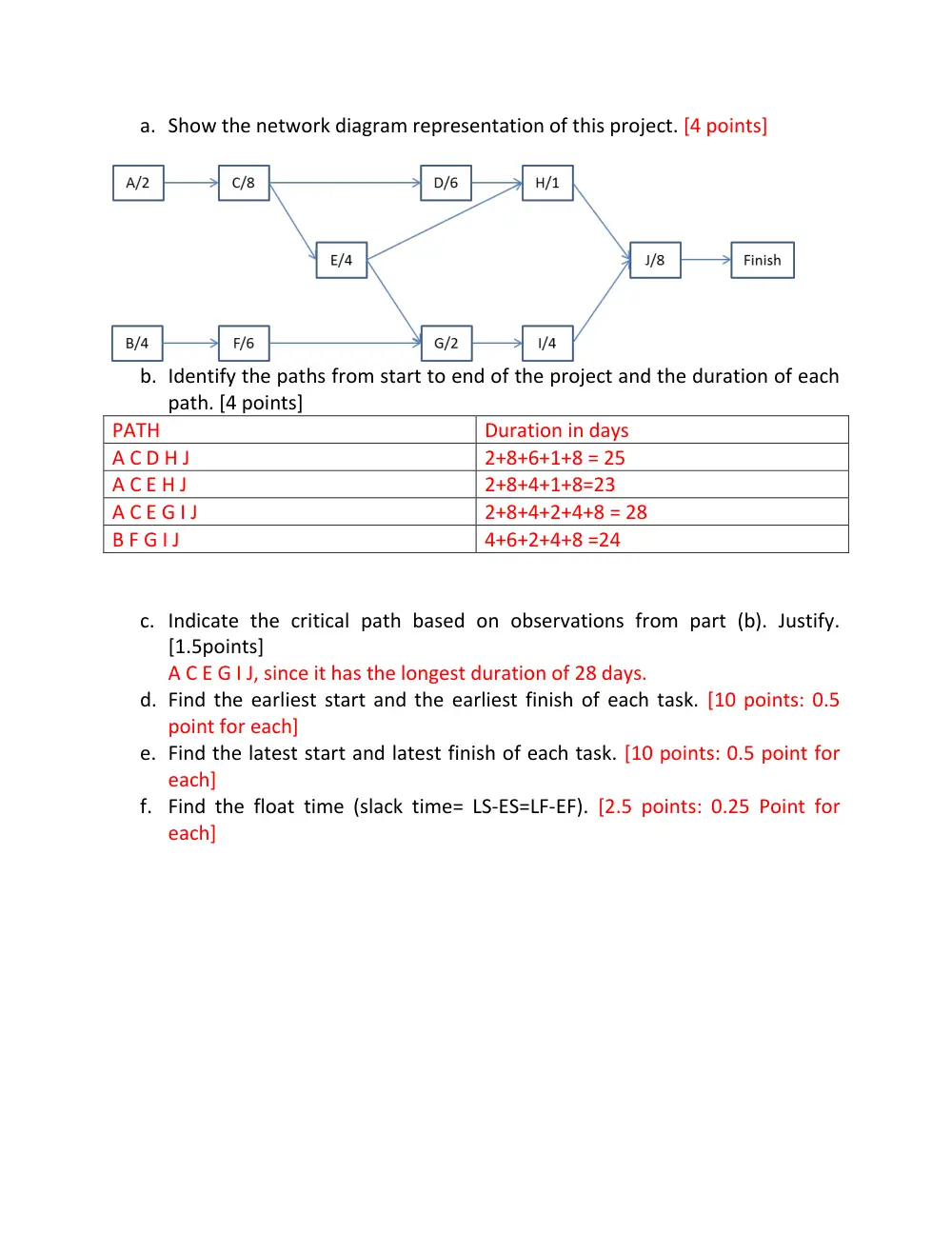
a. Show the network diagram representation of this project. [4 points]
b. Identify the paths from start to end of the project and the duration of each
path. [4 points]
PATH
Duration in days
A C D H J
2+8+6+1+8 = 25
A C E H J
2+8+4+1+8=23
A C E G I J
2+8+4+2+4+8 = 28
B F G I J
4+6+2+4+8 =24
c. Indicate the critical path based on observations from part (b). Justify.
[1.5points]
A C E G I J, since it has the longest duration of 28 days.
d. Find the earliest start and the earliest finish of each task. [10 points: 0.5
point for each]
e. Find the latest start and latest finish of each task. [10 points: 0.5 point for
each]
f. Find the float time (slack time= LS‐ES=LF‐EF). [2.5 points: 0.25 Point for
each]
TASK
Earliest
Start (ES)
Earliest
Finish (EF)
LS
LF
Float time
=LS-ES
A
0
2
0
2
0
B
0
4
4
8
4
C
2
10
2
10
0
D
10
16
13
19
3
E
10
14
10
14
0
F
4
10
8
14
4
G
14
16
14
16
0
H
16
17
19
20
3
I
16
20
16
20
0
J
20
28
20
28
0
g. Indicate the critical path based on observations from part (f). Justify.
[2 points]
The tasks that have 0 float time belong to the critical path, so the critical
path is: A C E G I J
h. Find the minimum project completion time. [1 point]
The minimum project completion time is the duration of the critical path:
28 days