
EECE 230 Final, Fall 2013
American University of Beirut · Introduction to Programming · 6 pages · Prof. Fadi Zaraket

More EECE 230 files
- Final Exam · Spring 2020Final examView
- Final Questions · Spring 2019Final examView
- Final Questions · Fall 2018Final examView
- Final Solutions · Fall 2018Final exam · with solutionView
- Final Collection Finals with Solution · Spring 2017Final exam · with solutionView
- Final Problem 2 · Fall 2013Final examView
- Final Problem 3 · Fall 2013Final examView
- Final · Fall 2013Final examView
Show the text of this final exam
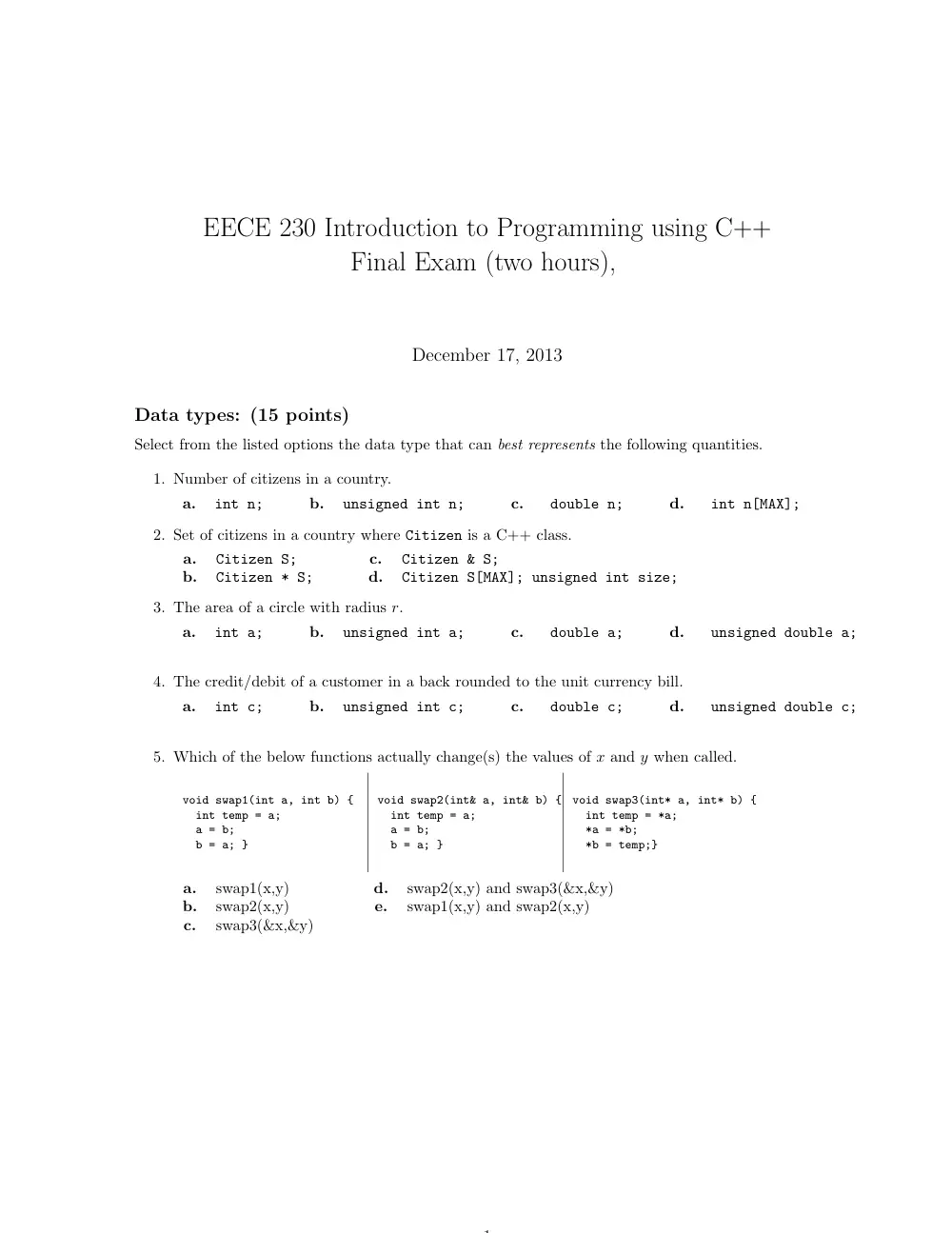
EECE 230 Introduction to Programming using C++
Final Exam (two hours),
December 17, 2013
Data types: (15 points)
Select from the listed options the data type that can best represents the following quantities.
1. Number of citizens in a country.
a.
int n;
b.
unsigned int n;
c.
double n;
d.
int n[MAX];
2. Set of citizens in a country where Citizen is a C++ class.
a.
Citizen S;
c.
Citizen & S;
b.
Citizen * S;
d.
Citizen S[MAX]; unsigned int size;
3. The area of a circle with radius r.
a.
int a;
b.
unsigned int a;
c.
double a;
d.
unsigned double a;
4. The credit/debit of a customer in a back rounded to the unit currency bill.
a.
int c;
b.
unsigned int c;
c.
double c;
d.
unsigned double c;
5. Which of the below functions actually change(s) the values of x and y when called.
void swap1(int a, int b) {
int temp = a;
a = b;
b = a; }
void swap2(int& a, int& b) {
int temp = a;
a = b;
b = a; }
void swap3(int* a, int* b) {
int temp = *a;
*a = *b;
*b = temp;}
a.
swap1(x,y)
d.
swap2(x,y) and swap3(&x,&y)
b.
swap2(x,y)
e.
swap1(x,y) and swap2(x,y)
c.
swap3(&x,&y)
1
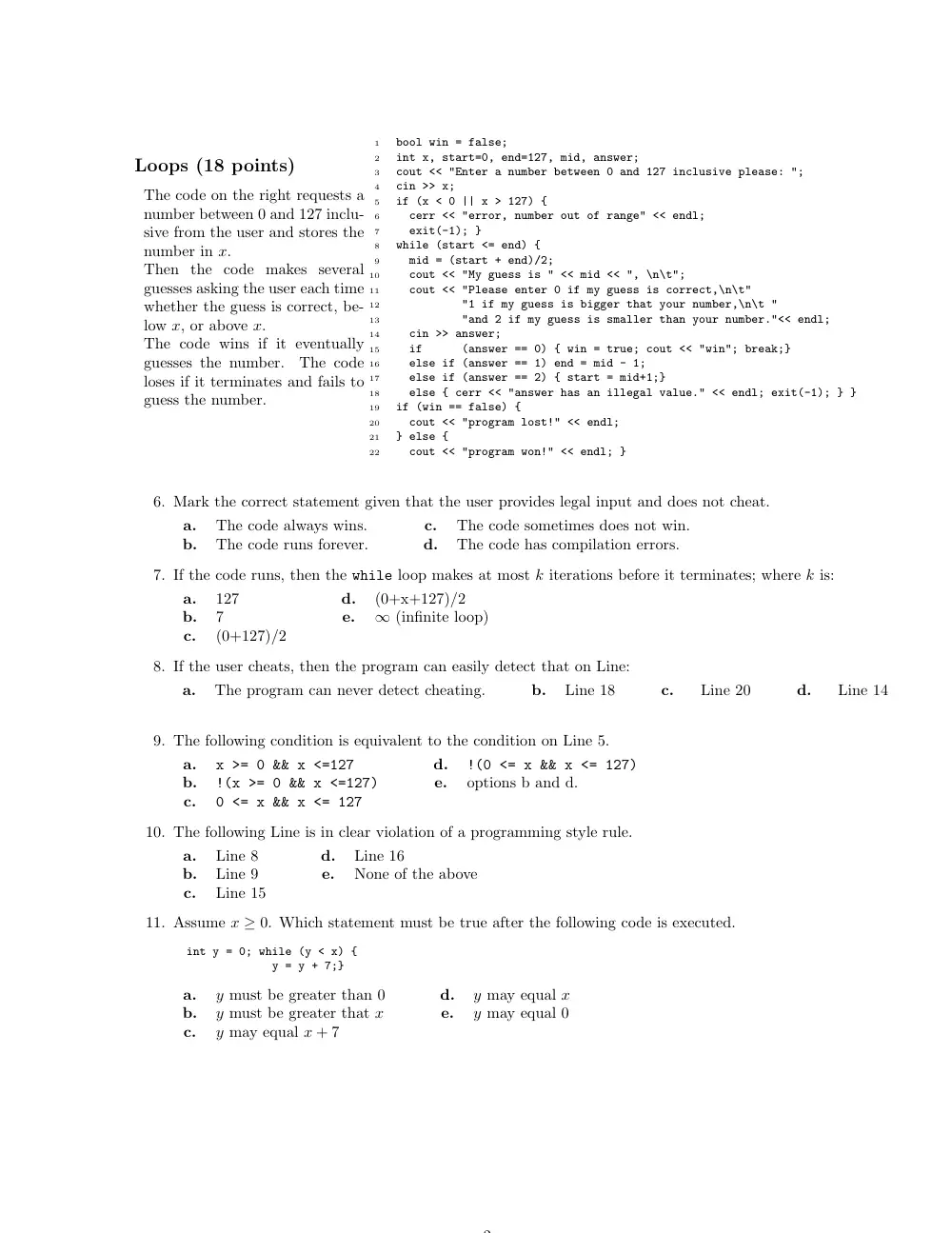
Loops (18 points)
The code on the right requests a
number between 0 and 127 inclu-
sive from the user and stores the
number in x.
Then the code makes several
guesses asking the user each time
whether the guess is correct, be-
low x, or above x.
The code wins if it eventually
guesses the number.
The code
loses if it terminates and fails to
guess the number.
1
bool win = false;
2
int x, start=0, end=127, mid, answer;
3
cout << "Enter a number between 0 and 127 inclusive please: ";
4
cin >> x;
5
if (x < 0 || x > 127) {
6
cerr << "error, number out of range" << endl;
7
exit(-1); }
8
while (start <= end) {
9
mid = (start + end)/2;
10
cout << "My guess is " << mid << ", \n\t";
11
cout << "Please enter 0 if my guess is correct,\n\t"
12
"1 if my guess is bigger that your number,\n\t "
13
"and 2 if my guess is smaller than your number."<< endl;
14
cin >> answer;
15
if
(answer == 0) { win = true; cout << "win"; break;}
16
else if (answer == 1) end = mid - 1;
17
else if (answer == 2) { start = mid+1;}
18
else { cerr << "answer has an illegal value." << endl; exit(-1); } }
19
if (win == false) {
20
cout << "program lost!" << endl;
21
} else {
22
cout << "program won!" << endl; }
6. Mark the correct statement given that the user provides legal input and does not cheat.
a.
The code always wins.
c.
The code sometimes does not win.
b.
The code runs forever.
d.
The code has compilation errors.
7. If the code runs, then the while loop makes at most k iterations before it terminates; where k is:
a.
127
d.
(0+x+127)/2
b.
7
e.
∞ (infinite loop)
c.
(0+127)/2
8. If the user cheats, then the program can easily detect that on Line:
a.
The program can never detect cheating.
b.
Line 18
c.
Line 20
d.
Line 14
9. The following condition is equivalent to the condition on Line 5.
a.
x >= 0 && x <=127
d.
!(0 <= x && x <= 127)
b.
!(x >= 0 && x <=127)
e.
options b and d.
c.
0 <= x && x <= 127
10. The following Line is in clear violation of a programming style rule.
a.
Line 8
d.
Line 16
b.
Line 9
e.
None of the above
c.
Line 15
11. Assume x ≥ 0. Which statement must be true after the following code is executed.
int y = 0; while (y < x) {
y = y + 7;}
a.
y must be greater than 0
d.
y may equal x
b.
y must be greater that x
e.
y may equal 0
c.
y may equal x + 7
2
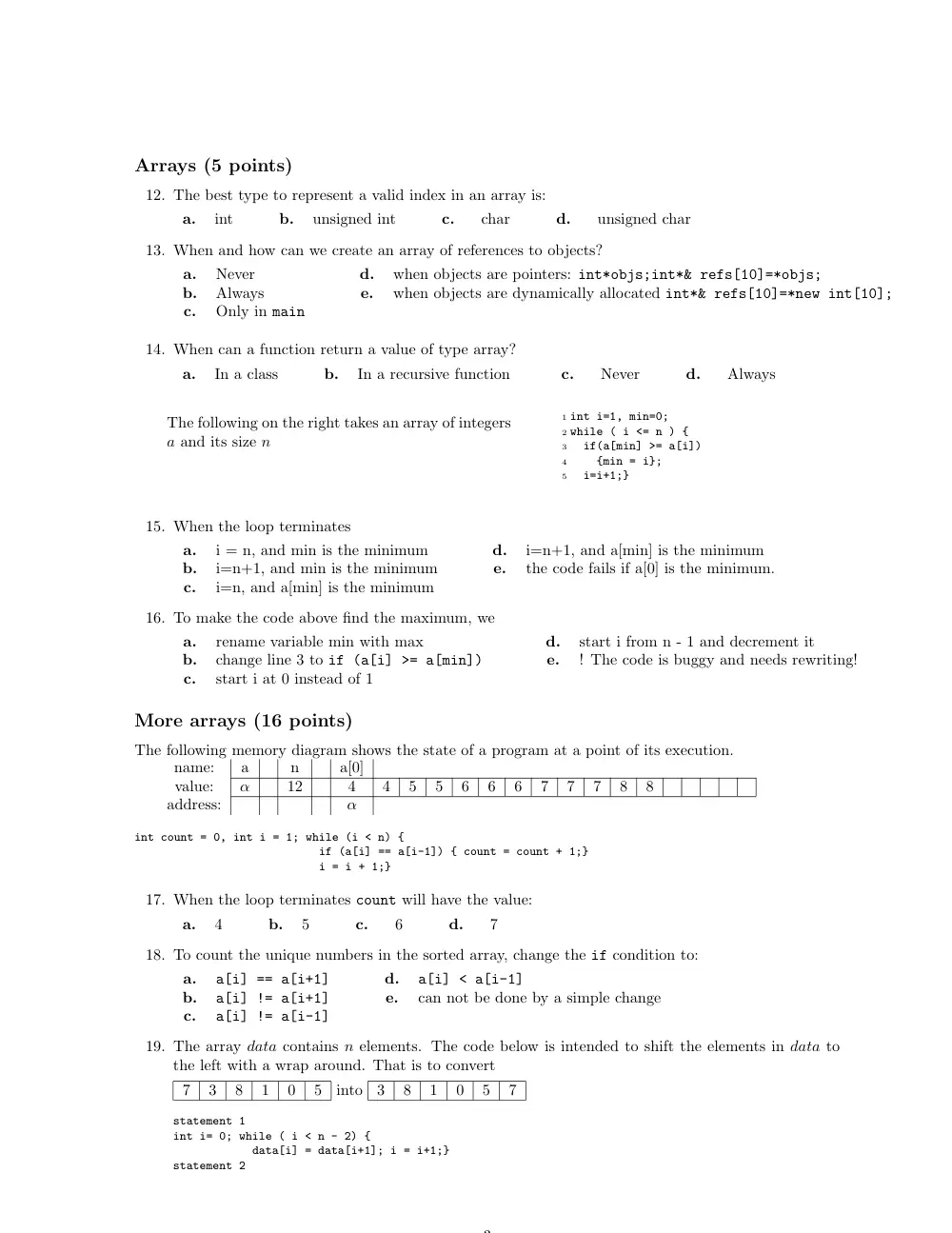
Arrays (5 points)
12. The best type to represent a valid index in an array is:
a.
int
b.
unsigned int
c.
char
d.
unsigned char
13. When and how can we create an array of references to objects?
a.
Never
d.
when objects are pointers: int*objs;int*& refs[10]=*objs;
b.
Always
e.
when objects are dynamically allocated int*& refs[10]=*new int[10];
c.
Only in main
14. When can a function return a value of type array?
a.
In a class
b.
In a recursive function
c.
Never
d.
Always
The following on the right takes an array of integers
a and its size n
1 int i=1, min=0;
2 while ( i <= n ) {
3
if(a[min] >= a[i])
4
{min = i};
5
i=i+1;}
15. When the loop terminates
a.
i = n, and min is the minimum
d.
i=n+1, and a[min] is the minimum
b.
i=n+1, and min is the minimum
e.
the code fails if a[0] is the minimum.
c.
i=n, and a[min] is the minimum
16. To make the code above find the maximum, we
a.
rename variable min with max
d.
start i from n - 1 and decrement it
b.
change line 3 to if (a[i] >= a[min])
e.
! The code is buggy and needs rewriting!
c.
start i at 0 instead of 1
More arrays (16 points)
The following memory diagram shows the state of a program at a point of its execution.
name:
a
n
a[0]
value:
α
12
4
4
5
5
6
6
6
7
7
7
8
8
address:
α
int count = 0, int i = 1; while (i < n) {
if (a[i] == a[i-1]) { count = count + 1;}
i = i + 1;}
17. When the loop terminates count will have the value:
a.
4
b.
5
c.
6
d.
7
18. To count the unique numbers in the sorted array, change the if condition to:
a.
a[i] == a[i+1]
d.
a[i] < a[i-1]
b.
a[i] != a[i+1]
e.
can not be done by a simple change
c.
a[i] != a[i-1]
19. The array data contains n elements. The code below is intended to shift the elements in data to
the left with a wrap around. That is to convert
7
3
8
1
0
5
into
3
8
1
0
5
7
statement 1
int i= 0; while ( i < n - 2) {
data[i] = data[i+1]; i = i+1;}
statement 2
3
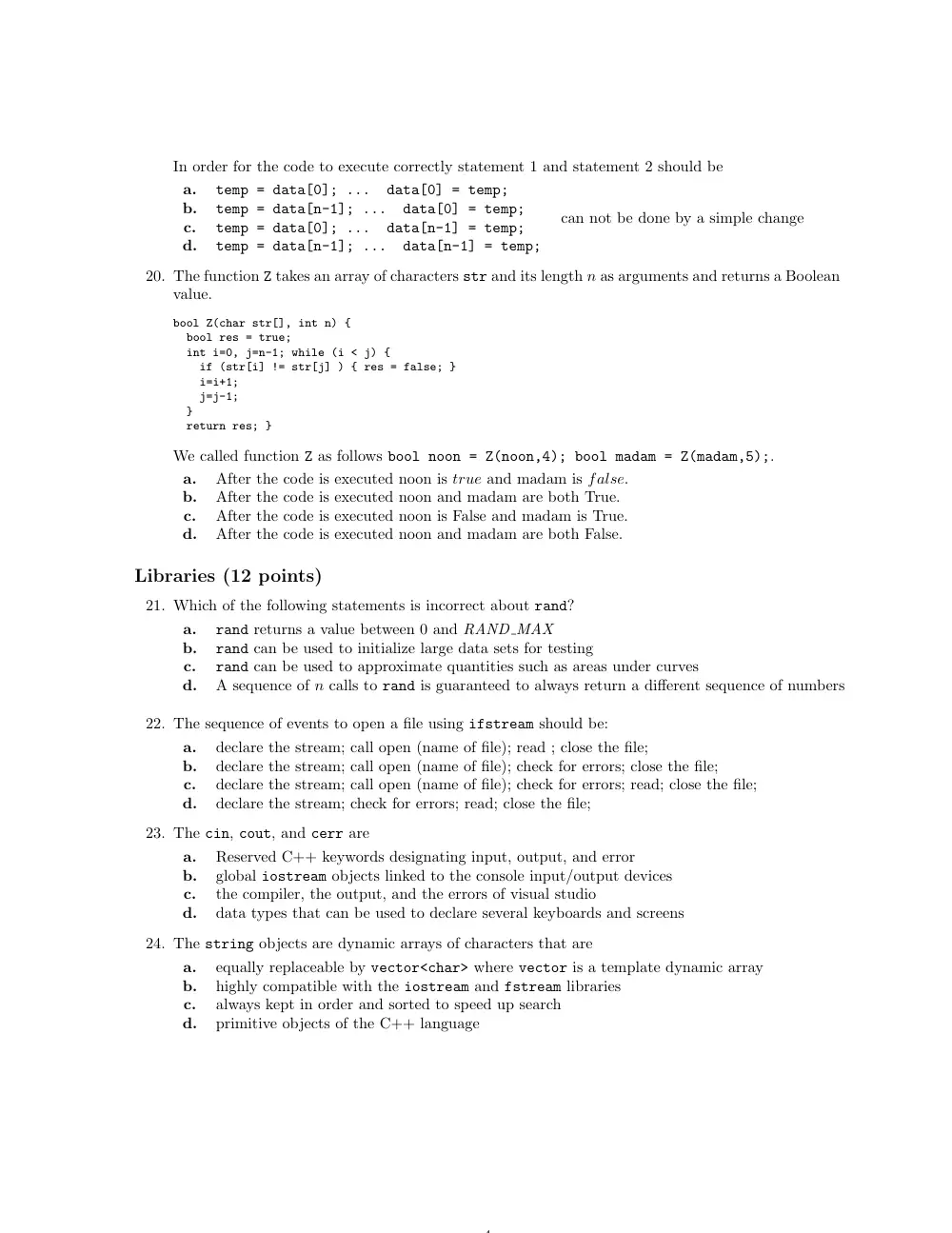
In order for the code to execute correctly statement 1 and statement 2 should be
a.
temp = data[0]; ...
data[0] = temp;
b.
temp = data[n-1]; ...
data[0] = temp;
c.
temp = data[0]; ...
data[n-1] = temp;
d.
temp = data[n-1]; ...
data[n-1] = temp;
can not be done by a simple change
20. The function Z takes an array of characters str and its length n as arguments and returns a Boolean
value.
bool Z(char str[], int n) {
bool res = true;
int i=0, j=n-1; while (i < j) {
if (str[i] != str[j] ) { res = false; }
i=i+1;
j=j-1;
}
return res; }
We called function Z as follows bool noon = Z(noon,4); bool madam = Z(madam,5);.
a.
After the code is executed noon is true and madam is false.
b.
After the code is executed noon and madam are both True.
c.
After the code is executed noon is False and madam is True.
d.
After the code is executed noon and madam are both False.
Libraries (12 points)
21. Which of the following statements is incorrect about rand?
a.
rand returns a value between 0 and RAND MAX
b.
rand can be used to initialize large data sets for testing
c.
rand can be used to approximate quantities such as areas under curves
d.
A sequence of n calls to rand is guaranteed to always return a different sequence of numbers
22. The sequence of events to open a file using ifstream should be:
a.
declare the stream; call open (name of file); read ; close the file;
b.
declare the stream; call open (name of file); check for errors; close the file;
c.
declare the stream; call open (name of file); check for errors; read; close the file;
d.
declare the stream; check for errors; read; close the file;
23. The cin, cout, and cerr are
a.
Reserved C++ keywords designating input, output, and error
b.
global iostream objects linked to the console input/output devices
c.
the compiler, the output, and the errors of visual studio
d.
data types that can be used to declare several keyboards and screens
24. The string objects are dynamic arrays of characters that are
a.
equally replaceable by vector<char> where vector is a template dynamic array
b.
highly compatible with the iostream and fstream libraries
c.
always kept in order and sorted to speed up search
d.
primitive objects of the C++ language
4
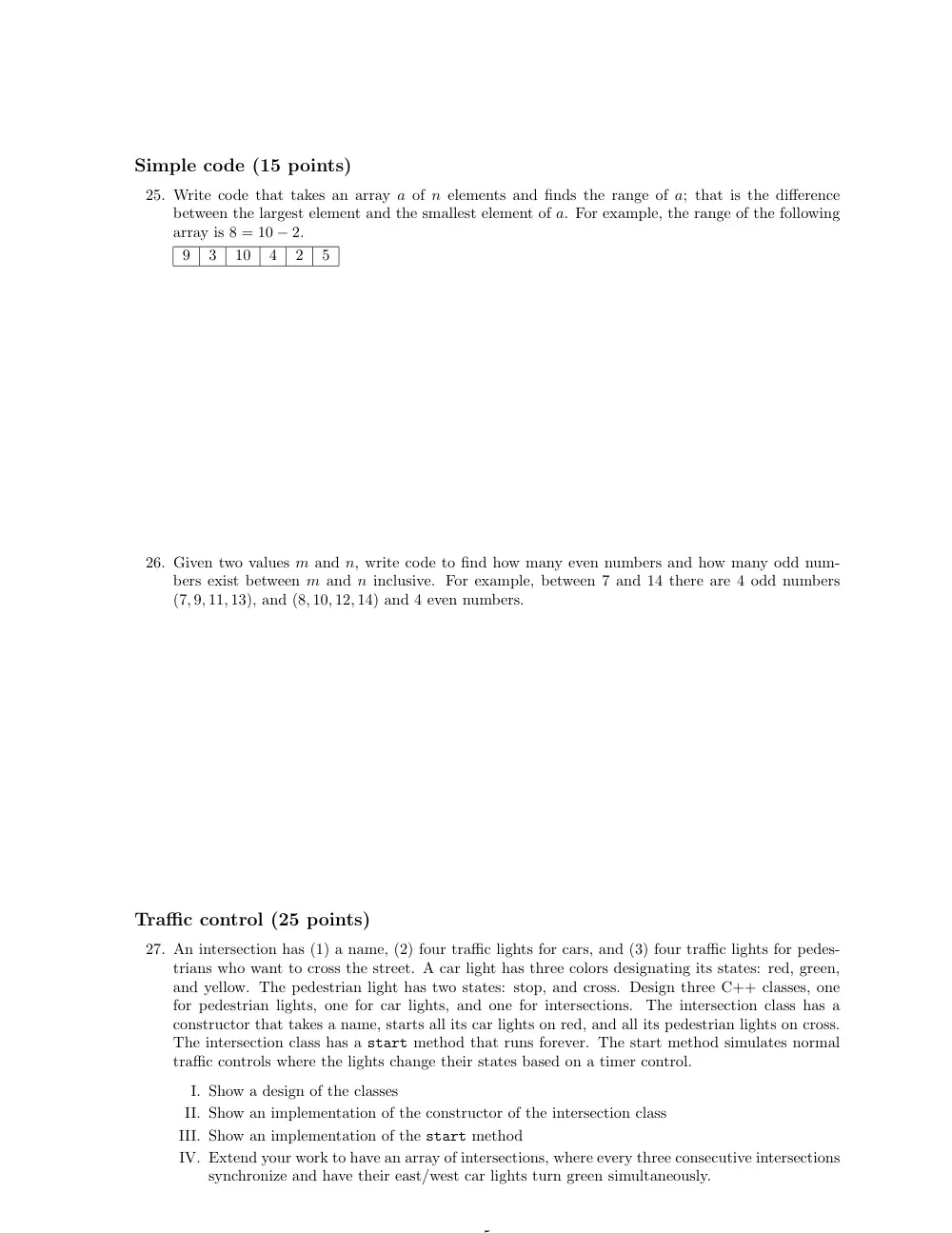
Simple code (15 points)
25. Write code that takes an array a of n elements and finds the range of a; that is the difference
between the largest element and the smallest element of a. For example, the range of the following
array is 8 = 10 − 2.
9
3
10
4
2
5
26. Given two values m and n, write code to find how many even numbers and how many odd num-
bers exist between m and n inclusive. For example, between 7 and 14 there are 4 odd numbers
(7, 9, 11, 13), and (8, 10, 12, 14) and 4 even numbers.
Traffic control (25 points)
27. An intersection has (1) a name, (2) four traffic lights for cars, and (3) four traffic lights for pedes-
trians who want to cross the street. A car light has three colors designating its states: red, green,
and yellow. The pedestrian light has two states: stop, and cross. Design three C++ classes, one
for pedestrian lights, one for car lights, and one for intersections.
The intersection class has a
constructor that takes a name, starts all its car lights on red, and all its pedestrian lights on cross.
The intersection class has a start method that runs forever. The start method simulates normal
traffic controls where the lights change their states based on a timer control.
I. Show a design of the classes
II. Show an implementation of the constructor of the intersection class
III. Show an implementation of the start method
IV. Extend your work to have an array of intersections, where every three consecutive intersections
synchronize and have their east/west car lights turn green simultaneously.
5
use this page for answers if needed.
Best of luck.
6