
EECE 231 Syllabus, Fall 2015
American University of Beirut · Introduction to Programming Using C++ and MATLAB · 3 pages · Dr. Wassim Masri
More EECE 231 files
- Lab 1024 · Fall 2017LabView
- Lecture All C++ Lectures · Fall 2015LabView
- Lecture All Matlab Slides · Fall 2015LabView
- Syllabus · Fall 2015LabView
- Lecture All Matlab Lectures · Fall 2015LabView
- Lecture All C++ Slides · Fall 2015LabView
- Lecture First Textbook PDF · Fall 2015LabView
- Lecture Second Textbook PDF · Fall 2015LabView
Show the text of this lab
1. Course number and name
EECE231 Introduction to Programming Using C++ and MATLAB
2. Credits and contact hours
3 Credits, 3 hours/week lectures + 2 hours/week lab
3. Instructor’s or course coordinator’s name
Course Coordinator: Fadi Zaraket
4. Text book: title, author, and year
Alex. Bielajew, Introduction to Computers and Programming using C++ and MATLAB,
University of Michigan, 2004, http://www-personal.umich.edu/~paulko/book.pdf
a. Other supplemental materials
Handouts, lab assignments and problem sets are posted on Moodle
5. Specific course information
a. Catalog description
An introductory course for non- ECE students on the principles of programming using C++ and
MATLAB. Basic data types, control structures, and arrays will be covered in C++. Algorithms,
functions, and arrays will be covered in MATLAB. In addition, the course will expose students to
the MATLAB environment and toolboxes with applications in Engineering. Weekly laboratory
assignments are an integral part of this course.
b. Prerequisites or co-requisites
Prerequisite: none.
c.
Required, elective, or selected elective course in the program
Required for Civil engineers, is not considered equivalent to EECE 230.
6. Specific goals for the course
a. Course learning outcomes
At the end of the course, students will be able to1:
Can edit, compile, and run a program using C++ and MATLAB
Know the various built-in data types in C++ and MATLAB
Know how to input/output data
Know how to use control structures (for, while, if/else…).
Know how to modularize a program through the use of functions.
Know how to write functions with call by value and call by reference.
Know how to write recursive functions.
Can use arrays in programs and functions.
Have learned and used the string manipulation functions.
Become Familiar with different MATLAB computational and plotting Libraries and toolboxes
Have gained hands-on experience in C++ and MATLAB programming through weekly lab
assignments
1 The learning outcomes are partially quoted from [1] ``Curriculum Guidelines for Undergraduate Degree Programs in Computer Engineering'',
A Report in the Computing Curricula Series, Joint Task Force on Computer Engineering Curricula: IEEE Computer Society, Association for
Computing Machinery, December 12, 2004
Know how to apply the principles of computer programming to the solution of engineering
problems.
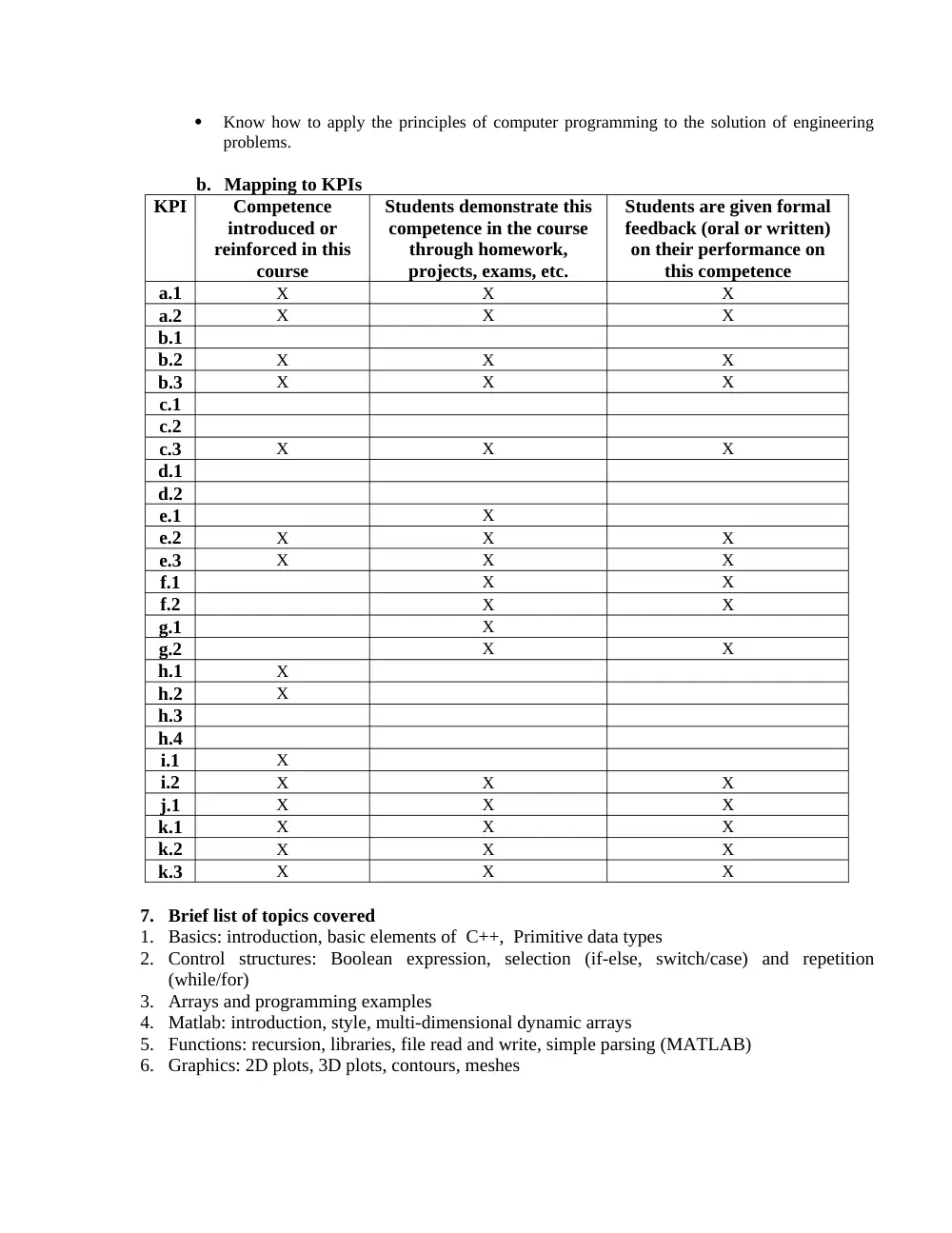
b. Mapping to KPIs
KPI
Competence
introduced or
reinforced in this
course
Students demonstrate this
competence in the course
through homework,
projects, exams, etc.
Students are given formal
feedback (oral or written)
on their performance on
this competence
a.1
X
X
X
a.2
X
X
X
b.1
b.2
X
X
X
b.3
X
X
X
c.1
c.2
c.3
X
X
X
d.1
d.2
e.1
X
e.2
X
X
X
e.3
X
X
X
f.1
X
X
f.2
X
X
g.1
X
g.2
X
X
h.1
X
h.2
X
h.3
h.4
i.1
X
i.2
X
X
X
j.1
X
X
X
k.1
X
X
X
k.2
X
X
X
k.3
X
X
X
7. Brief list of topics covered
1. Basics: introduction, basic elements of C++, Primitive data types
2. Control structures: Boolean expression, selection (if-else, switch/case) and repetition
(while/for)
3. Arrays and programming examples
4. Matlab: introduction, style, multi-dimensional dynamic arrays
5. Functions: recursion, libraries, file read and write, simple parsing (MATLAB)
6. Graphics: 2D plots, 3D plots, contours, meshes
7. Practical Applications: statistical parameters, area under a curve, interpolating within a set of
data, fitting a line or a power equation to a set of data, solution of a first order differential
equation using 1st and 2nd order schemes
8. Symbolic Computations: introduction, plotting