
EECE 311 Exam, Fall 2001
American University of Beirut · Electronic Circuits · 4 pages
More EECE 311 files
- Midterm with Answers · Spring 2014Exam · with solutionView
- Homework All Hw 2013+midterm · Spring 2013ExamView
- Midterm with Answers · Spring 2011Exam · with solutionView
- Midterm · Fall 2010ExamView
- Midterm · Summer 2010ExamView
- Exam 1 · Spring 2008ExamView
- Exam 2 · Spring 2008ExamView
- Exam 2 · Spring 2008ExamView
Show the text of this exam
ELEG 042 Quiz 1 – Fall 2001-2002 – Page 1 of 4
American University of Beirut
Faculty of Engineering and Architecture
Department of Electrical and Computer Engineering
ELEG 042 - Analog Electronics
Instructors: A. Kayssi and Z. Othman
Quiz 1
November 2001
Closed Book
Programmable Calculators Are Not Allowed.
Time: 1.5 hours
Name:_______________________________ ID#:__________________________
► Provide your answer on the computer card only.
► Return the computer card attached to the question sheet.
► Use a pencil for marking your answers and ID number on the computer card.
► When using an eraser, make sure you erased well.
► On this sheet, write with a pen your name followed by your ID number.
► All questions are equally graded.
► Only the computer card will be considered in grading.
PENALTY is FOUR to ONE
Penalty is calculated as follows:
One to three wrong answers result in no penalty; four to seven wrong answers result
in canceling one correct answer; eight to eleven wrong answers result in canceling
two correct answers; and so on.
ELEG 042 Quiz 1 – Fall 2001-2002 – Page 2 of 4
Assume in all problems that:
|VBE| = 0.7 V
VT = 25 mV
β = 100 unless otherwise specified
Capacitors are very large
Early effect and body effect are negligible unless otherwise specified
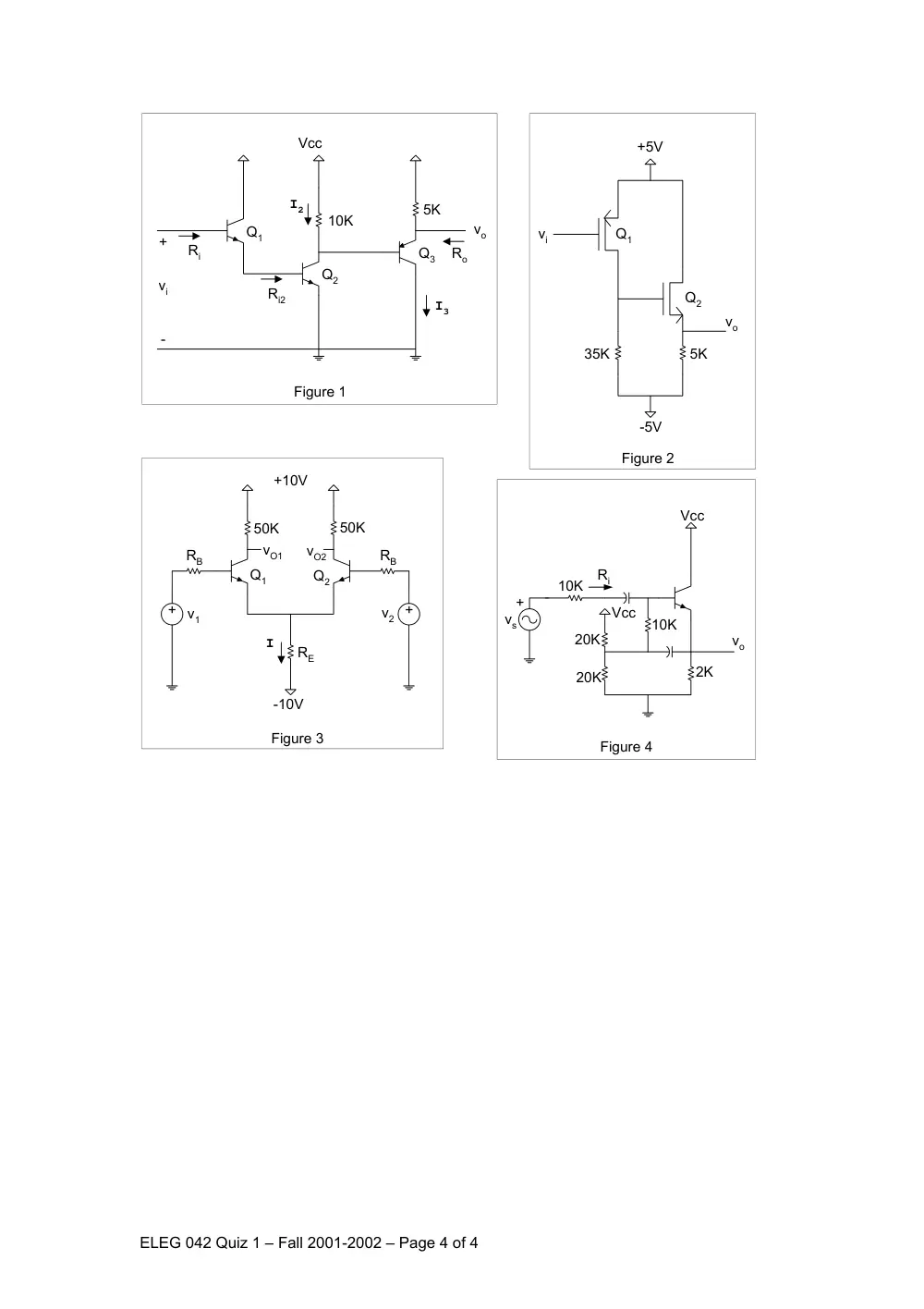
In the circuit of Figure 1, I2 = I3 = 0.24 mA.
1. Find the collector current of transistor Q2 in mA.
a) 1.21
b) 0.667
c) 0.242
d) 0.828
e) 0.354
2. Find the collector current of transistor Q1 in µA.
a) 2.4
b) 12
c) 6.6
d) 8.2
e) 3.5
3. Find the input resistance at the base of Q2 (Ri2) in KΩ.
a) 3.75
b) 2.06
c) 10.3
d) 3.02
e) 7.07
4. Find the input resistance at the base of Q1 (Ri) in MΩ.
a) 0.758
b) 0.610
c) 0.417
d) 1.43
e) 2.08
5. Find the voltage gain vc2/vb2 (vc2 and vb2 are the small-signal collector and base voltages of
transistor Q2, respectively.)
a) –138.7
b) –475.4
c) –261.5
d) –95.1
e) –324.9
6. Find the voltage gain vo/vi
a) –68.4
b) –236.7
c) –46.6
d) –161.5
e) –129.8
7. Find the output resistance Ro in Ohms.
a) 116.8
b) 125.9
c) 164.2
d) 194.3
e) 132.9
In the circuit of Figure 2, assume the DC value of the output voltage to be VO = -2 V.
The MOSFET parameters are Vtn = 0.8 V, ½ k’n(W/L)n = 0.5 mA/V2, λn = 0.01 V-1, and
Vtp = - 0.8 V, ½ k’p(W/L)p = 0.2 mA/V2, λp = - 0.01 V-1.
8. Find VGS for transistor Q2 in Volts.
a) 1.86
b) 1.66
c) 2.03
d) 1.41
e) 2.18
9. Find ID of Q1 in mA.
a) 0.139
b) 0.205
c) 0.105
d) 0.0687
e) 0.172
10. Find the voltage gain vo/vg2 (vg2 is the small-signal voltage at the gate of Q2.)
a) 0.862
b) 0.846
c) 0.820
d) 0.873
e) 0.766
11. Find the voltage gain vo/vi
a) –9.65
b) –8.26
c) –6.37
d) –10.8
e) –11.7
In the circuit of Figure 3, assume I = 250 µA and RB = 30 K.
12. Find the value of RE (in KΩ) to get the specified I when v1 = v2 = 0.
a) 37.1
b) 30.9
c) 92.9
d) 61.9
e) 46.4
13. Find Ad = vo2 / vd when v1 = +vd/2 and v2 = – vd/2
a) 49.8
b) 31.1
c) 39.3
d) 45.2
e) 53.4
ELEG 042 Quiz 1 – Fall 2001-2002 – Page 3 of 4
14. Find Acm = vo2/vcm when v1 = v2 = vcm
a) –0.664
b) –0.531
c) –0.266
d) –0.796
e) –0.398
15. Find the CMRR in dB, corresponding to the values of the gains calculated in the previous
two questions.
a) 41.4
b) 37.5
c) 36.5
d) 38.6
e) 39.9
16. Find the differential input resistance vd / ib1 in KΩ, when v1 = +vd/2 and v2 = – vd/2.
a) 127.3
b) 100.4
c) 161
d) 110.5
e) 93.7
17. Find the common-mode input resistance vcm/(2ib1) in MΩ, when v1 = v2 = vcm
a) 3.14
b) 9.42
c) 4.71
d) 6.28
e) 3.77
18. Find the input bias current in µA.
a) 0.743
b) 1.238
c) 0.495
d) 0.990
e) 1.485
19. Find the input offset current (in nA) when β is matched to within +/- 1.5%.
a) 22.3
b) 37.1
c) 29.7
d) 14.9
e) 44.6
A differential amplifier has a differential voltage gain of 350 and a CMRR of 85 dB. A
differential input signal of vd = 2 sin(ωt) mV is applied, along with a common-mode voltage of
vcm = 2 sin(ωt) V. Assume that the common-mode gain is positive.
20. Determine the amplitude of the ideal output voltage in Volts.
a) 0.7
b) 0.6
c) 0.3
d) 0.5
e) 0.4
21. Determine the amplitude of the actual output voltage in Volts.
a) 0.528
b) 0.638
c) 0.422
d) 0.739
e) 0.317
In the circuit of Figure 4, assume Vcc = 7 V.
22. Find the collector current of the BJT in mA.
a) 1.71
b) 1.49
c) 1.26
d) 0.811
e) 1.04
23. Find the value of re for the BJT in Ohms.
a) 23.9
b) 30.5
c) 16.7
d) 19.6
e) 14.5
24. Find the input resistance Ri in KΩ.
a) 148.4
b) 142.4
c) 145.8
d) 137.9
e) 131.4
25. Find minimum value of the total output voltage in Volts when vs = sin(ωt) Volt.
a) 2.076
b) 1.624
c) 2.529
d) 0.725
e) 1.174
ELEG 042 Quiz 1 – Fall 2001-2002 – Page 4 of 4
Figure 3
Figure 2
vi
vo
10K
Vcc
Q2
Q1
Ri
Figure 1
5K
+
-
Q3
Ro
I2
I3
Ri2
vi
vo
35K
5K
-5V
+5V
Q1
Q2
+10V
50K
50K
Q1
Q2
v1
v2
vO1
vO2
-10V
RE
RB
RB
+
+
I
Figure 4
vo
Vcc
10K
10K
20K
2K
Ri
20K
Vcc
+
vs