
EECE 320 Homework 2 with Solution, Fall 2007
American University of Beirut · Digital Systems Design · 5 pages · with solution
More EECE 320 files
Show the text of this homework
EECE 320 – Digital Systems Design
Homework 2
Fall 2007-2008
Problem 1 [10 points]: Prove theorems T10 and T10’ using perfect induction.
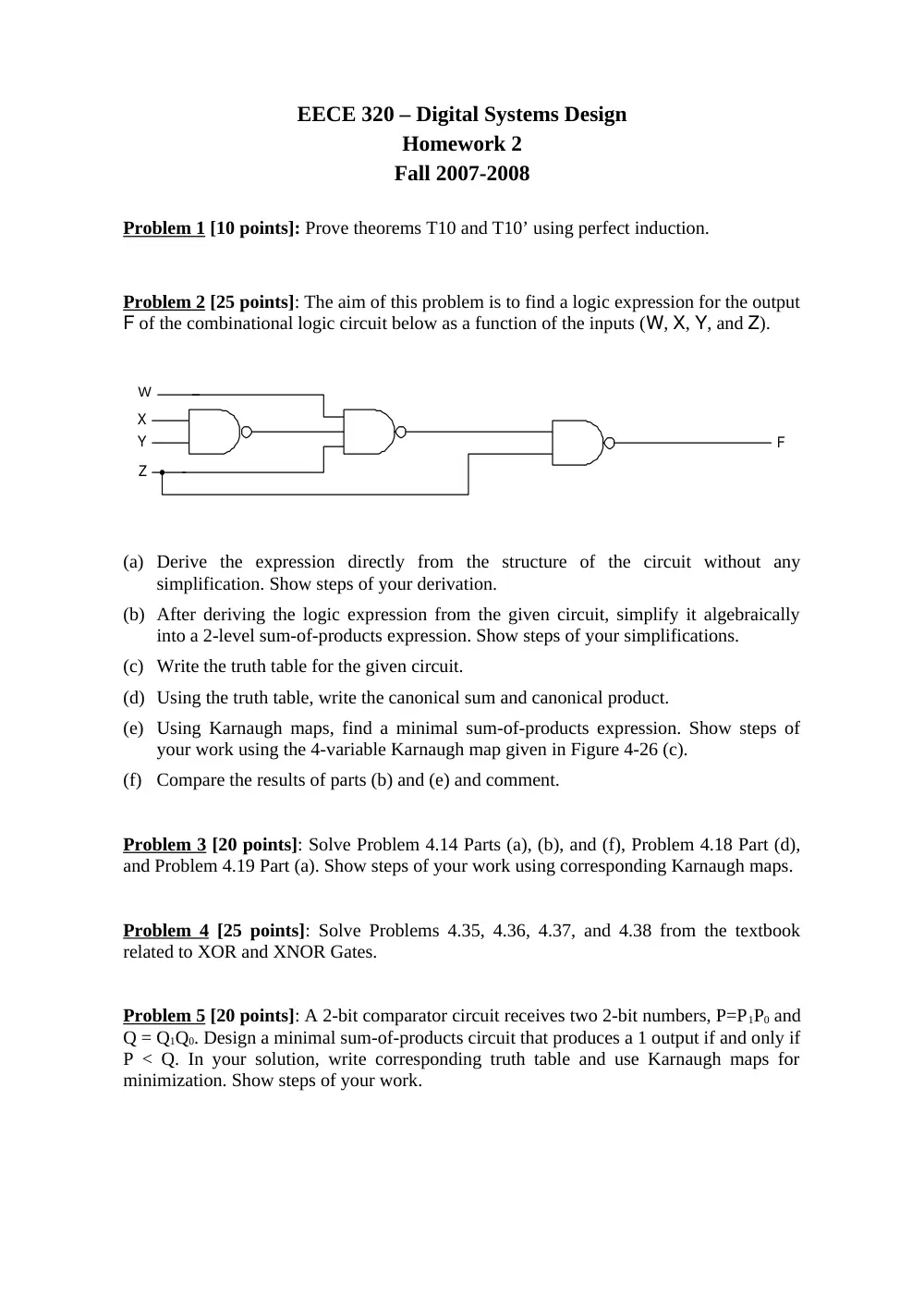
Problem 2 [25 points]: The aim of this problem is to find a logic expression for the output
F of the combinational logic circuit below as a function of the inputs (W, X, Y, and Z).
(a) Derive the expression directly from the structure of the circuit without any
simplification. Show steps of your derivation.
(b) After deriving the logic expression from the given circuit, simplify it algebraically
into a 2-level sum-of-products expression. Show steps of your simplifications.
(c) Write the truth table for the given circuit.
(d) Using the truth table, write the canonical sum and canonical product.
(e) Using Karnaugh maps, find a minimal sum-of-products expression. Show steps of
your work using the 4-variable Karnaugh map given in Figure 4-26 (c).
(f)
Compare the results of parts (b) and (e) and comment.
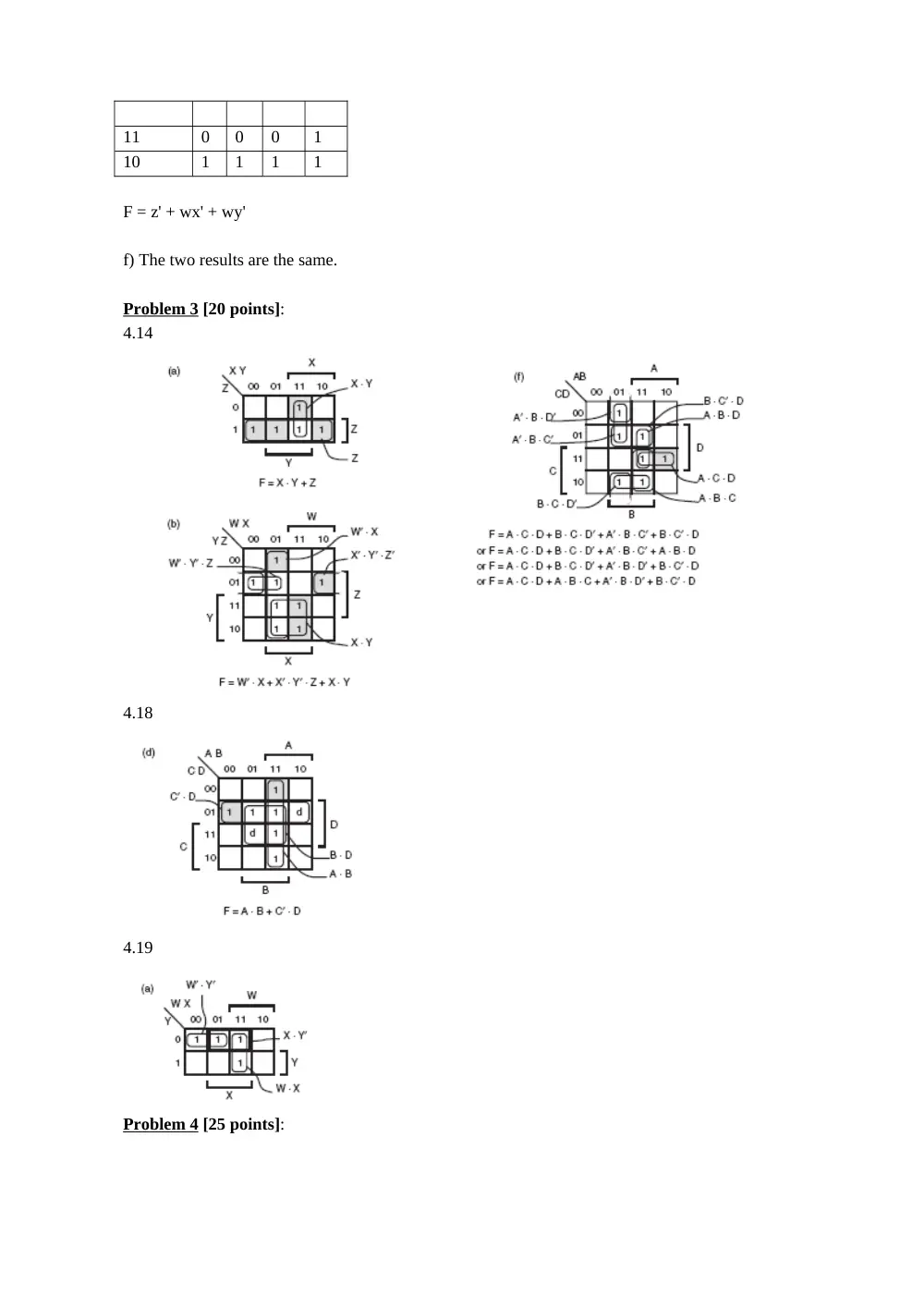
Problem 3 [20 points]: Solve Problem 4.14 Parts (a), (b), and (f), Problem 4.18 Part (d),
and Problem 4.19 Part (a). Show steps of your work using corresponding Karnaugh maps.
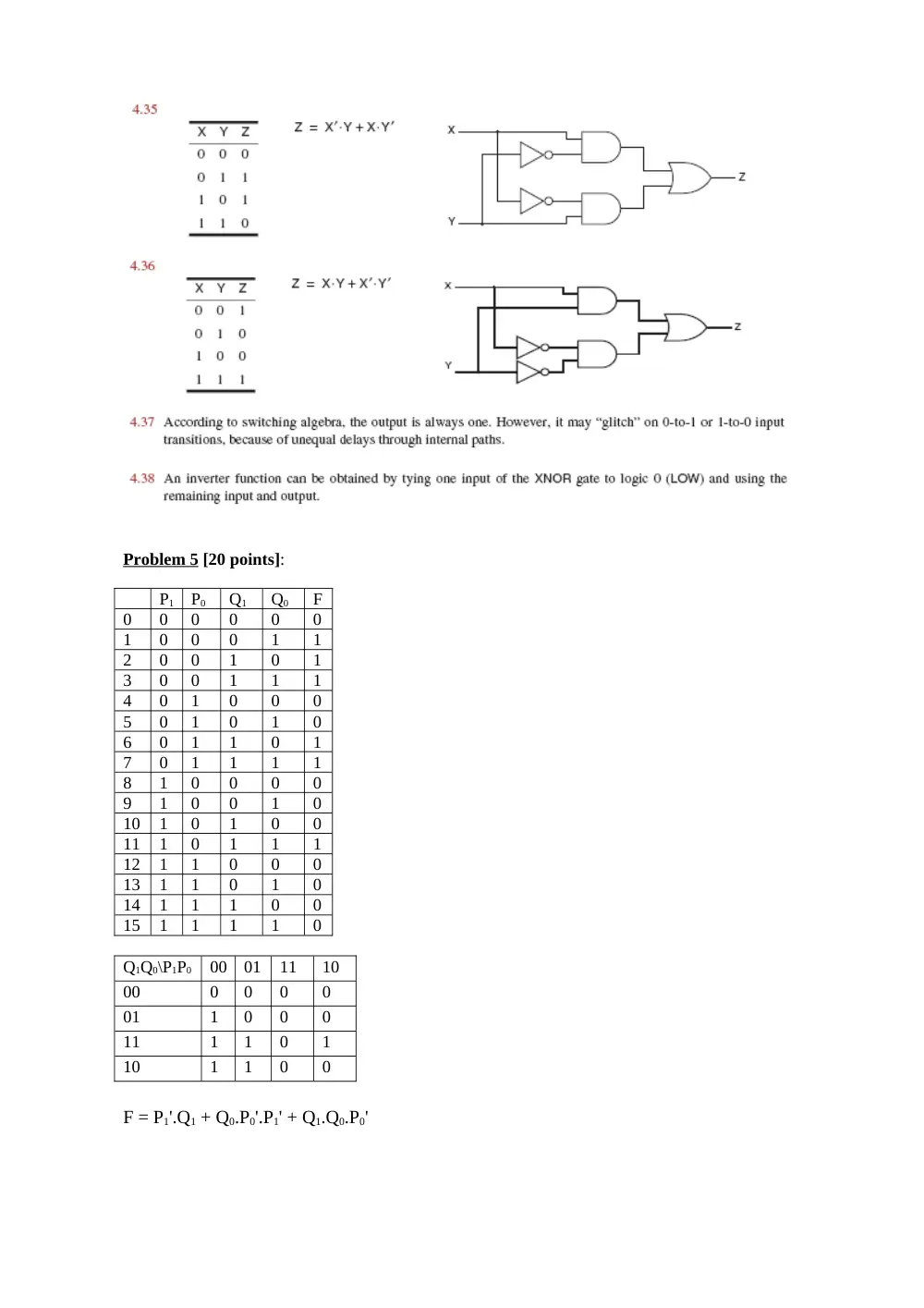
Problem 4 [25 points]: Solve Problems 4.35, 4.36, 4.37, and 4.38 from the textbook
related to XOR and XNOR Gates.
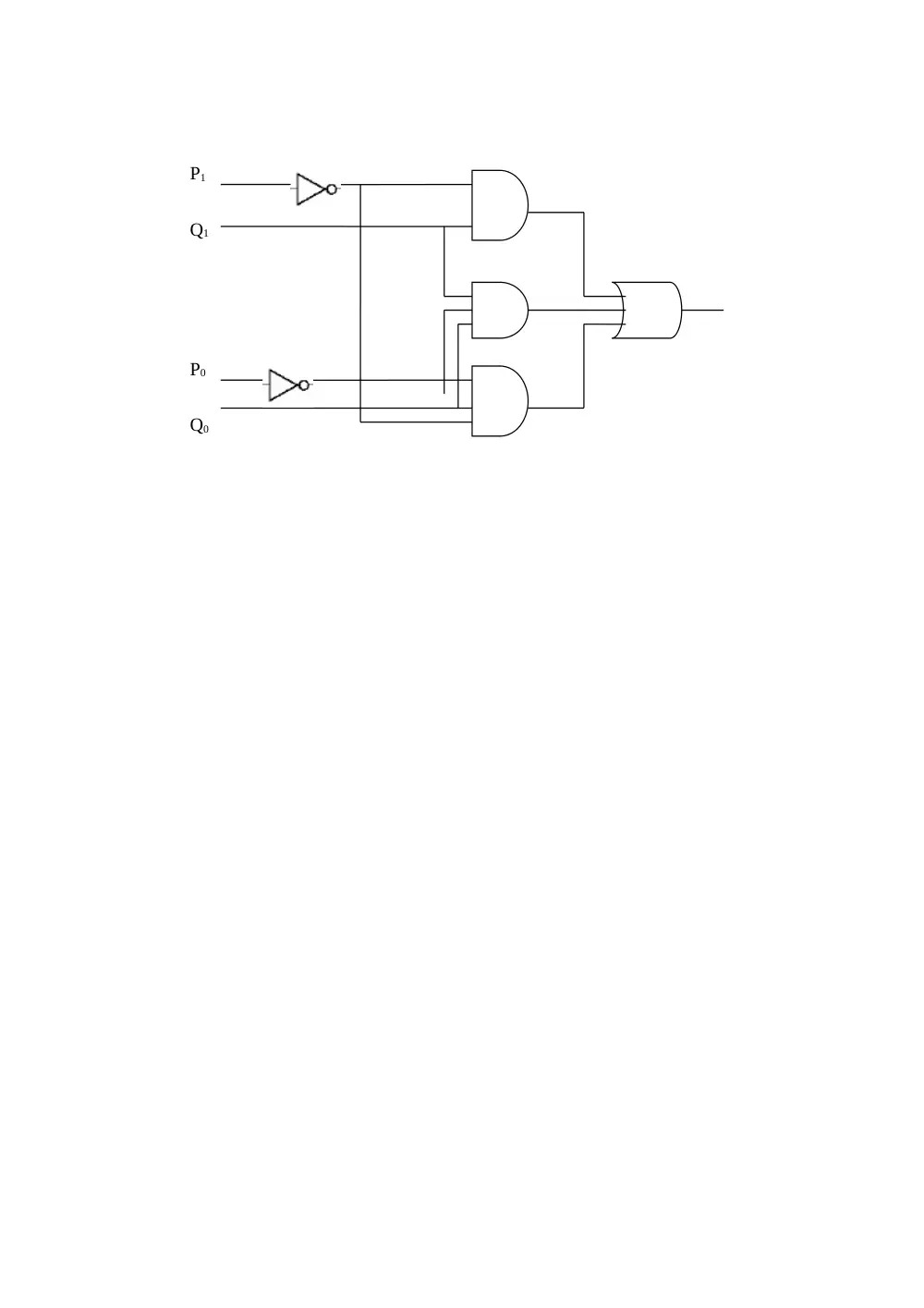
Problem 5 [20 points]: A 2-bit comparator circuit receives two 2-bit numbers, P=P1P0 and
Q = Q1Q0. Design a minimal sum-of-products circuit that produces a 1 output if and only if
P < Q. In your solution, write corresponding truth table and use Karnaugh maps for
minimization. Show steps of your work.
X
W
Y
Z
F
W
EECE 320 – Digital Systems Design
Homework 2 - Solution
Fall 2007-2008
Problem 1 [10 points]:
Problem 2 [25 points]:
a)
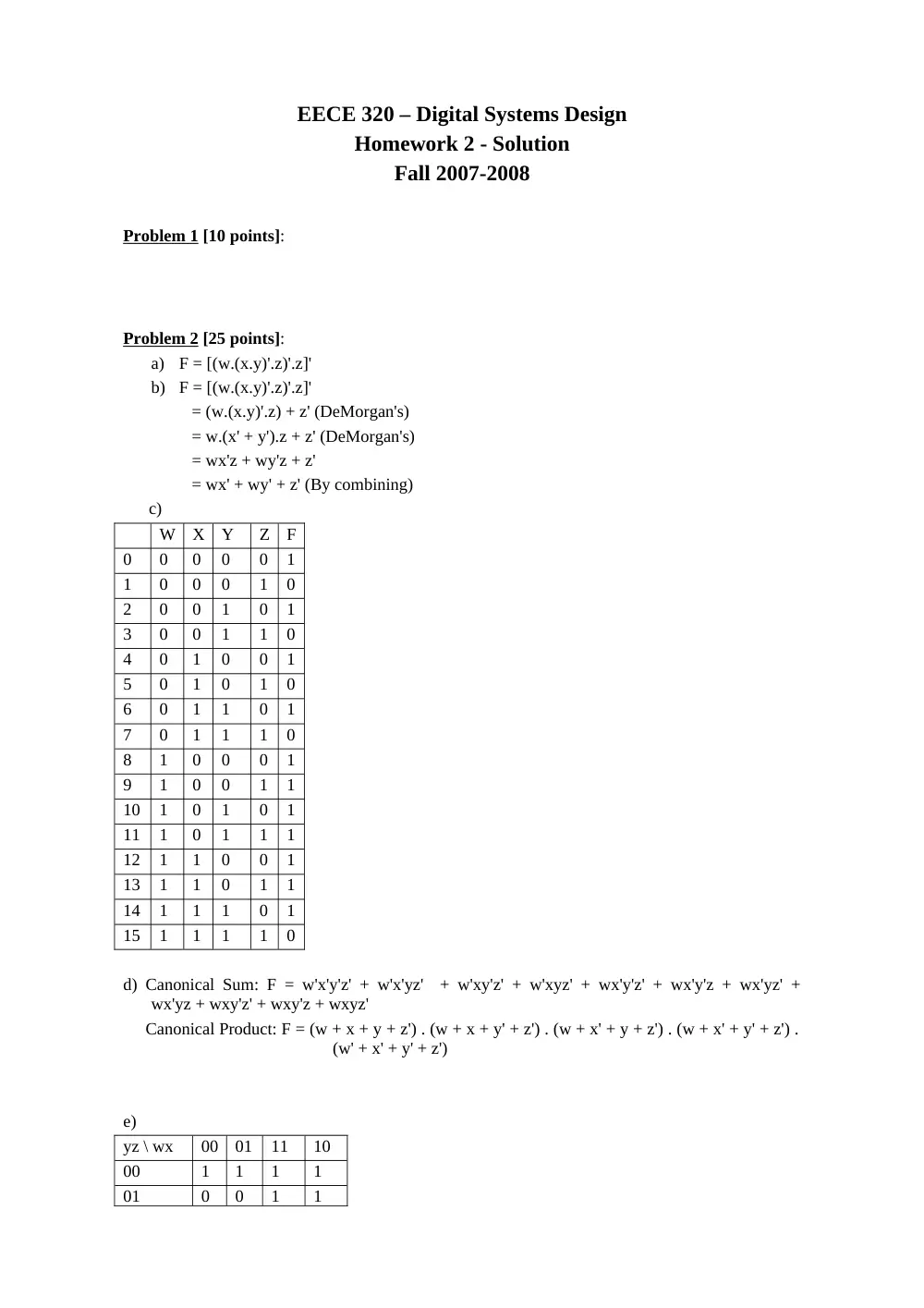
F = [(w.(x.y)'.z)'.z]'
b)
F = [(w.(x.y)'.z)'.z]'
= (w.(x.y)'.z) + z' (DeMorgan's)
= w.(x' + y').z + z' (DeMorgan's)
= wx'z + wy'z + z'
= wx' + wy' + z' (By combining)
c)
W
X
Y
Z
F
0
0
0
0
0
1
1
0
0
0
1
0
2
0
0
1
0
1
3
0
0
1
1
0
4
0
1
0
0
1
5
0
1
0
1
0
6
0
1
1
0
1
7
0
1
1
1
0
8
1
0
0
0
1
9
1
0
0
1
1
10
1
0
1
0
1
11
1
0
1
1
1
12
1
1
0
0
1
13
1
1
0
1
1
14
1
1
1
0
1
15
1
1
1
1
0
d) Canonical Sum: F = w'x'y'z' + w'x'yz' + w'xy'z' + w'xyz' + wx'y'z' + wx'y'z + wx'yz' +
wx'yz + wxy'z' + wxy'z + wxyz'
Canonical Product: F = (w + x + y + z') . (w + x + y' + z') . (w + x' + y + z') . (w + x' + y' + z') .
(w' + x' + y' + z')
e)
yz \ wx
00
01
11
10
00
1
1
1
1
01
0
0
1
1
11
0
0
0
1
10
1
1
1
1
F = z' + wx' + wy'
f) The two results are the same.
Problem 3 [20 points]:
4.14
4.18
4.19
Problem 4 [25 points]:
Problem 5 [20 points]:
P1
P0
Q1
Q0
F
0
0
0
0
0
0
1
0
0
0
1
1
2
0
0
1
0
1
3
0
0
1
1
1
4
0
1
0
0
0
5
0
1
0
1
0
6
0
1
1
0
1
7
0
1
1
1
1
8
1
0
0
0
0
9
1
0
0
1
0
10
1
0
1
0
0
11
1
0
1
1
1
12
1
1
0
0
0
13
1
1
0
1
0
14
1
1
1
0
0
15
1
1
1
1
0
Q1Q0\P1P0
00
01
11
10
00
0
0
0
0
01
1
0
0
0
11
1
1
0
1
10
1
1
0
0
F = P1'.Q1 + Q0.P0'.P1' + Q1.Q0.P0'
Q0
P0
P1
Q1