
EECE 320 Homework, Spring 2008
American University of Beirut · Digital Systems Design · 22 pages
Showing the first 10 of 22 pages. Download the PDF to see all of it.
More EECE 320 files
Show the text of this homework
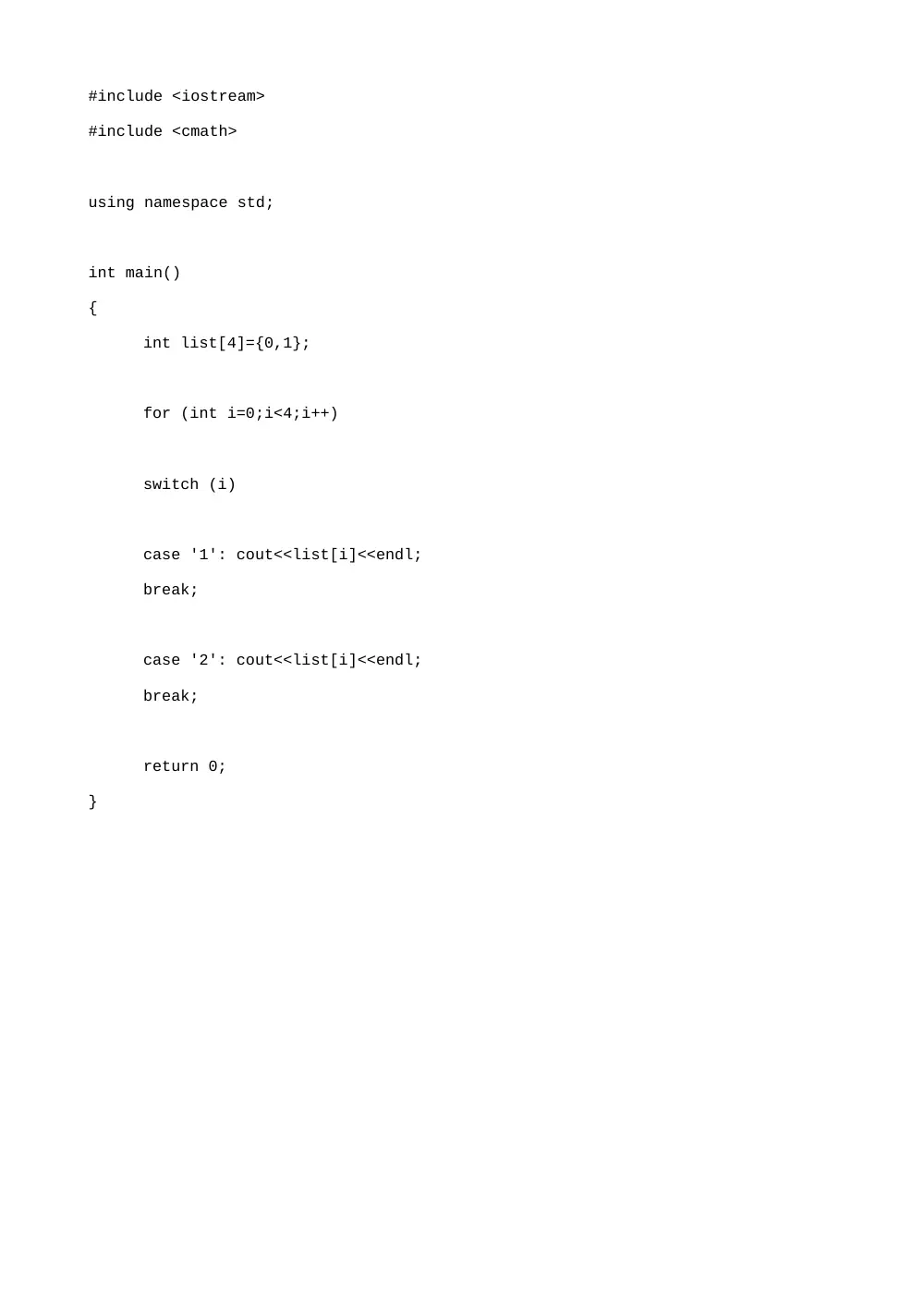
#include <iostream>
#include <cmath>
using namespace std;
int main()
{
int list[4]={0,1};
for (int i=0;i<4;i++)
switch (i)
case '1': cout<<list[i]<<endl;
break;
case '2': cout<<list[i]<<endl;
break;
return 0;
}
EECE 320
Homework #1
XXXX
XXX
12/10/2007
American University of Beirut
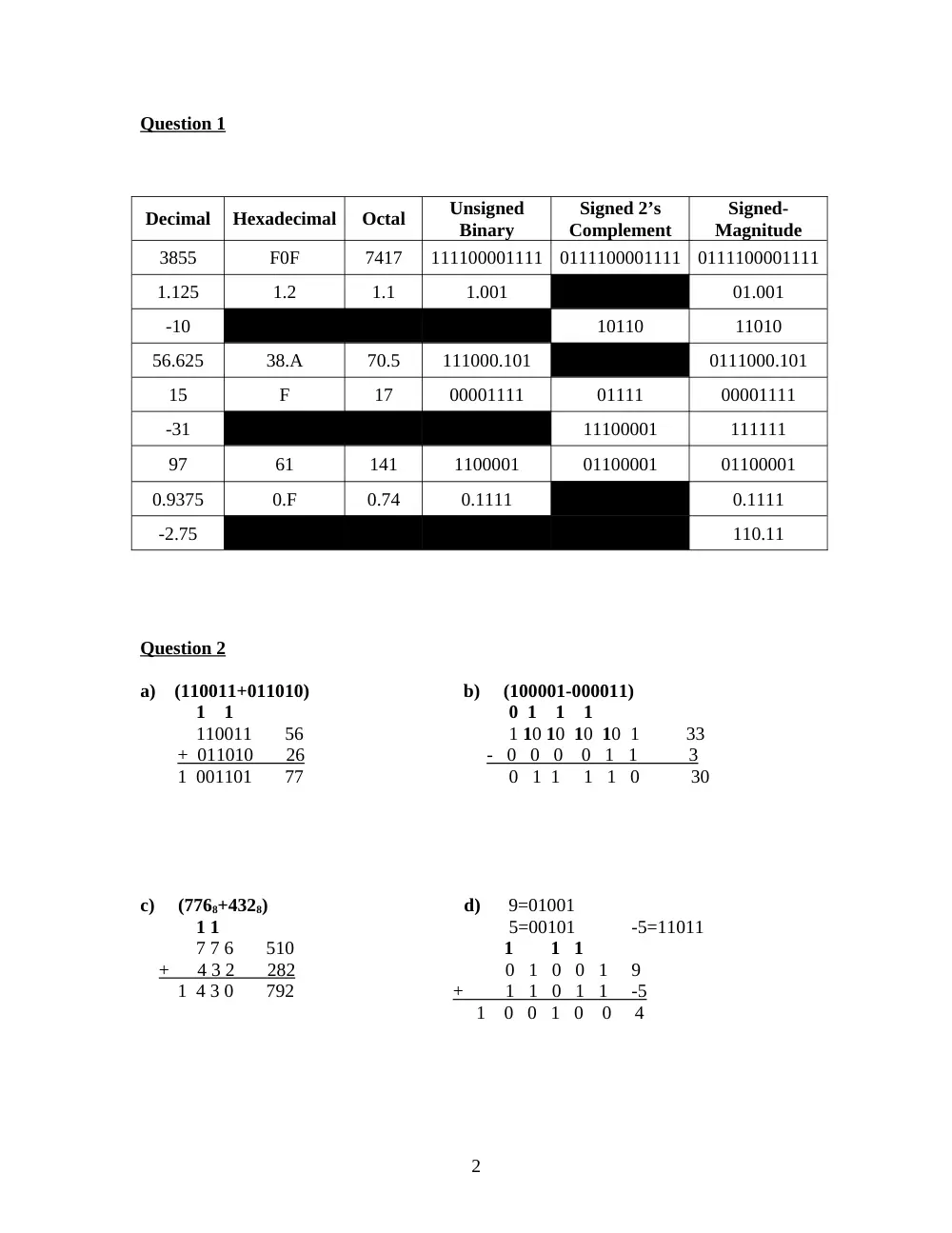
Question 1
Question 2
a) (110011+011010) b) (100001-000011)
1 1 0 1 1 1
110011 56 1 10 10 10 10 1 33
+ 011010 26 - 0 0 0 0 1 1 3
1 001101 77 0 1 1 1 1 0 30
c) (7768+4328) d) 9=01001
1 1 5=00101 -5=11011
7 7 6 510 1 1 1
+ 4 3 2 282 0 1 0 0 1 9
1 4 3 0 792 + 1 1 0 1 1 -5
1 0 0 1 0 0 4
Decimal
Hexadecimal
Octal
Unsigned
Binary
Signed 2’s
Complement
Signed-
Magnitude
3855
F0F
7417
111100001111
0111100001111
0111100001111
1.125
1.2
1.1
1.001
01.001
-10
10110
11010
56.625
38.A
70.5
111000.101
0111000.101
15
F
17
00001111
01111
00001111
-31
11100001
111111
97
61
141
1100001
01100001
01100001
0.9375
0.F
0.74
0.1111
0.1111
-2.75
110.11
2
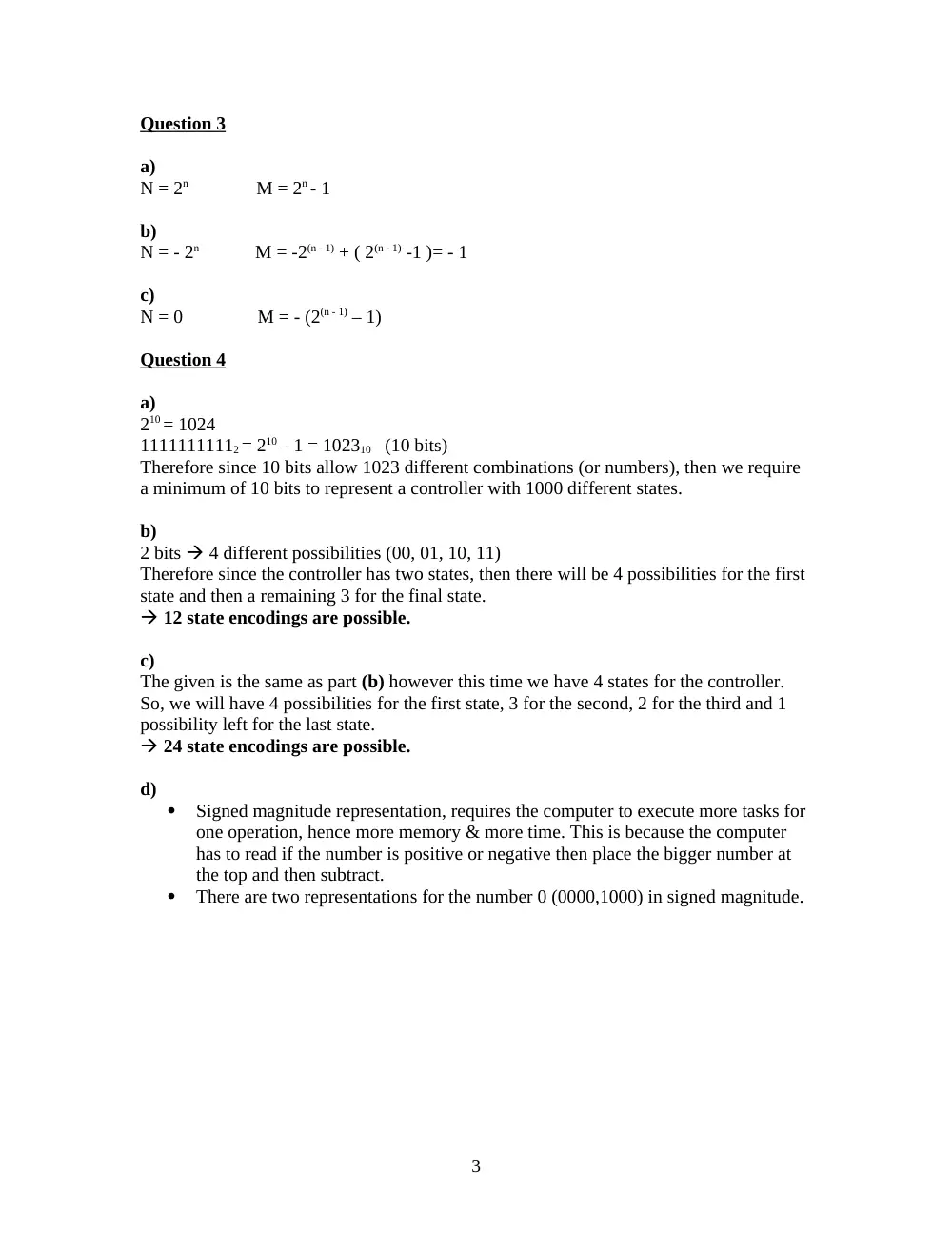
Question 3
a)
N = 2n M = 2n - 1
b)
N = - 2n M = -2(n - 1) + ( 2(n - 1) -1 )= - 1
c)
N = 0 M = - (2(n - 1) – 1)
Question 4
a)
210 = 1024
11111111112 = 210 – 1 = 102310 (10 bits)
Therefore since 10 bits allow 1023 different combinations (or numbers), then we require
a minimum of 10 bits to represent a controller with 1000 different states.
b)
2 bits 4 different possibilities (00, 01, 10, 11)
Therefore since the controller has two states, then there will be 4 possibilities for the first
state and then a remaining 3 for the final state.
12 state encodings are possible.
c)
The given is the same as part (b) however this time we have 4 states for the controller.
So, we will have 4 possibilities for the first state, 3 for the second, 2 for the third and 1
possibility left for the last state.
24 state encodings are possible.
d)
Signed magnitude representation, requires the computer to execute more tasks for
one operation, hence more memory & more time. This is because the computer
has to read if the number is positive or negative then place the bigger number at
the top and then subtract.
There are two representations for the number 0 (0000,1000) in signed magnitude.
3
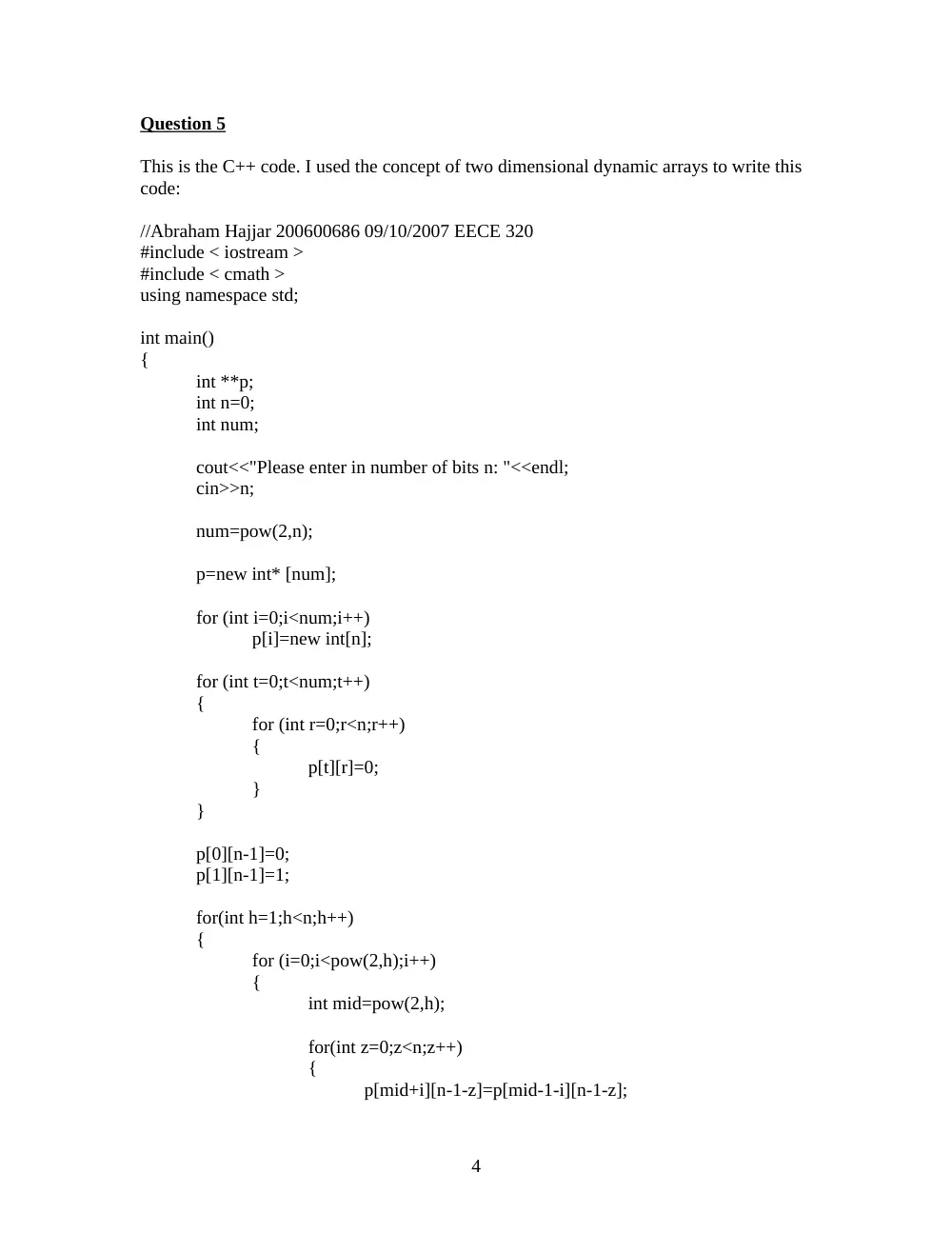
Question 5
This is the C++ code. I used the concept of two dimensional dynamic arrays to write this
code:
//Abraham Hajjar 200600686 09/10/2007 EECE 320
#include < iostream >
#include < cmath >
using namespace std;
int main()
{
int **p;
int n=0;
int num;
cout<<"Please enter in number of bits n: "<<endl;
cin>>n;
num=pow(2,n);
p=new int* [num];
for (int i=0;i<num;i++)
p[i]=new int[n];
for (int t=0;t<num;t++)
{
for (int r=0;r<n;r++)
{
p[t][r]=0;
}
}
p[0][n-1]=0;
p[1][n-1]=1;
for(int h=1;h<n;h++)
{
for (i=0;i<pow(2,h);i++)
{
int mid=pow(2,h);
for(int z=0;z<n;z++)
{
p[mid+i][n-1-z]=p[mid-1-i][n-1-z];
4
}
p[mid+i][n-h-1]=1;
p[mid-i-1][n-h-1]=0;
}
}
for (t=0;t<num;t++)
{
for (int r=0;r<n;r++)
{
cout<<p[t][r]<<" ";
}
cout<<endl;
}
return 0;
}
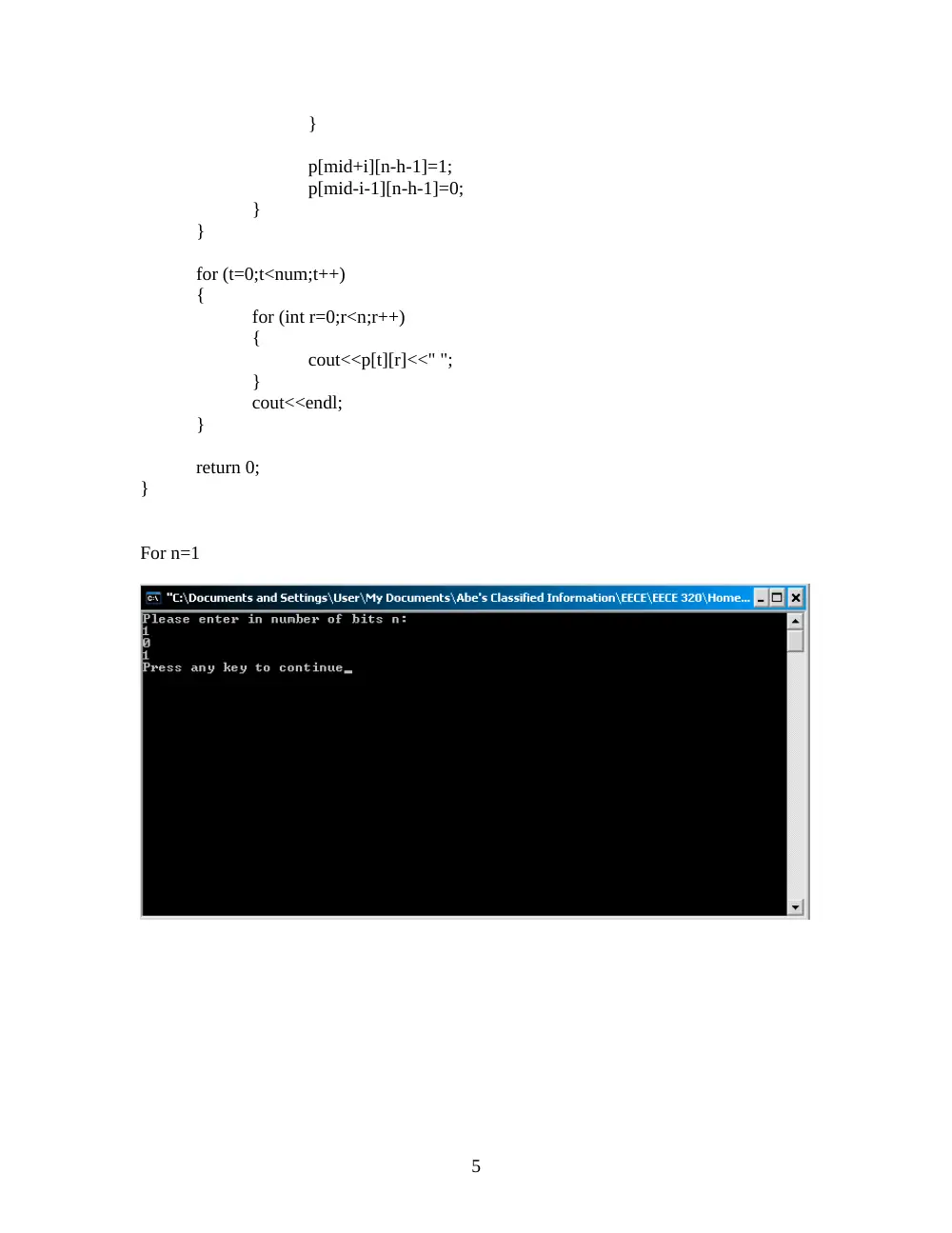
For n=1
5
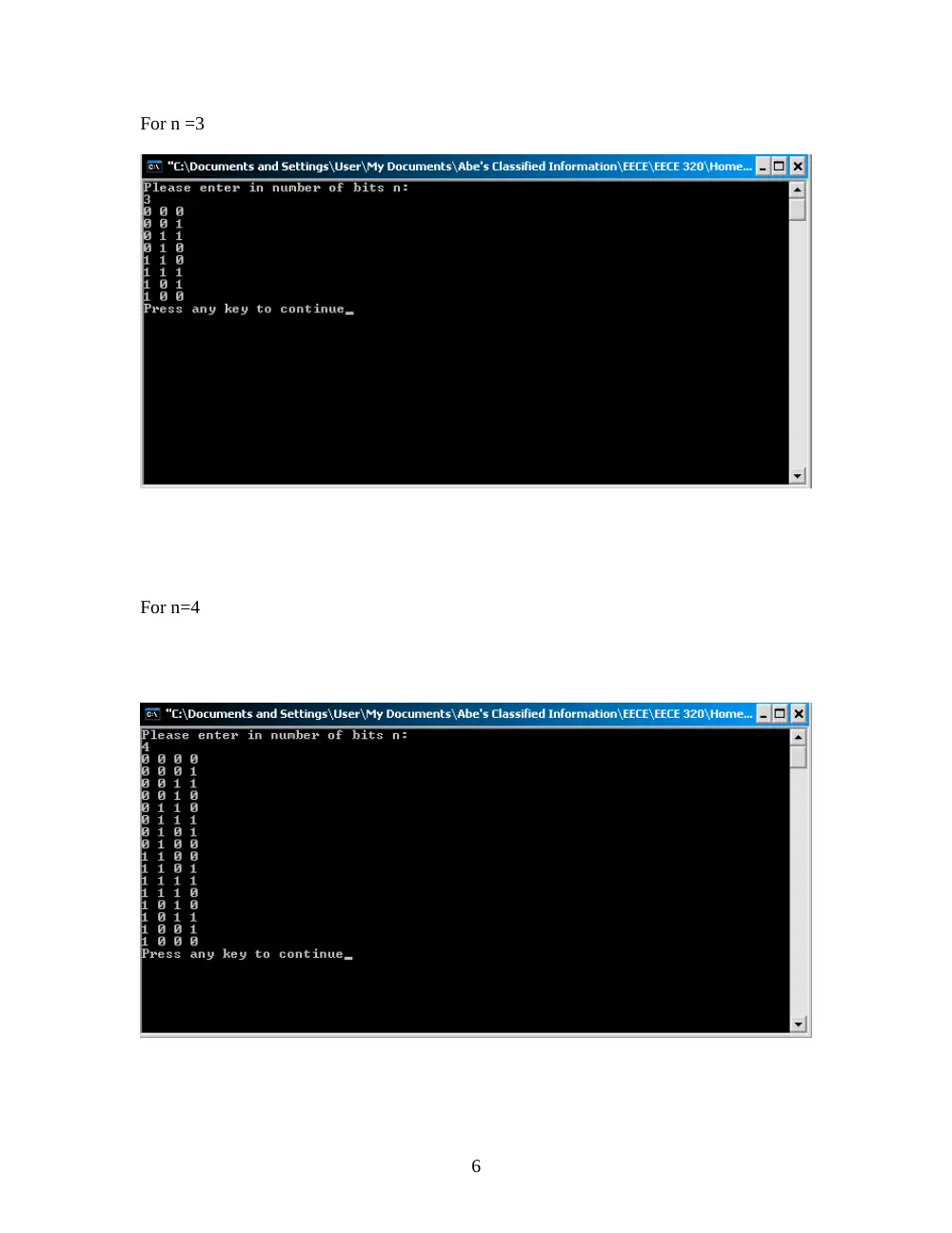
For n =3
For n=4
6
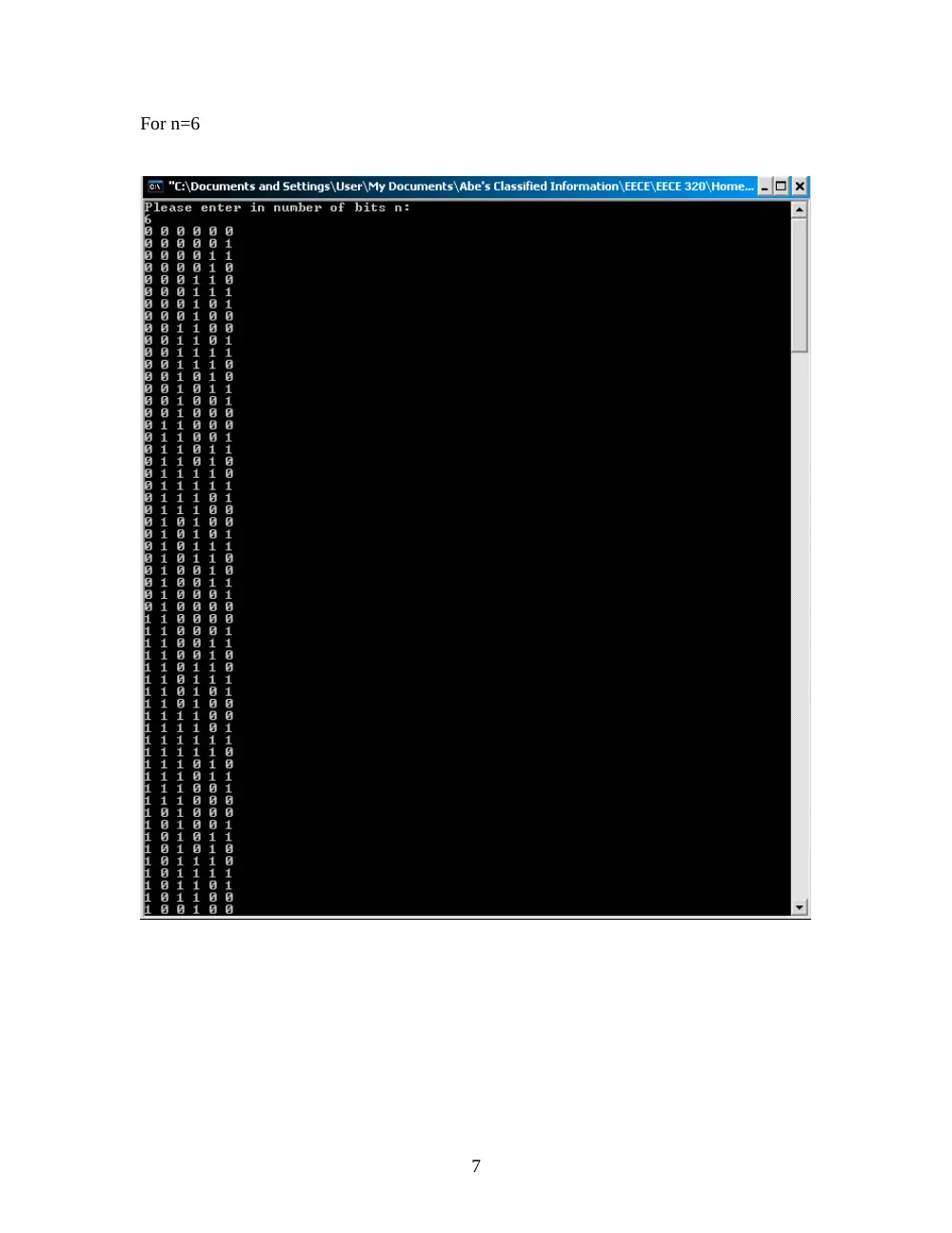
For n=6
7
EECE 320 – Digital Systems Design
Homework 1 - Solution
Fall 2007-2008
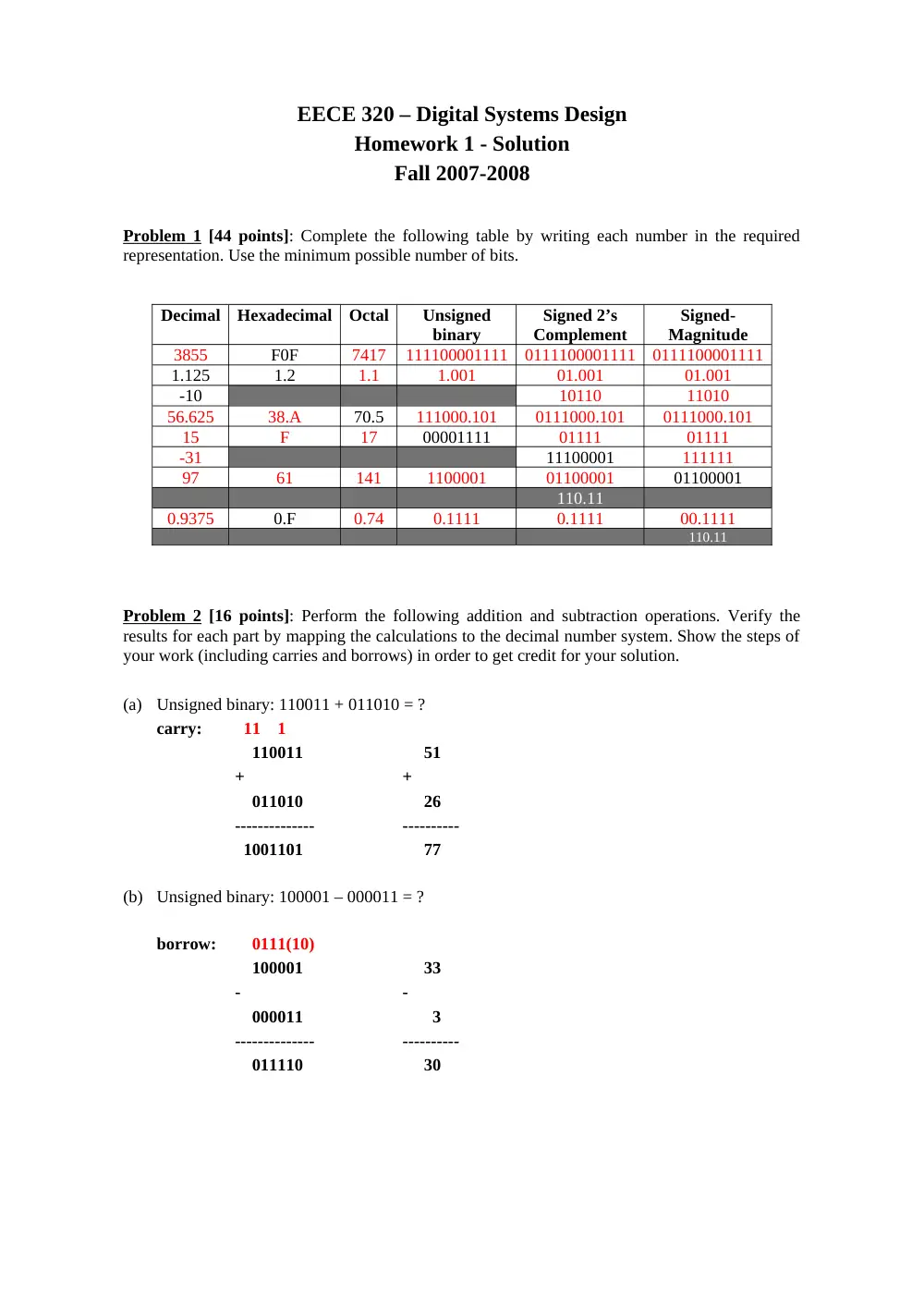
Problem 1 [44 points]: Complete the following table by writing each number in the required
representation. Use the minimum possible number of bits.
Decimal
Hexadecimal
Octal
Unsigned
binary
Signed 2’s
Complement
Signed-
Magnitude
3855
F0F
7417
111100001111
0111100001111
0111100001111
1.125
1.2
1.1
1.001
01.001
01.001
-10
10110
11010
56.625
38.A
70.5
111000.101
0111000.101
0111000.101
15
F
17
00001111
01111
01111
-31
11100001
111111
97
61
141
1100001
01100001
01100001
110.11
0.9375
0.F
0.74
0.1111
0.1111
00.1111
110.11
Problem 2 [16 points]: Perform the following addition and subtraction operations. Verify the
results for each part by mapping the calculations to the decimal number system. Show the steps of
your work (including carries and borrows) in order to get credit for your solution.
(a)
Unsigned binary: 110011 + 011010 = ?
carry:
11 1
110011
51
+
+
011010
26
--------------
----------
1001101
77
(b) Unsigned binary: 100001 – 000011 = ?
borrow:
0111(10)
100001
33
-
-
000011
3
--------------
----------
011110
30
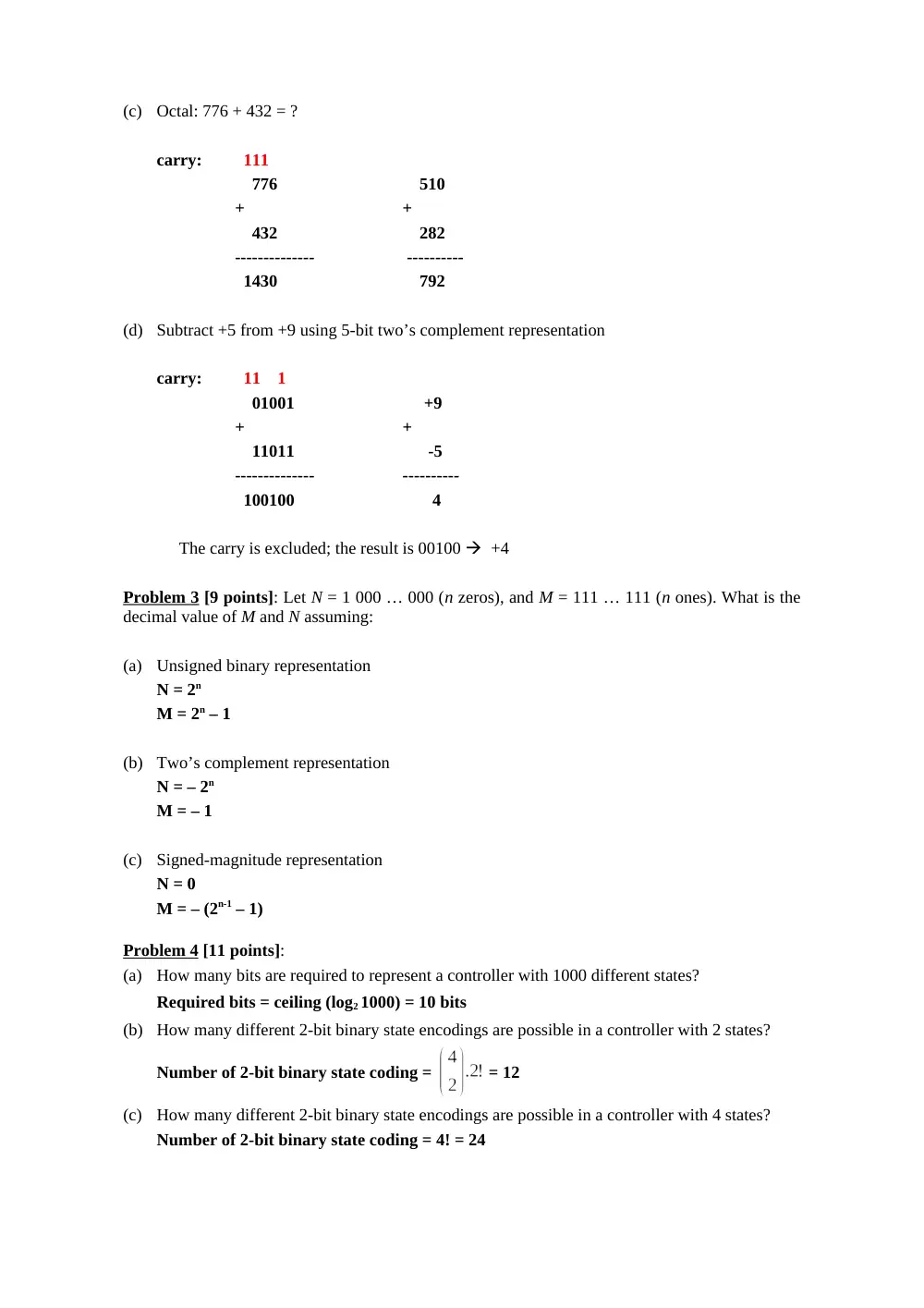
(c)
Octal: 776 + 432 = ?
carry:
111
776
510
+
+
432
282
--------------
----------
1430
792
(d) Subtract +5 from +9 using 5-bit two’s complement representation
carry:
11 1
01001
+9
+
+
11011
-5
--------------
----------
100100
4
The carry is excluded; the result is 00100 +4
Problem 3 [9 points]: Let N = 1 000 … 000 (n zeros), and M = 111 … 111 (n ones). What is the
decimal value of M and N assuming:
(a)
Unsigned binary representation
N = 2n
M = 2n – 1
(b) Two’s complement representation
N = – 2n
M = – 1
(c)
Signed-magnitude representation
N = 0
M = – (2n-1 – 1)
Problem 4 [11 points]:
(a)
How many bits are required to represent a controller with 1000 different states?
Required bits = ceiling (log2 1000) = 10 bits
(b) How many different 2-bit binary state encodings are possible in a controller with 2 states?
Number of 2-bit binary state coding =
= 12
(c)
How many different 2-bit binary state encodings are possible in a controller with 4 states?
Number of 2-bit binary state coding = 4! = 24
(d) List two advantages of two’s complement representation over signed-magnitude
representation.
o
Zero has only one representation
o
Subtraction/addition easier (less computations)
Problem 5 [20 points]: Write a program in C++ to find the Gray code for a given number of bits n
using the algorithm presented in class. Your program should take as input the variable n (integer >
0) and give as output the Gray-encoded list of codewords in a neat and clear format. Include with
your homework solution a printed copy of all code that you wrote. Include as well a printout of the
output of your program for the following cases: n = 1, n = 3, n = 4, and n = 6.
For n = 1:
Gray code: 0, 1
For n = 3:
Code: 0 0 0, 1 0 0, 1 1 0, 0 1 0, 0 1 1, 1 1 1, 1 0 1, 0 0 1
For n = 4:
Code: 0 0 0 0, 1 0 0 0, 1 1 0 0, 0 1 0 0, 0 1 1 0, 1 1 1 0, 1 0 1 0, 0 0 1 0, 0 0 1 1, 1 0 1 1,
1 1 1 1, 0 1 1 1, 0 1 0 1, 1 1 0 1, 1 0 0 1, 0 0 0 1
EECE320 – Digital Systems Design
Homework 1 XXX
Fall 2007-2008 XXXX
Problem 1:
Decimal
Hexadecimal
Octal
Unsigned
binary
Signed 2’s
Complement
Signed
Magnitude
3855
F0F
7417
111100001111
0111100001111
0111100001111
1.125
1.16
1.1
1.001
01.001
01.001
-10
10110
11010
56.625
38.A
70.5
111000.101
0111000.101
0111000.101
15
0F
017
00001111
000001111
000001111
-31
11100001
10011111
97
61
181
1100001
01100001
01100001
-1.25
110.11
101.01
0.9375
0.F
0.74
0.1111
00.1111
00.1111
-2.75
101.01
110.11
Problem 2:
a- Unsigned binary: 110011 + 011010:
110011 = 1+2+16+32 =51 110011
011010 = 2+8+16 =26 + 011010 ≡ 51 + 26 = 77
1001101 1001101 =1+4+8+64 = 77
b- Unsigned binary: 100001 – 000011:
100001= 1+32 =33 100001
000011= 1+2 =3 -000011 ≡ 33 – 3 = 30
011110 011110 =2+4+8+16 = 30
c- Octal: 776 + 432:
776= 6+7*8+7*64 =510 776
432=2+3*8+4*64 =282
+432 ≡ 510 + 282 = 792
1430 1430 =3*8+4*64+512 =792
d- +9 = 01001
+5= 00101 → -5= 11011
9-5=+9+ (-5)
01001
+11011
1 00100 00100 = 4 = 9-5
Problem 3:
N = 1 000…000 (n zeroes)
M = 111…111 (n ones)
a- N = 2^n M = (2^n)-1
b- N = -2^n M = -1
c- N = 0 M = -(2^(n-1) – 1)
Problem 4:
a- 2^9= 512, 2^10=1024. So we need 10 bits to represent a controller with 1000
different states.
b- 00, 01, 10, 11. Therefore there are 12 (4*3) 2-bit binary encodings possible in a
controller with 2 states.
c- There are 24 (4*3*2*1) 2-bit binary encodings possible in a controller with 4
states.
d- 1) Zero has 2 signed and magnitude representations (0000 and 1000) while it has
a unique two’s complement representation.
2) Addition and subtraction is easier in 2’s complement representation.
Problem 5:
#include < iostream >
#include < cmath >
using namespace std;
int main()
{
int **p;
int n=0;
int num;
cout<<"Please enter in number of bits n: "<<endl;
cin>>n;
num=pow(2,n);
p=new int* [num];
for (int i=0;i<num;i++)
p[i]=new int[n];
for (int t=0;t<num;t++)
{
for (int r=0;r<n;r++)
{
p[t][r]=0;
}
}
p[0][n-1]=0;
p[1][n-1]=1;
for(int h=1;h<n;h++)
{
for (i=0;i<pow(2,h);i++)
{
int mid=pow(2,h);
for(int z=0;z<n;z++)
{
p[mid+i][n-1-z]=p[mid-1-i][n-1-z];
}
p[mid+i][n-h-1]=1;
p[mid-i-1][n-h-1]=0;
}
}
for (t=0;t<num;t++)
{
for (int r=0;r<n;r++)
{
cout<<p[t][r]<<" ";
}
cout<<endl;
}
return 0;
}
#include < iostream >
#include < cmath >
using namespace std;
int graycode(int n,int m);
int main()
{
int n=1;
int m=0;
cout<<"Please enter in n: "<<endl;
cin>>n;
m=pow(2,n);
graycode(n,m);
return 0;
}
int graycode(int n,int m)
{
cout<<endl;
if(n==1)
{
cout<<1<<endl;
return 0;
}
else if(m>=(n+1))
{
cout<<endl;
return graycode(n,m-1);
}
else
{
cout<<endl;
return graycode(n,m-1);
}
}
Question 5
This is the C++ code. I used the concept of two dimensional dynamic arrays to write this
code:
#include < iostream >
#include < cmath >
using namespace std;
int main()
{
int **p;
int n=0;
int num;
cout<<"Please enter in number of bits n: "<<endl;
cin>>n;
num=pow(2,n);
p=new int* [num];
for (int i=0;i<num;i++)
p[i]=new int[n];
for (int t=0;t<num;t++)
{
for (int r=0;r<n;r++)
{
p[t][r]=0;
}
}
p[0][n-1]=0;
p[1][n-1]=1;
for(int h=1;h<n;h++)
{
for (i=0;i<pow(2,h);i++)
{
int mid=pow(2,h);
for(int z=0;z<n;z++)
{
p[mid+i][n-1-z]=p[mid-1-i][n-1-z];
}
p[mid+i][n-h-1]=1;
p[mid-i-1][n-h-1]=0;
}
}
for (t=0;t<num;t++)
{
for (int r=0;r<n;r++)
{
cout<<p[t][r]<<" ";
}
cout<<endl;
}
return 0;
}
For n=1
For n =3
For n=4
For n=6
C++ Code
# include <iostream>
# include <iomanip>
# include <string>
# include <cmath>
using namespace std;
int main () {
int N;
cout<<"Enter N (from 1 to n)"<<endl;
cin>>N;
string * p;
p= new string [pow(2,N)];
p[0]="0";
p[1]="1";
for (int i=1;i<N;i++)
for (int j=0; j<pow(2,i);j++)
{
int half=pow(2,i);
p[half+j]=p[half-1-j];
p[half+j]="1"+p[half+j];
p[half-1-j]= "0"+p[half-1-j];
}
for (i=0;i<pow(2,N);i++)
cout<<setw(10)<<i<<setw(20)<<p[i]<<endl;
return 0;}
Output
for n=1
for n=3
for n=4
for n=6