
EECE 321 Exam 3 with Solution, Fall 2012
American University of Beirut · Computer Organization · 3 pages · Prof. Haitham Akkary · with solution


More EECE 321 files
Show the text of this exam
H. AKKARY
DEPT. OF ELECTRICAL AND COMPUTER ENGINEERING
AMERICAN UNIVERSITY OF BEIRUT
EECE321 – COMPUTER ORGANIZATION
QUIZ 3 – Fall 2012
NAME: ________________________
ID: ___________________________
INSTRUCTIONS:
Page 1 of 3
THE EXAM IS CLOSED BOOK/CLOSED NOTES, EXCEPT FOR MIPS ISA SHEET
THE DURATION IS 90 MINUTES.
THE PROBLEMS ARE WEIGHTED EQUALLY.
NO QUESTIONS ARE ALLOWED.
YOU ARE NOT ALLOWED TO LEAVE THE EXAM ROOM UNTIL YOU TURN IN YOUR
EXAM.
MAKE SURE YOU HAVE 3 PAGES IN THIS QUIZ
WRITE YOUR NAME AND ID NUMBER IN THE SPACE PROVIDED ABOVE.
PROVIDE YOUR ANSWERS IN THE SPACE PROVIDED ON THE QUESTION SHEET.
USE THE BACK OF THE PAGES FOR SCRATCH
BE AS NEAT AND CLEAR AS POSSIBLE.
1.
Structural, data and control hazards typically require a processor pipeline to stall. Listed below are a series of optimization
techniques implemented in a processor pipeline designed to reduce or eliminate stalls due to these hazards. For each of the
following optimization techniques, state which pipeline hazard it addresses and how it addresses it.
a.
Register operands comparator in the decode stage.
Control hazard.
b.
Separate instruction and data cache
Structural hazard.
c.
Adder for computing next PC
Structural hazard.
d.
Data cache
Data hazard.
e.
Bypassing
Data hazard.
2.
Ideally, a pipeline achieves n speedup over a single cycle pipeline, where n is the number of stages. Give 4 reasons why
actual pipelines may not achieve the ideal speedup.
1) Unbalanced pipeline stage delays, 2) control hazards, 3) data hazards, 4) structural hazards, 5) branch mispredictions,
6) exceptions.
3.
A pipelined MIPS processor has the following pipe stage latencies. The latency for each stage includes the delay through
the pipeline register preceding it.
IF
ID
EX
MEM
WB
350ps
200ps
200ps
450ps
150ps
a.
What is the processor cycle time?
450ps
b.
Assuming that the pipeline register delay is 40ps. What is the cycle time of a single cycle implementation of this
MIPS processor?
1150ps.
c.
What is the speedup of this pipeline?
Page 2 of 3
1150/450 = 2.56.
4.
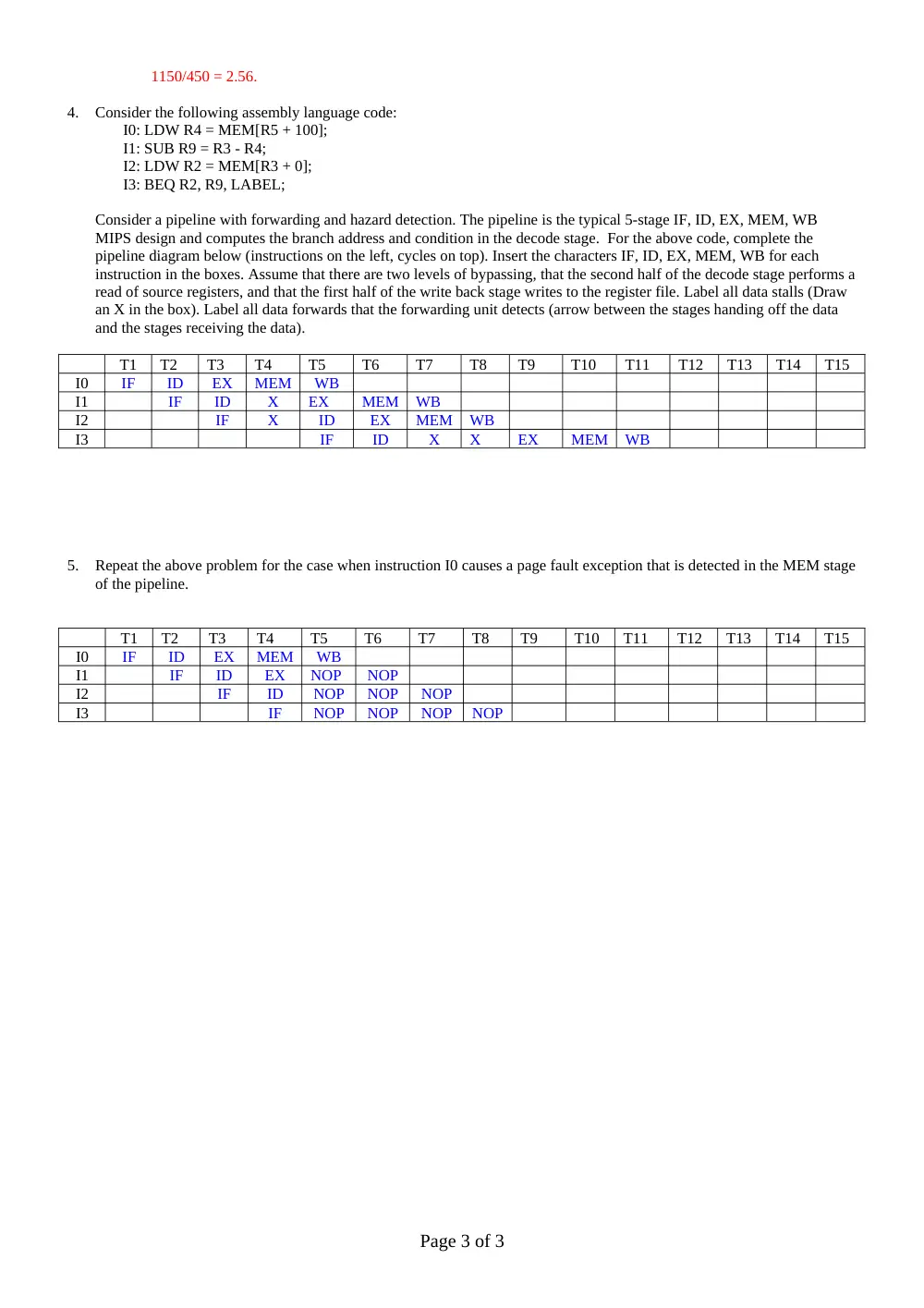
Consider the following assembly language code:
I0: LDW R4 = MEM[R5 + 100];
I1: SUB R9 = R3 - R4;
I2: LDW R2 = MEM[R3 + 0];
I3: BEQ R2, R9, LABEL;
Consider a pipeline with forwarding and hazard detection. The pipeline is the typical 5-stage IF, ID, EX, MEM, WB
MIPS design and computes the branch address and condition in the decode stage. For the above code, complete the
pipeline diagram below (instructions on the left, cycles on top). Insert the characters IF, ID, EX, MEM, WB for each
instruction in the boxes. Assume that there are two levels of bypassing, that the second half of the decode stage performs a
read of source registers, and that the first half of the write back stage writes to the register file. Label all data stalls (Draw
an X in the box). Label all data forwards that the forwarding unit detects (arrow between the stages handing off the data
and the stages receiving the data).
T1
T2
T3
T4
T5
T6
T7
T8
T9
T10
T11
T12
T13
T14
T15
I0
IF
ID
EX
MEM
WB
I1
IF
ID
X
EX
MEM
WB
I2
IF
X
ID
EX
MEM
WB
I3
IF
ID
X
X
EX
MEM
WB
5.
Repeat the above problem for the case when instruction I0 causes a page fault exception that is detected in the MEM stage
of the pipeline.
T1
T2
T3
T4
T5
T6
T7
T8
T9
T10
T11
T12
T13
T14
T15
I0
IF
ID
EX
MEM
WB
I1
IF
ID
EX
NOP
NOP
I2
IF
ID
NOP
NOP
NOP
I3
IF
NOP
NOP
NOP
NOP
Page 3 of 3