
EECE 330 Chapter 1 Old Lectures, Fall 2007
American University of Beirut · Data Structures and Algorithms · 59 pages
Showing the first 10 of 59 pages. Download the PDF to see all of it.
More EECE 330 files
Show the text of this lab
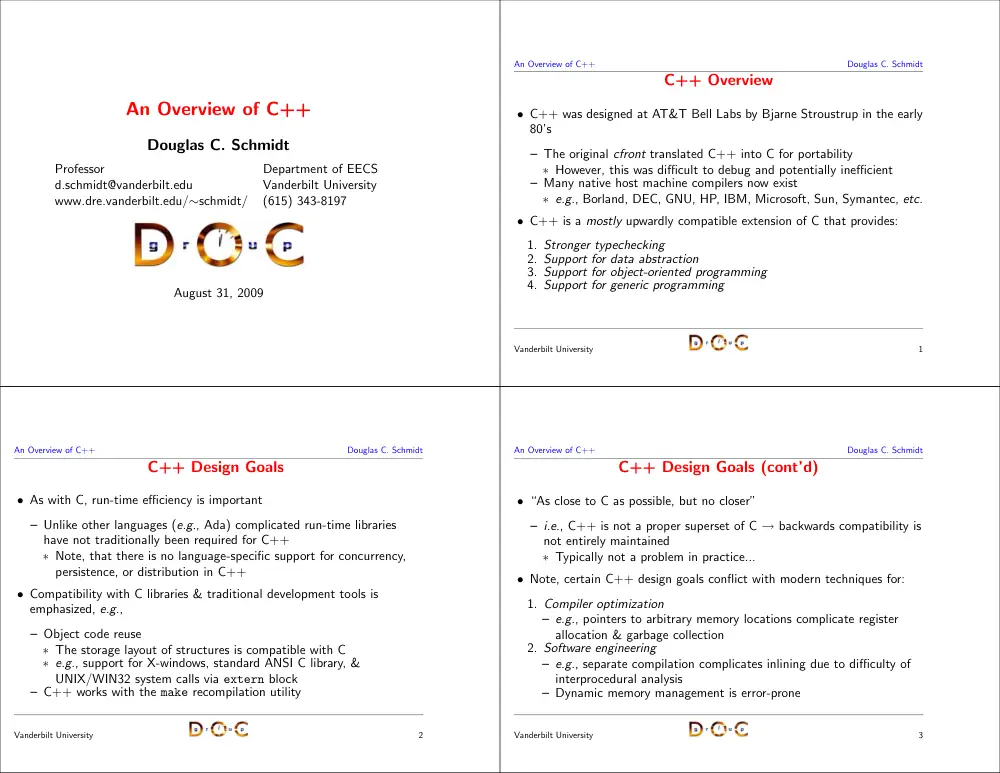
An Overview of C++
Douglas C. Schmidt
Professor
Department of EECS
d.schmidt@vanderbilt.edu
Vanderbilt University
www.dre.vanderbilt.edu/∼schmidt/
(615) 343-8197
August 31, 2009
An Overview of C++
Douglas C. Schmidt
C++ Overview
• C++ was designed at AT&T Bell Labs by Bjarne Stroustrup in the early
80’s
– The original cfront translated C++ into C for portability
∗ However, this was difficult to debug and potentially inefficient
– Many native host machine compilers now exist
∗ e.g., Borland, DEC, GNU, HP, IBM, Microsoft, Sun, Symantec, etc.
• C++ is a mostly upwardly compatible extension of C that provides:
1. Stronger typechecking
2. Support for data abstraction
3. Support for object-oriented programming
4. Support for generic programming
Vanderbilt University
1
An Overview of C++
Douglas C. Schmidt
C++ Design Goals
• As with C, run-time efficiency is important
– Unlike other languages (e.g., Ada) complicated run-time libraries
have not traditionally been required for C++
∗ Note, that there is no language-specific support for concurrency,
persistence, or distribution in C++
• Compatibility with C libraries & traditional development tools is
emphasized, e.g.,
– Object code reuse
∗ The storage layout of structures is compatible with C
∗ e.g., support for X-windows, standard ANSI C library, &
UNIX/WIN32 system calls via extern block
– C++ works with the make recompilation utility
Vanderbilt University
2
An Overview of C++
Douglas C. Schmidt
C++ Design Goals (cont’d)
• “As close to C as possible, but no closer”
– i.e., C++ is not a proper superset of C → backwards compatibility is
not entirely maintained
∗ Typically not a problem in practice...
• Note, certain C++ design goals conflict with modern techniques for:
1. Compiler optimization
– e.g., pointers to arbitrary memory locations complicate register
allocation & garbage collection
2. Software engineering
– e.g., separate compilation complicates inlining due to difficulty of
interprocedural analysis
– Dynamic memory management is error-prone
Vanderbilt University
3
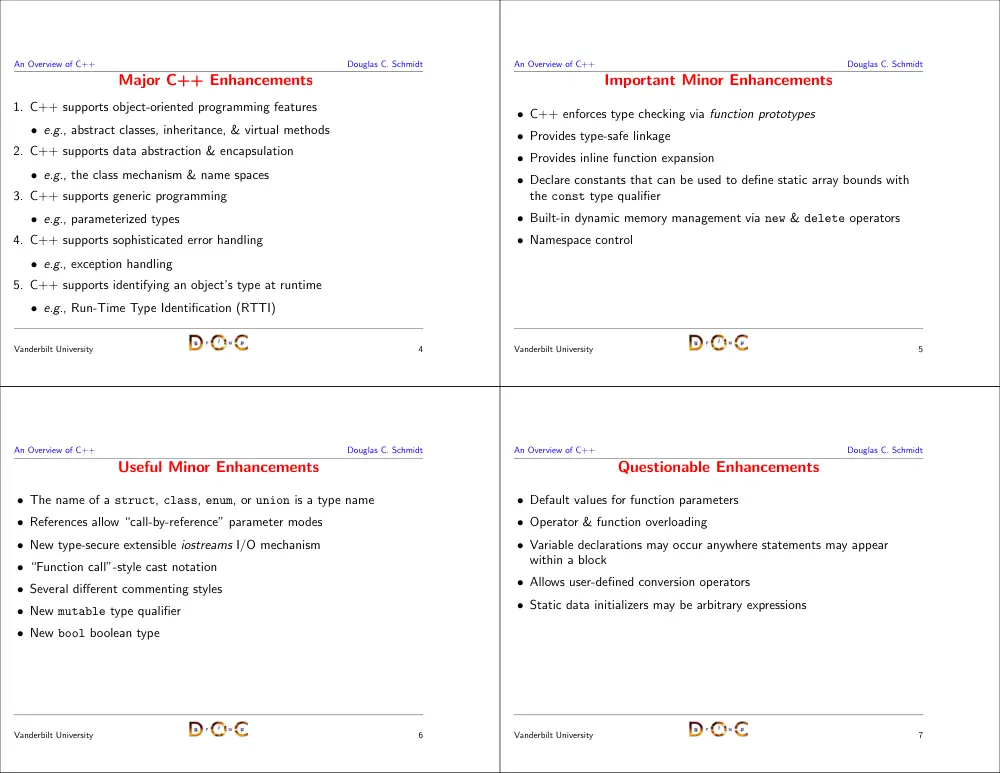
An Overview of C++
Douglas C. Schmidt
Major C++ Enhancements
1. C++ supports object-oriented programming features
• e.g., abstract classes, inheritance, & virtual methods
2. C++ supports data abstraction & encapsulation
• e.g., the class mechanism & name spaces
3. C++ supports generic programming
• e.g., parameterized types
4. C++ supports sophisticated error handling
• e.g., exception handling
5. C++ supports identifying an object’s type at runtime
• e.g., Run-Time Type Identification (RTTI)
Vanderbilt University
4
An Overview of C++
Douglas C. Schmidt
Important Minor Enhancements
• C++ enforces type checking via function prototypes
• Provides type-safe linkage
• Provides inline function expansion
• Declare constants that can be used to define static array bounds with
the const type qualifier
• Built-in dynamic memory management via new & delete operators
• Namespace control
Vanderbilt University
5
An Overview of C++
Douglas C. Schmidt
Useful Minor Enhancements
• The name of a struct, class, enum, or union is a type name
• References allow “call-by-reference” parameter modes
• New type-secure extensible iostreams I/O mechanism
• “Function call”-style cast notation
• Several different commenting styles
• New mutable type qualifier
• New bool boolean type
Vanderbilt University
6
An Overview of C++
Douglas C. Schmidt
Questionable Enhancements
• Default values for function parameters
• Operator & function overloading
• Variable declarations may occur anywhere statements may appear
within a block
• Allows user-defined conversion operators
• Static data initializers may be arbitrary expressions
Vanderbilt University
7
An Overview of C++
Douglas C. Schmidt
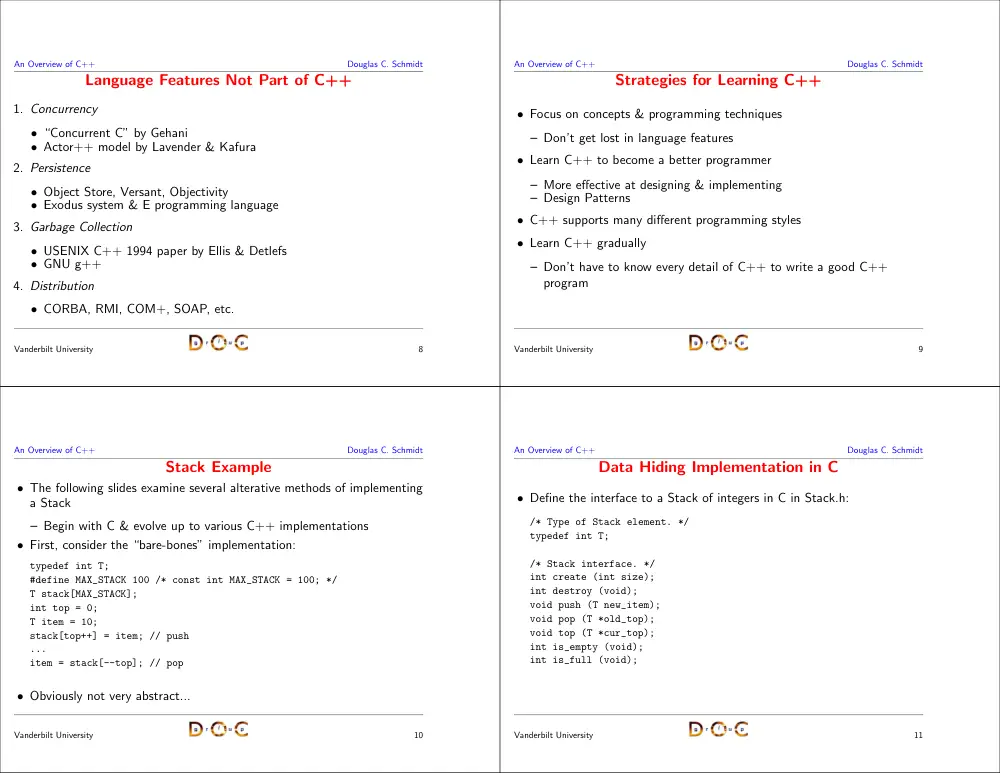
Language Features Not Part of C++
1. Concurrency
• “Concurrent C” by Gehani
• Actor++ model by Lavender & Kafura
2. Persistence
• Object Store, Versant, Objectivity
• Exodus system & E programming language
3. Garbage Collection
• USENIX C++ 1994 paper by Ellis & Detlefs
• GNU g++
4. Distribution
• CORBA, RMI, COM+, SOAP, etc.
Vanderbilt University
8
An Overview of C++
Douglas C. Schmidt
Strategies for Learning C++
• Focus on concepts & programming techniques
– Don’t get lost in language features
• Learn C++ to become a better programmer
– More effective at designing & implementing
– Design Patterns
• C++ supports many different programming styles
• Learn C++ gradually
– Don’t have to know every detail of C++ to write a good C++
program
Vanderbilt University
9
An Overview of C++
Douglas C. Schmidt
Stack Example
• The following slides examine several alterative methods of implementing
a Stack
– Begin with C & evolve up to various C++ implementations
• First, consider the “bare-bones” implementation:
typedef int T;
#define MAX_STACK 100 /* const int MAX_STACK = 100; */
T stack[MAX_STACK];
int top = 0;
T item = 10;
stack[top++] = item; // push
...
item = stack[--top]; // pop
• Obviously not very abstract...
Vanderbilt University
10
An Overview of C++
Douglas C. Schmidt
Data Hiding Implementation in C
• Define the interface to a Stack of integers in C in Stack.h:
/* Type of Stack element. */
typedef int T;
/* Stack interface. */
int create (int size);
int destroy (void);
void push (T new_item);
void pop (T *old_top);
void top (T *cur_top);
int is_empty (void);
int is_full (void);
Vanderbilt University
11
An Overview of C++
Douglas C. Schmidt
Data Hiding Implementation in C (cont’d)
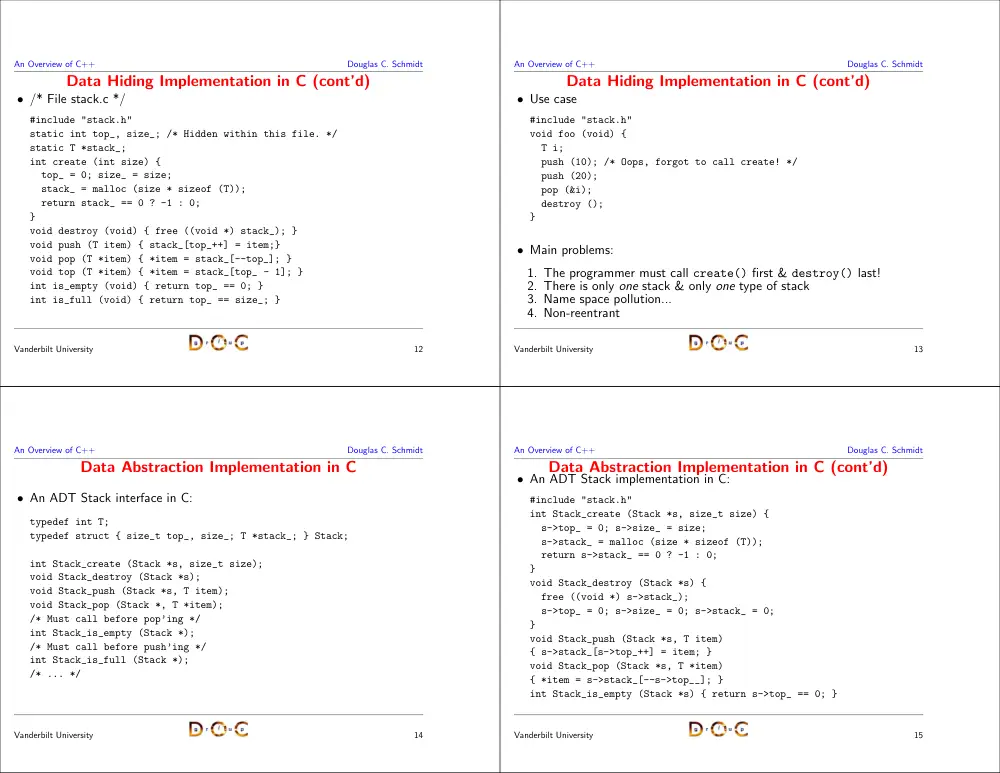
• /* File stack.c */
#include "stack.h"
static int top_, size_; /* Hidden within this file. */
static T *stack_;
int create (int size) {
top_ = 0; size_ = size;
stack_ = malloc (size * sizeof (T));
return stack_ == 0 ? -1 : 0;
}
void destroy (void) { free ((void *) stack_); }
void push (T item) { stack_[top_++] = item;}
void pop (T *item) { *item = stack_[--top_]; }
void top (T *item) { *item = stack_[top_ - 1]; }
int is_empty (void) { return top_ == 0; }
int is_full (void) { return top_ == size_; }
Vanderbilt University
12
An Overview of C++
Douglas C. Schmidt
Data Hiding Implementation in C (cont’d)
• Use case
#include "stack.h"
void foo (void) {
T i;
push (10); /* Oops, forgot to call create! */
push (20);
pop (&i);
destroy ();
}
• Main problems:
1. The programmer must call create() first & destroy() last!
2. There is only one stack & only one type of stack
3. Name space pollution...
4. Non-reentrant
Vanderbilt University
13
An Overview of C++
Douglas C. Schmidt
Data Abstraction Implementation in C
• An ADT Stack interface in C:
typedef int T;
typedef struct { size_t top_, size_; T *stack_; } Stack;
int Stack_create (Stack *s, size_t size);
void Stack_destroy (Stack *s);
void Stack_push (Stack *s, T item);
void Stack_pop (Stack *, T *item);
/* Must call before pop’ing */
int Stack_is_empty (Stack *);
/* Must call before push’ing */
int Stack_is_full (Stack *);
/* ... */
Vanderbilt University
14
An Overview of C++
Douglas C. Schmidt
Data Abstraction Implementation in C (cont’d)
• An ADT Stack implementation in C:
#include "stack.h"
int Stack_create (Stack *s, size_t size) {
s->top_ = 0; s->size_ = size;
s->stack_ = malloc (size * sizeof (T));
return s->stack_ == 0 ? -1 : 0;
}
void Stack_destroy (Stack *s) {
free ((void *) s->stack_);
s->top_ = 0; s->size_ = 0; s->stack_ = 0;
}
void Stack_push (Stack *s, T item)
{ s->stack_[s->top_++] = item; }
void Stack_pop (Stack *s, T *item)
{ *item = s->stack_[--s->top__]; }
int Stack_is_empty (Stack *s) { return s->top_ == 0; }
Vanderbilt University
15
An Overview of C++
Douglas C. Schmidt
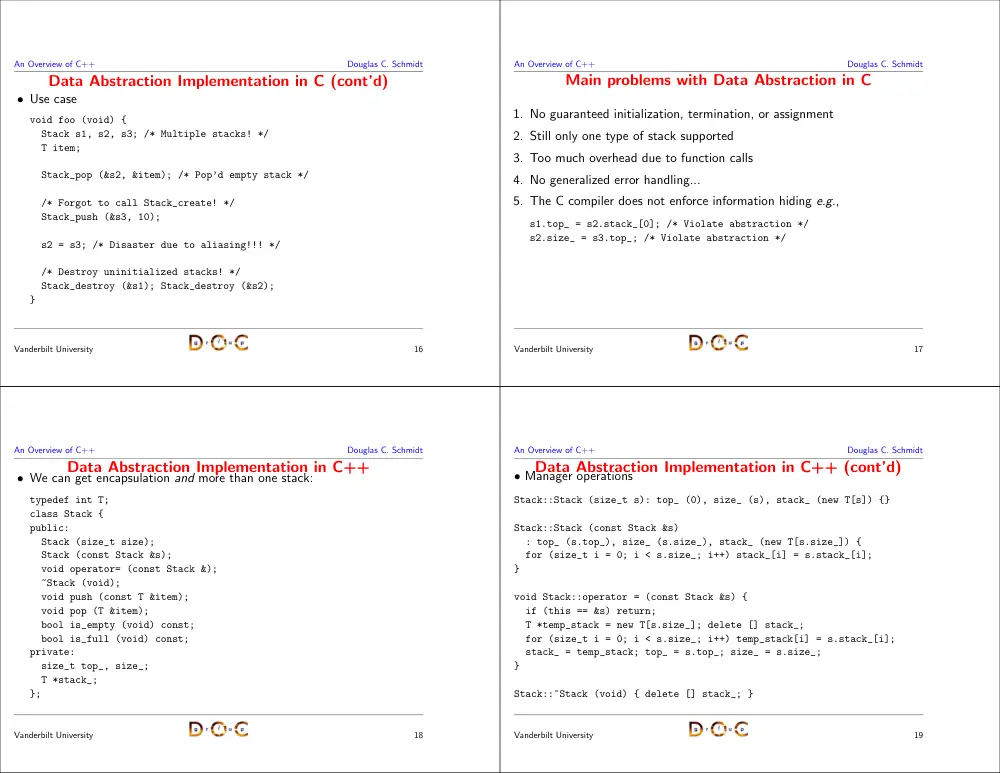
Data Abstraction Implementation in C (cont’d)
• Use case
void foo (void) {
Stack s1, s2, s3; /* Multiple stacks! */
T item;
Stack_pop (&s2, &item); /* Pop’d empty stack */
/* Forgot to call Stack_create! */
Stack_push (&s3, 10);
s2 = s3; /* Disaster due to aliasing!!! */
/* Destroy uninitialized stacks! */
Stack_destroy (&s1); Stack_destroy (&s2);
}
Vanderbilt University
16
An Overview of C++
Douglas C. Schmidt
Main problems with Data Abstraction in C
1. No guaranteed initialization, termination, or assignment
2. Still only one type of stack supported
3. Too much overhead due to function calls
4. No generalized error handling...
5. The C compiler does not enforce information hiding e.g.,
s1.top_ = s2.stack_[0]; /* Violate abstraction */
s2.size_ = s3.top_; /* Violate abstraction */
Vanderbilt University
17
An Overview of C++
Douglas C. Schmidt
Data Abstraction Implementation in C++
• We can get encapsulation and more than one stack:
typedef int T;
class Stack {
public:
Stack (size_t size);
Stack (const Stack &s);
void operator= (const Stack &);
~Stack (void);
void push (const T &item);
void pop (T &item);
bool is_empty (void) const;
bool is_full (void) const;
private:
size_t top_, size_;
T *stack_;
};
Vanderbilt University
18
An Overview of C++
Douglas C. Schmidt
Data Abstraction Implementation in C++ (cont’d)
• Manager operations
Stack::Stack (size_t s): top_ (0), size_ (s), stack_ (new T[s]) {}
Stack::Stack (const Stack &s)
: top_ (s.top_), size_ (s.size_), stack_ (new T[s.size_]) {
for (size_t i = 0; i < s.size_; i++) stack_[i] = s.stack_[i];
}
void Stack::operator = (const Stack &s) {
if (this == &s) return;
T *temp_stack = new T[s.size_]; delete [] stack_;
for (size_t i = 0; i < s.size_; i++) temp_stack[i] = s.stack_[i];
stack_ = temp_stack; top_ = s.top_; size_ = s.size_;
}
Stack::~Stack (void) { delete [] stack_; }
Vanderbilt University
19
An Overview of C++
Douglas C. Schmidt
Data Abstraction Implementation in C++ (cont’d)
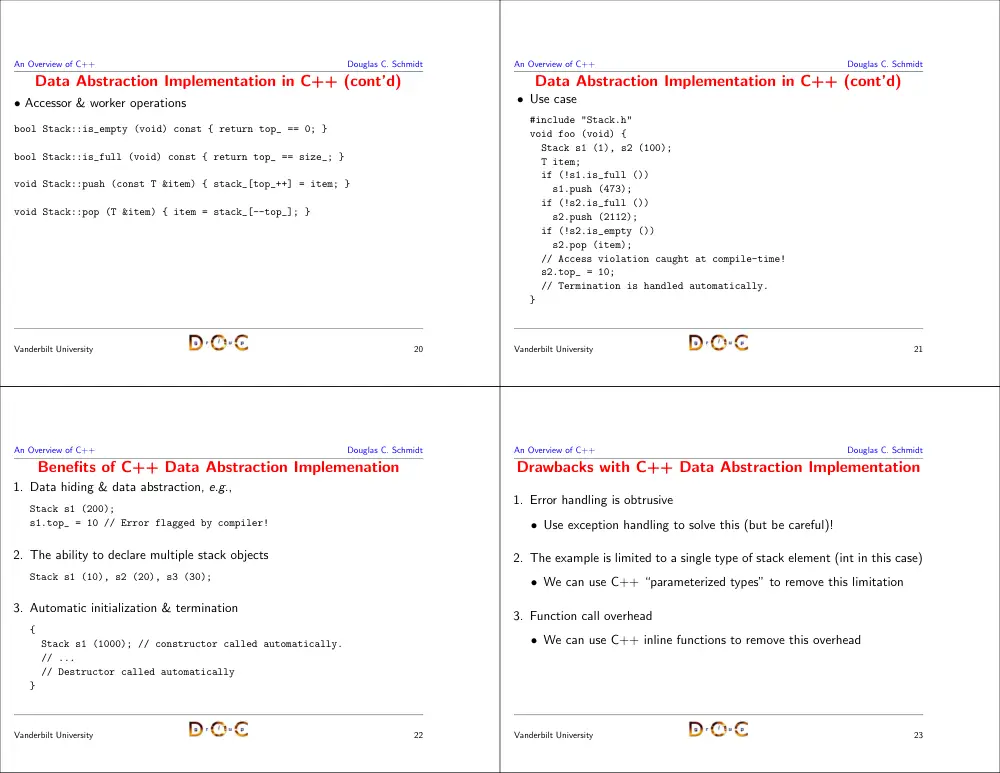
• Accessor & worker operations
bool Stack::is_empty (void) const { return top_ == 0; }
bool Stack::is_full (void) const { return top_ == size_; }
void Stack::push (const T &item) { stack_[top_++] = item; }
void Stack::pop (T &item) { item = stack_[--top_]; }
Vanderbilt University
20
An Overview of C++
Douglas C. Schmidt
Data Abstraction Implementation in C++ (cont’d)
• Use case
#include "Stack.h"
void foo (void) {
Stack s1 (1), s2 (100);
T item;
if (!s1.is_full ())
s1.push (473);
if (!s2.is_full ())
s2.push (2112);
if (!s2.is_empty ())
s2.pop (item);
// Access violation caught at compile-time!
s2.top_ = 10;
// Termination is handled automatically.
}
Vanderbilt University
21
An Overview of C++
Douglas C. Schmidt
Benefits of C++ Data Abstraction Implemenation
1. Data hiding & data abstraction, e.g.,
Stack s1 (200);
s1.top_ = 10 // Error flagged by compiler!
2. The ability to declare multiple stack objects
Stack s1 (10), s2 (20), s3 (30);
3. Automatic initialization & termination
{
Stack s1 (1000); // constructor called automatically.
// ...
// Destructor called automatically
}
Vanderbilt University
22
An Overview of C++
Douglas C. Schmidt
Drawbacks with C++ Data Abstraction Implementation
1. Error handling is obtrusive
• Use exception handling to solve this (but be careful)!
2. The example is limited to a single type of stack element (int in this case)
• We can use C++ “parameterized types” to remove this limitation
3. Function call overhead
• We can use C++ inline functions to remove this overhead
Vanderbilt University
23
An Overview of C++
Douglas C. Schmidt
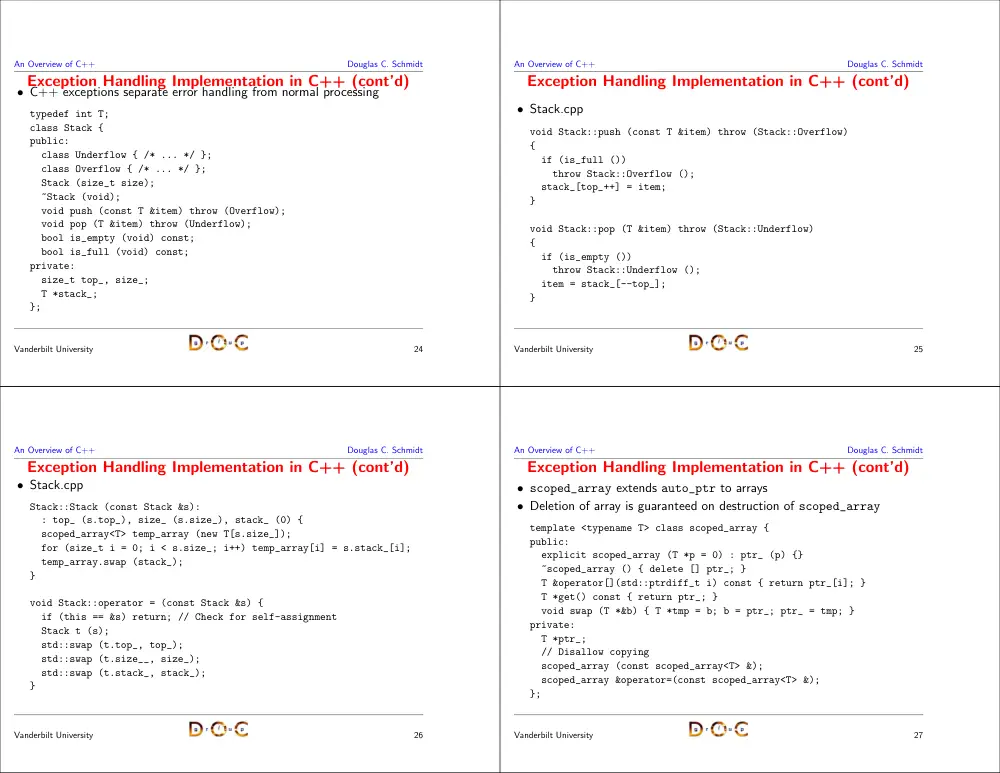
Exception Handling Implementation in C++ (cont’d)
• C++ exceptions separate error handling from normal processing
typedef int T;
class Stack {
public:
class Underflow { /* ... */ };
class Overflow { /* ... */ };
Stack (size_t size);
~Stack (void);
void push (const T &item) throw (Overflow);
void pop (T &item) throw (Underflow);
bool is_empty (void) const;
bool is_full (void) const;
private:
size_t top_, size_;
T *stack_;
};
Vanderbilt University
24
An Overview of C++
Douglas C. Schmidt
Exception Handling Implementation in C++ (cont’d)
• Stack.cpp
void Stack::push (const T &item) throw (Stack::Overflow)
{
if (is_full ())
throw Stack::Overflow ();
stack_[top_++] = item;
}
void Stack::pop (T &item) throw (Stack::Underflow)
{
if (is_empty ())
throw Stack::Underflow ();
item = stack_[--top_];
}
Vanderbilt University
25
An Overview of C++
Douglas C. Schmidt
Exception Handling Implementation in C++ (cont’d)
• Stack.cpp
Stack::Stack (const Stack &s):
: top_ (s.top_), size_ (s.size_), stack_ (0) {
scoped_array<T> temp_array (new T[s.size_]);
for (size_t i = 0; i < s.size_; i++) temp_array[i] = s.stack_[i];
temp_array.swap (stack_);
}
void Stack::operator = (const Stack &s) {
if (this == &s) return; // Check for self-assignment
Stack t (s);
std::swap (t.top_, top_);
std::swap (t.size__, size_);
std::swap (t.stack_, stack_);
}
Vanderbilt University
26
An Overview of C++
Douglas C. Schmidt
Exception Handling Implementation in C++ (cont’d)
• scoped_array extends auto_ptr to arrays
• Deletion of array is guaranteed on destruction of scoped_array
template <typename T> class scoped_array {
public:
explicit scoped_array (T *p = 0) : ptr_ (p) {}
~scoped_array () { delete [] ptr_; }
T &operator[](std::ptrdiff_t i) const { return ptr_[i]; }
T *get() const { return ptr_; }
void swap (T *&b) { T *tmp = b; b = ptr_; ptr_ = tmp; }
private:
T *ptr_;
// Disallow copying
scoped_array (const scoped_array<T> &);
scoped_array &operator=(const scoped_array<T> &);
};
Vanderbilt University
27
An Overview of C++
Douglas C. Schmidt
Exception Handling Implementation in C++ (cont’d)
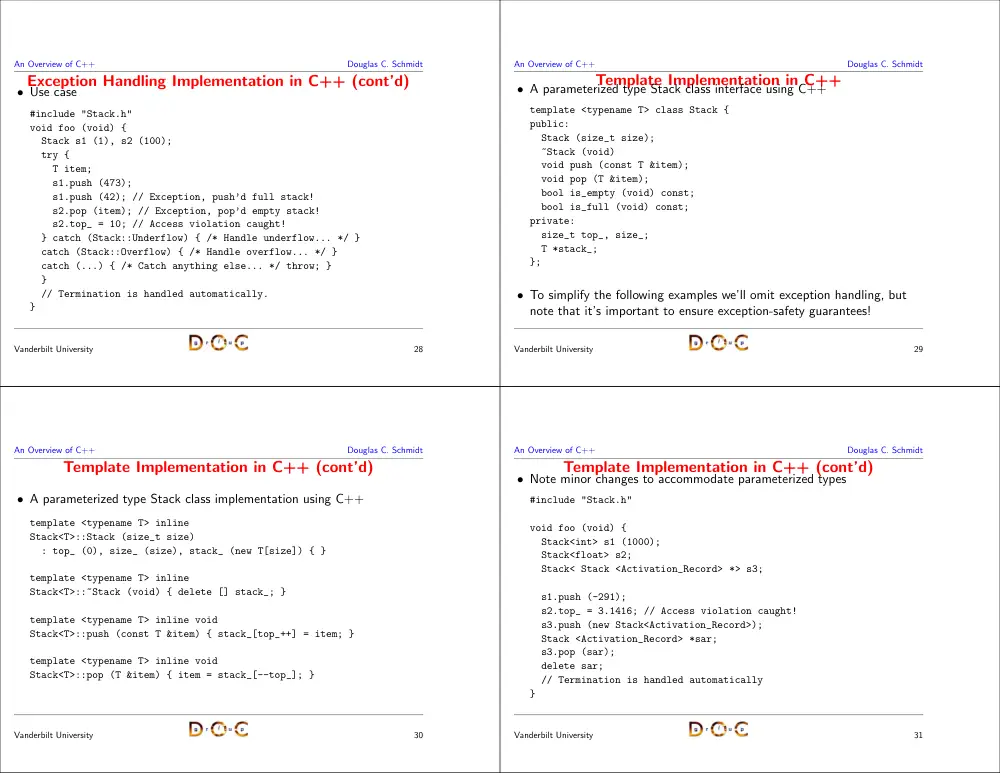
• Use case
#include "Stack.h"
void foo (void) {
Stack s1 (1), s2 (100);
try {
T item;
s1.push (473);
s1.push (42); // Exception, push’d full stack!
s2.pop (item); // Exception, pop’d empty stack!
s2.top_ = 10; // Access violation caught!
} catch (Stack::Underflow) { /* Handle underflow... */ }
catch (Stack::Overflow) { /* Handle overflow... */ }
catch (...) { /* Catch anything else... */ throw; }
}
// Termination is handled automatically.
}
Vanderbilt University
28
An Overview of C++
Douglas C. Schmidt
Template Implementation in C++
• A parameterized type Stack class interface using C++
template <typename T> class Stack {
public:
Stack (size_t size);
~Stack (void)
void push (const T &item);
void pop (T &item);
bool is_empty (void) const;
bool is_full (void) const;
private:
size_t top_, size_;
T *stack_;
};
• To simplify the following examples we’ll omit exception handling, but
note that it’s important to ensure exception-safety guarantees!
Vanderbilt University
29
An Overview of C++
Douglas C. Schmidt
Template Implementation in C++ (cont’d)
• A parameterized type Stack class implementation using C++
template <typename T> inline
Stack<T>::Stack (size_t size)
: top_ (0), size_ (size), stack_ (new T[size]) { }
template <typename T> inline
Stack<T>::~Stack (void) { delete [] stack_; }
template <typename T> inline void
Stack<T>::push (const T &item) { stack_[top_++] = item; }
template <typename T> inline void
Stack<T>::pop (T &item) { item = stack_[--top_]; }
Vanderbilt University
30
An Overview of C++
Douglas C. Schmidt
Template Implementation in C++ (cont’d)
• Note minor changes to accommodate parameterized types
#include "Stack.h"
void foo (void) {
Stack<int> s1 (1000);
Stack<float> s2;
Stack< Stack <Activation_Record> *> s3;
s1.push (-291);
s2.top_ = 3.1416; // Access violation caught!
s3.push (new Stack<Activation_Record>);
Stack <Activation_Record> *sar;
s3.pop (sar);
delete sar;
// Termination is handled automatically
}
Vanderbilt University
31
An Overview of C++
Douglas C. Schmidt
Template Implementation in C++ (cont’d)
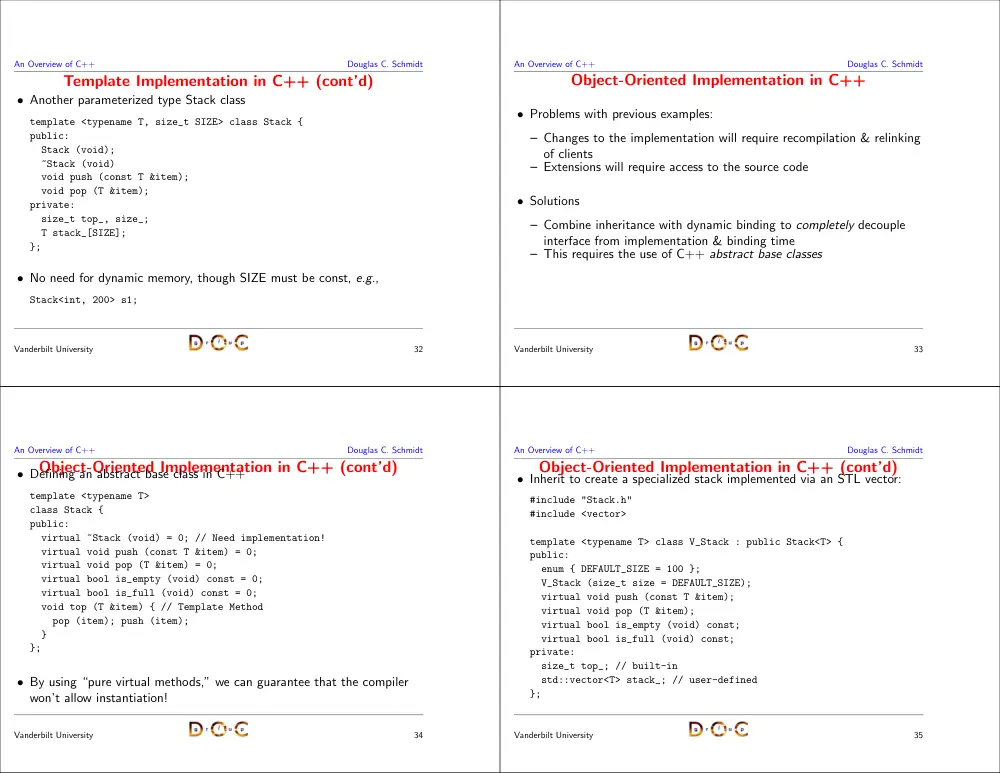
• Another parameterized type Stack class
template <typename T, size_t SIZE> class Stack {
public:
Stack (void);
~Stack (void)
void push (const T &item);
void pop (T &item);
private:
size_t top_, size_;
T stack_[SIZE];
};
• No need for dynamic memory, though SIZE must be const, e.g.,
Stack<int, 200> s1;
Vanderbilt University
32
An Overview of C++
Douglas C. Schmidt
Object-Oriented Implementation in C++
• Problems with previous examples:
– Changes to the implementation will require recompilation & relinking
of clients
– Extensions will require access to the source code
• Solutions
– Combine inheritance with dynamic binding to completely decouple
interface from implementation & binding time
– This requires the use of C++ abstract base classes
Vanderbilt University
33
An Overview of C++
Douglas C. Schmidt
Object-Oriented Implementation in C++ (cont’d)
• Defining an abstract base class in C++
template <typename T>
class Stack {
public:
virtual ~Stack (void) = 0; // Need implementation!
virtual void push (const T &item) = 0;
virtual void pop (T &item) = 0;
virtual bool is_empty (void) const = 0;
virtual bool is_full (void) const = 0;
void top (T &item) { // Template Method
pop (item); push (item);
}
};
• By using “pure virtual methods,” we can guarantee that the compiler
won’t allow instantiation!
Vanderbilt University
34
An Overview of C++
Douglas C. Schmidt
Object-Oriented Implementation in C++ (cont’d)
• Inherit to create a specialized stack implemented via an STL vector:
#include "Stack.h"
#include <vector>
template <typename T> class V_Stack : public Stack<T> {
public:
enum { DEFAULT_SIZE = 100 };
V_Stack (size_t size = DEFAULT_SIZE);
virtual void push (const T &item);
virtual void pop (T &item);
virtual bool is_empty (void) const;
virtual bool is_full (void) const;
private:
size_t top_; // built-in
std::vector<T> stack_; // user-defined
};
Vanderbilt University
35
An Overview of C++
Douglas C. Schmidt
Object-Oriented Implementation in C++ (cont’d)
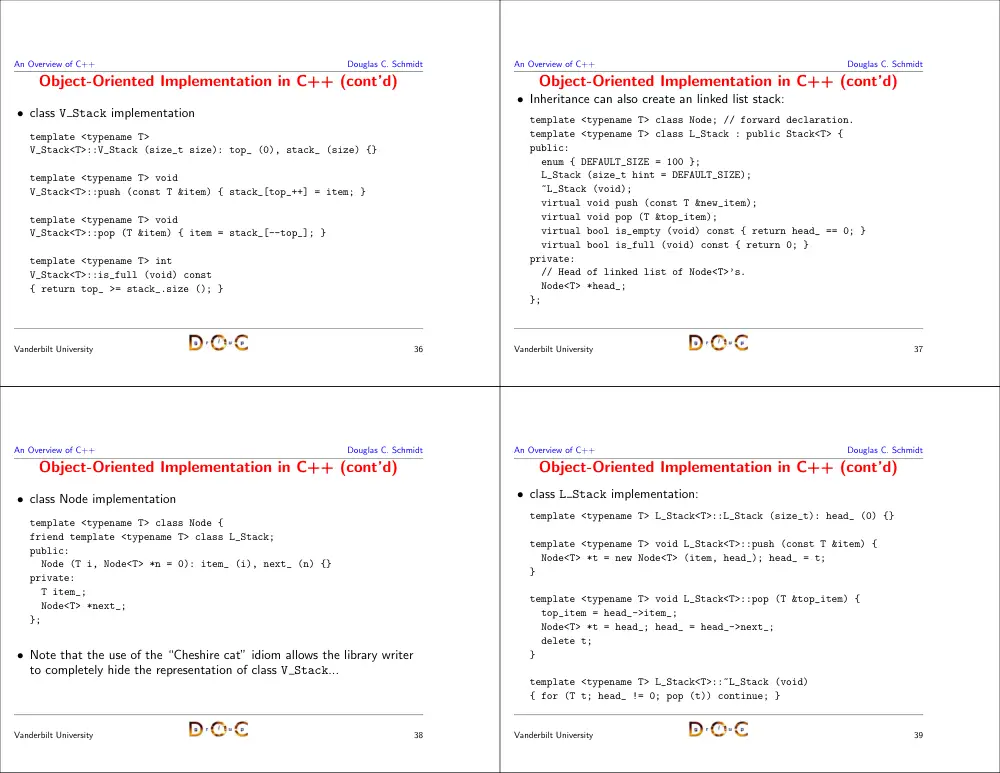
• class V Stack implementation
template <typename T>
V_Stack<T>::V_Stack (size_t size): top_ (0), stack_ (size) {}
template <typename T> void
V_Stack<T>::push (const T &item) { stack_[top_++] = item; }
template <typename T> void
V_Stack<T>::pop (T &item) { item = stack_[--top_]; }
template <typename T> int
V_Stack<T>::is_full (void) const
{ return top_ >= stack_.size (); }
Vanderbilt University
36
An Overview of C++
Douglas C. Schmidt
Object-Oriented Implementation in C++ (cont’d)
• Inheritance can also create an linked list stack:
template <typename T> class Node; // forward declaration.
template <typename T> class L_Stack : public Stack<T> {
public:
enum { DEFAULT_SIZE = 100 };
L_Stack (size_t hint = DEFAULT_SIZE);
~L_Stack (void);
virtual void push (const T &new_item);
virtual void pop (T &top_item);
virtual bool is_empty (void) const { return head_ == 0; }
virtual bool is_full (void) const { return 0; }
private:
// Head of linked list of Node<T>’s.
Node<T> *head_;
};
Vanderbilt University
37
An Overview of C++
Douglas C. Schmidt
Object-Oriented Implementation in C++ (cont’d)
• class Node implementation
template <typename T> class Node {
friend template <typename T> class L_Stack;
public:
Node (T i, Node<T> *n = 0): item_ (i), next_ (n) {}
private:
T item_;
Node<T> *next_;
};
• Note that the use of the “Cheshire cat” idiom allows the library writer
to completely hide the representation of class V Stack...
Vanderbilt University
38
An Overview of C++
Douglas C. Schmidt
Object-Oriented Implementation in C++ (cont’d)
• class L Stack implementation:
template <typename T> L_Stack<T>::L_Stack (size_t): head_ (0) {}
template <typename T> void L_Stack<T>::push (const T &item) {
Node<T> *t = new Node<T> (item, head_); head_ = t;
}
template <typename T> void L_Stack<T>::pop (T &top_item) {
top_item = head_->item_;
Node<T> *t = head_; head_ = head_->next_;
delete t;
}
template <typename T> L_Stack<T>::~L_Stack (void)
{ for (T t; head_ != 0; pop (t)) continue; }
Vanderbilt University
39
An Overview of C++
Douglas C. Schmidt
Object-Oriented Implementation in C++ (cont’d)
• Using our abstract base class, it is possible to write code that does not
depend on the stack implementation, e.g.,
template <typename T> Stack<T> *make_stack (bool use_V_Stack)
{ return use_V_Stack ? new V_Stack<T> : new L_Stack<T>; }
template <typename T>
void foo (Stack<T> *stack, const T &t) {
T s;
stack->push (t);
stack->pop (s);
// ...
}
foo<int> (make_stack<int> (true), 10);
Vanderbilt University
40
An Overview of C++
Douglas C. Schmidt
Object-Oriented Implementation in C++ (cont’d)
• Moreover, we can make changes at run-time without modifying,
recompiling, or relinking existing code
– i.e., can use “dynamic linking” to select stack representation at
run-time, e.g.,
char stack_symbol[MAXNAMLEN];
char stack_file[MAXNAMLEN];
cin >> stack_file >> stack_symbol;
void *handle = ACE_OS::dlopen (stack_file);
void *sym = ACE_OS::dlsym (handle, stack_symbol);
if (Stack<int> *sp = // Note use of RTTI
dynamic_cast <Stack<int> *> (sym)) foo (sp);
• Note, no need to stop, modify, & restart an executing application!
– Naturally, this requires careful configuration management...
Vanderbilt University
41
An Overview of C++
Douglas C. Schmidt
Summary
• A major contribution of C++ is its support for defining abstract data
types (ADTs) & for generic programming
– e.g., classes, parameterized types, & exception handling
• For some systems, C++’s ADT support is more important than using
the OO features of the language
• For other systems, the use of C++’s OO features is essential to build
highly flexible & extensible software
– e.g., inheritance, dynamic binding, & RTTI
Vanderbilt University
42
EECE 330 Data Structures and Algorithms
American University of Beirut
Topic #01: INTRODUCTION TO ALGORITHM ANALYSIS; SORTING PROBLEM
READINGS:
[Shaffer]
Chapters 2,3
REFERENCES:
[CLRS]
Chapters 1,2
• MOTIVATION:
Linear Search, Binary Search
• SORTING PROBLEM
• INSERTION SORT
• MERGE SORT
– E.C.E., AUB –
1
THE SORTING PROBLEM; MOTIVATION
• One of the most frequently performed tasks
−→ Introduction to “algorithm analysis”
• Having “sorted” data makes searching more efficient
Recall
Linear Search
Binary Search
– E.C.E., AUB –
2
Linear Search:
Pseudocode:
LINEAR-SEARCH(A[1,··· ,n],key)
1
for i ← 1 to n
2
do if A[i] = key
3
then return i
4
return Not Found
Translation into C++:
Running Time:
– E.C.E., AUB –
3
Binary Search:
Assumes the array is already sorted
Compare the key to middle element
If smaller, search first half
If greater, search second half
BINARY-SEARCH(A[1,··· ,n],key)
1
min ← 1
2
max ← n
3
while min ≤ max
4
do mid ← (min+max)/2
5
if key = A[mid]
6
then return mid
7
else if key > A[mid]
8
then min ← mid +1
9
else max ← mid −1
10
return Not Found
– E.C.E., AUB –
4
Translation into C++:
Running Time:
– E.C.E., AUB –
5
THE SORTING PROBLEM; DEFINITION
Definition: Sorting Problem
Input: sequence (a1,a2,··· ,an) of numbers
Output: permutation (a′
1,a′
2,··· ,a′
n)
such that
a′
1 ≤ a′
2 ≤ ··· ≤ a′
n
Example:
−→
Need an algorithm to solve this problem
We will see 2 algorithms: Insertion sort and Merge sort
– E.C.E., AUB –
6
INSERTION SORT
Like sorting your deck of cards in a game of “Tarnib”
Example:
INSERTION-SORT(A[1,··· ,n])
1
for i ← 2 to n
2
do key ← A[i]
3
j ← i−1
4
while j > 0 and A[j] > key
5
do A[j +1] ← A[j]
6
j ← j −1
7
A[j +1] ← key
– E.C.E., AUB –
7
Correctness Proof
Claim: At the end of each iteration of the for loop, A[1,··· ,i] consists of the original
elements of A[1,··· ,i] but in sorted order
Proof of claim:
Proof of correctness of Insertion-Sort:
Note: loop-invariant properties
⇐⇒
arguments by induction
– E.C.E., AUB –
8
Running Time
Best case?
Worst case?
“Average” case?
−→
Function of the input size
−→
Machine dependent !
Notes:
Remove machine-dependencies: ignore machine-dependent constants
Consider asymptotic growth: as input-size n increases to infinity
−→
Drop low order terms
−→
Ignore constants
Example:
– E.C.E., AUB –
9
Notation:
We say 5n2 +n ∈ Θ(n2)
or simply 5n2 +n = Θ(n2)
Examples: 2n−6√n = Θ(n), 4n+logn = Θ(n)
Formal definitions ... later
Worst-case running-time of Insertion-Sort:
Let T(n) be the max running time on all inputs of size n
Occurs when input is sorted in reverse order!
Fix such input
Let u(i) be the time of the i-th iteration in the “for loop”
– E.C.E., AUB –
10
T(n) =
n
∑
i=2
u(i)
Now
u(i) = c2 +c3 +c4i+c5(i−1)+c6(i−1)+c7,
Since
n
∑
i=2
i =
⇒
T(n) =
– E.C.E., AUB –
11
MERGE SORT
It’s a recursive procedure as opposed to iterative (like Insertion Sort)
Idea: Input A[1···n]
(i) If n = 1 DONE
(ii) If n > 1, recursively sort A[1,··· ,⌈n/2⌉] and A[⌈n/2⌉+1,··· ,n]
(iii) Merge the two sorted arrays
Big Picture: Divide & Conquer approach
Divide the problem into a number of subproblems
Conquer subproblems by solving them recursively (until sizes are small enough)
Combine the solutions of the subproblems into the solution of the original problem
Example:
– E.C.E., AUB –
12
MERGE-SORT(A, p,r)
1
if p < r
2
then q ← ⌊ p+r
2 ⌋
3
MERGE-SORT(A, p,q)
4
MERGE-SORT(A,q+1,r)
5
MERGE(A[p,··· ,q],A[q+1,··· ,r])
Note:
Initial call: Merge-Sort (A,1,n)
The “Merge” function takes as input two sorted arrays
– E.C.E., AUB –
13
MERGE(L[1,··· ,n1],R[1,··· ,n2])
1
Construct an all-zero array C of size n1 +n2
2
i ← 1
3
j ← 1
4
for k ← 1 to n1 +n2
5
do if L[i] ≤ R[j]
6
then C[k] ← L[i]
7
i ← i+1
8
else C[k] ← R[j]
9
j ← j +1
10
return C
Running-Time of “Merge”:
– E.C.E., AUB –
14
Correctness Proof of Merge-sort ... (by induction)
Worst-case running time of Merge-Sort
Let T(n) be the max running time on all inputs of size n
Recurrence:
T(n) =
� Θ(1)
if n = 1
T
�
⌈n
2⌉
�
+T
�
⌊n
2⌋
�
+Θ(n)
if n > 1
Consider a simplified version of the recurrence: n a power of 2
general case ... later
Assume the running time of “Merge” is cn, where c is a positive constant
⇒
Recurrence:
T(n) =
� c0
if n = 1
2T
�n
2
�
+cn
if n > 1
– E.C.E., AUB –
15
Solution: using the Recursion-tree method
depth/height of the tree?
count the leaves:
T(n) =
– E.C.E., AUB –
16
Summary
• Insertion Sort
• Merge Sort
• Note: There are hidden constants in asymptotic running-time analysis
• Recursive
algorithm,
Divide
and
Conquer
approach,
Recurrence
relation,
Recursion-Tree method, proof by Induction
– E.C.E., AUB –
17
EECE 330 Data Structures and Algorithms
American University of Beirut
Topic #05: C++ REVIEW
READINGS:
[Malik]
Chapters 14, 13
• TEMPLATES
• VIRTUAL FUNCTIONS
– E.C.E., AUB –
1
TEMPLATES
Example
• Arrays are essentially pointers in disguise
An array “a” is a pointer to (memory address of) the first element of the array “a”
“T a[size];”
creates a variable a of type “T *”
it will be pointing to “a[0]”
Similarly, “a” is simply “&a[0]”
In general: “a[i]” is equivalent to “*(a+i)”
“a+i” is equivalent to “&a[i]”
– E.C.E., AUB –
2
• To pass an array as an argument to a function
void f(int * a, int n) {
//do something
}
Or
void f(int a[], int n) {
//do something
}
– E.C.E., AUB –
3
Or
void f(int a[10]) {
//assume a has size 10
//do something
}
Misleading!, because
• What if we want the compiler to fully enforce the type on the argument? (a function
that takes as parameter an array of integers of size 10, i.e. the whole thing as one
entity, not just the pointer)
−→ pass the array by reference
It fully preserves the information about the type of the array
– E.C.E., AUB –
4
void f(int (&a)[10]) {
. . .
}
• We lost some flexibility! We need a function for every possible array size
void f(int (&a)[1]) {
//process array of size 1
}
void f(int (&a)[2]) {
//process array of size 2
}
.
.
void f(int (&a)[100]) {
//process array of size 100
}
– E.C.E., AUB –
5
• what if we can generate the appropriate function only when we need it?
• C++ provides such ability using a template
template <int n>
void f(int (&a)[n]) {
//process array of size n
}
• Represents an infinite number of functions, one for each possible value of n
• Compiler however does not generate all of them (it is impossible to do so)
• When needed, the compiler performs the appropriate specialization of the
template,
determines a specific value for n (called the parameter of the template)
generates the corresponding function
– E.C.E., AUB –
6
Can go further! make the function independent of the type of elements of the array
template<class T, int n>
void f(T (&a)[n]) {
//process an array of Ts of size n
}
General syntax: for templated functions and classes
template <class Type>
declaration;
“Type” is the type of the data; specifies type of parameters, return type of a function,
declares variables within a function
“declaration” is either a function declaration or a class declaration
“class” refers to any user-defined type or built-in type
– E.C.E., AUB –
7
#include <iostream>
#include <string>
using namespace std;
template <class Type>
Type larger(Type x, Type y);
int main()
{
string str1 = "Hello";
string str2 = "Happy";
cout << "Larger of 5 and 6 = " << larger(5, 6) << endl;
cout << "Larger of A and B = " << larger(’A’, ’B’) << endl;
cout << "Larger of 5.6 and 3.2 = " << larger(5.6, 3.2) << endl;
cout << "Larger of " << str1 << " and "
<< str2 << " = " << larger(str1, str2)
<< endl;
return 0;
}
template<class Type>
Type larger(Type x, Type y)
{
if (x >= y)
return x;
else
return y;
}
– E.C.E., AUB –
8
Syntax: definition of member functions of templated classes
template<class Type>
returnType
className<Type>::memberFunction(){
//do whatever it needs to do}
−→ The function members of a class template are considered function templates
className<specificType>
anObject;
For the compiler to specialize the template, all parameters of the template must be
known at compile time
Passing parameters to a function takes effect at run time
Passing a parameter to a class template takes effect at compile time
– E.C.E., AUB –
9
Consequences: Cannot compile the implementation file independently of the user
code
Can put class definition and the definitions of the function templates directly in the
user code
Can put class definition and the definitions of the function templates in the same
header file
Or you can have declaration in header .h file along with a directive to include
definition from a definition .cpp file
– E.C.E., AUB –
10
VIRTUAL FUNCTIONS
• Recall a class object can be passed by value or by reference, but parameters need
to match
• In C++, we can pass an object of a derived class to a formal parameter of the base
class type
• Without virtual functions, C++ would associate the function with the proper class.
This is called compile-time binding: necessary code to call a specific function is
generated by the compiler.
Also known as static binding
– E.C.E., AUB –
11
Example:
class baseClass
{ public:
void print();
baseClass( int u = 0);
private:
int x;
};
#include <iostream>
#include "baseClass.h"
using namespace std;
void baseClass::print()
//Note