
EECE 370 Problems On Electromagnetic Circuits, Fall 2011
American University of Beirut · Electric Machines and Power Fundamentals · 3 pages


More EECE 370 files
- Problems PROBLEM SET · Fall 2012ProblemsView
- Problems Power Factor Correction Example · Summer 2011ProblemsView
- Problems Solution Manual · Fall 2011Problems · with solutionView
- Problems Similar to Previous Exams · Fall 2011ProblemsView
- Problems · Spring 2010ProblemsView
- Problems Synchronous Generators · Summer 2007ProblemsView
- Midterm · Summer 2017ExamView
- Lecture Handout 2 · Fall 2016LabView
Show the text of this problems
Eng. & Arca, Libesry
FEA/ECE
EECE370,
ELECTRIC MACHINES AND POWER FUNDAMENTALS
PROBLEMS ON ELECTROMAGNETIC CIRCUITS
1. Figure 1.1 shows a small assembly intended for use as a door holder. The keeper is
attached to the door while the remainder is positioned on the door frame. The
magnet used is ferrite D whose demagnetization curve is shown in Fig.1.2. The iron
pieces are infinitely permeable and neither fringing nor leakage is accounted.
a. Draw the equivalent magnetic circuit.
b. Find the maximum permissible length of the air gap if a flux density of 0.6T is
needed to provide the necessary force. Circuit dimensions are: a = 20 mm, b = 10
mm, and c = 5 mm (/.57mm)
c. Repeat “b” for the magnet lengths b = 5 and 2 mm. What do you conclude?
B[T]
ry
70.3
Permanent magnet x) +0,2
Soft Iron Keeper ‘
way,
@
70.1
4
@o fF
ir ZEN
0
t-O-+— © 300 200 1 H[KA/m]
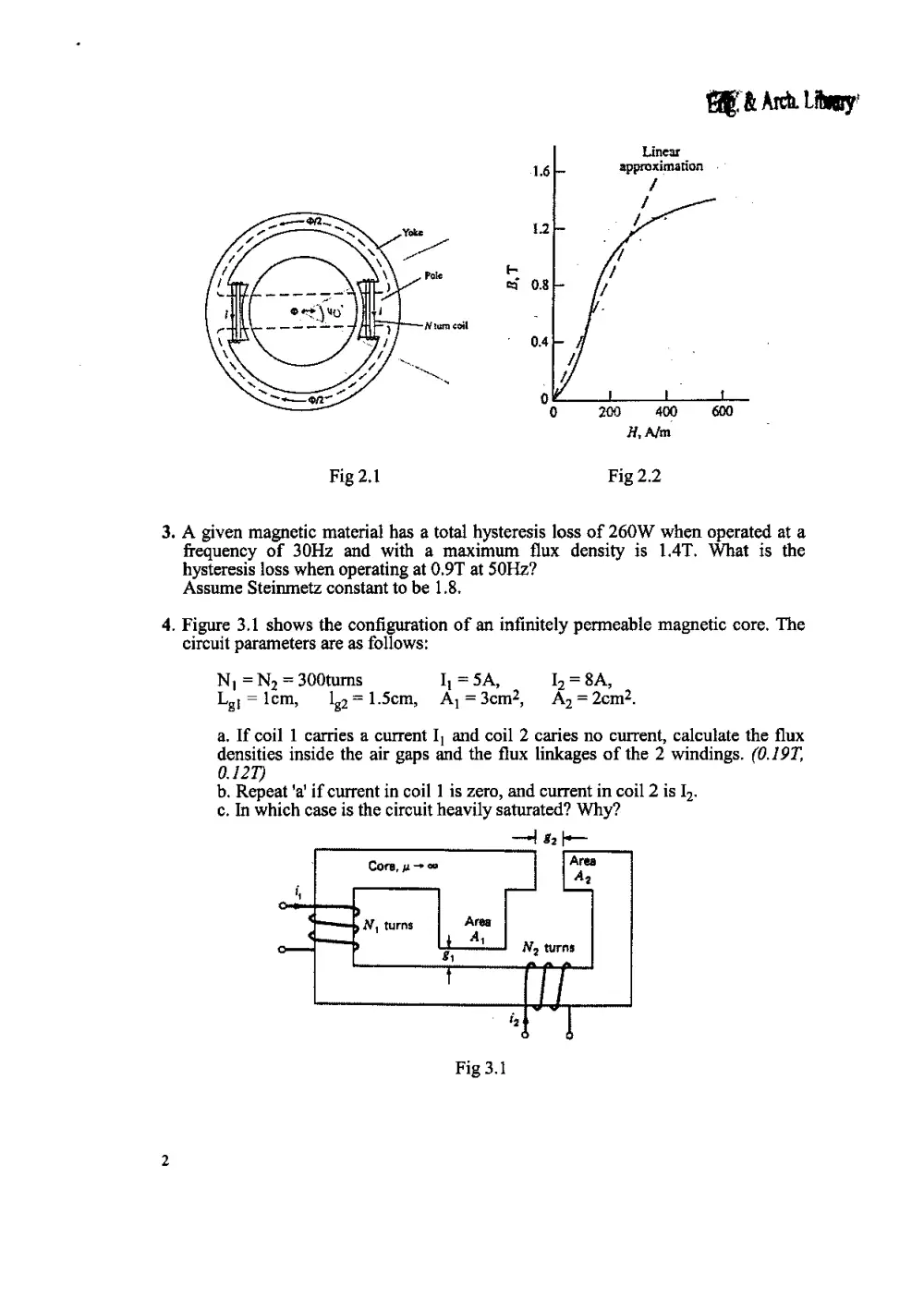
2. Given a cross- section of a rotating motor, Fig.2.1. The rotor has a radius of
120mm and an axial length of 20mm. Each pole covers an arc of 40° and is of the
same axial length as the rotor. The air gap lengths are 1.5mm each. The motor core
is made of material represented by the B-H curve of Fig.2.2. Each pole has a coil of
360 turns connected in series. Draw the equivalent magnetic circuit and determine:
a. The approximate reluctance of each air gap. (772KA/Wb)
b. The flux in each pole if the air gap flux density is 0.8T.
c. The current required in the coils to produce the flux of (b), if the core is
infinitely permeable.(2.65A)
d. The flux density in the yoke whose outer radius is 210mm and its thickness is
25mm. (1.347)
e. The current required for an air gap flux density of 0.8T if the yoke mmf is
included but that of the poles and the rotor core is ignored.(2.98A)
TARE be Arch. Liteery
Linear
1.6 approximation .
0 200 400 600
H, Alm
Fig 2.1 Fig 2.2
3. A given magnetic material has a total hysteresis loss of 260W when operated at a
frequency of 30Hz and with a maximum flux density is 1.4T. What is the
hysteresis loss when operating at 0.9T at 50Hz?
Assume Steinmetz constant to be 1.8.
4. Figure 3.1 shows the configuration of an infinitely permeable magnetic core. The
circuit parameters are as follows:
N, = N, = 300turns I, = 5A, I, =8A,
Lyy=lem, 1)=1.5em, A,=3cm?, A) =2cm?.
a. If coil 1 carries a current I, and coil 2 caries no current, calculate the flux
densities inside the air gaps and the flux linkages of the 2 windings. (0.197,
0.12T)
b. Repeat ‘a’ if current in coil 1 is zero, and current in coil 2 is Ip.
c. In which case is the circuit heavily saturated? Why?
a
\ §, Estimate the hysteresis loss at 60 Hz for a toroidal core of 300- mm mean diameter
' and a square cross- sections of 50x50 mm. The corresponding hysteresis loop for
| the M-36 sheet is shown in Fig.4.1.(30.44) ,
|
H (ampere-turns per meter
dane neon
~250 -200 ~150 -100 -750 0 100 150 200 250
}-t0 egg Aree Le
i
' Symmetrical hysteresis loop for M36 electic sheet steel.
|
Fig 4.1