
EECE 450 Final with Soln, Spring 2014
American University of Beirut · Computer Networks · 4 pages
More EECE 450 files
Show the text of this final exam
1/4
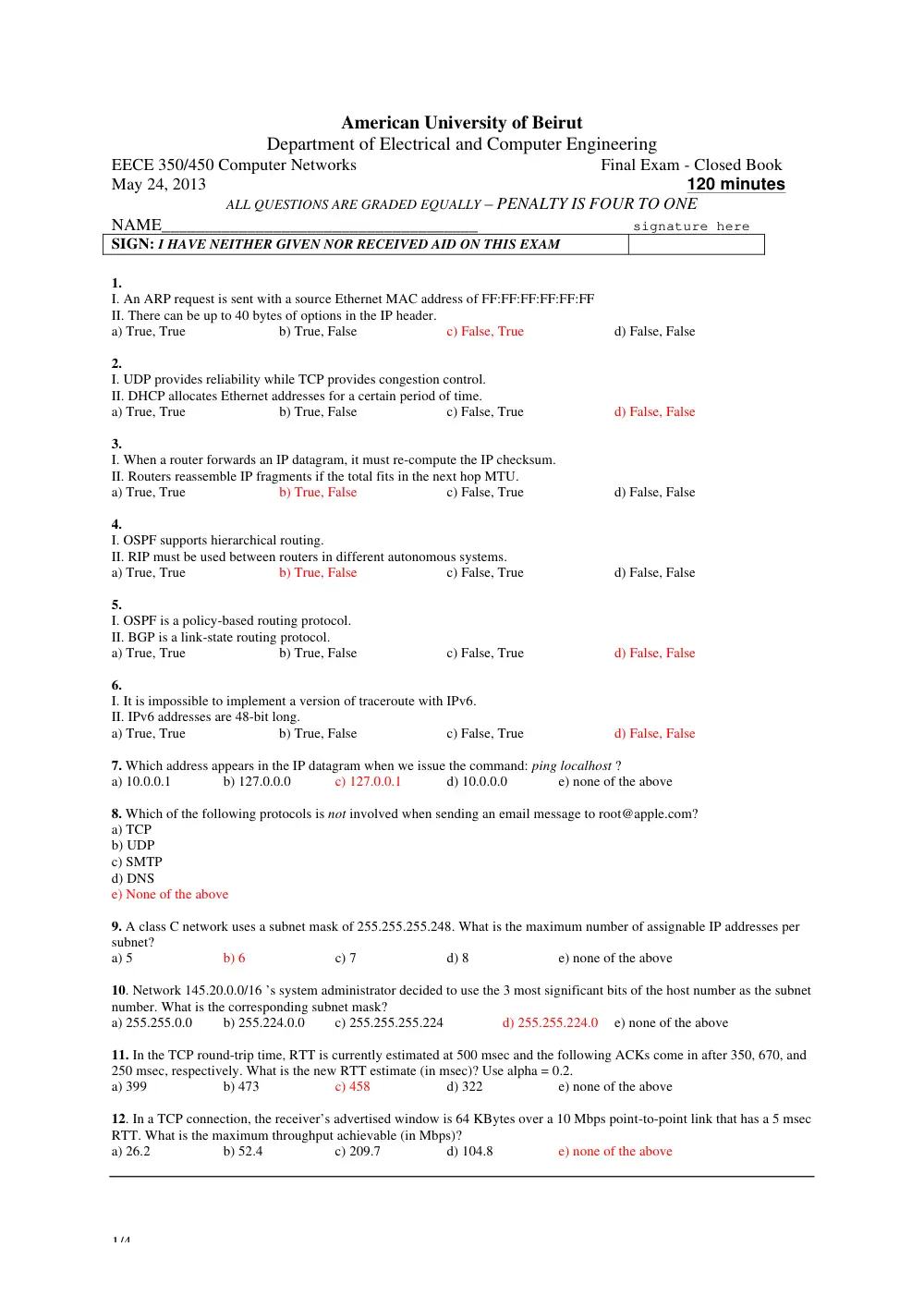
American University of Beirut
Department of Electrical and Computer Engineering
EECE 350/450 Computer Networks Final Exam - Closed Book
May 24, 2013
120 minutes
ALL QUESTIONS ARE GRADED EQUALLY – PENALTY IS FOUR TO ONE
NAME_____________________________________ signature here
SIGN: I HAVE NEITHER GIVEN NOR RECEIVED AID ON THIS EXAM
1.
I. An ARP request is sent with a source Ethernet MAC address of FF:FF:FF:FF:FF:FF
II. There can be up to 40 bytes of options in the IP header.
a) True, True
b) True, False
c) False, True
d) False, False
2.
I. UDP provides reliability while TCP provides congestion control.
II. DHCP allocates Ethernet addresses for a certain period of time.
a) True, True
b) True, False
c) False, True
d) False, False
3.
I. When a router forwards an IP datagram, it must re-compute the IP checksum.
II. Routers reassemble IP fragments if the total fits in the next hop MTU.
a) True, True
b) True, False
c) False, True
d) False, False
4.
I. OSPF supports hierarchical routing.
II. RIP must be used between routers in different autonomous systems.
a) True, True
b) True, False
c) False, True
d) False, False
5.
I. OSPF is a policy-based routing protocol.
II. BGP is a link-state routing protocol.
a) True, True
b) True, False
c) False, True
d) False, False
6.
I. It is impossible to implement a version of traceroute with IPv6.
II. IPv6 addresses are 48-bit long.
a) True, True
b) True, False
c) False, True
d) False, False
7. Which address appears in the IP datagram when we issue the command: ping localhost ?
a) 10.0.0.1
b) 127.0.0.0
c) 127.0.0.1
d) 10.0.0.0
e) none of the above
8. Which of the following protocols is not involved when sending an email message to root@apple.com?
a) TCP
b) UDP
c) SMTP
d) DNS
e) None of the above
9. A class C network uses a subnet mask of 255.255.255.248. What is the maximum number of assignable IP addresses per
subnet?
a) 5
b) 6
c) 7
d) 8
e) none of the above
10. Network 145.20.0.0/16 ’s system administrator decided to use the 3 most significant bits of the host number as the subnet
number. What is the corresponding subnet mask?
a) 255.255.0.0
b) 255.224.0.0
c) 255.255.255.224
d) 255.255.224.0
e) none of the above
11. In the TCP round-trip time, RTT is currently estimated at 500 msec and the following ACKs come in after 350, 670, and
250 msec, respectively. What is the new RTT estimate (in msec)? Use alpha = 0.2.
a) 399
b) 473
c) 458
d) 322
e) none of the above
12. In a TCP connection, the receiver’s advertised window is 64 KBytes over a 10 Mbps point-to-point link that has a 5 msec
RTT. What is the maximum throughput achievable (in Mbps)?
a) 26.2
b) 52.4
c) 209.7
d) 104.8
e) none of the above
2/4
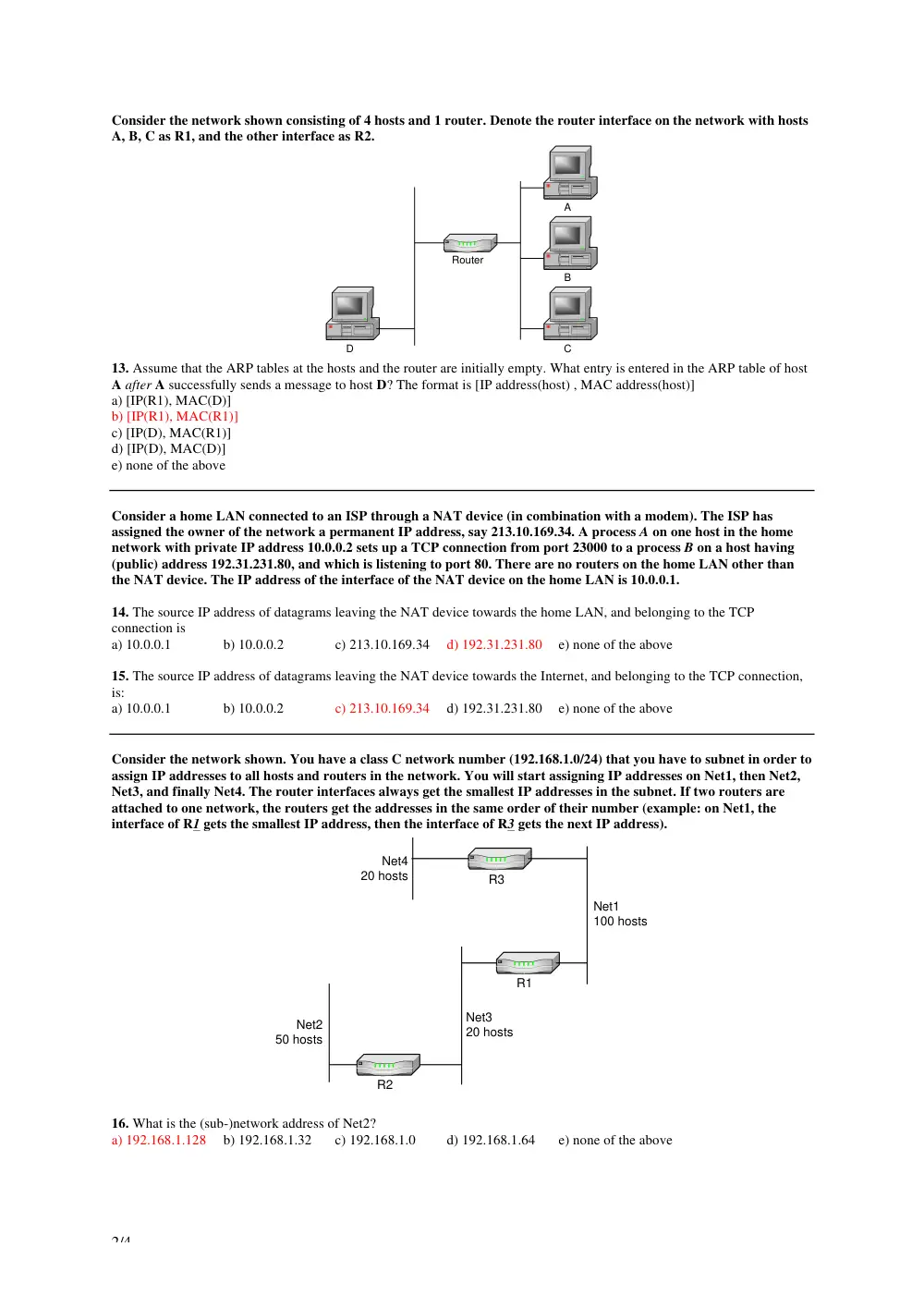
Consider the network shown consisting of 4 hosts and 1 router. Denote the router interface on the network with hosts
A, B, C as R1, and the other interface as R2.
Router
A
C
B
D
13. Assume that the ARP tables at the hosts and the router are initially empty. What entry is entered in the ARP table of host
A after A successfully sends a message to host D? The format is [IP address(host) , MAC address(host)]
a) [IP(R1), MAC(D)]
b) [IP(R1), MAC(R1)]
c) [IP(D), MAC(R1)]
d) [IP(D), MAC(D)]
e) none of the above
Consider a home LAN connected to an ISP through a NAT device (in combination with a modem). The ISP has
assigned the owner of the network a permanent IP address, say 213.10.169.34. A process A on one host in the home
network with private IP address 10.0.0.2 sets up a TCP connection from port 23000 to a process B on a host having
(public) address 192.31.231.80, and which is listening to port 80. There are no routers on the home LAN other than
the NAT device. The IP address of the interface of the NAT device on the home LAN is 10.0.0.1.
14. The source IP address of datagrams leaving the NAT device towards the home LAN, and belonging to the TCP
connection is
a) 10.0.0.1
b) 10.0.0.2
c) 213.10.169.34
d) 192.31.231.80
e) none of the above
15. The source IP address of datagrams leaving the NAT device towards the Internet, and belonging to the TCP connection,
is:
a) 10.0.0.1
b) 10.0.0.2
c) 213.10.169.34
d) 192.31.231.80
e) none of the above
Consider the network shown. You have a class C network number (192.168.1.0/24) that you have to subnet in order to
assign IP addresses to all hosts and routers in the network. You will start assigning IP addresses on Net1, then Net2,
Net3, and finally Net4. The router interfaces always get the smallest IP addresses in the subnet. If two routers are
attached to one network, the routers get the addresses in the same order of their number (example: on Net1, the
interface of R1 gets the smallest IP address, then the interface of R3 gets the next IP address).
R1
R2
R3
Net2
50 hosts
Net3
20 hosts
Net1
100 hosts
Net4
20 hosts
16. What is the (sub-)network address of Net2?
a) 192.168.1.128
b) 192.168.1.32
c) 192.168.1.0
d) 192.168.1.64
e) none of the above
3/4
17. What is the IP address of the interface of R2 on Net3?
a) 192.168.1.129
b) 192.168.1.194
c) 192.168.1.193
d) 192.168.1.1
e) none of the above
18. The following are two entries in R3’s routing table. The sum of the missing two numbers is:
destination
next hop
192.168.1.X/27
Direct
192.168.1.Y/25
Direct
a) X + Y = 192
b) X + Y = 160
c) X + Y = 224
d) X + Y = 240
e) none of the above
19. What is the broadcast address on Net3?
a) 192.168.1.127
b) 192.168.1.223
c) 192.168.1.255
d) 192.168.1.191
e) none of the above
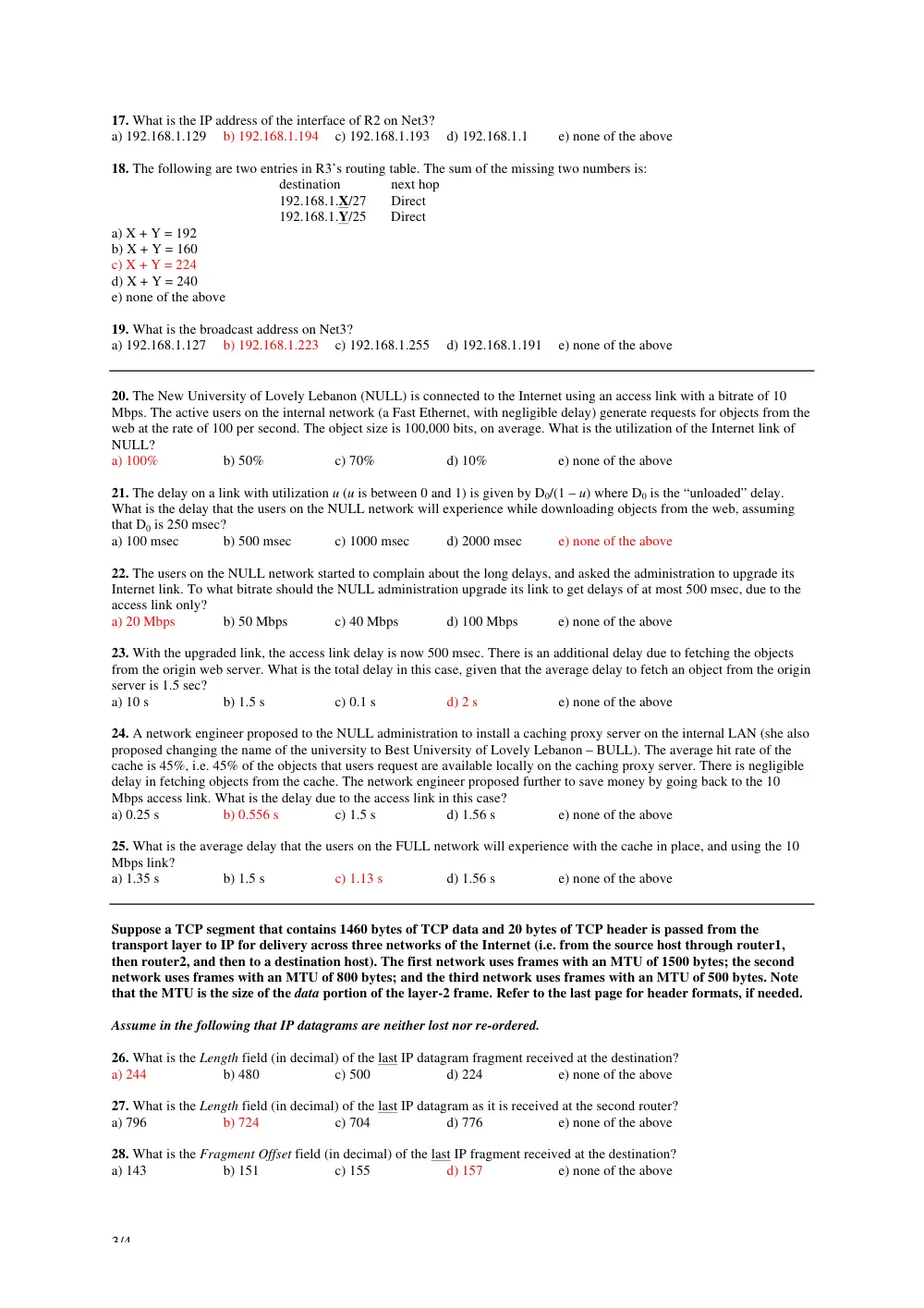
20. The New University of Lovely Lebanon (NULL) is connected to the Internet using an access link with a bitrate of 10
Mbps. The active users on the internal network (a Fast Ethernet, with negligible delay) generate requests for objects from the
web at the rate of 100 per second. The object size is 100,000 bits, on average. What is the utilization of the Internet link of
NULL?
a) 100%
b) 50%
c) 70%
d) 10%
e) none of the above
21. The delay on a link with utilization u (u is between 0 and 1) is given by D0/(1 – u) where D0 is the “unloaded” delay.
What is the delay that the users on the NULL network will experience while downloading objects from the web, assuming
that D0 is 250 msec?
a) 100 msec
b) 500 msec
c) 1000 msec
d) 2000 msec
e) none of the above
22. The users on the NULL network started to complain about the long delays, and asked the administration to upgrade its
Internet link. To what bitrate should the NULL administration upgrade its link to get delays of at most 500 msec, due to the
access link only?
a) 20 Mbps
b) 50 Mbps
c) 40 Mbps
d) 100 Mbps
e) none of the above
23. With the upgraded link, the access link delay is now 500 msec. There is an additional delay due to fetching the objects
from the origin web server. What is the total delay in this case, given that the average delay to fetch an object from the origin
server is 1.5 sec?
a) 10 s
b) 1.5 s
c) 0.1 s
d) 2 s
e) none of the above
24. A network engineer proposed to the NULL administration to install a caching proxy server on the internal LAN (she also
proposed changing the name of the university to Best University of Lovely Lebanon – BULL). The average hit rate of the
cache is 45%, i.e. 45% of the objects that users request are available locally on the caching proxy server. There is negligible
delay in fetching objects from the cache. The network engineer proposed further to save money by going back to the 10
Mbps access link. What is the delay due to the access link in this case?
a) 0.25 s
b) 0.556 s
c) 1.5 s
d) 1.56 s
e) none of the above
25. What is the average delay that the users on the FULL network will experience with the cache in place, and using the 10
Mbps link?
a) 1.35 s
b) 1.5 s
c) 1.13 s
d) 1.56 s
e) none of the above
Suppose a TCP segment that contains 1460 bytes of TCP data and 20 bytes of TCP header is passed from the
transport layer to IP for delivery across three networks of the Internet (i.e. from the source host through router1,
then router2, and then to a destination host). The first network uses frames with an MTU of 1500 bytes; the second
network uses frames with an MTU of 800 bytes; and the third network uses frames with an MTU of 500 bytes. Note
that the MTU is the size of the data portion of the layer-2 frame. Refer to the last page for header formats, if needed.
Assume in the following that IP datagrams are neither lost nor re-ordered.
26. What is the Length field (in decimal) of the last IP datagram fragment received at the destination?
a) 244
b) 480
c) 500
d) 224
e) none of the above
27. What is the Length field (in decimal) of the last IP datagram as it is received at the second router?
a) 796
b) 724
c) 704
d) 776
e) none of the above
28. What is the Fragment Offset field (in decimal) of the last IP fragment received at the destination?
a) 143
b) 151
c) 155
d) 157
e) none of the above
4/4
29. What is the Fragment Offset field (in decimal) of the last IP datagram as it is received at the second router?
a) 91
b) 93
c) 95
d) 97
e) none of the above
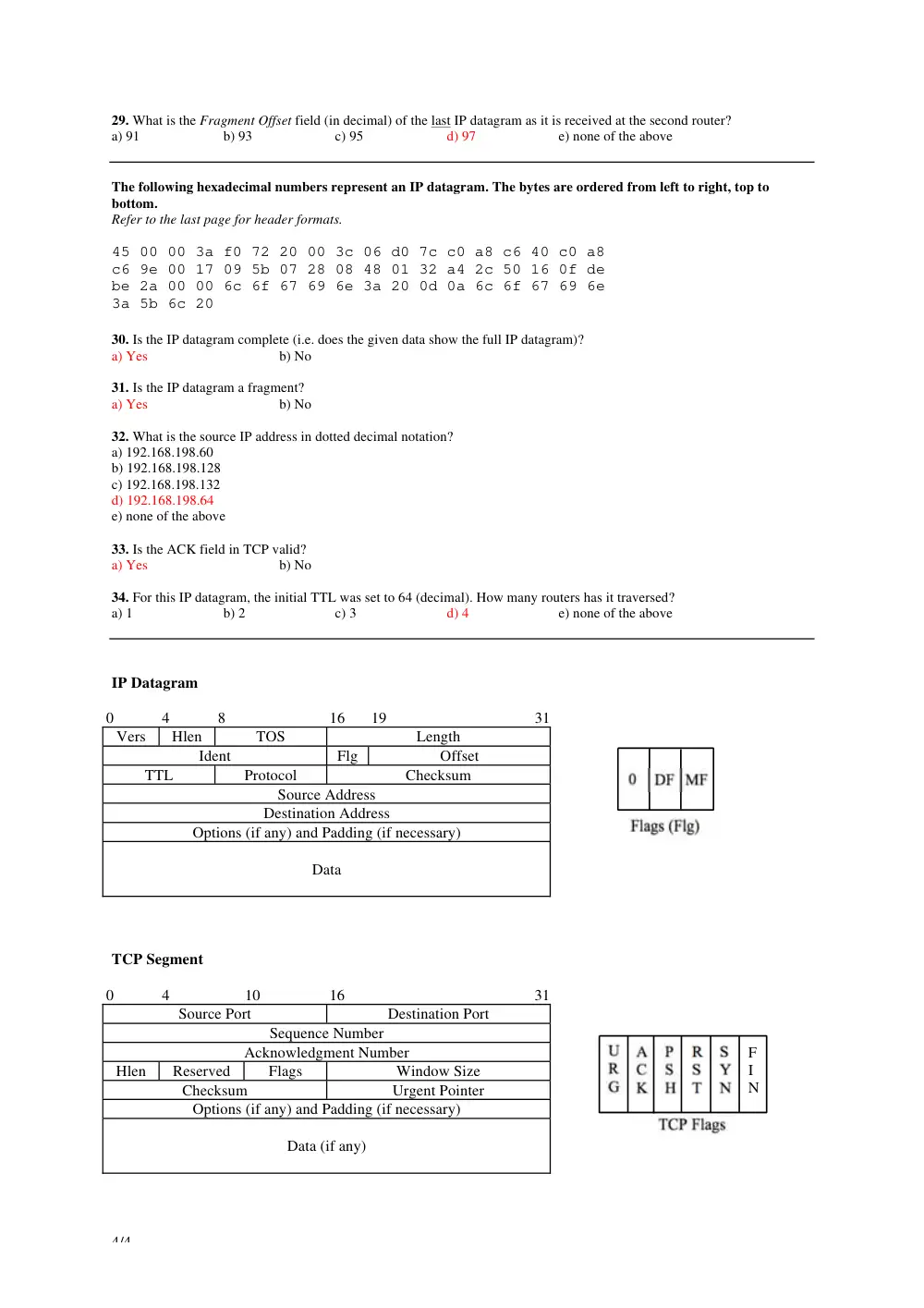
The following hexadecimal numbers represent an IP datagram. The bytes are ordered from left to right, top to
bottom.
Refer to the last page for header formats.
45 00 00 3a f0 72 20 00 3c 06 d0 7c c0 a8 c6 40 c0 a8
c6 9e 00 17 09 5b 07 28 08 48 01 32 a4 2c 50 16 0f de
be 2a 00 00 6c 6f 67 69 6e 3a 20 0d 0a 6c 6f 67 69 6e
3a 5b 6c 20
30. Is the IP datagram complete (i.e. does the given data show the full IP datagram)?
a) Yes
b) No
31. Is the IP datagram a fragment?
a) Yes
b) No
32. What is the source IP address in dotted decimal notation?
a) 192.168.198.60
b) 192.168.198.128
c) 192.168.198.132
d) 192.168.198.64
e) none of the above
33. Is the ACK field in TCP valid?
a) Yes
b) No
34. For this IP datagram, the initial TTL was set to 64 (decimal). How many routers has it traversed?
a) 1
b) 2
c) 3
d) 4
e) none of the above
IP Datagram
0
4
8
16
19
31
Vers
Hlen
TOS
Length
Ident
Flg
Offset
TTL
Protocol
Checksum
Source Address
Destination Address
Options (if any) and Padding (if necessary)
Data
TCP Segment
0
4
10
16
31
Source Port
Destination Port
Sequence Number
Acknowledgment Number
Hlen
Reserved
Flags
Window Size
Checksum
Urgent Pointer
Options (if any) and Padding (if necessary)
Data (if any)
Flags (Flg)
0
DF MF
TCP Flags
U
R
G
A
C
K
P
S
H
R
S
T
S
Y
N
F
I
N