
EECE 450 Midterm with Soln, Spring 2014
American University of Beirut · Computer Networks · 7 pages



More EECE 450 files
Show the text of this exam
Page 1 of 7
American University of Beirut
Department of Electrical and Computer Engineering
EECE 350 – Computer Networks
Spring 2014
Midterm – March 28, 2014
Closed Book / Notes – No Programmable Calculators – 90 minutes
NAME:___________________________ ID Number: ______________________
v All questions are equally graded
v PENALTY is four-to-one (four wrong answers cancel one correct answer, one to
three wrong answers have no effect)
v Grading is based on the answers marked on the SCANTRON computer sheet only.
v There are 50 questions and 7 pages in this exam.
Page 2 of 7
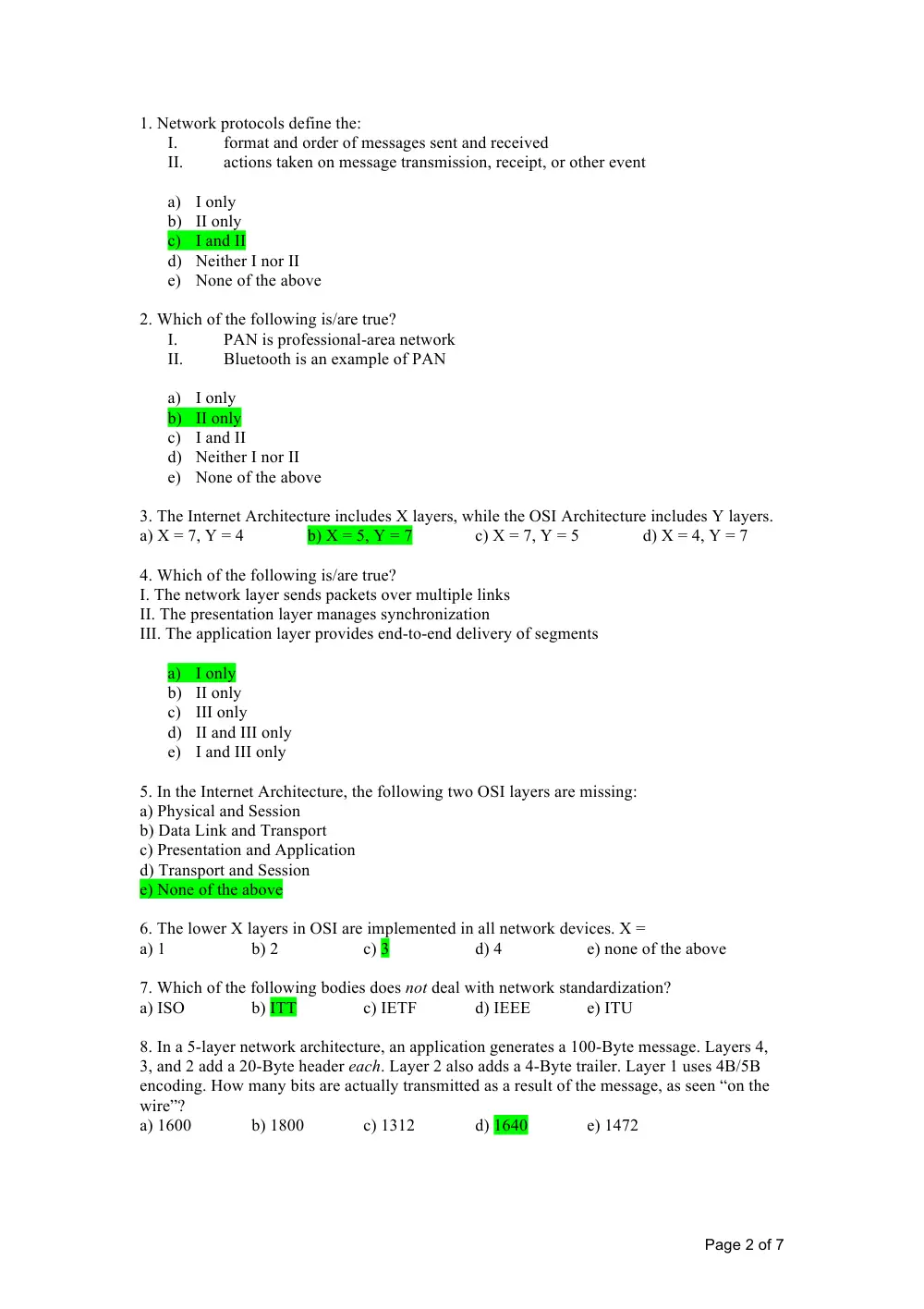
1. Network protocols define the:
I.
format and order of messages sent and received
II.
actions taken on message transmission, receipt, or other event
a) I only
b) II only
c) I and II
d) Neither I nor II
e) None of the above
2. Which of the following is/are true?
I.
PAN is professional-area network
II.
Bluetooth is an example of PAN
a) I only
b) II only
c) I and II
d) Neither I nor II
e) None of the above
3. The Internet Architecture includes X layers, while the OSI Architecture includes Y layers.
a) X = 7, Y = 4
b) X = 5, Y = 7
c) X = 7, Y = 5
d) X = 4, Y = 7
4. Which of the following is/are true?
I. The network layer sends packets over multiple links
II. The presentation layer manages synchronization
III. The application layer provides end-to-end delivery of segments
a) I only
b) II only
c) III only
d) II and III only
e) I and III only
5. In the Internet Architecture, the following two OSI layers are missing:
a) Physical and Session
b) Data Link and Transport
c) Presentation and Application
d) Transport and Session
e) None of the above
6. The lower X layers in OSI are implemented in all network devices. X =
a) 1
b) 2
c) 3
d) 4
e) none of the above
7. Which of the following bodies does not deal with network standardization?
a) ISO
b) ITT
c) IETF
d) IEEE
e) ITU
8. In a 5-layer network architecture, an application generates a 100-Byte message. Layers 4,
3, and 2 add a 20-Byte header each. Layer 2 also adds a 4-Byte trailer. Layer 1 uses 4B/5B
encoding. How many bits are actually transmitted as a result of the message, as seen “on the
wire”?
a) 1600
b) 1800
c) 1312
d) 1640
e) 1472
Page 3 of 7
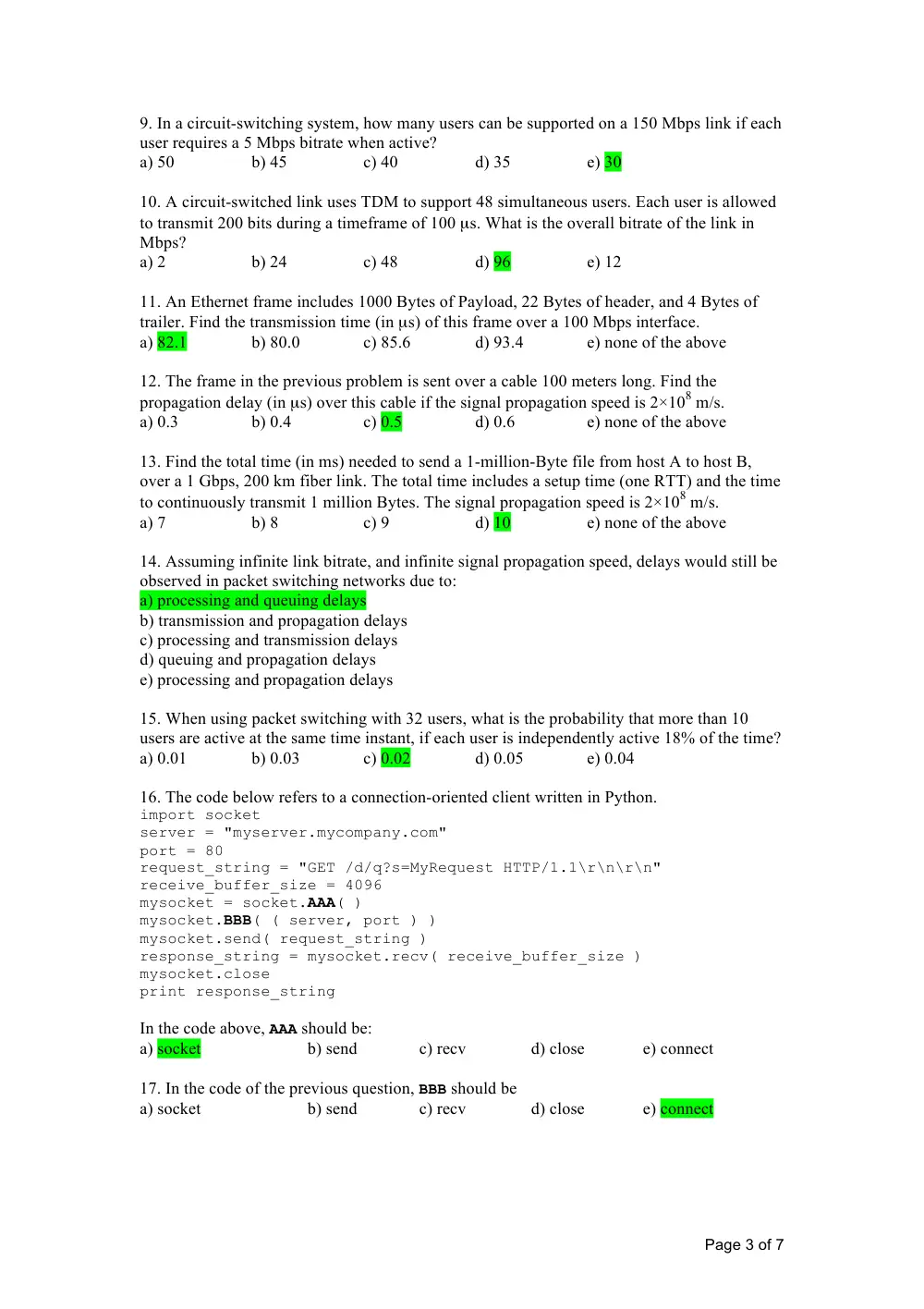
9. In a circuit-switching system, how many users can be supported on a 150 Mbps link if each
user requires a 5 Mbps bitrate when active?
a) 50
b) 45
c) 40
d) 35
e) 30
10. A circuit-switched link uses TDM to support 48 simultaneous users. Each user is allowed
to transmit 200 bits during a timeframe of 100 µs. What is the overall bitrate of the link in
Mbps?
a) 2
b) 24
c) 48
d) 96
e) 12
11. An Ethernet frame includes 1000 Bytes of Payload, 22 Bytes of header, and 4 Bytes of
trailer. Find the transmission time (in µs) of this frame over a 100 Mbps interface.
a) 82.1
b) 80.0
c) 85.6
d) 93.4
e) none of the above
12. The frame in the previous problem is sent over a cable 100 meters long. Find the
propagation delay (in µs) over this cable if the signal propagation speed is 2×10⁸ m/s.
a) 0.3
b) 0.4
c) 0.5
d) 0.6
e) none of the above
13. Find the total time (in ms) needed to send a 1-million-Byte file from host A to host B,
over a 1 Gbps, 200 km fiber link. The total time includes a setup time (one RTT) and the time
to continuously transmit 1 million Bytes. The signal propagation speed is 2×10⁸ m/s.
a) 7
b) 8
c) 9
d) 10
e) none of the above
14. Assuming infinite link bitrate, and infinite signal propagation speed, delays would still be
observed in packet switching networks due to:
a) processing and queuing delays
b) transmission and propagation delays
c) processing and transmission delays
d) queuing and propagation delays
e) processing and propagation delays
15. When using packet switching with 32 users, what is the probability that more than 10
users are active at the same time instant, if each user is independently active 18% of the time?
a) 0.01
b) 0.03
c) 0.02
d) 0.05
e) 0.04
16. The code below refers to a connection-oriented client written in Python.
import socket
server = "myserver.mycompany.com"
port = 80
request_string = "GET /d/q?s=MyRequest HTTP/1.1\r\n\r\n"
receive_buffer_size = 4096
mysocket = socket.AAA( )
mysocket.BBB( ( server, port ) )
mysocket.send( request_string )
response_string = mysocket.recv( receive_buffer_size )
mysocket.close
print response_string
In the code above, AAA should be:
a) socket
b) send
c) recv
d) close
e) connect
17. In the code of the previous question, BBB should be
a) socket
b) send
c) recv
d) close
e) connect
Page 4 of 7
18.
I. Satellite broadcast is an example of full-duplex communication
II. Error rates over fiber links are similar to those over copper links
III. Bitrates that are obtained over fiber links are much higher than those over copper links
a) All statements are true
b) All statements are false
c) Only statement II is false
d) Only statement III is false
e) Statements I and II are false
19.
I. DSL uses frequency-division multiplexing
II. Omnidirectional wireless transmission requires careful antenna alignment
III. Geostationary satellites orbit at an altitude of 36000 km.
a) All statements are true
b) All statements are false
c) Only statement II is false
d) Only statement III is false
e) Statements I and II are false
20. What bandwidth (in kHz) is needed to transmit at 2 Mbps over a channel with a signal-to-
noise ratio of 33 dB?
a) 91.2
b) 182.4
c) 606.0
d) 362.8
e) none of the above
21. What is the minimum number of signal levels that are needed in the previous problem?
a) 8
b) 16
c) 32
d) 64
e) 128
In the following problems, assume that all signals are initially LOW. Consider the following
sequence of data bits that should be transmitted
0 0 0 1 1 0 1 0 0 1 0 1 0 1 1 1 0 0 0 0 1 0
Count the number of LOW-TO-HIGH transitions when using the encoding scheme:
22. NRZ
a) 3
b) 4
c) 5
d) 6
e) none of the above
23. NRZI
a) 3
b) 4
c) 5
d) 6
e) none of the above
24. Manchester
a) 3
b) 4
c) 5
d) 6
e) none of the above
25. The payload of an HDLC frame consists of 500 bits, with all bits being “1”. After bit
stuffing, how many bits are transmitted as payload?
a) 600
b) 500
c) 560
d) 640
e) 400
26. The bit-error-rate over a wireless link is 10–4. What is the expected number of bits in error
out of 1 million bits that are received by a wireless station?
a) 1000
b) 100
c) 10
d) 500
e) 5000
27. In the previous problem, the 1 million bits are received as a sequence of frames, each with
M Bytes. What is the maximum value of M in order to limit the frame error rate to 0.13?
a) 144
b) 214
c) 174
d) 84
e) 324
Page 5 of 7
28. How many additional Forward-Error-Correction bits are needed to correct single-bit
errors in 8000-bit frames? Assume Hamming code is used.
a) 13
b) 12
c) 14
d) 15
e) none of the above
29. In the previous problem, how many additional bits (to be sent with the data bits) are
needed to detect single-bit errors in an 8000-bit frame?
a) 10
b) 1
c) 3
d) 5
e) none of the above
30. In a 2D even parity scheme, the following sequence of bits are taken 7 at a time, with a
parity bit added at the end of the seven bits to create a Byte.
1000011 1010001 0111101
The three resulting Bytes are then followed by a vertical parity Byte, which should be:
a) 10000110 b) 01011111 c) 01111111 d) 00000110 e) none of the above
31. Find the internet checksum of the following message:
1000001111010001 1011111011010011
a) 1010100101011010
b) 1011111101111010
c) 1011110101011010
d) 1011111101011011
e) none of the above
32. The 3-bit CRC of the message 11000011 using the generator polynomial x3+x+1 is:
a) 010
b) 110
c) 001
d) 111
e) none of the above
33. A Stop-and-Wait scheme uses data frames of length 6000 bits and ACK frames of
negligible size, over a symmetrical link with bitrate 500 kbps, and an RTT of 30 ms. What is
the cycle time (in ms) for this scheme?
a) 12
b) 22
c) 32
d) 42
e) 52
34. What is the throughput in the previous problem (in kbps)?
a) 234
b) 462
c) 311
d) 78
e) 143
35. If the frames in the previous problem arrive with an error rate of 0.111, and the error is
always detected by the receiver, and assuming the minimum timeout value for correct
operation at the sender, find the throughput (in kbps).
a) 208
b) 127
c) 276
d) 350
e) 88
36. Over a 250 kbps satellite link, the RTT between two hosts is 500 ms. Data frames are
6000 bits, and ACK frames are negligible in size. What is the minimum window size in a
sliding-windows scheme for maximum utilization of this satellite link?
a) 22
b) 18
c) 16
d) 24
e) 26
37. Assume in the previous problem that Go-Back-N is used, how many bits are needed in the
header to store the sequence number of a frame?
a) 3
b) 4
c) 5
d) 6
e) 7
38. Repeat the previous question if Selective Repeat is used.
a) 3
b) 4
c) 5
d) 6
e) 7
Page 6 of 7
Station A wants to send 1000-Byte frames to station B over an 802.11 wireless LAN. Assume
that the distance from A to B is 15 meters, the bitrate is 117 Mbps, DIFS is 50 µs, SIFS is
10 µs. RTS and CTS frames are 20 Bytes and 16 Bytes, respectively, and ACK frames are
64 Bytes. The propagation speed is 3×10⁸ m/sec, and processing delays are negligible.
39. Since the frame size is small, the stations do not use RTS/CTS. Station A starts its DIFS
timer at time t = 0. Estimate the time at which the ACK frame is completely received by A (in
microseconds).
a) 132.9
b) 128.5
c) 122.8
d) 172.8
e) none of the above
40. If the RTS/CTS scheme is used, at what time (in microseconds) does station A start
transmitting its data frame bits?
a) 55.6
b) 62.6
c) 32.6
d) 72.6
e) none of the above
41. When the RTS/CTS scheme is not used, what is effective useful throughput of the
network (in Mbps)? The useful bits are those of the data frames only.
a) 49.7
b) 60.2
c) 93.1
d) 75.6
e) none of the above
42. Given two stations A and B connected to one Ethernet network cable, with no other
stations on the network. Both stations attempt to transmit at time t = 0. As a result, a collision
occurs. After the first collision, the stations try to transmit again, but collide a second time.
What is the probability that the two stations will collide the third time they try to transmit?
a) 0.25
b) 0.125
c) 0.75
d) 0.005
e) none of the above
43.
I. A MAC address consists of 48 bits
II. A station can have only one MAC address
III. Sending a frame with a source address equal to FF:FF:FF:FF:FF:FF results in a broadcast
a) All statements are true
b) All statements are false
c) Only statement I is true
d) Only statement II is false
e) None of the above
The circles in the network diagram below depict LAN bridges. The bridge ID is the number
inside the circle. The thick lines depict LAN segments (LAN 1 to LAN 5).
21
77
91
64
40
48
55
port 1
port 1
port 1
port 1
port 1
port 1
port 1
port 2
port 2
port 2
port 2
port 2
port 2
port 2
port 3
port 3
LAN 2
LAN 5
LAN 1
LAN 3
LAN 4
Page 7 of 7
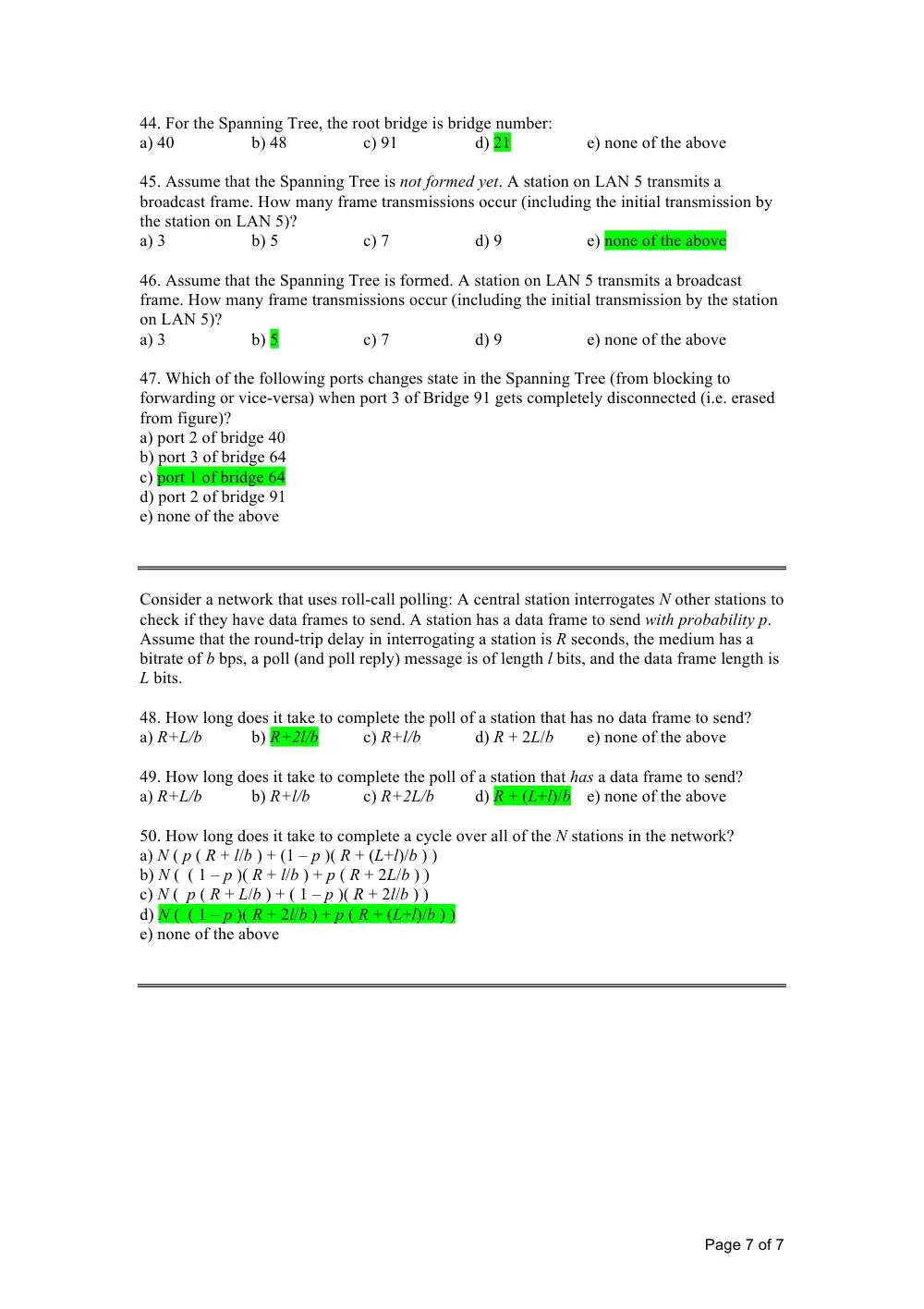
44. For the Spanning Tree, the root bridge is bridge number:
a) 40
b) 48
c) 91
d) 21
e) none of the above
45. Assume that the Spanning Tree is not formed yet. A station on LAN 5 transmits a
broadcast frame. How many frame transmissions occur (including the initial transmission by
the station on LAN 5)?
a) 3
b) 5
c) 7
d) 9
e) none of the above
46. Assume that the Spanning Tree is formed. A station on LAN 5 transmits a broadcast
frame. How many frame transmissions occur (including the initial transmission by the station
on LAN 5)?
a) 3
b) 5
c) 7
d) 9
e) none of the above
47. Which of the following ports changes state in the Spanning Tree (from blocking to
forwarding or vice-versa) when port 3 of Bridge 91 gets completely disconnected (i.e. erased
from figure)?
a) port 2 of bridge 40
b) port 3 of bridge 64
c) port 1 of bridge 64
d) port 2 of bridge 91
e) none of the above
Consider a network that uses roll-call polling: A central station interrogates N other stations to
check if they have data frames to send. A station has a data frame to send with probability p.
Assume that the round-trip delay in interrogating a station is R seconds, the medium has a
bitrate of b bps, a poll (and poll reply) message is of length l bits, and the data frame length is
L bits.
48. How long does it take to complete the poll of a station that has no data frame to send?
a) R+L/b
b) R+2l/b
c) R+l/b
d) R + 2L/b
e) none of the above
49. How long does it take to complete the poll of a station that has a data frame to send?
a) R+L/b
b) R+l/b
c) R+2L/b
d) R + (L+l)/b e) none of the above
50. How long does it take to complete a cycle over all of the N stations in the network?
a) N ( p ( R + l/b ) + (1 – p )( R + (L+l)/b ) )
b) N ( ( 1 – p )( R + l/b ) + p ( R + 2L/b ) )
c) N ( p ( R + L/b ) + ( 1 – p )( R + 2l/b ) )
d) N ( ( 1 – p )( R + 2l/b ) + p ( R + (L+l)/b ) )
e) none of the above