
ENG 100 Final, Fall 2001
American University of Beirut · Intensive English · 8 pages

More ENG 100 files
Show the text of this final exam
ERICaN CoC ERITH
LIBRARY
ENGLISH 100 FINAL EXAM OF BK
FALL 2001-2002
READING COMPREHENSION
The Perfect Family
by
Alice Hoffman
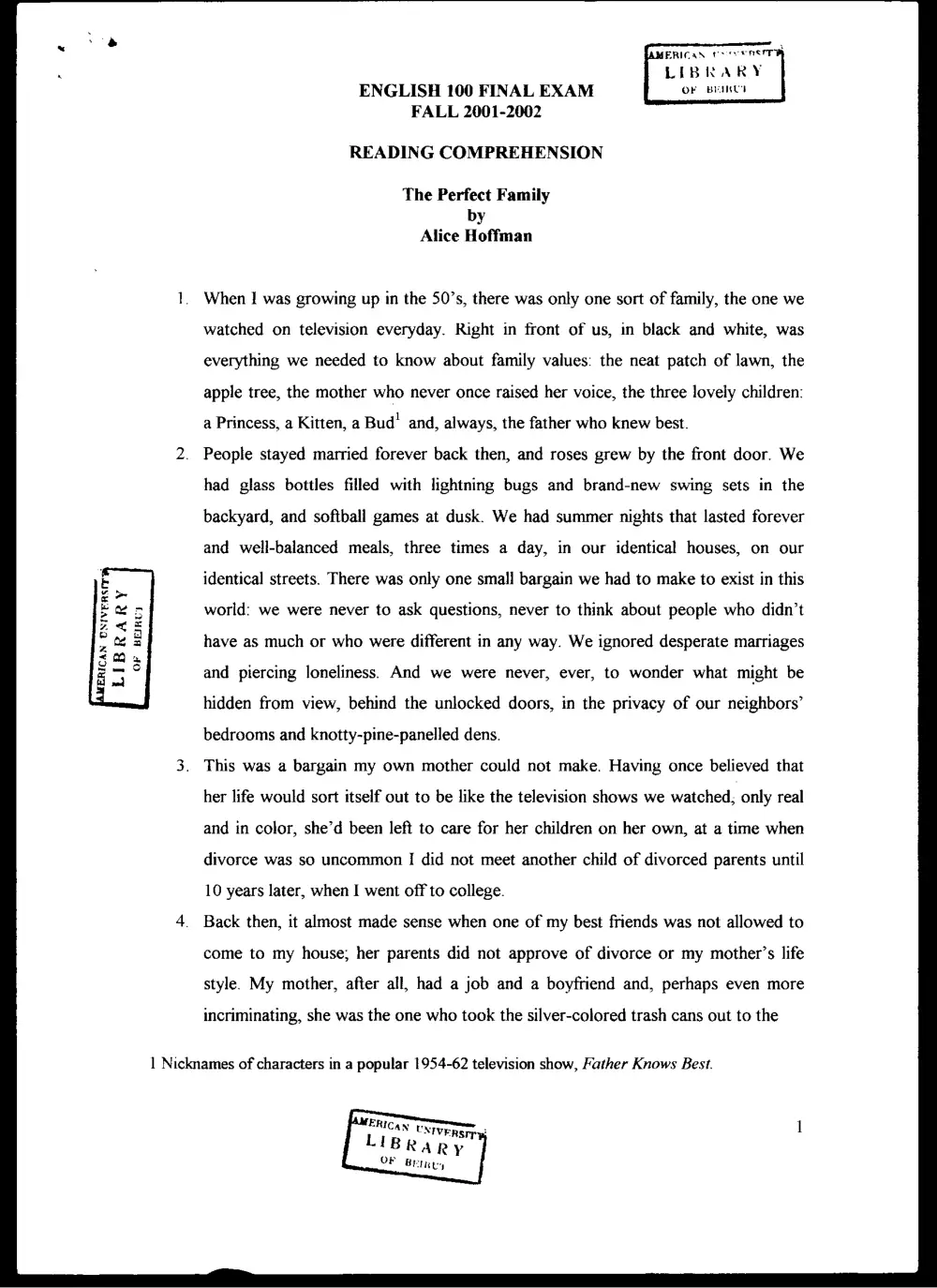
When | was growing up in the 50’s, there was only one sort of family, the one we
watched on television everyday. Right in front of us, in black and white, was
everything we needed to know about family values: the neat patch of lawn, the
apple tree, the mother who never once raised her voice, the three lovely children:
a Princess, a Kitten, a Bud! and, always, the father who knew best.
People stayed married forever back then, and roses grew by the front door. We
had glass bottles filled with lightning bugs and brand-new swing sets in the
backyard, and softball games at dusk. We had summer nights that lasted forever
and well-balanced meals, three times a day, in our identical houses, on our
identical streets. There was only one small bargain we had to make to exist in this
world: we were never to ask questions, never to think about people who didn’t
have as much or who were different in any way. We ignored desperate marriages
OF BEIRUY
&
rd
bd
E
z
Z.
6
z
of
yo
FA
LIBRARY
and piercing loneliness. And we were never, ever, to wonder what might be
hidden from view, behind the unlocked doors, in the privacy of our neighbors’
bedrooms and knotty-pine-panelled dens.
This was a bargain my own mother could not make. Having once believed that
her life would sort itself out to be like the television shows we watched, only real
and in color, she’d been left to care for her children on her own, at a time when
divorce was so uncommon I did not meet another child of divorced parents until
10 years later, when I went off to college.
Back then, it almost made sense when one of my best friends was not allowed to
come to my house; her parents did not approve of divorce or my mother’s life
style. My mother, after all, had a job and a boyfriend and, perhaps even more
incriminating, she was the one who took the silver-colored trash cans out to the
1 Nicknames of characters in a popular 1954-62 television show, Father Knows Best.
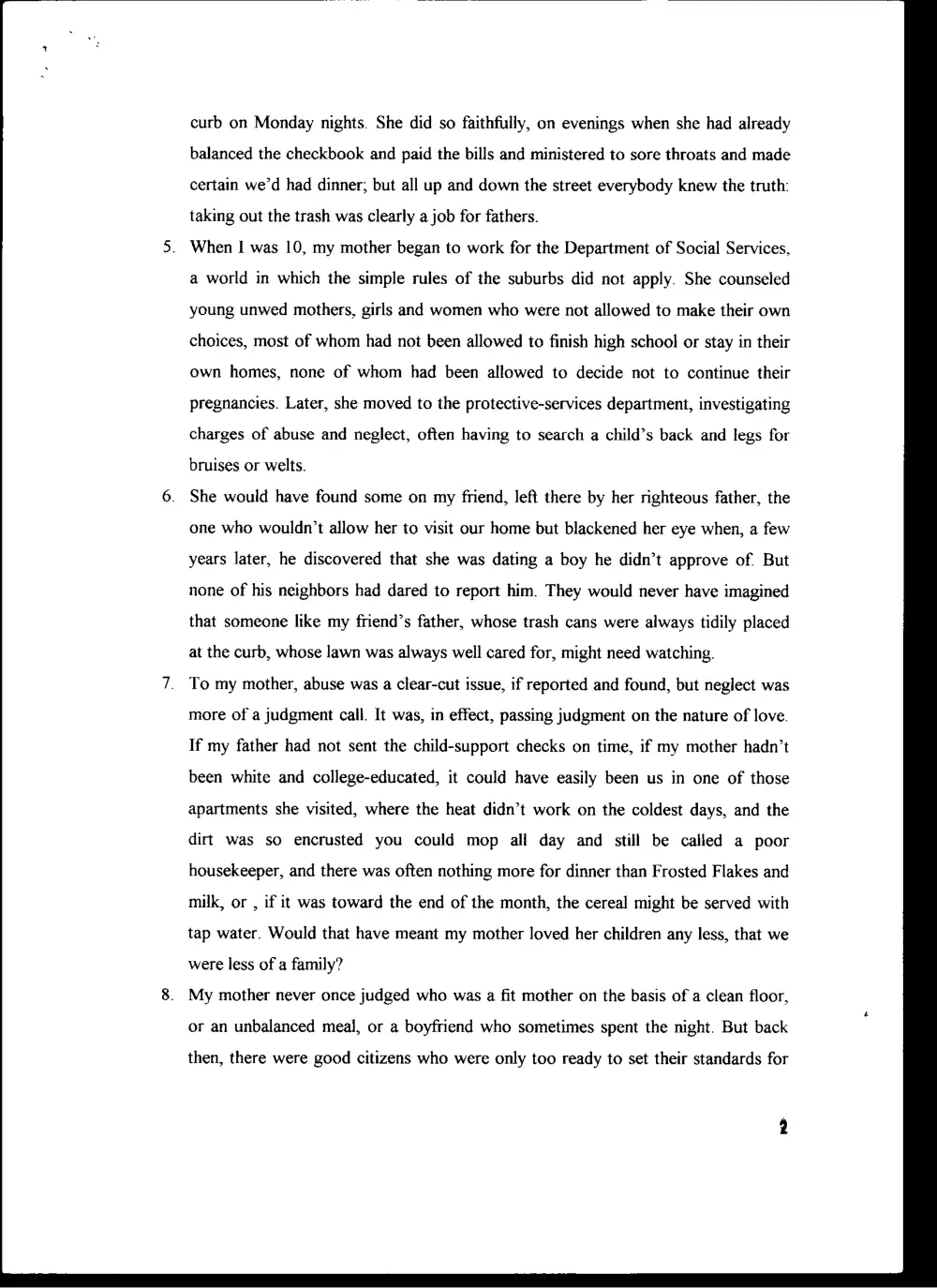
curb on Monday nights. She did so faithfully, on evenings when she had already
balanced the checkbook and paid the bills and ministered to sore throats and made
certain we’d had dinner; but all up and down the street everybody knew the truth:
taking out the trash was clearly a job for fathers.
. When I was 10, my mother began to work for the Department of Social Services,
a world in which the simple rules of the suburbs did not apply. She counseled
young unwed mothers, girls and women who were not allowed to make their own
choices, most of whom had not been allowed to finish high school or stay in their
own homes, none of whom had been allowed to decide not to continue their
pregnancies. Later, she moved to the protective-services department, investigating
charges of abuse and neglect, often having to search a child’s back and legs for
bruises or welts.
She would have found some on my friend, left there by her righteous father, the
one who wouldn’t allow her to visit our home but blackened her eye when, a few
years later, he discovered that she was dating a boy he didn’t approve of. But
none of his neighbors had dared to report him. They would never have imagined
that someone like my friend’s father, whose trash cans were always tidily placed
at the curb, whose lawn was always well cared for, might need watching.
To my mother, abuse was a clear-cut issue, if reported and found, but neglect was
more of a judgment call. It was, in effect, passing judgment on the nature of love.
If my father had not sent the child-support checks on time, if my mother hadn’t
been white and college-educated, it could have easily been us in one of those
apartments she visited, where the heat didn’t work on the coldest days, and the
dirt was so encrusted you could mop all day and still be called a poor
housekeeper, and there was often nothing more for dinner than Frosted Flakes and
milk, or , if it was toward the end of the month, the cereal might be served with
tap water. Would that have meant my mother loved her children any less, that we
were less of a family?
My mother never once judged who was a fit mother on the basis of a clean floor,
or an unbalanced meal, or a boyfriend who sometimes spent the night. But back
then, there were good citizens who were only too ready to set their standards for
women and children, factoring out poverty or exhaustion or simply a different set
of beliefs.
There are always those who are ready to deal out judgment with the ready fist of
the righteous. I know this because before the age of 10 I was one of the righteous,
too. I believed that mothers were meant to stay home and fathers should carry out
the trash on Monday nights. 1 believed that parents could create a domestic life
that was the next best thing to heaven, if they just tried. That is what I’d been told,
that in the best of all worlds we could live identical lives in identical houses.
_It’s a simple view of the world, too simple even for childhood. Certainly, it’s a
vision that is much too limited for the lives we live now, when only one in 19
families are made up of a wage-earner father, a mother who doesn’t work outside
the home and two or more children. And even long ago, when I was growing up,
we paid too high a price when we cut ourselves off from the rest of the world. We
ourselves did not dare to be different. In the safety we created, we became
trapped.
_ There are still places where softball games are played at dusk and roses grow by
the front door. There are families with sons named Bud, with kind and generous
fathers, and mothers who put up strawberry preserves every June and always have
time to sing lullabies. But do these families love their children any more than the
single mother who works all day? Are their lullabies any sweeter? If I felt
deprived as a child, it was only when our family was measured against some
notion of what we were supposed to be. The truth of it was, we jacked for little.
_ And now that I have children of my own, and am exhausted at the end of the day
in which I’ve probably failed in a hundred different ways, 1 am amazed that
women alone can manage. That they do, in spite of everything, is a simple fact.
They rise from sleep in the middle of the night when their children call out for
them. They rush for the cough syrup and cold washcloths and keep watch till
dawn. These are real family values, the same ones we knew when we were
children. As far as we were concerned our mother could cure a fever with a kiss.
This may be the only thing we ever need to know about love. The rest, no one can
judge.
Taken from Viewpoint : by Royce Adam
3
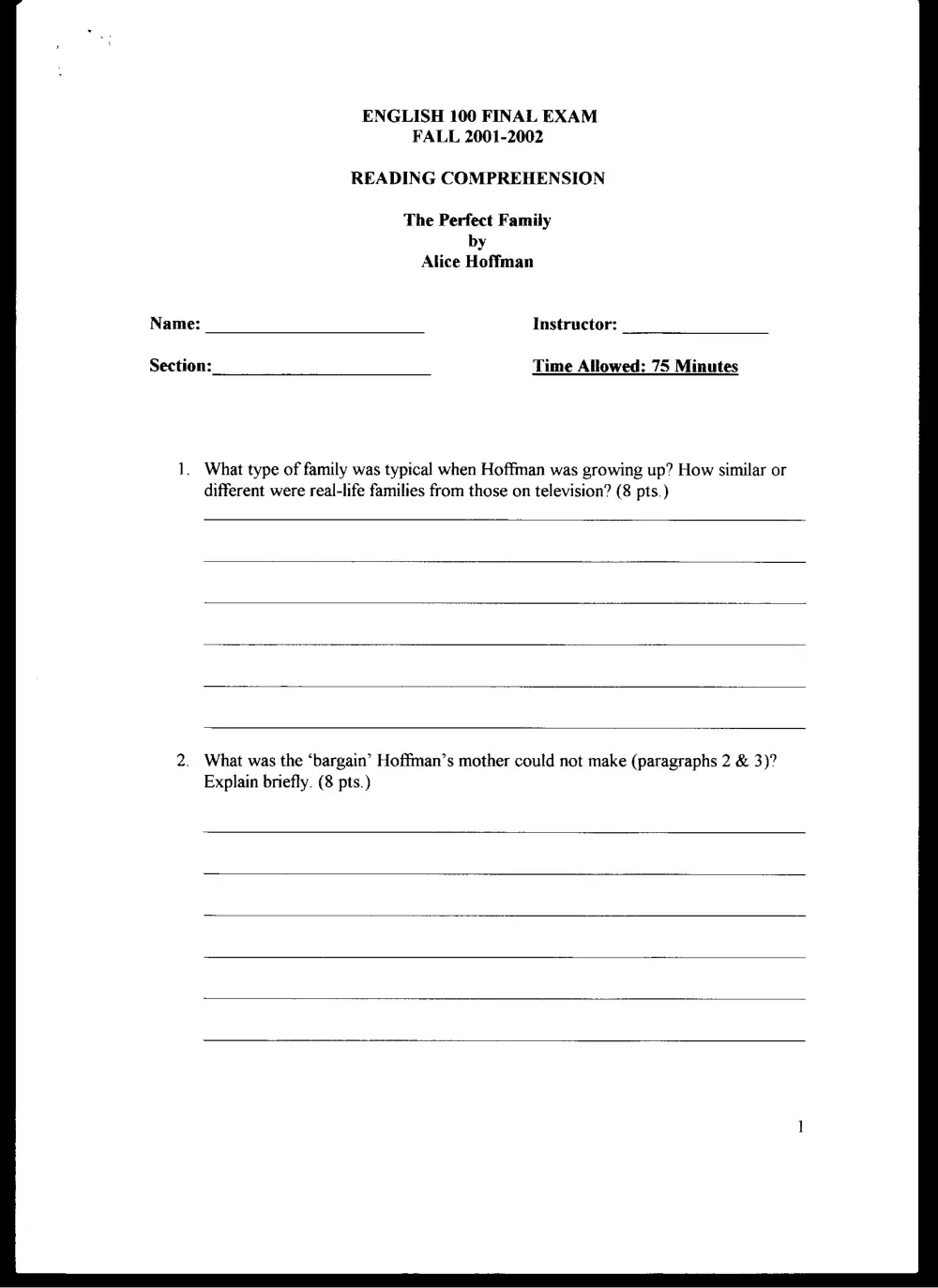
ENGLISH 100 FINAL EXAM
FALL 2001-2002
READING COMPREHENSION
The Perfect Family
by
Alice Hoffman
Name: Instructor:
Section: Time Allowed: 75 Minutes
1. What type of family was typical when Hoffman was growing up? How similar or
different were real-life families from those on television? (8 pts.)
2. What was the ‘bargain’ Hoffman’s mother could not make (paragraphs 2 & 3)?
Explain briefly. (8 pts.)
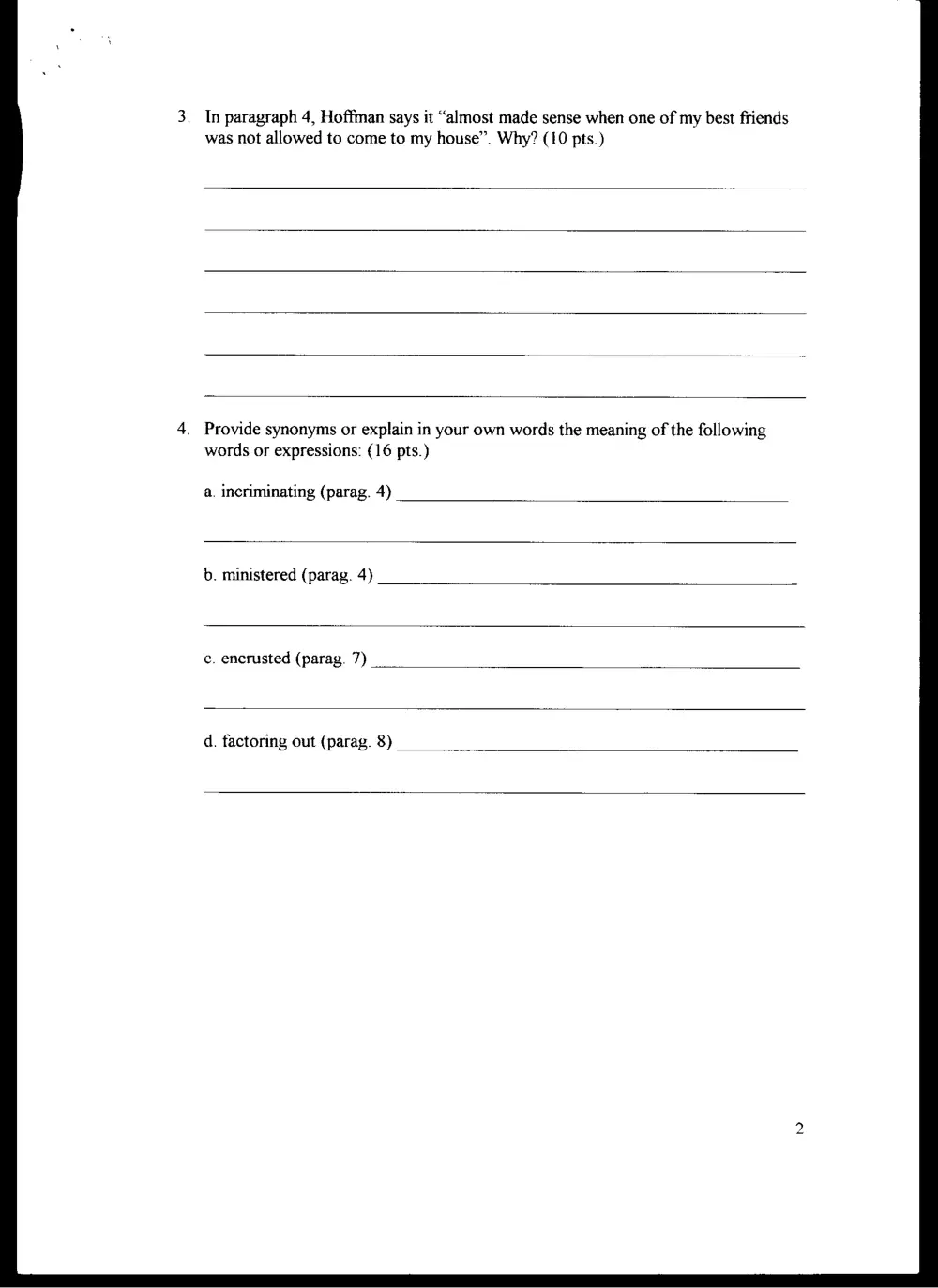
3. In paragraph 4, Hoffman says it “almost made sense when one of my best friends
was not allowed to come to my house”. Why? (10 pts.)
4. Provide synonyms or explain in your own words the meaning of the following
words or expressions: (16 pts.)
a. incriminating (parag. 4)
b. ministered (parag. 4)
c. encrusted (parag. 7)
d. factoring out (parag. 8)
2
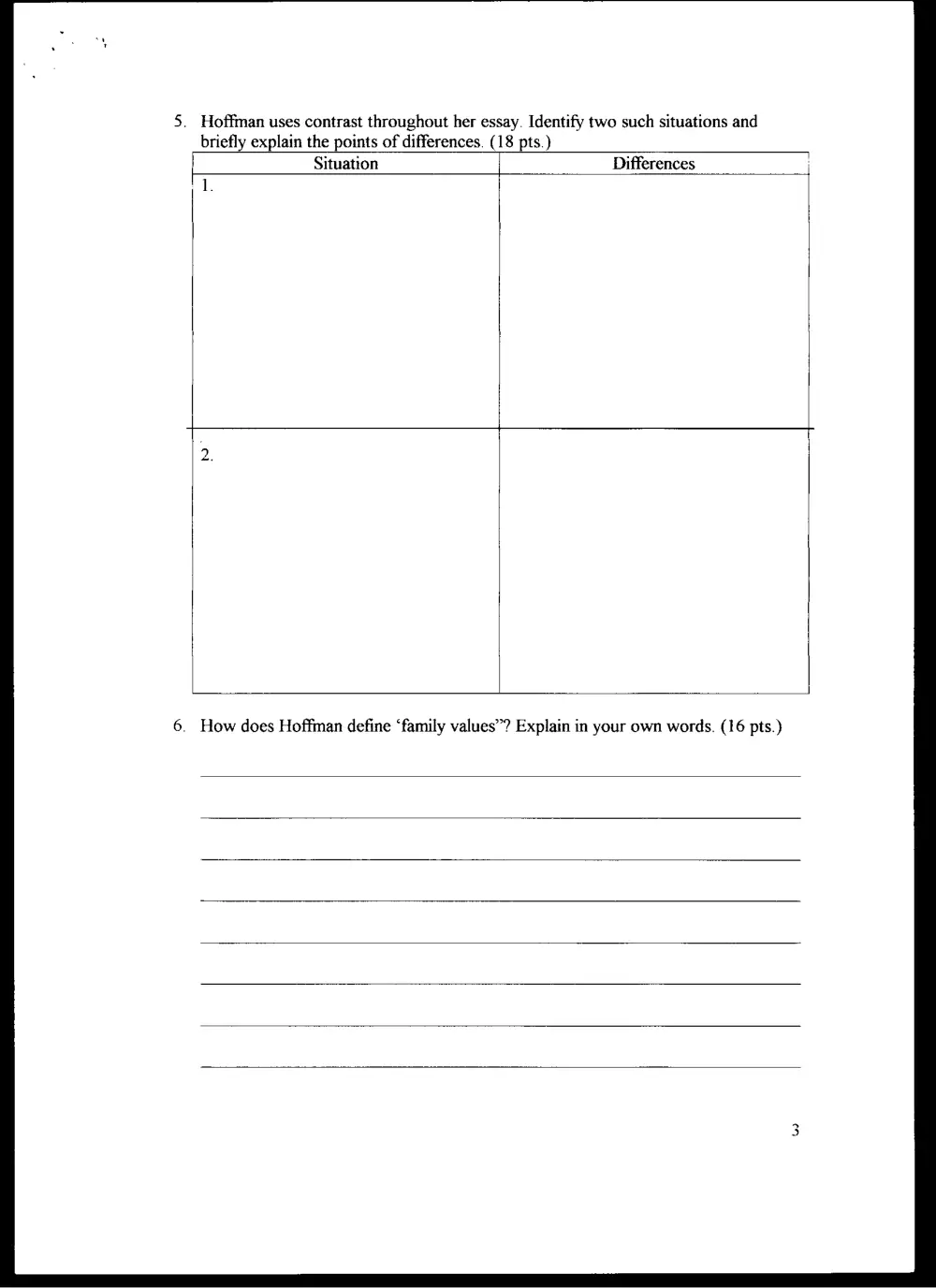
. Hoffman uses contrast throughout her essay. Identify two such situations and
briefly explain the points of differences. (18 pts.)
Situation Differences
1.
How does Hoffman define ‘family values”? Explain in your own words. (16 pts.)
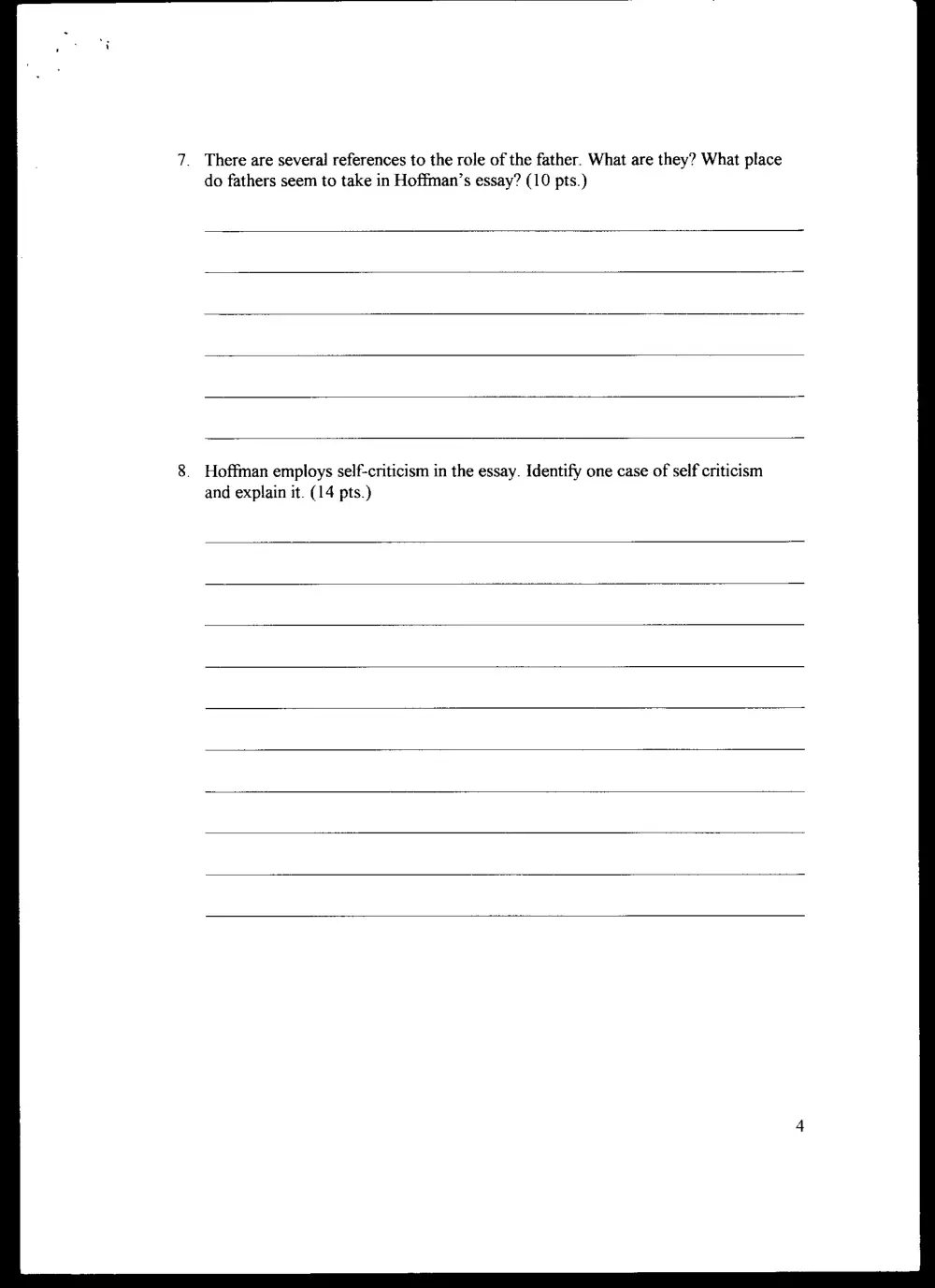
7. There are several references to the role of the father. What are they? What place
do fathers seem to take in Hoffman’s essay? (10 pts.)
8. Hoffman employs self-criticism in the essay. Identify one case of self criticism
and explain it. (14 pts.)
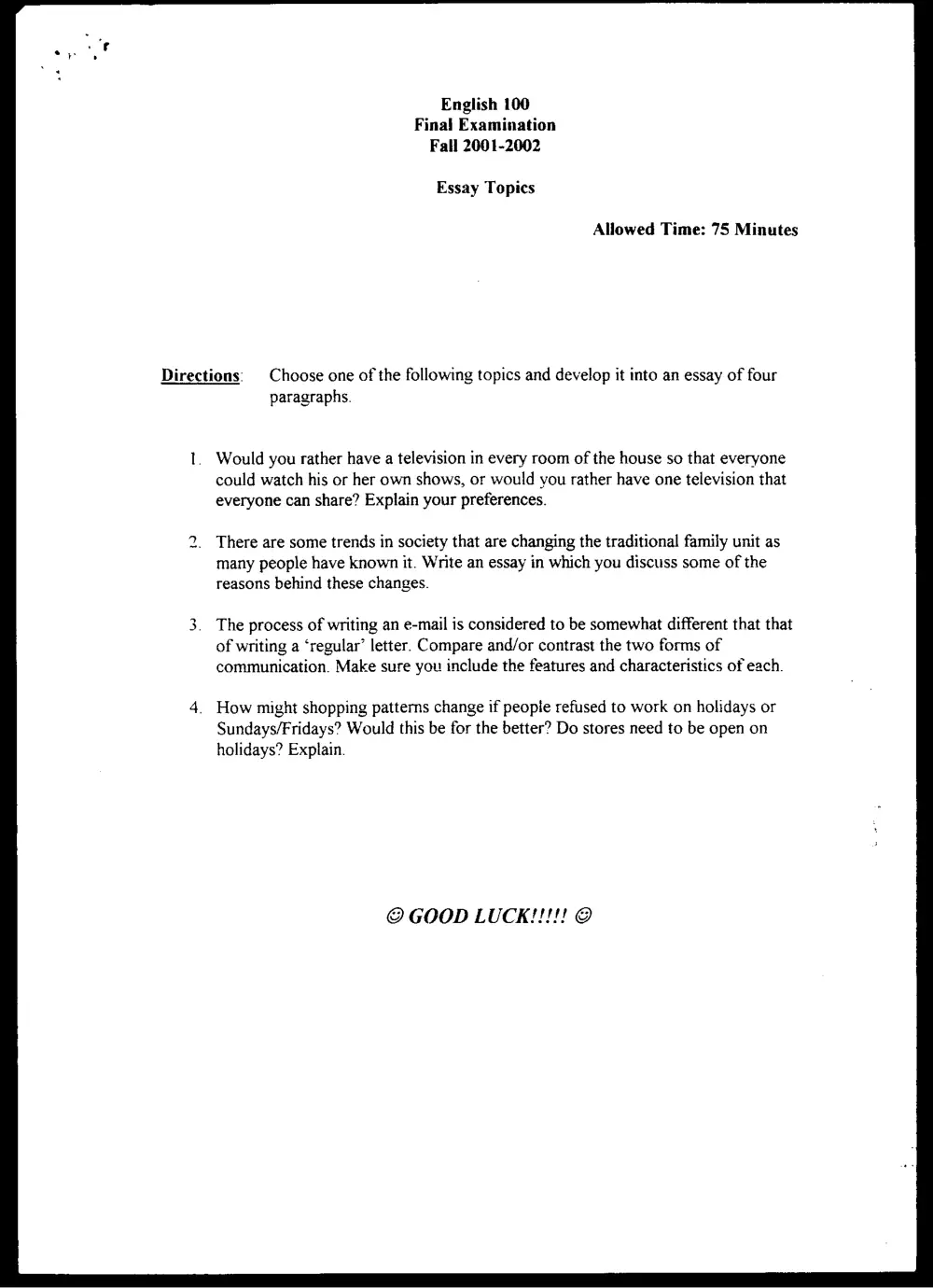
English 100
Final Examination
Fall 2001-2002
Essay Topics
Allowed Time: 75 Minutes
Directions: | Choose one of the following topics and develop it into an essay of four
paragraphs.
Would you rather have a television in every room of the house so that everyone
could watch his or her own shows, or would you rather have one television that
everyone can share? Explain your preferences.
There are some trends in society that are changing the traditional family unit as
many people have known it. Write an essay in which you discuss some of the
reasons behind these changes.
The process of writing an e-mail is considered to be somewhat different that that
of writing a ‘regular’ letter. Compare and/or contrast the two forms of
communication. Make sure you include the features and characteristics of each.
How might shopping patterns change if people refused to work on holidays or
Sundays/Fridays? Would this be for the better? Do stores need to be open on
holidays? Explain.