
ENG 100 Final, Fall 2003
American University of Beirut · Intensive English · 10 pages




More ENG 100 files
Show the text of this final exam
Sag ht
Libesca ft
OF Haeut j
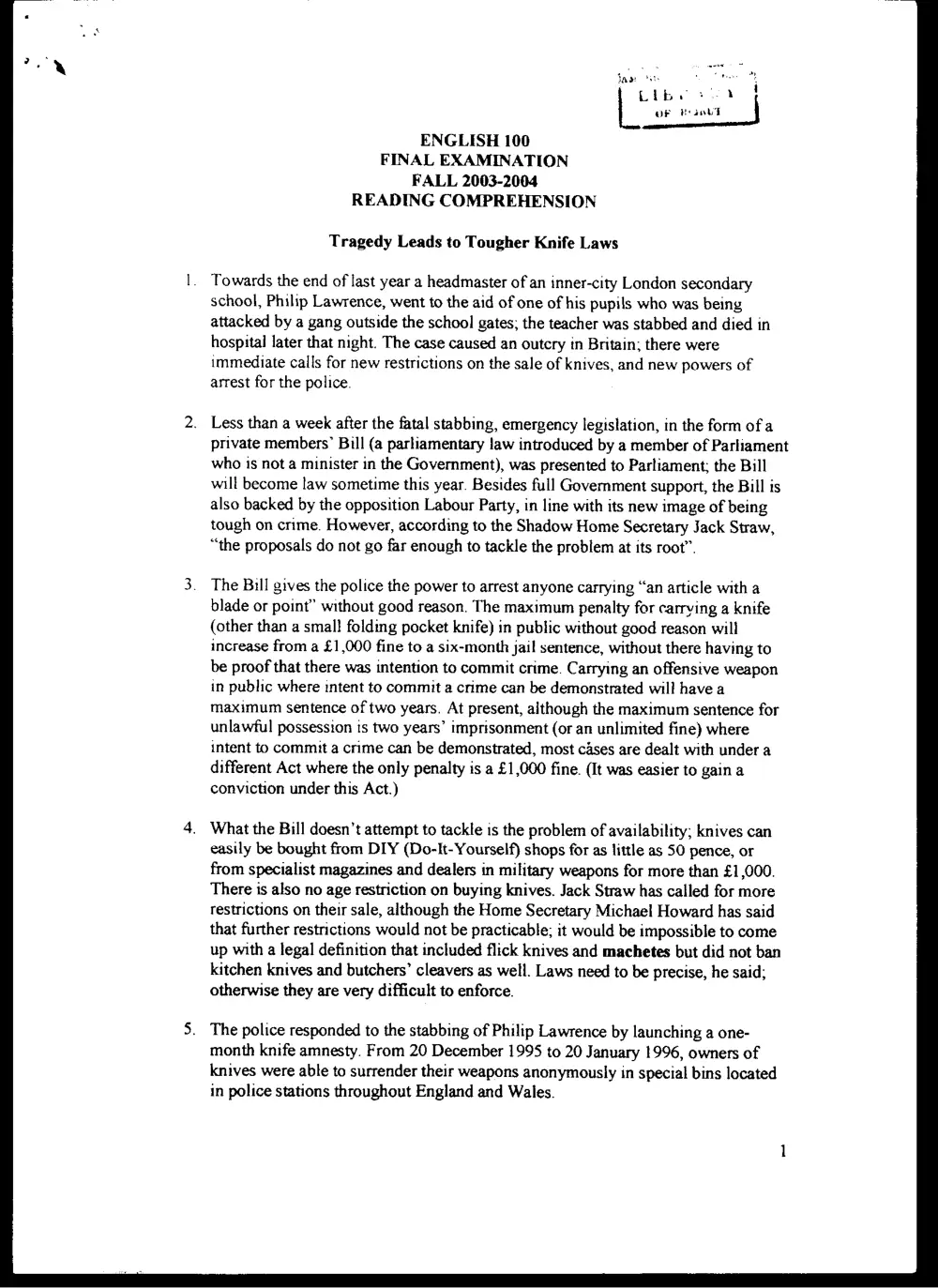
ENGLISH 100
FINAL EXAMINATION
FALL 2003-2004
READING COMPREHENSION
Tragedy Leads to Tougher Knife Laws
Towards the end of last year a headmaster of an inner-city London secondary
school, Philip Lawrence, went to the aid of one of his pupils who was being
attacked by a gang outside the school gates; the teacher was stabbed and died in
hospital later that night. The case caused an outcry in Britain; there were
immediate calls for new restrictions on the sale of knives, and new powers of
arrest for the police.
Less than a week after the fatal stabbing, emergency legislation, in the form of a
private members’ Bill (a parliamentary Jaw introduced by a member of Parliament
who 1s not a minister in the Government), was presented to Parliament; the Bill
will become law sometime this year. Besides full Government support, the Bill is
also backed by the opposition Labour Party, in line with its new image of being
tough on crime. However, according to the Shadow Home Secretary Jack Straw,
“the proposals do not go far enough to tackle the problem at its root”.
The Bill gives the police the power to arrest anyone carrying “an article with a
blade or point” without good reason. The maximum penalty for carrying a knife
(other than a smal! folding pocket knife) in public without good reason will
increase from a £1,000 fine to a six-month jail sentence, without there having to
be proof that there was intention to commit crime. Carrying an offensive weapon
in public where intent to commit a crime can be demonstrated will have a
maximum sentence of two years. At present, although the maximum sentence for
unlawful possession is two years’ imprisonment (or an unlimited fine) where
intent to commit a crime can be demonstrated, most cases are dealt with under a
different Act where the only penalty is a £1,000 fine. (It was easier to gain a
conviction under this Act.)
What the Bill doesn’t attempt to tackle is the problem of availability; knives can
easily be bought from DIY (Do-It-Yourself) shops for as little as 5O pence, or
from specialist magazines and dealers in military weapons for more than £1,000.
There is also no age restriction on buying knives. Jack Straw has called for more
restrictions on their sale, although the Home Secretary Michael Howard has said
that further restrictions would not be practicable; it would be impossible to come
up with a legal definition that included flick knives and machetes but did not ban
kitchen knives and butchers’ cleavers as well. Laws need to be precise, he said;
otherwise they are very difficult to enforce.
The police responded to the stabbing of Philip Lawrence by launching a one-
month knife amnesty. From 20 December 1995 to 20 January 1996, owners of
knives were able to surrender their weapons anonymously in special bins located
in police stations throughout England and Wales.
10.
1h.
apenas
ERIC oN UNIVERSE
LIBRAR Y
oy BEARCT
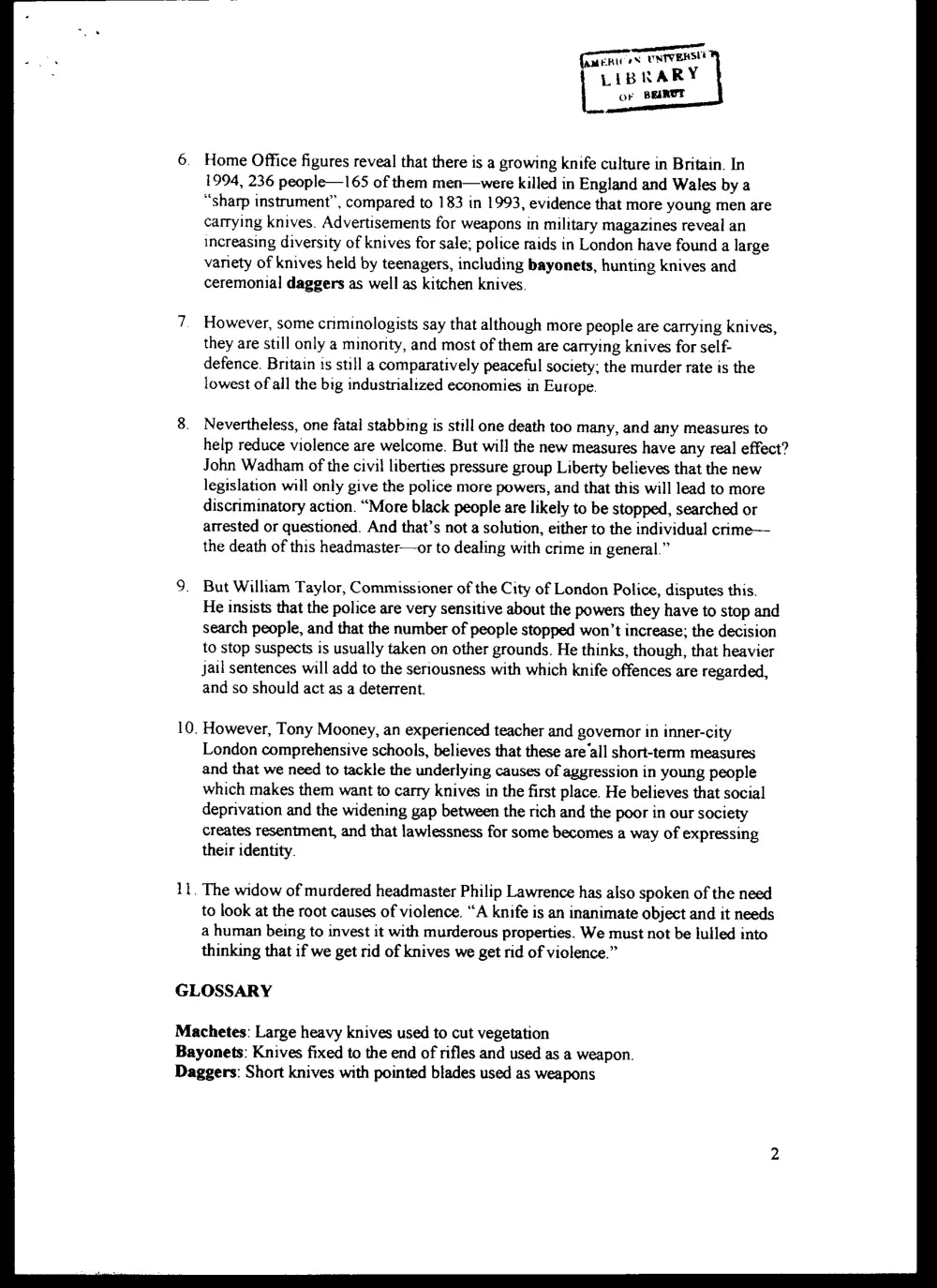
Home Office figures reveal that there is a growing knife culture in Britain. In
1994, 236 people—165 of them men—were killed in England and Wales by a
“sharp instrument’, compared to 183 in 1993, evidence that more young men are
carrying knives. Advertisements for weapons in military magazines reveal an
increasing diversity of knives for sale; police raids in London have found a large
variety of knives held by teenagers, including bayonets, hunting knives and
ceremonial daggers as well as kitchen knives.
However, some criminologists say that although more people are carrying knives,
they are still only a minority, and most of them are carrying knives for self-
defence. Britain is still a comparatively peaceful society; the murder rate is the
lowest of all the big industrialized economies in Europe.
Nevertheless, one fatal stabbing is still one death too many, and any measures to
help reduce violence are welcome. But will the new measures have any real effect?
John Wadham of the civil liberties pressure group Liberty believes that the new
legislation will only give the police more powers, and that this will lead to more
discriminatory action. “More black people are likely to be stopped, searched or
arrested or questioned. And that’s not a solution, either to the individual crime—
the death of this headmaster—or to dealing with crime in general.”
But William Taylor, Commissioner of the City of London Police, disputes this.
He insists that the police are very sensitive about the powers they have to stop and
search people, and that the number of people stopped won’t increase; the decision
to stop suspects is usually taken on other grounds. He thinks, though, that heavier
Jail sentences will add to the seriousness with which knife offences are regarded,
and so should act as a deterrent.
However, Tony Mooney, an experienced teacher and govemor in inner-city
London comprehensive schools, believes that these are‘all short-term measures
and that we need to tackle the underlying causes of aggression in young people
which makes them want to carry knives in the first place. He believes that social
deprivation and the widening gap between the rich and the poor in our society
creates resentment, and that lawlessness for some becomes a way of expressing
their identity.
The widow of murdered headmaster Philip Lawrence has also spoken of the need
to look at the root causes of violence. “A knife is an inanimate object and it needs
a human being to invest it with murderous properties. We must not be lulled into
thinking that if we get rid of knives we get rid of violence.”
GLOSSARY
Machetes: Large heavy knives used to cut vegetation
Bayonets: Knives fixed to the end of rifles and used as a weapon.
Daggers: Short knives with pointed blades used as weapons
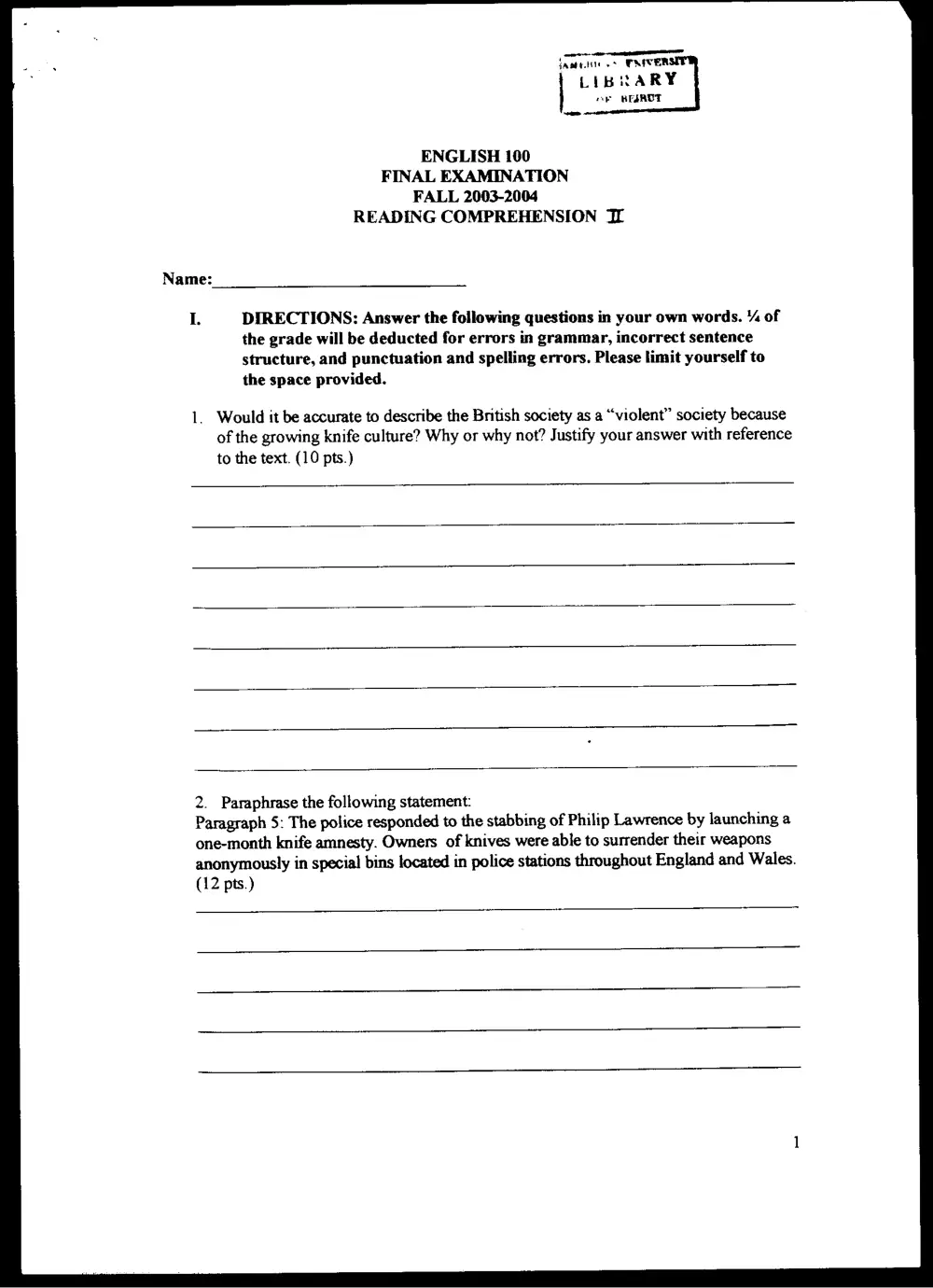
ENGLISH 100
FINAL EXAMINATION
FALL 2003-2004
READING COMPREHENSION JT
DIRECTIONS: Answer the following questions in your own words. % of
the grade will be deducted for errors in grammar, incorrect sentence
structure, and punctuation and spelling errors. Please limit yourself to
the space provided.
1. Would it be accurate to describe the British society as a “violent” society because
of the growing knife culture? Why or why not? Justify your answer with reference
to the text. (10 pts.)
2. Paraphrase the following statement:
Paragraph 5: The police responded to the stabbing of Philip Lawrence by launching a
one-month knife amnesty. Owners of knives were able to surrender their weapons
anonymously in special bins located in police stations throughout England and Wales.
(12 pts.)
mene
fasenic.\ ENPORRSIT
LIBRARY
OF BEIRUY
In paragraph 2, the author reports that a Bill was presented to the Parliament:
What does this Bill say? State the answer in your own words. (9 pts.)
. Do you think that the Bill has a good chance to pass and to become law? Why or
why not? Justify your answer with reference to the text. (9 pts.)
c. What are three problems with the Bill? Briefly describe each. (9 pts.)
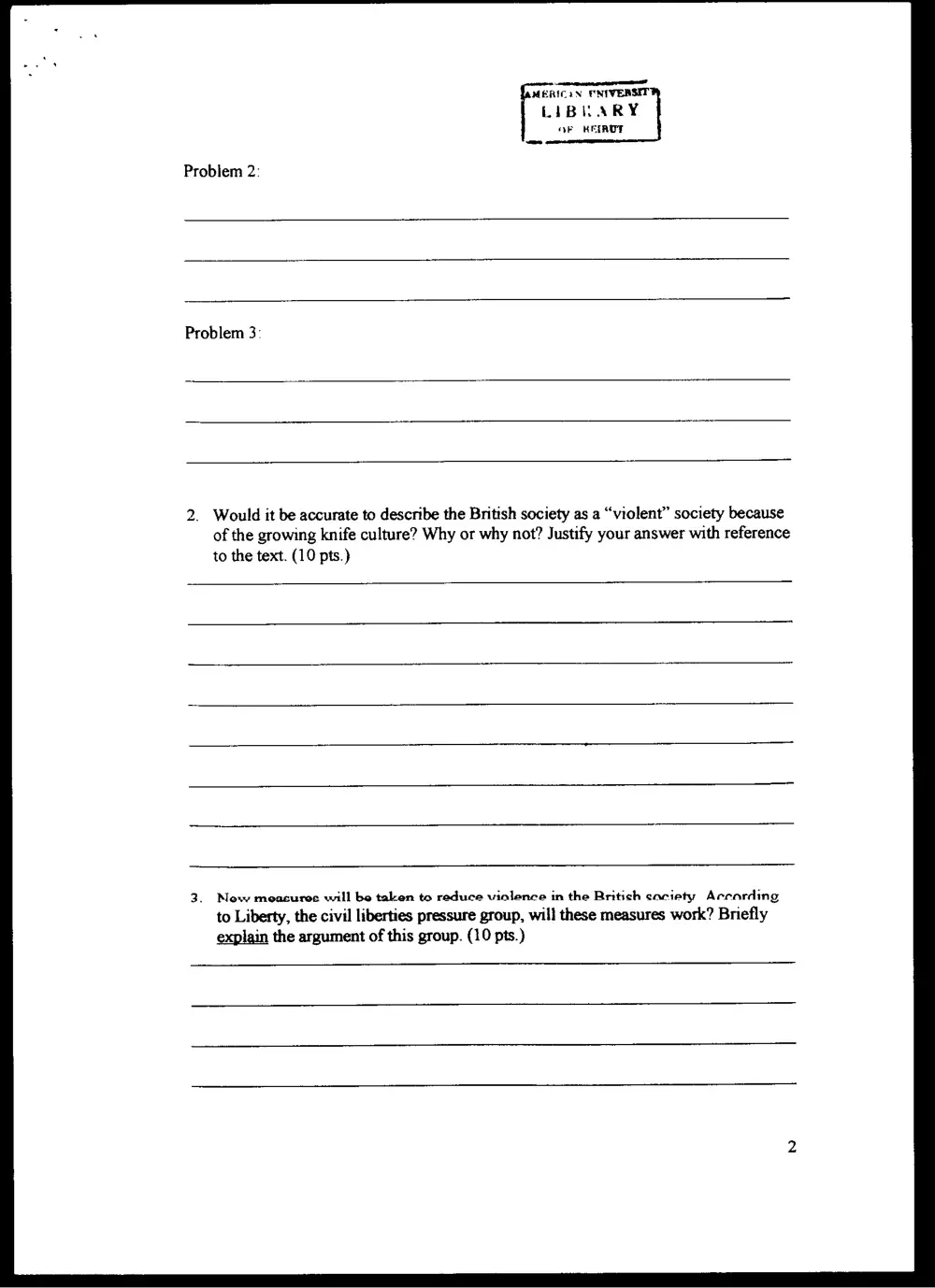
Problem 1:
Problem 2:
Problem 3:
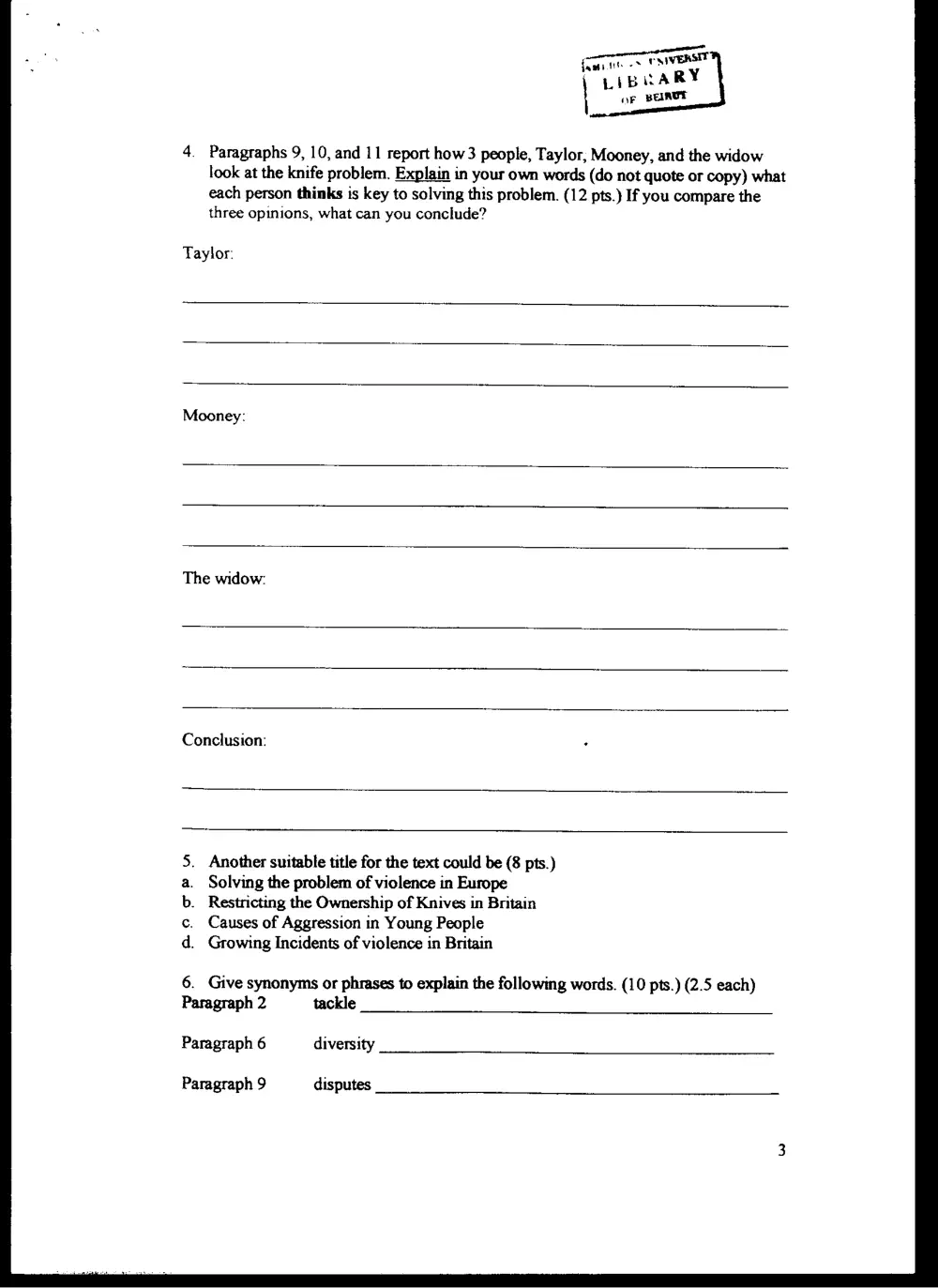
4. Paragraphs 9, 10, and 11 report how 3 people, Taylor, Mooney, and the widow
look at the knife problem. Explain in your own words (do not quote or copy) what
each person thinks is key to solving this problem. (12 pts.) If you compare the
three opinions, what can you conclude?
Taylor:
Mooney:
The widow:
Conclusion: .
Another suitable title for the text could be (8 pts.)
Solving the problem of violence in Europe
Restricting the Ownership of Knives in Britain
Causes of Aggression in Young People
Growing Incidents of violence in Britain
BOT PN
6. Give synonyms or phrases to explain the following words. (10 pts.) (2.5 each)
Paragraph 2 tackle
Paragraph 6 diversity
Paragraph 9 disputes
LIBRARY
Of BEIROY
Paragraph 9 deterrent
7. New measures will be taken to reduce violence in the British society. According
to Liberty, the civil liberties pressure group, will these measures work? Briefly
explain the argument of this group. (10 pts.)
8. a. Is the thesis statement stated or implied?
b. If stated, quote it and mention the paragraph and lines. If implied, generate (i.e.,
write) one yourself. (11 pts.)
OF ROTROT
ENGLISH 100
FINAL EXAMINATION
FALL 2003-2004
READING COMPREHENSION I
DIRECTIONS: Answer the following questions in your own words. % of
the grade will be deducted for errors in grammar, incorrect sentence
structure, and punctuation and spelling errors. Please limit yourself to
the space provided.
. In paragraph 2, the author reports that a Bill was presented to the Parliament:
What does this Bill say? State the answer in your own words. (9 pts.)
. Do you think that the Bill has a good chance to pass and to become law? Why or
why not? Justify your answer with reference to the text. (9 pts.)
c. What are three problems with the Bill? Briefly describe each. (9 pts.)
Problem 1:
enone eeaemmeenal
MERIC IN UNIVERSIT
LIBLARY
OF KEIRUT
2. Would it be accurate to describe the British society as a “violent” society because
of the growing knife culture? Why or why not? Justify your answer with reference
to the text. (10 pts.)
3. New meacuree will bo taken to reduce violence in the British saciety According
to Liberty, the civil liberties pressure group, will these measures work? Briefly
explain the argument of this group. (10 pts.)
-ite PR nares.
. LiBRARY
OF BEIRUT
4. Paragraphs 9, 10, and 11 report how 3 people, Taylor, Mooney, and the widow
look at the knife problem. Explain in your own words (do not quote or copy) what
each person thinks is key to solving this problem. (12 pts.) If you compare the
three opinions, what can you conclude?
Taylor:
Mooney:
The widow:
Conclusion:
a ee ee
fiancee 2 tNev RRS
LiBbAARY
oF BEIRUT
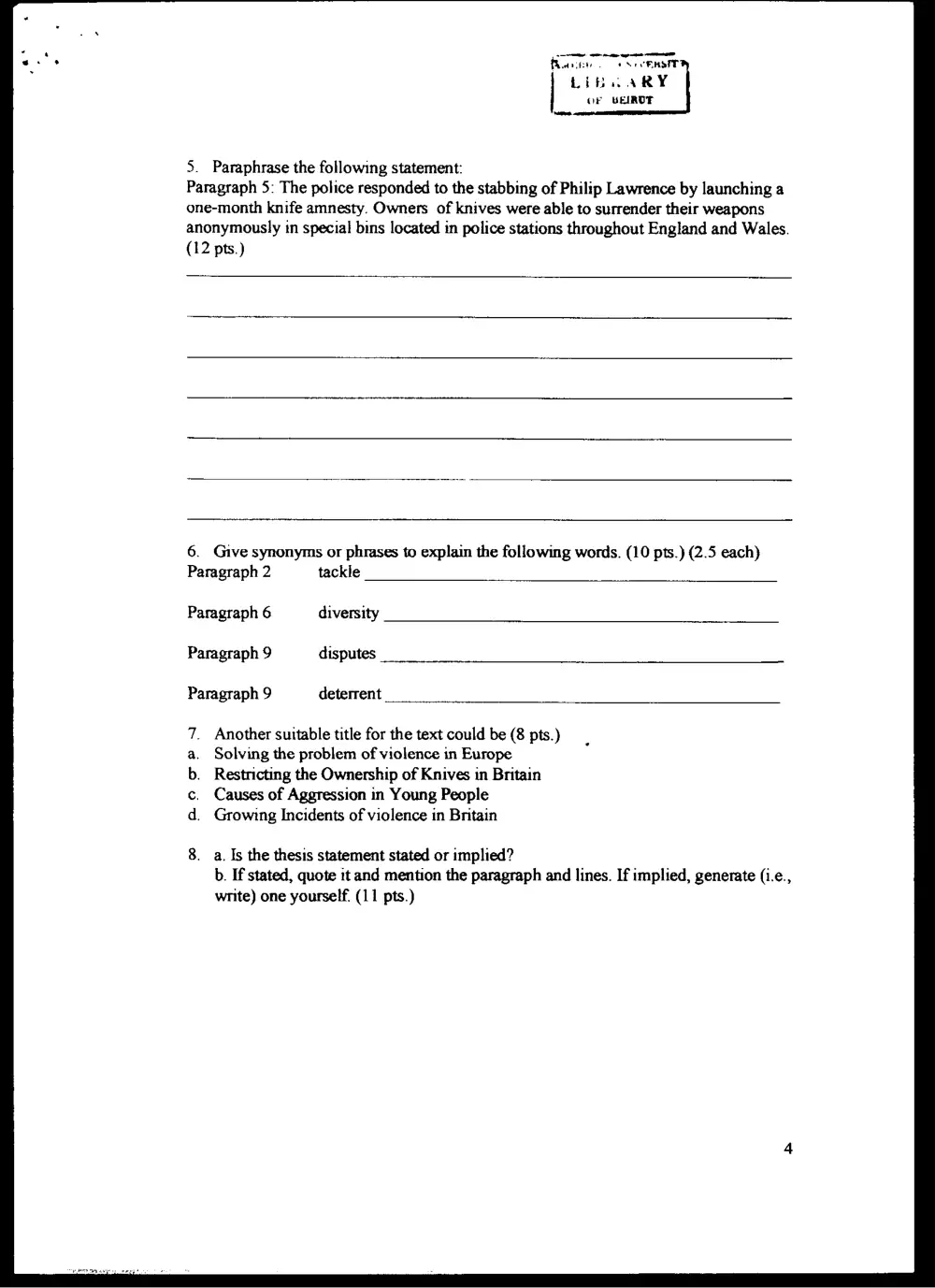
5. Paraphrase the following statement:
Paragraph 5: The police responded to the stabbing of Philip Lawrence by launching a
one-month knife amnesty. Owners of knives were able to surrender their weapons
anonymously in special bins located in police stations throughout England and Wales.
(12 pts.)
6. Give synonyms or phrases to explain the following words. (10 pts.) (2.5 each)
Paragraph 2 tackle
Paragraph 6 diversity
Paragraph 9 disputes
Paragraph 9 deterrent
. Another suitable title for the text could be (8 pts.)
Solving the problem of violence in Europe
. Restricting the Ownership of Knives in Britain
. Causes of Aggression in Young People
. Growing Incidents of violence in Britain
. a. Is the thesis statement stated or implied?
b. If stated, quote it and mention the paragraph and lines. If implied, generate (i.e.,
write) one yourself. (11 pts.)