
ENG 100 Final, Spring 2000
American University of Beirut · Intensive English · 7 pages



More ENG 100 files
Show the text of this final exam
English 100
Final Examination
Spring 2000-2001
Reading Comprehension
Time Allowed: 75 Minutes
The Friendship Bond
by
Mary Brown Parlee
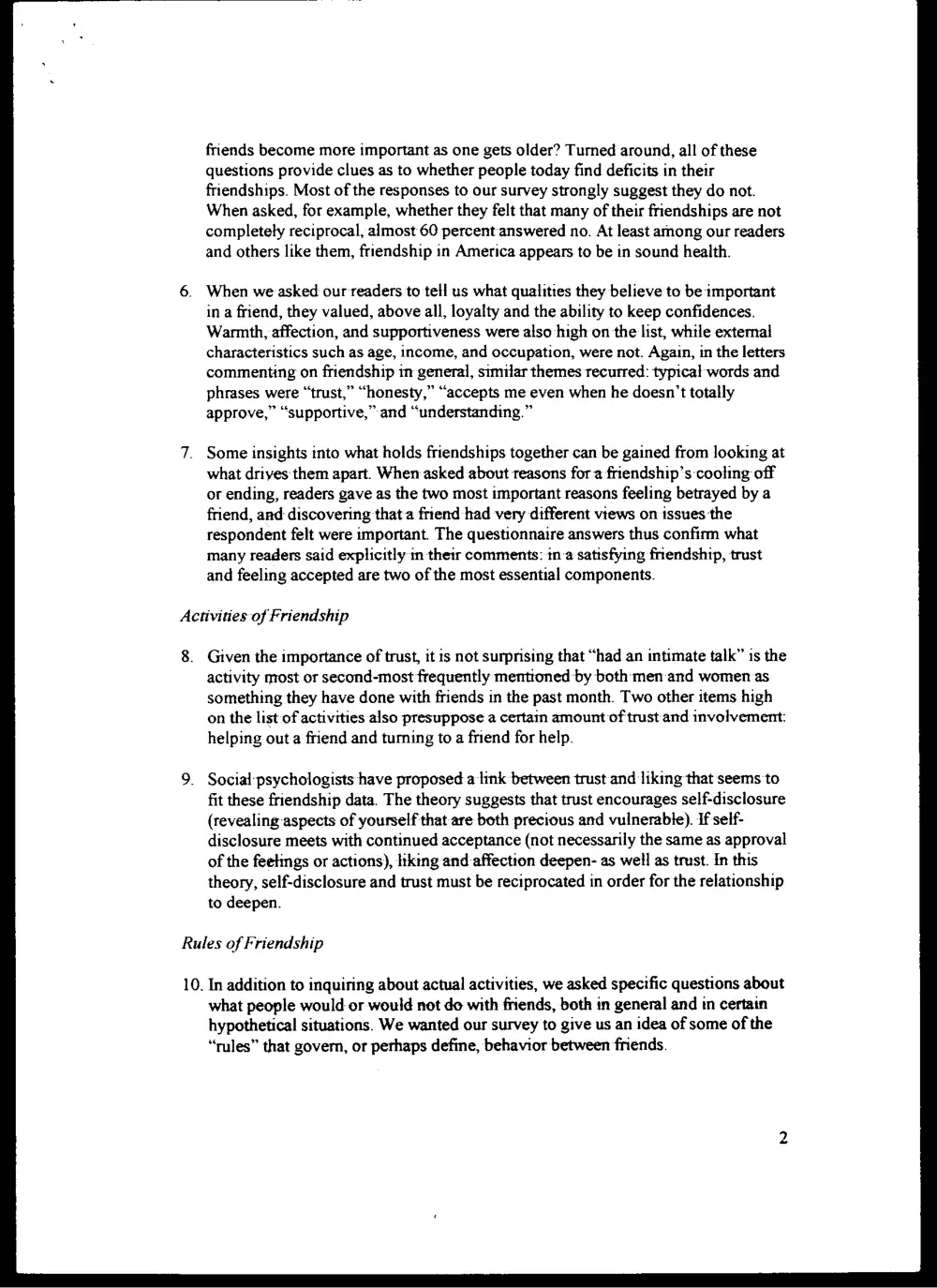
More than forty thousand readers told us what they looked for in close
friendships, what they expected of friends, what they were willing to give in
return, and how satisfied they were with the quality of their friendships. The
results give cold comfort to social critics.
Friendship appears to be-a unique form of human-bending. Unlike marriage or the
ties that bind parents and children, it is not defined or regulated by law. Unlike
other social roles that we are expected to play—as citizens, employees, members
of professional societies and other organizations—it has its own subjective
rationale, which is to enhance feelings of warmth, trust, love, and affection
between two people.
The questionnaire on friendship appeared in the March issue of Psychology
Today. The findings confirm that issues of trust and betrayal are central to
friendship. They also suggest that our readers do not look for friends only among
those who are most like them, but find many who differ m race, sexual
preference, religion, and ethnic background. Arguably the most important
conclusion that emerges from the data, however, is not something that we
found—but what we did not.
Social critics have pointed to the dislocation and isolation that they think grows
out of the high mobility rate among Americans and a loss of community supports.
Ever since the work of sociologist Emile Durkheim, they have described the
impersonality and anomie of life in modern cities, where increasing numbers of
people choose to live alone. They have written a good dea! about a trend toward
self-indutgence and lack of commitment in our society, which could very well
lead to tensions in friendships just as it may be contributing to the divorce rate
among married couples.
. In the questionnaire responses, we looked for signs of dissatisfaction with the
quality of people’s friendships, but we found few. Do people confide in their
friends these days? Do they tend to tum to them in times of emotional crisis? Do
friends become more important as one gets older? Turned around, all of these
questions provide clues as to whether people today find deficits in their
friendships. Most of the responses to our survey strongly suggest they do not.
When asked, for example, whether they felt that many of their friendships are not
completely reciprocal, almost 60 percent answered no. At least arnong our readers
and others like them, friendship in America appears to be in sound health.
6. When we asked our readers to tell us what qualities they believe to be important
in a friend, they valued, above all, loyalty and the ability to keep confidences.
Warmth, affection, and supportiveness were also high on the list, while extemal
characteristics such as age, income, and occupation, were not. Again, in the letters
commenting on friendship in general, similar themes recurred: typical words and
phrases were “trust,” “honesty,” “accepts me even when he doesn’t totally
approve,” “supportive,” and “understanding.”
7. Some insights into what holds friendships together can be gained from looking at
what drives them apart. When asked about reasons for a friendship’s cooling off
or ending, readers gave as the two most important reasons feeling betrayed by a
friend, and discovering that a friend had very different views on issues the
respondent felt were important. The questionnaire answers thus confirm what
many readers said explicitly in their comments: tn a satisfying friendship, trust
and feeling accepted are two of the most essential components.
Activities of Friendship
8. Given the importance of trust, it is not surprising that “had an intimate talk” is the
activity most or second-most frequently mentioned by both men:and women as
something they have done with friends in the past month. Two other items high
on the list of activities also presuppose a certain amount of trust and involvement:
helping outa friend and tuming to a friend for help.
9. Social-psychologists have proposed a tink between trust and liking that seems to
fit these friendship data. The theory suggests that trust encourages self-disclosure
(revealing-aspects of yourself that are both precious and vulnerable). If self-
disclosure meets with continued acceptance (not necessarily the same as approval
of the feetings or actions), liking and-affection deepen- as well as trust. In this
theory, self-disclosure and trust must be reciprocated in order for the relationship
to deepen.
Rules of Friendship
10. In addition to inquiring about actual activities, we asked specific questions about
what people would or would not do with friends, both in general and in certain
hypothetical situations. We wanted our survey to give us an idea of some of the
“rules” that govern, or pethaps define, behavior between frends.
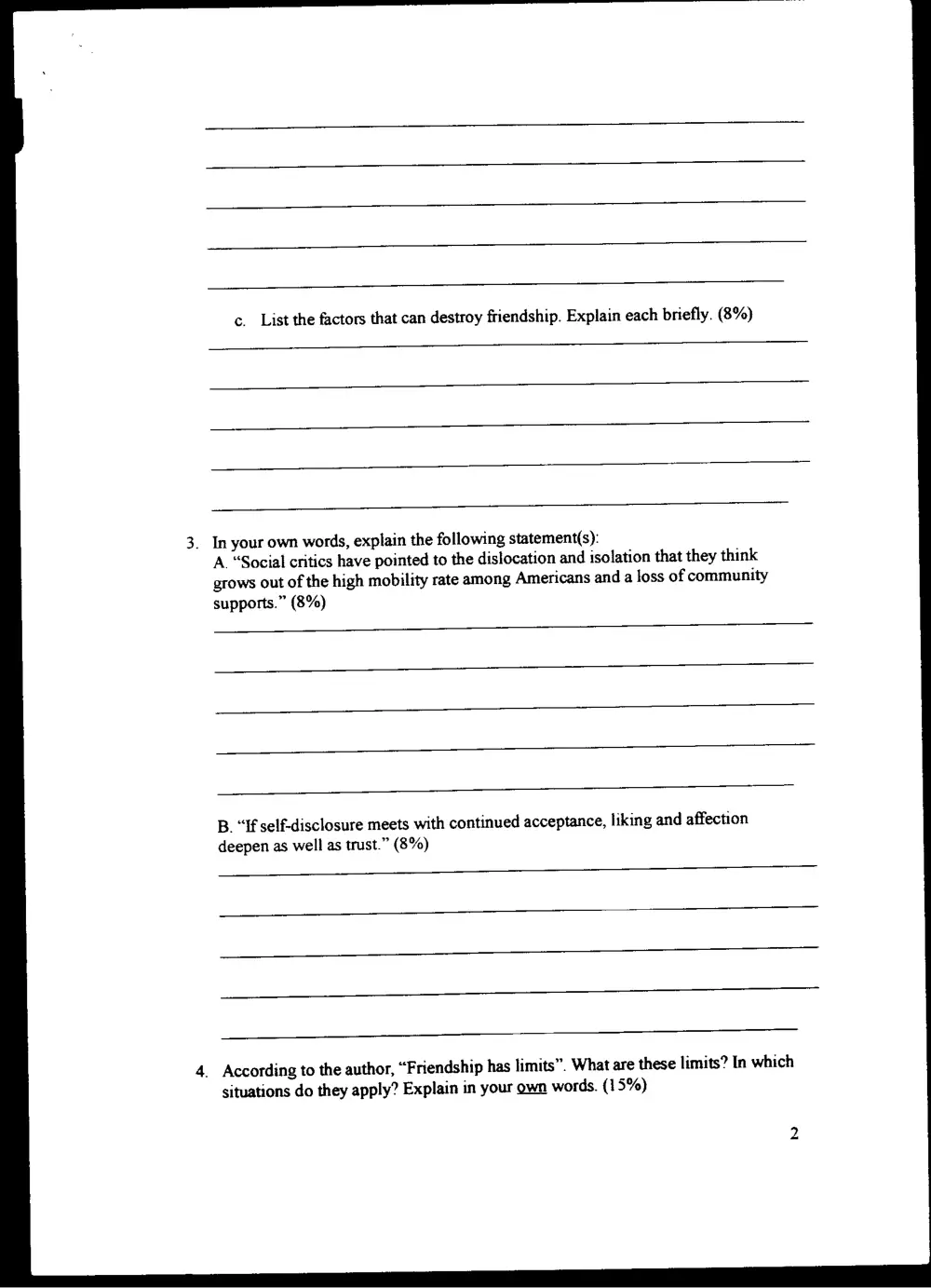
c. List the factors that can destroy friendship. Explain each briefly. (8%)
3. In your own words, explain the following statement(s):
A. “Social critics have pointed to the dislocation and isolation that they think
grows out of the high mobility rate among Americans and a loss of community
supports.” (8%)
B. “If self-disclosure meets with continued acceptance, liking and affection
deepen as well as trust.” (8%)
4. According to the author, “Friendship has limits”. What are these limits? In which
situations do they apply? Explain in your own words. (15%)
5. In the concluding statement, the author points out an inconsistency. What is it?
How would you explain it? (14%)
6. If this questionnaire were conducted in Lebanon or the Arab world, would you
expect the conclusions about friendship to be similar to or different from those in
the article? Justify your answer with reference to the article and/or your personal
experience. Write a short paragraph of 6-8 sentences. (20%)
11.
12.
13.
14.
1S.
As both theory and the data suggest, one rule of friendship is that friends confide
in each other, sharing intimate aspects of their personal lives and feelings. Perhaps
most significantly, bad as well-as good news can be shared. Even though in our
society, one’s success is often equated with success at work, 89 percent of our
sample said: they would tell a close friend about a failure at work.
Furthermore, over two-thirds (68 percent) said that if they had a terminal illness,
they would tell a friend. Eighty-seven percent of the respondents say they talk
with friends about sexual activities (60 percent discussing activities in general, 27
percent in detail).
Our respondents clearly indicated that in some situations, the rules of friendship
involve the right to ask for help-(presumably the obligation to help a friend is also
implicitly acknowledged). When asked who they would tum to first in a crisis,
over half.(51 percent) said they would turn to friends before family. This was true
for all subgroups, even though older people in the sample said they tend to rely
more on family and professional counsetors in a crisis than do the younger age
groups, and a higher proportion of men than women said they go it alone.
Yet friendship has limits. Only 10 percent of the sample said they thought a friend
should help another commit suicide if the friend wanted to but was too feeble to
do it alone-(41 percent said no and 36-percent were opposed-to suicide.)
In short, there are no striking contradictions between people’s descriptions of
actual friendships, their beliefs about friendship in general, and-their perception: of
the rules that apply to these relationships. This consistency, and the glowing
descriptions of friends and friendship we received, suggest that our readers-are
satisfied with their friendships, even though 67 percent of the respondents also
acknowledge feeling-lonely “sometimes” or “often.”
from Psychology Today Magazine
English 100
Final Examination
Spring 2000-2001
Reading Comprehension
Time Allowed: 75 Minutes
Name
Section
Instructor’s Name
The Friendship Bond
by
Mary Brown Parlee
1. The author, M. Parlee, explores the concept of friendship. In your own words,
present her definition. (15%)
2. The study discusses “rules” that govern behavior between friends.
a. What are these rules? List them and define each briefly. (6%)
b. Do you believe that friendship should be mled by codes and principles?
Explain (6%)
English 100
Final Examination
Spring 2000-2001
Essay Topics
Allowed Time: 75 Minutes
Directions: Choose one of the following topics and develop it into an essay of four
paragraphs.
1. Many young people have friends from both sexes. Do you think the quality of
friendship varies according-to sex? Write an essay comparing and contrasting the
two kinds of friendships.
2. In this part of the world, some teenagers rebel against family traditions and follow
westem styles instead. Write an essay discussing why they prefer to do that.
Illustrate with examples.
3. “The liar’s punishment... is that he cannot believe anyone else.” — George
Berard Shaw.
What are some of the consequences of lying? Support by giving examples.