
ENG 100 Final, Spring 2003
American University of Beirut · Intensive English · 10 pages

More ENG 100 files
Show the text of this final exam
ENGLISH 100
FINAL EXAMINATION
SPRING 2002-2003
READING COMPREHENSION
Types of Memory
b
Nick Kenny
Most readers will be familiar with the experience of looking up a telephone
number and then repeating it to themselves for the time it takes to sit down and
dial the number. As luck would have it, this is invariably the occasion for
someone to ask a distracting question with the result that the number is forgotten
and has to be looked up all over again. Equally familtar and irritating is when you
need the same number twenty-four hours later and find that you are quite unable
to remember it.
These experiences reflect the widely recognized view among psychologists that
with verbal learning the ability to hold information for brief periods (usually up to
30 seconds in duration) demands fairly constant repetition, and any distraction or
interruption is likely to severely impede that ability. Moreover, it has been
established that our capacity for short-term retention is remarkably consistent, and
that most people expertence some breakdown in retention as soon as the number
of items or chunks of information exceeds seven.
. This type of memory, known as ‘short-term memory’, is clearly different from
‘long-term memory’, which is our capacity for recall of information minutes,
weeks and years after the original input. Furthermore, the difference is not simply
one of duration. Unlike short-term memory which is limited in capacity, long-
term memory is seemingly inexhaustible and can accommodate any amount of
new information. Not surprisingly, this new information can be stored at a price;
it is generally acknowledged that we need to work much harder to commit
information to long-term memory; and the type of repetition we described as
being essential to short term retention may not be adequate for long term
retention.
Our ‘mental lexicon’ is highly organized and efficient. Were storage of
information haphazard, we would be forced to search in a random fashion to
retrieve words; this simply is not feasible when one considers the speed at which
we need to recognize and recall. Furthermore, it is extremely improbable that we
organize words in the brain as a dictionary does. Imagine you were trying to recall
the word ‘nozzle’ for instance. It is unlikely that you would retrieve the word
PRS TNE re ay
LIBRARY
OF BEIRUT
“noxious” (which appears next to ‘nozzle’ in the dictionary) in place of the target
word
Some very interesting experiments carried out by Brown and McNeil exemplify
this point forcefully and give us clues about lexical organization. The
experimenters gave testees definitions of low frequency vocabulary items and
asked them to name the item. One definition was ‘A navigational instrument used
in measuring angular distances, especially the altitude of the sun, moon and stars
at sea’. Some testees were able to supply the correct answer which was ‘sextant’,
but the researchers were more interested in the testees who had the answer ‘on the
tip of their tongues’. Some gave the answer ‘compass’, which seemed to indicate
that they had accessed the right semantic field but found the wrong item. Others
had a very clear idea of the ‘shape’ of the item, and were often able to say how
many syllables it had, what the first letter was, etc. It seems, then, that these
systems are interrelated: at a very basic level there appears to be a phonological
system, a system of meaning relations and a spelling system.
One way in which researchers investigate how the mental lexicon is organized is
by comparing the speed at which people are able to recall items. It is generally
accepted that if certain types of prompts can be answered more quickly than
others, then this will reflect the lexical system. Freedman and Loftus asked testees
to perform two different types of tasks: e.g.
1, Name a fruit that begins with a ‘p’.
2. Name a word beginning with a ‘p’ that is a fruit.
Testees were able to answer the first type of question more quickly than the
second. This seems to indicate that ‘fruits beginning with p’ are categorized under
‘fruit’ rather than under a ‘words beginning with p’ heading. Furthermore,
experimenters discovered in subsequent tests that once testees had access to the
‘fruit’ category, they were able to find other fruits more quickly. This seems to
provide further evidence that semantically related items are ‘stored together’.
Most researchers appear to agree that items are arranged in a series of associative
networks.
We also have to consider other variables which affect storage. One important
factor here is ‘word frequency’: items which occur most frequently are also easily
recognized and retrieved. Imagine a pile of cards, each representing an item of
vocabulary. In this system the most frequently used words are ‘at the top of the
pile’, and therefore easier to retrieve. ‘Recency of use’ is another variable, and, to
retum to the analogy of the pile, one can imagine words most recently used being
at the top. These variables are concerned with the use of items, but it is also
important to consider when items were first learnt. Imagine a pile of words
organized chronologically: the words learnt on the first day of a language course
would be at one extreme and those most recently learnt at the other.
OF Eni
ERICAN UNTVERSIT’
LIBRAR |
Clearly, native speakers do not acquire all their vocabulary in lexical sets, but
rather acquire items in a haphazard, chronological fashion, generally in a fairly
predictable order of frequency. However, native speakers have many years in
which to build up a comprehensive lexicon, whereas foreign learners are limited
in this respect. Exploiting our present knowledge of storage systems to the full
should allow us to attempt to speed up the learning process and facilitate storage.
Taken from Proficiency Passkey
ENLISH 100
FINAL EXAMINATION
SPRING 2002-2003
Reading Comprehension
Time Allowed: 75 Minutes
Types of Memory
by
Nick Kenny
Name
Section
Instructor's Name
Part I; Multiple Choice: Reading Comprehension and Vocabulary(24%)
Directions: Circle the letter that best completes each of the following:
1. The word ‘impede (Paragraph2, line4) is closest in meaning to
a. concentrate
b. obstruct
c. discriminate
d. diffuse
2. The word ‘sextant’ most likely means a(n) .
a. navigational instrument
b. associative network
¢. compass
d. semantic field
3. The tone of the passage is
a. neutral
b. sarcastic
c. humorous
d. ironic
4. Acquiring vocabulary for native and non-native speakers is .
a. similar
b. different
justify your choice:
Part II: Short Answer Questions (76%)
Directions: In your own words, answer each of the following questions. Be sure to use
correct sentence structure, punctuation, and spelling. Please limit yourself to the space
provided.
1. Explain the meaning of the following expression, “Not surprisingly, this new
information can be stored at a price...” (paragraph 3, line 6) (7%)
2. What are the conclusions which can be made from the research that has been
conducted by the following: (14%)
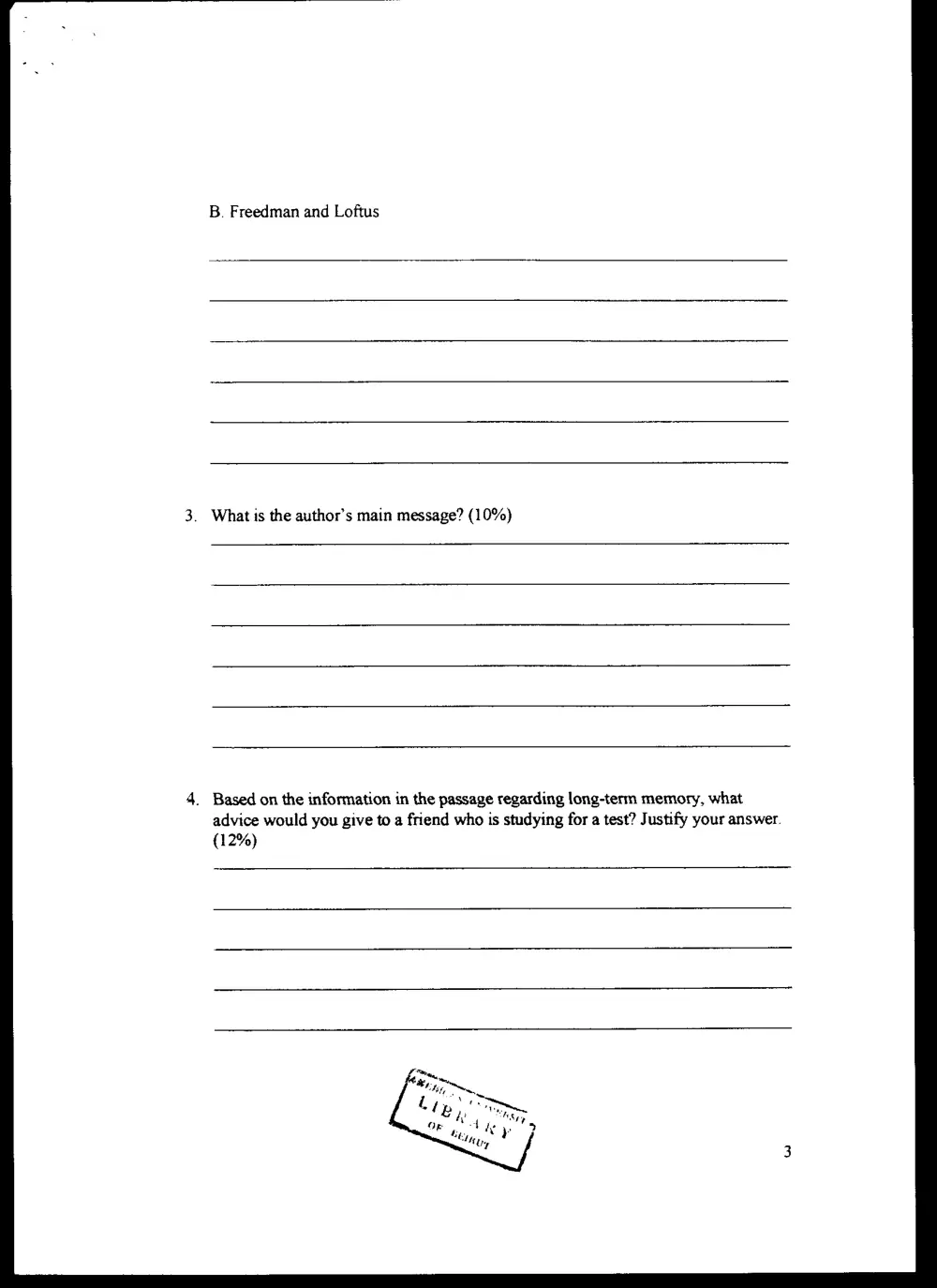
A. Brown and McNeil
B. Freedman and Loftus
3. What is the author’s main message? (10%)
4. Based on the information in the passage regarding long-term memory, what
advice would you give to a friend who is studying for a test? Justify your answer.
(12%)
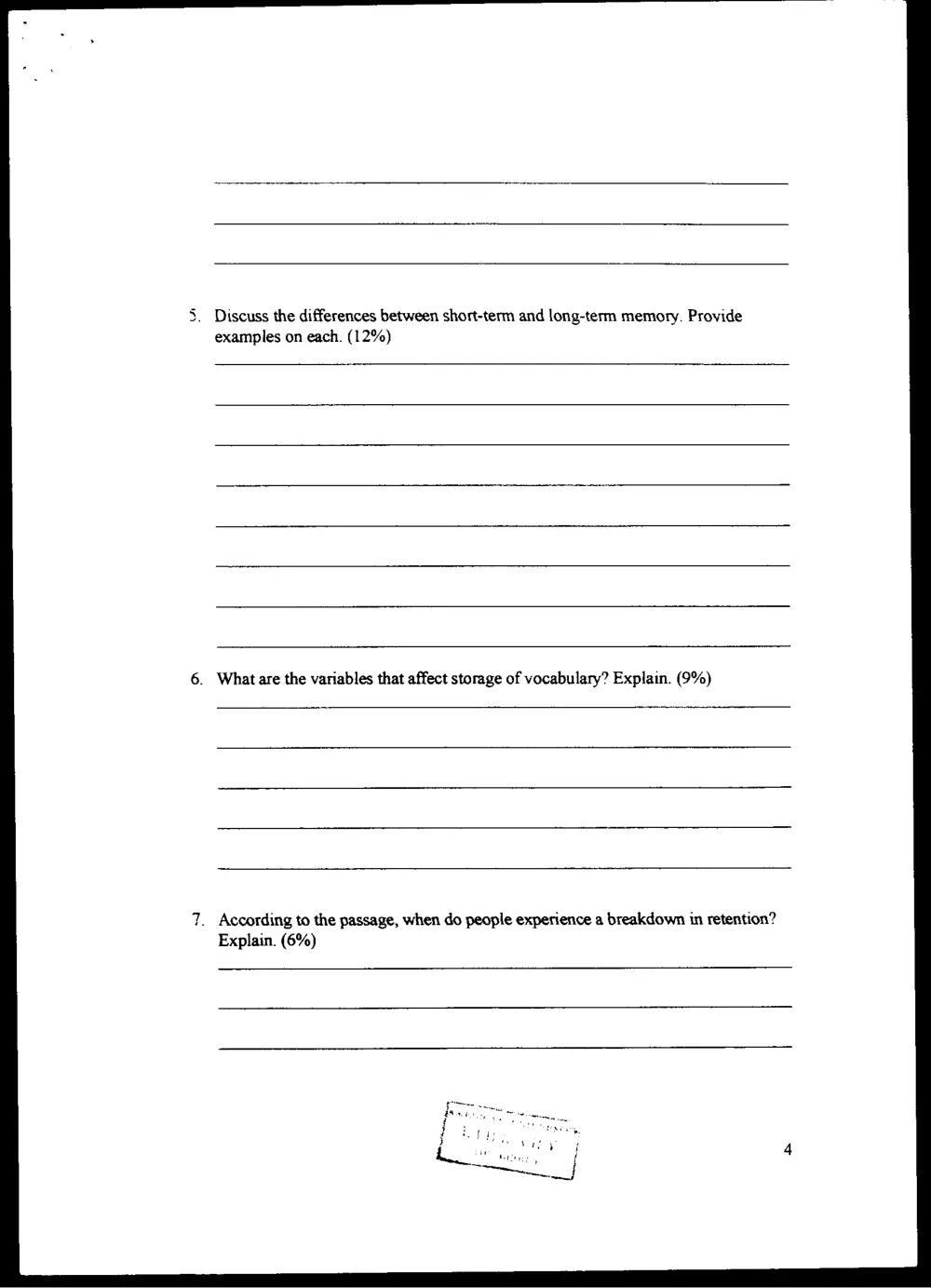
Discuss the differences between short-term and long-term memory. Provide
examples on each. (12%)
. What are the variables that affect storage of vocabulary? Explain. (9%)
According to the passage, when do people experience a breakdown in retention?
Explain. (6%)
8. Give examples of two types of development used in this passage. (6%)
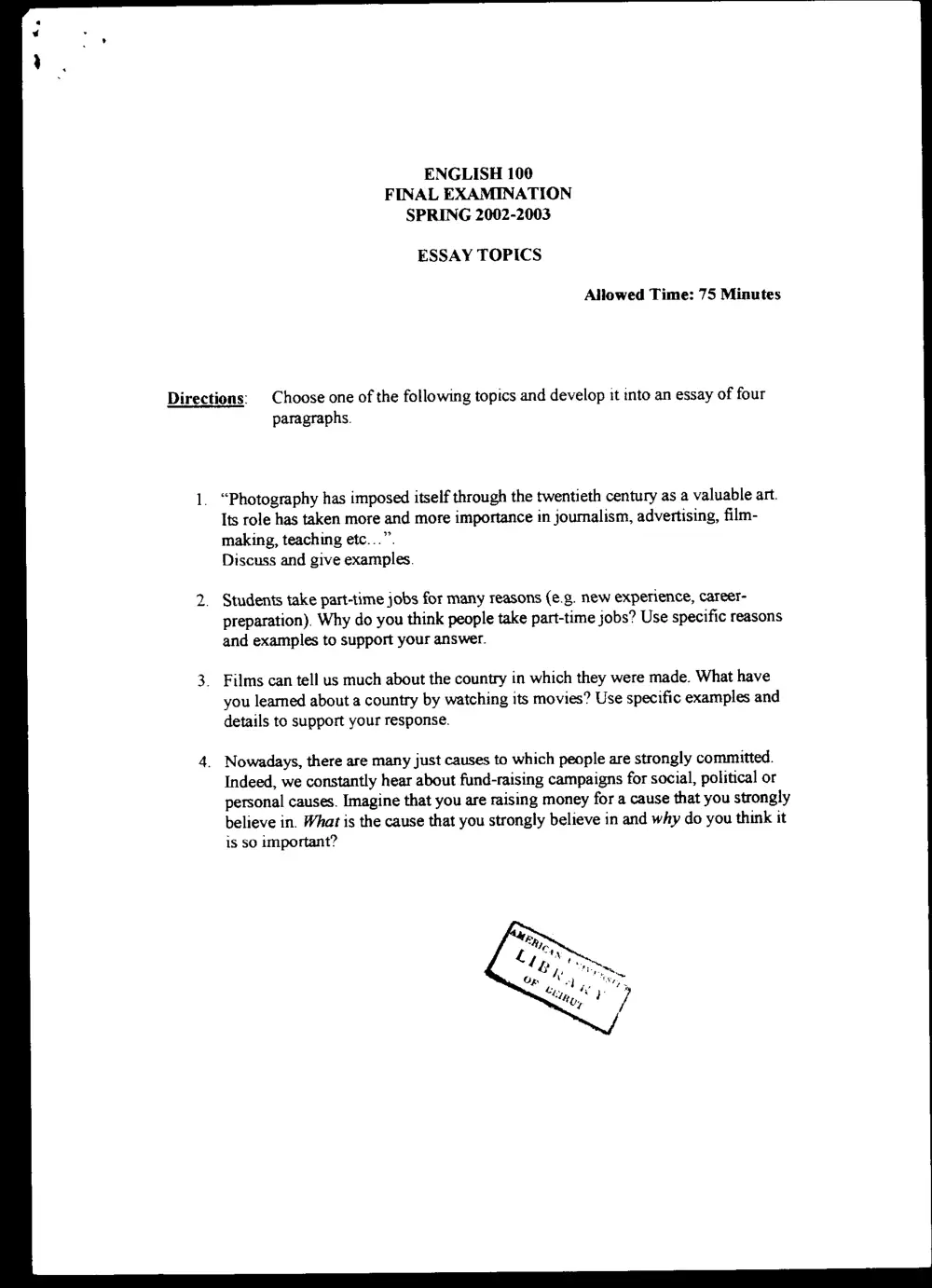
ENGLISH 100
FINAL EXAMINATION
SPRING 2002-2003
ESSAY TOPICS
Allowed Time: 75 Minutes
Directions: | Choose one of the following topics and develop it into an essay of four
paragraphs.
1. “Photography has imposed itself through the twentieth century as a valuable art.
Its role has taken more and more importance in journalism, advertising, film-
making, teaching etc...”
Discuss and give examples.
Students take part-time jobs for many reasons (e.g. new experience, career-
preparation). Why do you think people take part-time jobs? Use specific reasons
and examples to support your answer.
_ Films can tell us much about the country in which they were made. What have
you learned about a country by watching its movies? Use specific examples and
details to support your response.
. Nowadays, there are many just causes to which people are strongly committed.
Indeed, we constantly hear about fund-raising campaigns for social, political or
personal causes. Imagine that you are raising money for a cause that you strongly
believe in. What is the cause that you strongly believe in and why do you think it
is so important?
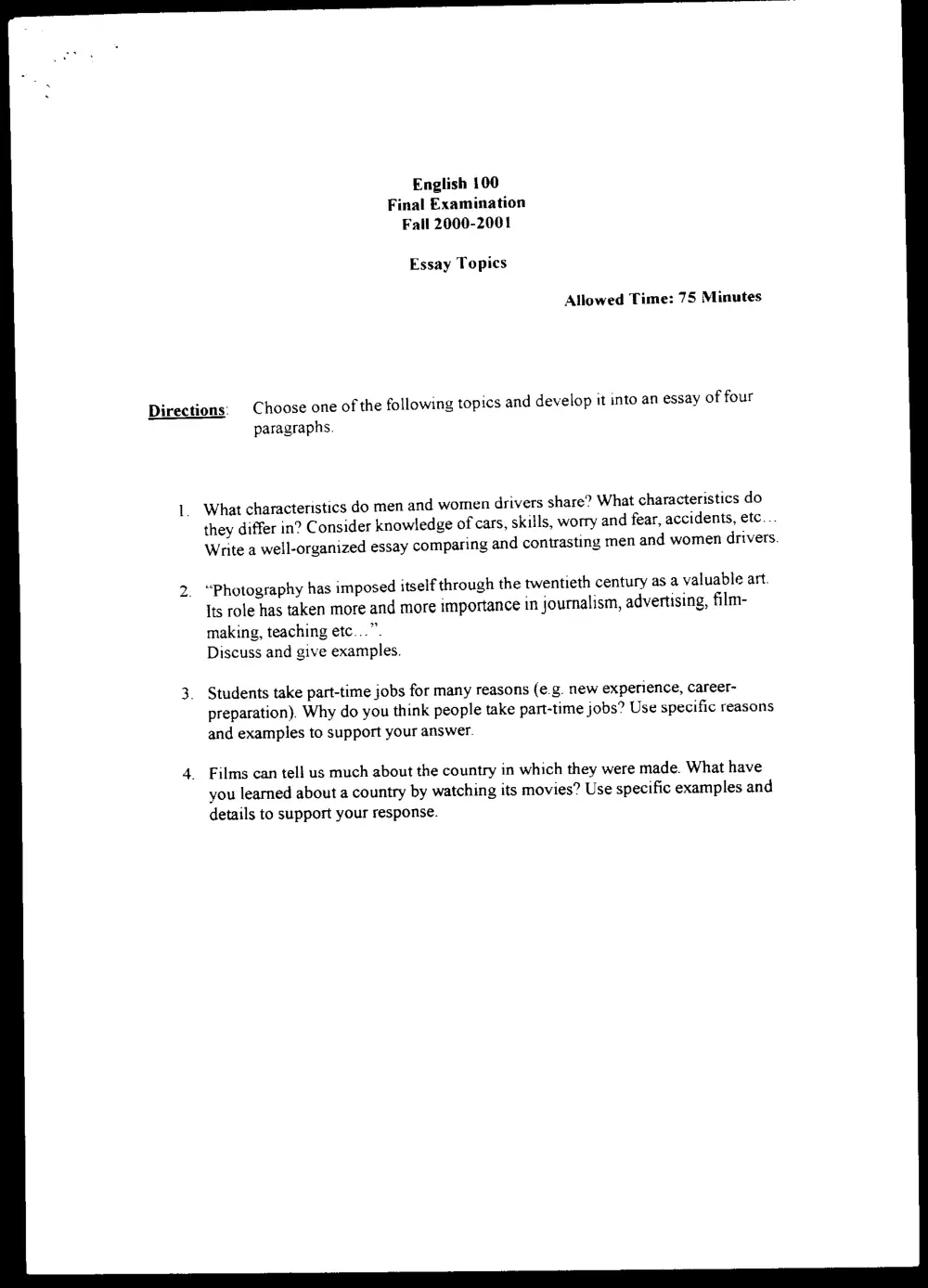
English 100
Final Examination
Fall 2000-2001
Essay Topics
Allowed Time: 75 Minutes
Directions: Choose one of the following topics and develop it into an essay of four
1.
paragraphs.
What characteristics do men and women drivers share? What characteristics do
they differ in? Consider knowledge of cars, skills, worry and fear, accidents, etc...
Write a well-organized essay comparing and contrasting men and women drivers.
“Photography has imposed itself through the twentieth century as a valuable art.
Its role has taken more and more importance in journalism, advertising, film-
making, teaching etc...”.
Discuss and give examples.
Students take part-time jobs for many reasons (e.g. new experience, career-
preparation). Why do you think people take part-time jobs? Use specific reasons
and examples to support your answer.
Films can tell us much about the country in which they were made. What have
you learned about a country by watching its movies? Use specific examples and
details to support your response.