
ENG 204 Final, Fall 2010
American University of Beirut · Advanced Academic English · 12 pages





Showing the first 10 of 12 pages. Download the PDF to see all of it.
More ENG 204 files
Show the text of this final exam
Political Corruption:
What should be done to reduce this monstrous
phenomenon?
A Research By: Ibrahim Mohammad Zouhair Intabli
Course: ENGL 204: Advanced Academic English
Due on: Tuesday, January 4th, 2011
Instructor: Ms. Rima Deeb
Outline
I. Introduction
A. A few definitions of political corruption and the evolution of its concept throughout
history
B. Points to ponder in the research paper
1. Reasons why political corruption is widely-spread
2. Consequences of political corruption on the society, economy, and politics
II. Controlled corruption versus Uncontrolled (calculable) corruption
III. Determinants of political corruption
A. Economic explanation
B. Political Explanations
1. Government size
2. Democratic versus Dictatorial political regimes
C. Others determinants
1. History
2. Geography
IV. Consequences of political corruption
A. Economic consequences
1. Positive consequence(s)
2. Negative consequences
i. Foreign financial investments
ii. Ruining the governments’ budget
B. Political consequences:
1. The systems of taxation
2. Way the country is ruled
3. legitimacy and efficiency of the state
C. Other consequences: Misallocating resources from some specialized governmental
departments
1. Social consequences:
i. Health
ii. Insurance
iii. Sports
2. Environmental consequences
V. Methods by which corruption can be reduced
A. Intervention of the media
B. Assigning special committees to monitor politicians’ acts
C. Recruiting according to professionalism
D. Forms of punishment with models
VI. Conclusion
I. Introduction:
Every day, we hear people talking about politicians and corruption in politics, or at least that’s
the case here in Lebanon. What causes politicians to be corrupt in certain countries? What
consequences does corruption have, whether positive or negative, on the society and economy of the
country? The Corruption Perception Index (CPI) of the past couple of decades sheds lights on
countries of Southeastern Asia as the most politically corrupt countries of the world. Note that the
concept of the CPI serves as a composite index using compiled or published data between 2006 and
2007 via a specific mathematical formula.
Corruption refers most often to “misconduct involving the deflection of officials from duties to
institutions such as governments, firms, unions, and churches, especially duties to provide services
without personally profiting from them” (Corruption). As a matter of fact, the concept of corruption
isn’t that recent. For instance, Socrates perceived it as a concept by which some people get their illegal
goals throughout “making others, [especially the ones in charge of a duty], skeptics or teaching them
the arts of persuasion”. Back then, Greek thought categorized corruption as a form of shifting to the
dark side where it “concerned warping people's lives by leading them, especially when young, into
evil ways” (Corruption). Throughout its history of modification, the concept kept its evil identity. At
the early age of the Catholic Church, it was considered a sin with its symptoms and consequences.
Nevertheless, what was once looked at as a major sin “now often figures as just another lifestyle”
(Corruption). In fact, Goel K. Rajeev and Nelson A. Michael, throughout the yearly report of the Bank
of Finland entitled Causes of Corruption: History, Geography and Government, confirm that history
plays an important role in modifying the society’s look toward corruption:
“History shapes the cultural norms that dictate corrupt acts. Bribe-giving and bribe-taking
may be socially acceptable in one country, while frowned upon elsewhere. Bribe-givers and
bribe-takers also develop “efficient” mechanisms over time for engaging in corrupt
practices.” (Goel and Nelson)
Also, Inge Amundsen, author of Political Corruption: An Introduction to the Issues, understands
corruption as “everything from the paying of bribes to civil servants in return for some favor and the
theft of public purses, to a wide range of dubious economic and political practices in which politicians
and bureaucrats enrich themselves and any abusive use of public power to a personal end”. He
describes it as if it were a cancer that lives on eating up the economic and social fabric of the society.
In addition, the definition supplied by Mushtäq Khan is a very common one; according to Khan, it is
the “behavior that deviates from the formal rules of conduct governing the actions of someone in a
position of public authority because of private-regarding motives such as wealth, power, or status”.
In fact, my paper intends to ponder the determinants of corruption in a certain country, which
range from geography to history, and most importantly financial power of this country in the
worldwide markets. These causes lead many countries to be placed on the top of the list of countries
setting high scores in the CPI. The consequences resulting from the act of political corruption are
present in various fields, such as the society, the economy, and the political trajectory of a country, and
might not be necessarily negative ones. Because the majority of the consequences of political
corruption are negative, serious action should be taken in order to prevent, or at least reduce
corruption, so as to serve the welfare of the nation.
II. Controlled (Calculable) Corruption Versus Uncontrolled Corruption
It is of great importance to distinguish between two concepts: controlled and
uncontrolled corruption. In the former, which is also known as disciplined or centralized,
people in authority firmly control the processes of corruption. Among such countries are
Asian countries such as Taiwan and South Korea, or the former Soviet Union, where the
economic status was refreshed alongside with progress of corruption. There, corruption does
not stand as an obstacle in the path of businesses and investments, as measurable expenses
can be determined are well defined in accordance with the level of corruption. On the other
hand, uncontrolled corruption is more likely to be harmful to the economy of the country,
mainly
because
it
is
unpredictable
and
thus
eliminates
any
chance
or
opportunity
instantaneously in both the short and the long runs. But always keep in mind, as we proceed,
that even controlled corruption has its damage on the economy on the long run, and that the
two concepts are ideals; that is, most countries in the world lie somewhere in between.
(Regional Anti-Corruption Initiative)
III. Determinants of Political Corruption
In order to diagnose the consequences of corruption, one must take its causes into
consideration. First of all, it is quite obvious, throughout recently and previously conducted
research, that the relation between economic prosperity and corruption is negatively related;
that is, the better off the forms of wealth in a certain country are (e.g., income level or
availability of resources), the less is the need for corruption to take place. However, this
relation doesn’t determine what determines the other. One causality relation could be that a
country’s wealth and its resource allocation in such a way to satisfy more percentage of
people than in poorer countries are factors leading people to depend less on illegal ways to
satisfy their needs, and vice versa; another explanation could be that as the process of
corruption appears into picture, resources and efforts would be misallocated, which would
lead the country to be eventually worse off if corruption continues to proceed. Moreover, the
research conducted by Yelena Kalyuzhnova from The University of Reading, Reading, UK;
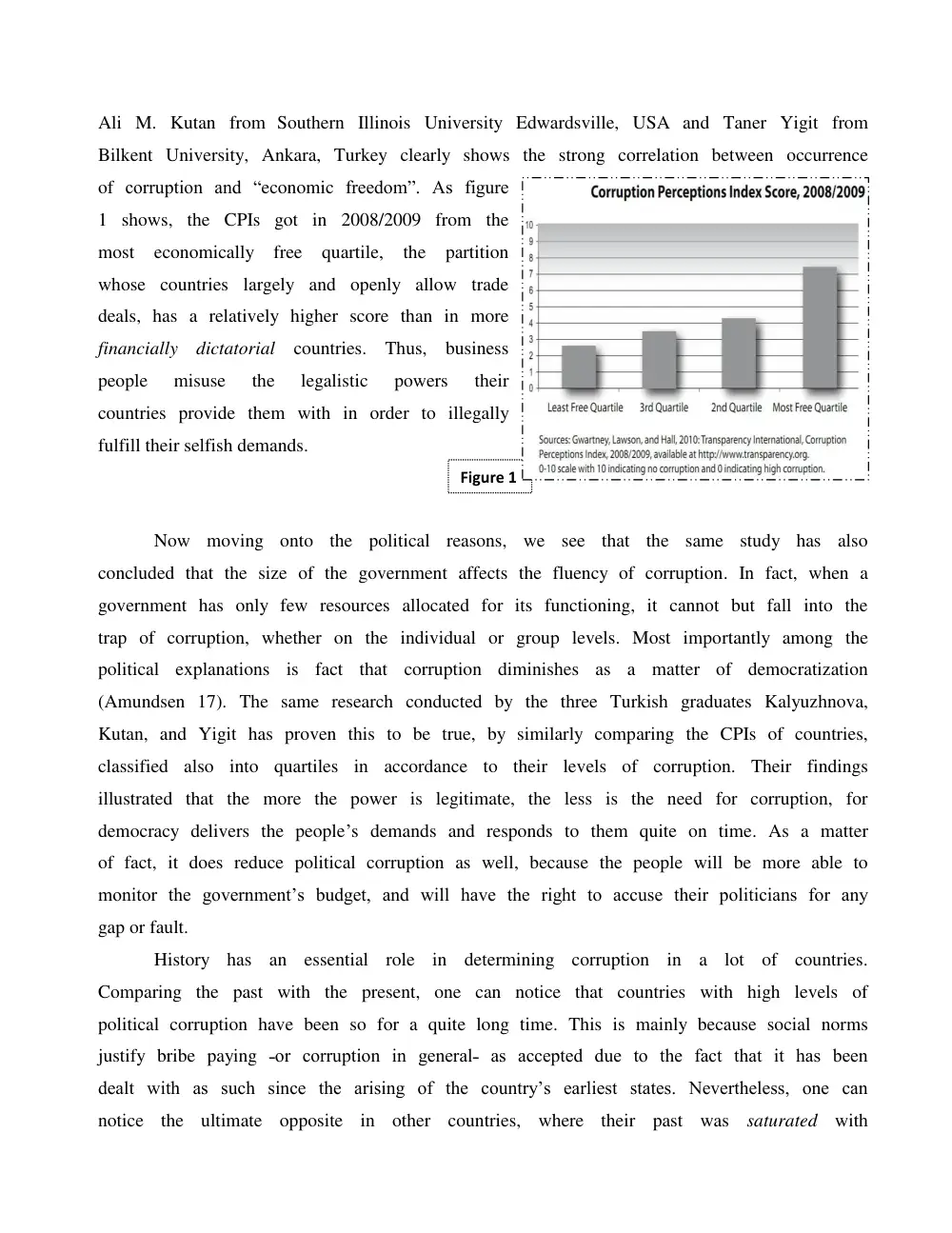
Figure 1
Ali M. Kutan from Southern Illinois University Edwardsville, USA and Taner Yigit from
Bilkent University, Ankara, Turkey clearly shows the strong correlation between occurrence
of corruption and “economic freedom”. As figure
1 shows, the CPIs got in 2008/2009 from the
most
economically
free quartile,
the partition
whose countries largely and openly allow trade
deals, has a relatively higher score than in more
financially dictatorial countries. Thus, business
people
misuse
the
legalistic
powers
their
countries provide them with in order to illegally
fulfill their selfish demands.
Now moving onto the political reasons, we see that the same study has also
concluded that the size of the government affects the fluency of corruption. In fact, when a
government has only few resources allocated for its functioning, it cannot but fall into the
trap of corruption, whether on the individual or group levels. Most importantly among the
political explanations is fact that corruption diminishes as a matter of democratization
(Amundsen 17). The same research conducted by the three Turkish graduates Kalyuzhnova,
Kutan, and Yigit has proven this to be true, by similarly comparing the CPIs of countries,
classified also into quartiles in accordance to their levels of corruption. Their findings
illustrated that the more the power is legitimate, the less is the need for corruption, for
democracy delivers the people’s demands and responds to them quite on time. As a matter
of fact, it does reduce political corruption as well, because the people will be more able to
monitor the government’s budget, and will have the right to accuse their politicians for any
gap or fault.
History has an essential role in determining corruption in a lot of countries.
Comparing the past with the present, one can notice that countries with high levels of
political corruption have been so for a quite long time. This is mainly because social norms
justify bribe paying ˗or corruption in general˗ as accepted due to the fact that it has been
dealt with as such since the arising of the country’s earliest states. Nevertheless, one can
notice the ultimate opposite in other countries, where their past was saturated with
corruption, yet its people and governments were convinced with the importance and
significance of the change towards the better. This has been the case in Britain, where the
nineteenth century and the beginning of the 20th have been fair witnesses to the severity of
consequences of corruption; yet, this country is now among the most countries who stand in
front corruption worldwide.
Finally, geography of a country can also affect the spread of the phenomenon of
corruption. In this domain, Goel and Nelson say that “large, sprawling countries might be
exposed to greater corruption due to their inability to effectively monitor public officials, the
potential bribe-takers” (14), specifically the ones in far, remote regions. For instance, the
CPI in Russia has always been high due to the hugeness of its area, not to mention its
distribution over two continents. Furthermore, it is harder for a country with a relatively
high population intensity to keep an eye on its politicians for the same reasoning. China has
noticed that one of the advantages of the anti-baby-boom policy it has taken was to well
regard its recourses and to limit corruption as much as possible.
IV. Consequences of Political Corruption:
When speaking about consequences of corruption, one could wonder: could this
phenomenon bring back competitive edges? As a matter of fact, it does. I mean, other than
those benefits gotten by the bribe-payer who has the big favor in return for his paid money,
or the bribe-taker who gains all this cash, corruption helps enhance the economy. It works
on making businesses that will benefit a lot of people, even those who had really nothing to
do with the illegal deals. For instance, using political authority to found an illegally paved
beach
would
create
job
opportunities
and
reduce
impacts
of
unemployment.
Thus,
corruption may help turn the economic wheel and unlock hidden doors, but under a major
condition, which is that it has to be controlled corruption: well-planned and not harmful for
the economy at least on the short run.
But these, as they may seem, might be the sole advantages for political corruption.
You might think looking at the dark side is usually pessimism, but actually, when the room
for light to leak in is so tiny, one has to regard the negative effects of corruption and take
them seriously into consideration, for they cannot be easily dealt with.
Corruption affects foreign investments in different ways, according to the political
and economic nature of the corrupt nation. As you would think, an investor is likely to
invest his capital in a country whose resources are being eaten up by this or that; he
wouldn’t feel safe in his business. This has been mainly the case in Nigeria, where the $12
million offered by Western Region Marketing Board into Action Group coffers from 1959-
1962 have been apparently gone for good and not invested in the field of development
foundations (Nye, 417). But one cannot but confront to the fact that in some rare cases,
corruption could attract foreign investments and bring back short-run profits to the host
country, as it has been in some Southeast Asian countries, mainly the three economic tigers:
Hong Kong, Singapore, South Korea and Taiwan, or in India’s Congress Party.
As we have seen, the severity of centralized corruption is far less than the
uncontrolled form. But still, both types lead to misallocation of the government’s resources;
they simply ruin the overall budget. This, in turn, has tons of drawbacks. Politically
speaking, when balance of the budget isn’t within reach anymore, the government will be
forced to ask for and/or accept loans or grants in order to fulfill its people’s basic needs of
nutrition and shelter. Thus, the country would be hung unable to take but the decisions the
gift donor force them to take. The nation would fall a prisoner under the merci of others,
which alters both the way the country is ruled on the one hand; i.e. it may change from
dictatorship to democracy or vice versa, and legitimacy and efficiency of the state on the
other hand, where the people of the country forcefully stand against their government for
abandoning its people and preferring the selfish needs of (some of) its members. Also, a
country would have to incrementally impose taxes to fit in the financial gaps in the
government budget; all of this, in addition to some other reasons to follow, will leave the
stage for a rebellion to rise, leading to chaos and more losses in money and resources.
In addition, misallocation of a government’s resources toward corruption will leave a
gap in the budget, a part of which should have been specified to serve the society in a better
way. One form of this gap is ignoring or leaving behind the importance of health care; this
has been the case in the Ottoman Empire in the last century, where the increased political
corruption
rates
shed
away
the
lights
from
using
insecticides
against
aphids
and
grasshoppers that are agriculturally harmful. The fact that locusts targeted its Middle
Eastern part of the empire in June 1916 was one of the major reasons for the economic, and
eventually the total, pitfall of the empire. Also health-wise speaking, the government would
allocate much less budget, if any, on caring for the elderly. Not only would the elderly
suffer, but also all citizens in general because of the lack of efficiency of insurance plans.
Similar enhancement features will be missing in the fields of sports, where the country
won’t afford paying the extra expanses for what it may call luxury.
One more drawback of political corruption may appear environmentally, for going
into illegal, unplanned or mis-planned projects may be harmful for the safety and health of
surrounding nature. By revisiting the example of the artificial seashore, we can notice the
impact of damage the project has produced by looking at the huge amounts of dead fish and
the degradation of some rare sea creatures and features, not to mention the hideous scene
left behind of blown-off sands and pebbles.
V. Action To Be Taken To Reduce Corruption:
Now that we have taken a look on some of the causes for political corruption and its
major consequences, it is time to look forward for solutions, or at least suggestions, that
present limitations to corruption. First of all, media has been and will always be the direct
link that brings back fresh news to the people. It is them who expose the illegal deals in
which politicians get involved in front of the public, and hence turning the public opinion
against those corrupt politicians, especially in the democratic countries that allow freedom
of the press to express opinions. For example, in 2009, the British press, along with the
Telegraph Group was successfully able to reveal the “United Kingdom Parliamentary
expenses scandal” which was a shocking political scandal for a while triggered by the leak
and subsequent publications of the read, seen, and heard media; members of the United
Kingdom
Parliament
have
been
misusing
their
permitted
expenditure
budgets
and
allowances over several years with the excuse of governmental needs for national security.
In fact, “corruption scandals may actually sharpen the instruments of control” (Amundsen,
21). Of course, one must take into consideration the role of the media in being realistic and
in staying consistent with and obedient to the ethics of their profession, characterized by
transparency, objectivity, modesty, and integrity.
Another suggested solution for corruption is allocating some budget for special
committees, each to monitor the actions of a group of politicians within a certain geographic
stance; their mission would simply be monitoring the money expenditure of the politicians,
even if takes them to look into private accounts, just to make sure no bribes are being paid
or no act of theft or financial laundry is being taken. I know it seems hard to apply, but as a
matter of fact when there’s intention for cutting down on corruption, this is quite an
effective solution that might come in handy in the future!
In addition, recruiting new employees in governmental or public institutions should
be based on the abilities and professionalism of the person instead of giving priority to those
who know people willing to misuse their legalistic authority for any favor in return.
Finally, the politicians that have already been busted should be an example for the
coming rulers. The law should increase severity of the punishment for those who have been
exposed as corrupt; their punishment shouldn’t be confined by jail for a couple of years, or
even waiting a couple of months before a bribe is being paid for him to be out of prison
soon!
VI. Conclusion:
In a nutshell, my research shows correlation between the factors leading to the
phenomenon of political corruption and sheds light on most, if not all, of its possible
consequences. It also offers suggestions to be followed in order to establish corruption-free
nations; such regulations include the intervention of the media, assigning special committees
to monitor politicians’ acts, recruiting according to professionalism, in addition to some
forms of punishment with models. I truly believe that this is a serious topic that should be
carefully dealt with, for its results are in most cases, as we saw, monstrous to the wellbeing
of the society. So I hope more progress takes place in light of the information provided in
this research, and may our efforts to lessen corruption not be lost in vain.
Works Cited
“Corruption”. Encyclopedia of Ethics. London: Routledge, 2001. Credo Reference, Web. 23
November 2010.
"Glossary of terms." Regional Anti-Corruption Initiative. Ratkovic, Vesna, PhD. Web. 30 Dec. 2010.
<http://www.rai-see.org/knowledge-base/glossary/Glossary-82/C/Controlled-vs.-uncontrolled-
corruption-22/>
Goel, Rajeev K. and Nelson, Micheal A.: Causes of Corruption: History, Geography and Government.
Finland: Bank of Finland, BOFIT, Institute for Economies in Transition, 2008.
Guartney, Lawson, and Hall. Corruption Perception Index 2008/2009. Transparency International.
N.p. 2010. Web. 26 Dec. 2010. < http://www.transparency.org >
Kalyuzhnova, Yelena; Kutan, Ali M.; and Yigit, Taner. Determinants of Corruption and the Growth-
Corruption Link in Energy-Rich Economies. Entrepreneur Webpage. N.p. n.d. Web. 30 Dec.
2010. <http://www.entrepreneur.com/tradejournals/article/200783692.html>
Khan, Mushtaq H.: A Typology of Corrupt Transactions in Developing Countries in IDS Bulletin,
vol.27, no.2, April 1996.
Nye, J. S. Corruption And Political Development: A Cost-Benefit Analysis. The American Political
Science Review, Vol. 61, No. 2. American Political Science Association. Jun., 1967. Web. 22
Nov. 2010. < http://www.jstor.org/stable/1953254 >