
ENG 204 Final, Spring 2005
American University of Beirut · Advanced Academic English · 3 pages
More ENG 204 files
Show the text of this final exam
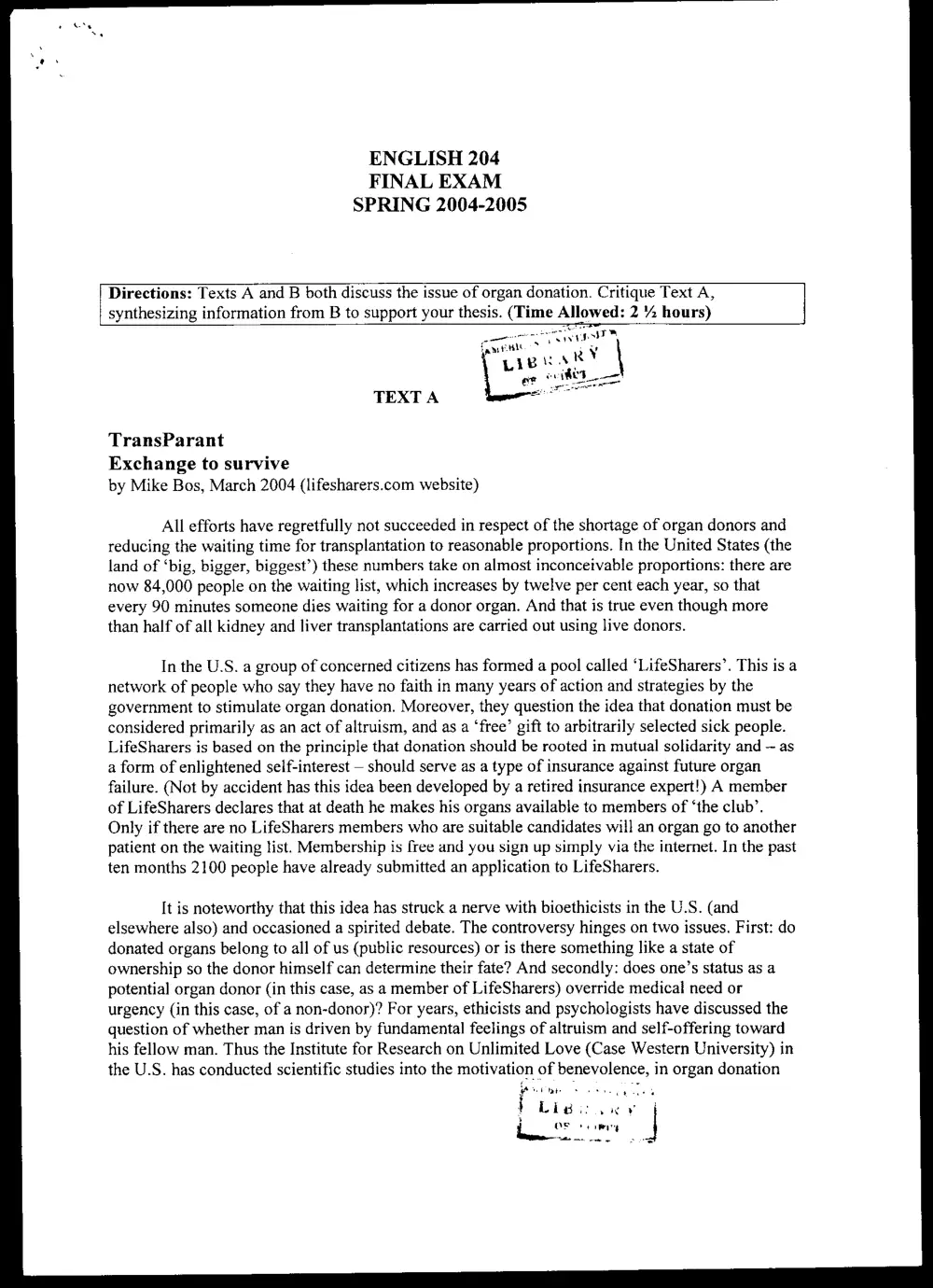
ENGLISH 204
FINAL EXAM
SPRING 2004-2005
Directions: Texts A and B both discuss the issue of organ donation. Critique Text A,
synthesizing information from B to support your thesis. (Time Allowed: 2 4 hours)
ey Se
Fa EH x
TransParant
Exchange to survive
by Mike Bos, March 2004 (lifesharers.com website)
All efforts have regretfully not succeeded in respect of the shortage of organ donors and
reducing the waiting time for transplantation to reasonable proportions. In the United States (the
land of ‘big, bigger, biggest’) these numbers take on almost inconceivable proportions: there are
now 84,000 people on the waiting list, which increases by twelve per cent each year, so that
every 90 minutes someone dies waiting for a donor organ. And that is true even though more
than half of all kidney and liver transplantations are carried out using live donors.
In the U.S. a group of concerned citizens has formed a pool called ‘LifeSharers’. This is a
network of people who say they have no faith in many years of action and strategies by the
government to stimulate organ donation. Moreover, they question the idea that donation must be
considered primarily as an act of altruism, and as a ‘free’ gift to arbitrarily selected sick people.
LifeSharers is based on the principle that donation should be rooted in mutual solidarity and ~ as
a form of enlightened self-interest — should serve as a type of insurance against future organ
failure. (Not by accident has this idea been developed by a retired insurance expert!) A member
of LifeSharers declares that at death he makes his organs available to members of ‘the club’.
Only if there are no LifeSharers members who are suitable candidates will an organ go to another
patient on the waiting list. Membership is free and you sign up simply via the internet. In the past
ten months 2100 people have already submitted an application to LifeSharers.
It is noteworthy that this idea has struck a nerve with bioethicists in the U.S. (and
elsewhere also) and occasioned a spirited debate. The controversy hinges on two issues. First: do
donated organs belong to all of us (public resources) or is there something like a state of
ownership so the donor himself can determine their fate? And secondly: does one’s status as a
potential organ donor (in this case, as a member of LifeSharers) override medical need or
urgency (in this case, of a non-donor)? For years, ethicists and psychologists have discussed the
question of whether man is driven by fundamental feelings of altruism and self-offering toward
his fellow man. Thus the Institute for Research on Unlimited Love (Case Western University) in
the U.S. has conducted scientific studies into the motivation of benevolence, in organ donation
Cy ee ry
Phisvivey |
i OF + cmirg |
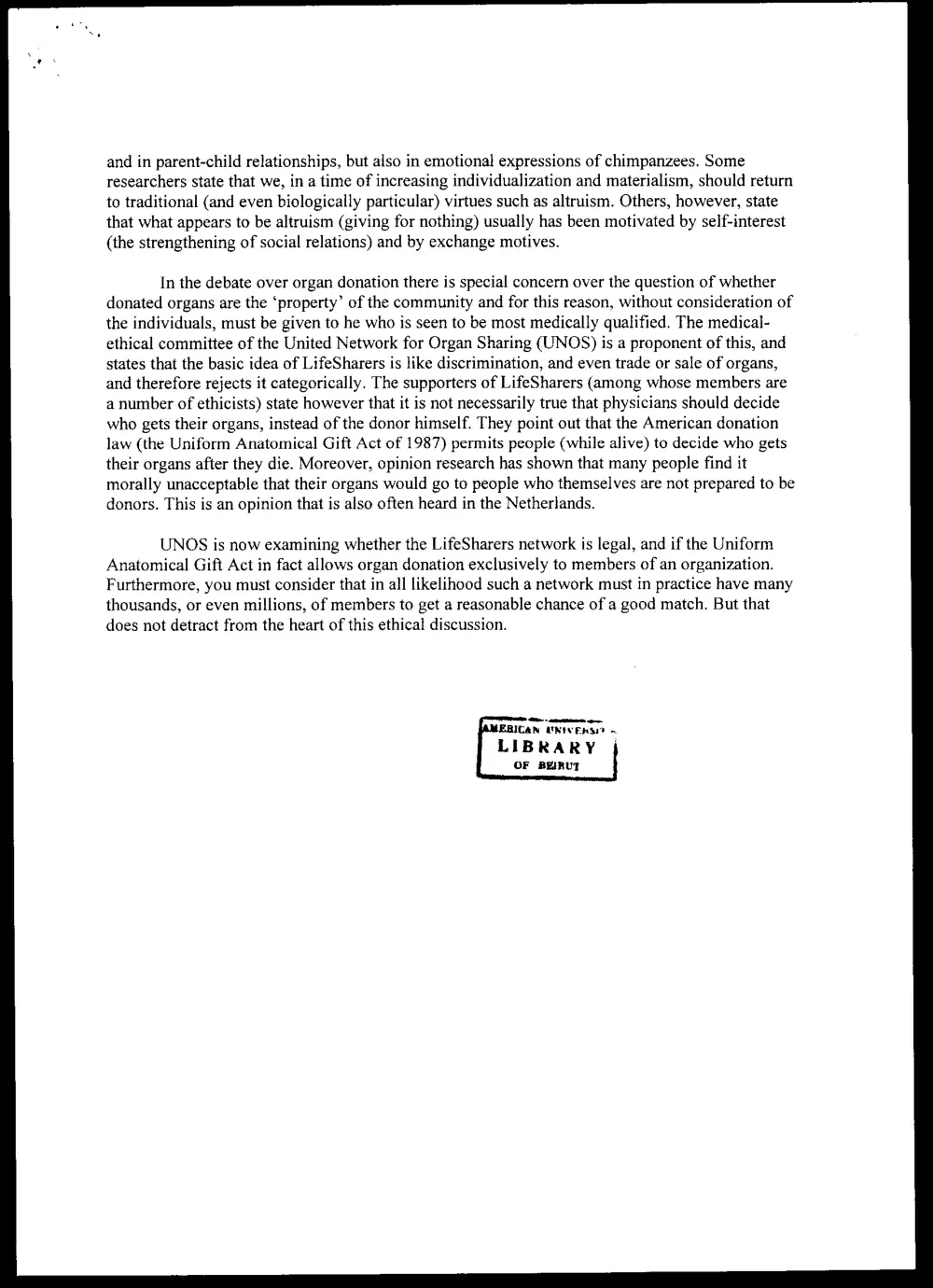
and in parent-child relationships, but also in emotional expressions of chimpanzees. Some
researchers state that we, in a time of increasing individualization and materialism, should return
to traditional (and even biologically particular) virtues such as altruism. Others, however, state
that what appears to be altruism (giving for nothing) usually has been motivated by self-interest
(the strengthening of social relations) and by exchange motives.
In the debate over organ donation there is special concern over the question of whether
donated organs are the ‘property’ of the community and for this reason, without consideration of
the individuals, must be given to he who is seen to be most medically qualified. The medical-
ethical committee of the United Network for Organ Sharing (UNOS) is a proponent of this, and
states that the basic idea of LifeSharers is like discrimination, and even trade or sale of organs,
and therefore rejects it categorically. The supporters of LifeSharers (among whose members are
a number of ethicists) state however that it is not necessarily true that physicians should decide
who gets their organs, instead of the donor himself. They point out that the American donation
law (the Uniform Anatomical Gift Act of 1987) permits people (while alive) to decide who gets
their organs after they die. Moreover, opinion research has shown that many people find it
morally unacceptable that their organs would go to people who themselves are not prepared to be
donors. This is an opinion that is also often heard in the Netherlands.
UNOS is now examining whether the LifeSharers network is legal, and if the Uniform
Anatomical Gift Act in fact allows organ donation exclusively to members of an organization.
Furthermore, you must consider that in all likelihood such a network must in practice have many
thousands, or even millions, of members to get a reasonable chance of a good match. But that
does not detract from the heart of this ethical discussion.
OF BEIRUT
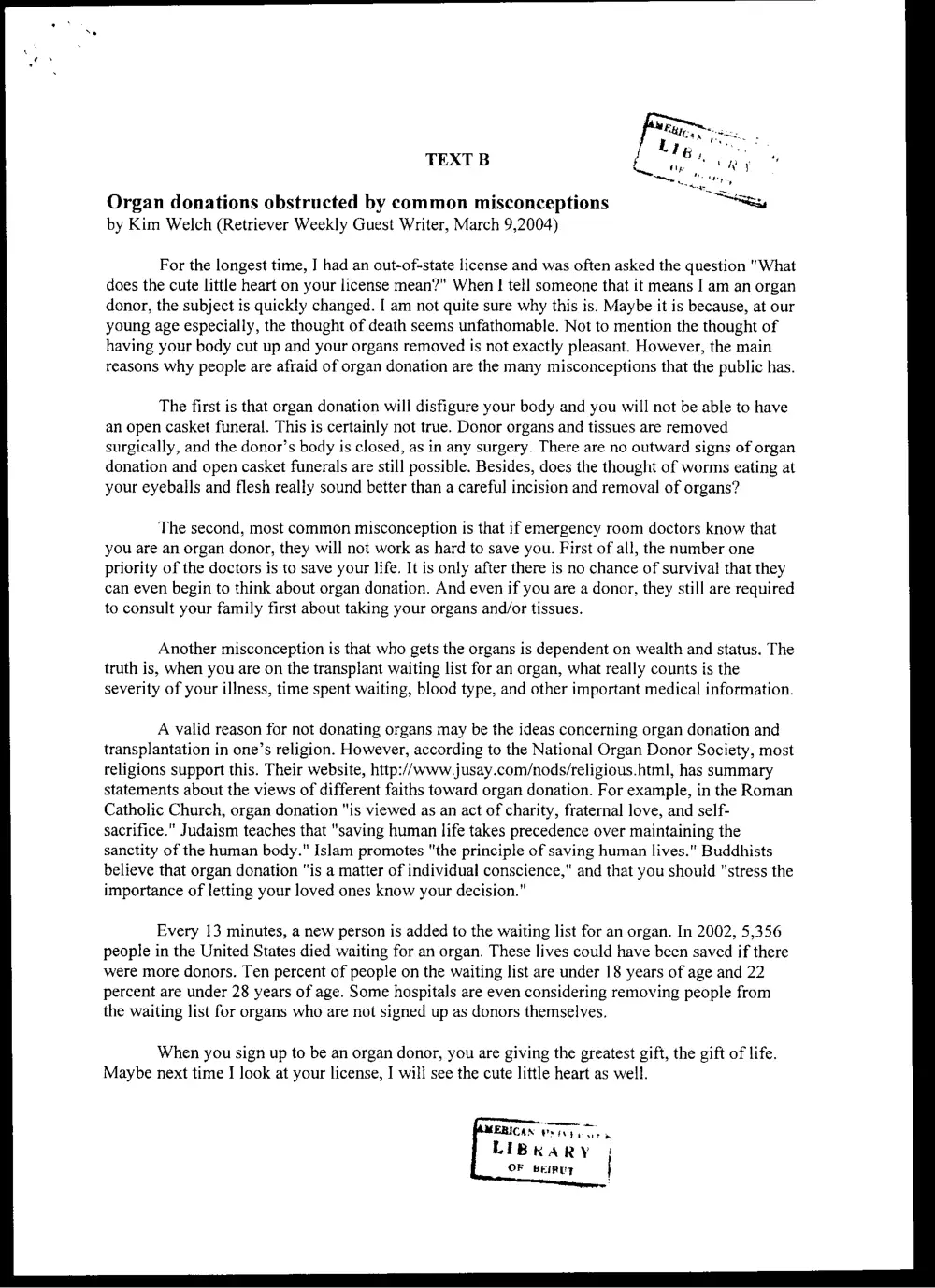
TEXT B
Organ donations obstructed by common misconceptions
by Kim Welch (Retriever Weekly Guest Writer, March 9,2004)
For the longest time, J] had an out-of-state license and was often asked the question "What
does the cute little heart on your license mean?” When I tell someone that it means I am an organ
donor, the subject is quickly changed. I am not quite sure why this is. Maybe it is because, at our
young age especially, the thought of death seems unfathomable. Not to mention the thought of
having your body cut up and your organs removed is not exactly pleasant. However, the main
reasons why people are afraid of organ donation are the many misconceptions that the public has.
The first is that organ donation will disfigure your body and you will not be able to have
an open casket funeral. This is certainly not true. Donor organs and tissues are removed
surgically, and the donor’s body is closed, as in any surgery. There are no outward signs of organ
donation and open casket funerals are still possible. Besides, does the thought of worms eating at
your eyeballs and flesh really sound better than a careful incision and removal of organs?
The second, most common misconception is that if emergency room doctors know that
you are an organ donor, they will not work as hard to save you. First of all, the number one
priority of the doctors is to save your life. It is only after there is no chance of survival that they
can even begin to think about organ donation. And even if you are a donor, they still are required
to consult your family first about taking your organs and/or tissues.
Another misconception is that who gets the organs is dependent on wealth and status. The
truth is, when you are on the transplant waiting list for an organ, what really counts is the
severity of your illness, time spent waiting, blood type, and other important medical information.
A valid reason for not donating organs may be the ideas concerning organ donation and
transplantation in one’s religion. However, according to the National Organ Donor Society, most
religions support this. Their website, http://www .jusay.com/nods/religious.html, has summary
statements about the views of different faiths toward organ donation. For example, in the Roman
Catholic Church, organ donation "is viewed as an act of charity, fraternal love, and self-
sacrifice." Judaism teaches that "saving human life takes precedence over maintaining the
sanctity of the human body." Islam promotes "the principle of saving human lives." Buddhists
believe that organ donation "is a matter of individual conscience," and that you should "stress the
importance of letting your loved ones know your decision."
Every 13 minutes, a new person is added to the waiting list for an organ. In 2002, 5,356
people in the United States died waiting for an organ. These lives could have been saved if there
were more donors. Ten percent of people on the waiting list are under 18 years of age and 22
percent are under 28 years of age. Some hospitals are even considering removing people from
the waiting list for organs who are not signed up as donors themselves.
When you sign up to be an organ donor, you are giving the greatest gift, the gift of life.
Maybe next time I look at your license, ] will see the cute little heart as well.
OF BEIRUT