
ENG 206 Final, Fall 2001
American University of Beirut · Technical English · 8 pages



More ENG 206 files
Show the text of this final exam
ENGLISH 206 OF Seine
FINAL EXAM
FALL 2001-2002
Name:
PASSAGE A:
Search-and-Rescue Robots Nowadays
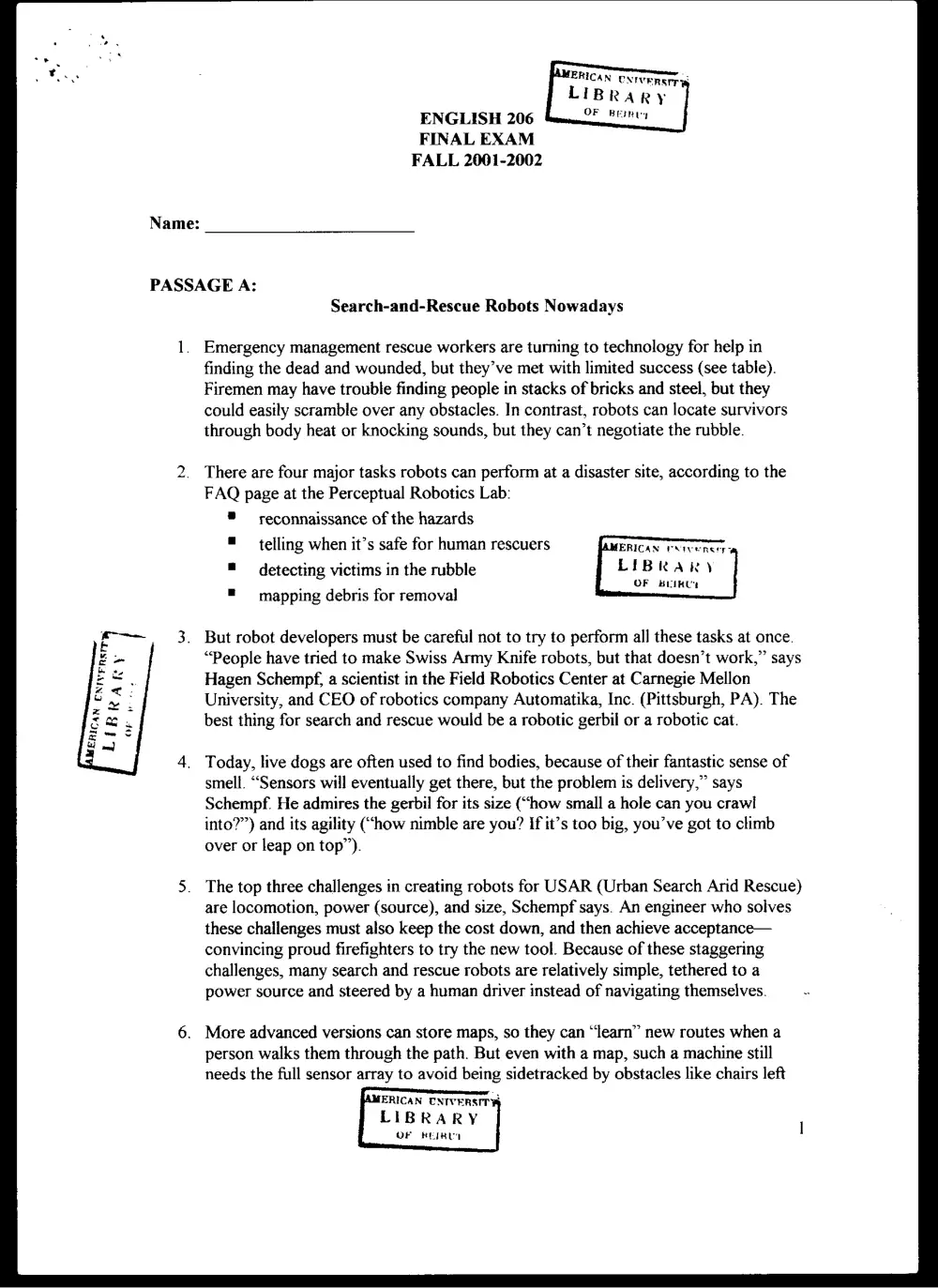
1. Emergency management rescue workers are turning to technology for help in
finding the dead and wounded, but they’ve met with limited success (see table).
Firemen may have trouble finding people in stacks of bricks and steel, but they
could easily scramble over any obstacles. In contrast, robots can locate survivors
through body heat or knocking sounds, but they can’t negotiate the rubble.
2. There are four major tasks robots can perform at a disaster site, according to the
FAQ page at the Perceptual Robotics Lab:
® reconnaissance of the hazards
™ telling when it’s safe for human rescuers ERICAN UArconery 4
™ detecting victims in the rubble LIBRARY)
OF BLIKUY
= mapping debris for removal —
3. But robot developers must be careful not to try to perform all these tasks at once.
“People have tried to make Swiss Army Knife robots, but that doesn’t work,” says
Hagen Schempf, a scientist in the Field Robotics Center at Carnegie Mellon
University, and CEO of robotics company Automatika, Inc. (Pittsburgh, PA). The
best thing for search and rescue would be a robotic gerbil or a robotic cat.
4. Today, live dogs are often used to find bodies, because of their fantastic sense of
smell. “Sensors wili eventually get there, but the problem is delivery,” says
Schempf. He admires the gerbil for its size (“how small a hole can you crawl
into?”) and its agility (“how nimble are you? If it’s too big, you’ve got to climb
over or leap on top”).
5. The top three challenges in creating robots for USAR (Urban Search Arid Rescue)
are locomotion, power (source), and size, Schempf says. An engineer who solves
these challenges must also keep the cost down, and then achieve acceptance—
convincing proud firefighters to try the new tool. Because of these staggering
challenges, many search and rescue robots are relatively simple, tethered to a
power source and steered by a human driver instead of navigating themselves.
6. More advanced versions can store maps, so they can “learn” new routes when a
person walks them through the path. But even with a map, such a machine still
needs the full sensor array to avoid being sidetracked by obstacles like chairs left
ERICAN UNIVERSITY)
LIBRARY
OF RETIRED
in a hallway, or wheel slippage on soapy floors—simple challenges compared to
the chaos of a disaster site.
Robot Efficiency in Different Situations
Robotic challenge Office use Search and rescue
Job predictability high low
Terrain smooth, geometric tugged, chaotic
Autonomy high low
Mapping simple impossible
Power soure onboard often thethered
[Source: Ames, B. (2001, November 5). Disaster
sites too complex for most robots. Design News, 56 (21), 34.]
PASSAGE B:
Futuristic Search-and-Rescue Robots
The next generation of search-and-rescue workers looking for victims in buildings
that collapsed in earthquakes or explosions will slither through eight-inch ducts,
navigate dark, rubble-strewn corridors and be tossed into third-floor windows.
They will be impervious to pain, fire and water. They will be robots-- autonomous
and mobile.
Industrial robots have been used successfully for decades, but their descendants
will be a relatively new breed with sufficient intelligence to carry out complex
tasks, including planning ad decision-making in unstructured and dynamic
environments where missions are time-critical.
But whether the robots are snakelike or rodent-size, they will think and, most
important, relay information to human rescuers. Researchers have already found
ways to create the necessary artificial intelligence.
Take, for instance, the ability to report locations, which has been a robotic catch-
22: In order for a robot to add its “perceptions” to a map, it needs to know its
location. But for a robot to determine its location, it often needs a map.
The answer lies in programming that provides localization capability based on a
given environment by correcting localization estimates incrementally and on the
fly instead of waiting until an unacceptable error level is accumulated. Navy
researchers say the errors are small, so fast correction techniques can be used.
6.
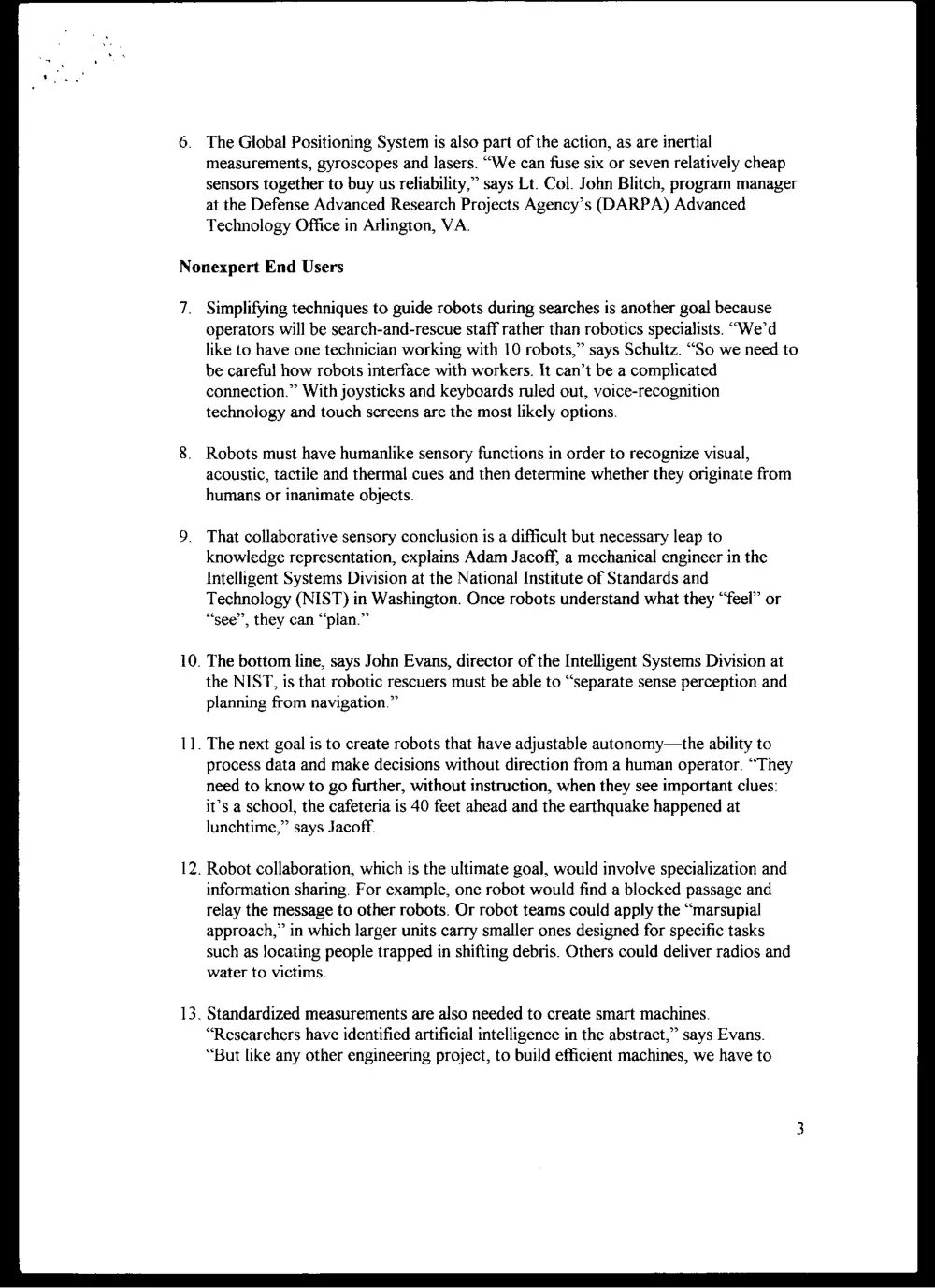
The Global Positioning System is also part of the action, as are inertial
measurements, gyroscopes and lasers. “We can fuse six or seven relatively cheap
sensors together to buy us reliability,” says Lt. Col. John Blitch, program manager
at the Defense Advanced Research Projects Agency’s (DARPA) Advanced
Technology Office in Arlington, VA.
Nonexpert End Users
7,
Simplifying techniques to guide robots during searches is another goal because
operators will be search-and-rescue staff rather than robotics specialists. “We'd
like to have one technician working with 10 robots,” says Schultz. “So we need to
be careful how robots interface with workers. It can’t be a complicated
connection.” With joysticks and keyboards ruled out, voice-recognition
technology and touch screens are the most likely options.
Robots must have humanlike sensory functions in order to recognize visual,
acoustic, tactile and thermal cues and then determine whether they originate from
humans or inanimate objects.
That collaborative sensory conclusion is a difficult but necessary leap to
knowledge representation, explains Adam Jacoff, a mechanical engineer in the
Intelligent Systems Division at the National Institute of Standards and
Technology (NIST) in Washington. Once robots understand what they “feel” or
“see”, they can “plan.”
. The bottom line, says John Evans, director of the Intelligent Systems Division at
the NIST, is that robotic rescuers must be able to “separate sense perception and
planning from navigation.”
. The next goal is to create robots that have adjustable autonomy—the ability to
process data and make decisions without direction from a human operator. “They
need to know to go further, without instruction, when they see important clues:
it’s a school, the cafeteria is 40 feet ahead and the earthquake happened at
lunchtime,” says Jacoff.
. Robot collaboration, which is the ultimate goal, would involve specialization and
information sharing. For example, one robot would find a blocked passage and
relay the message to other robots. Or robot teams could apply the “marsupial
approach,” in which larger units carry smaller ones designed for specific tasks
such as locating people trapped in shifting debris. Others could deliver radios and
water to victims.
. Standardized measurements are also needed to create smart machines.
“Researchers have identified artificial intelligence in the abstract,” says Evans.
“But like any other engineering project, to build efficient machines, we have to
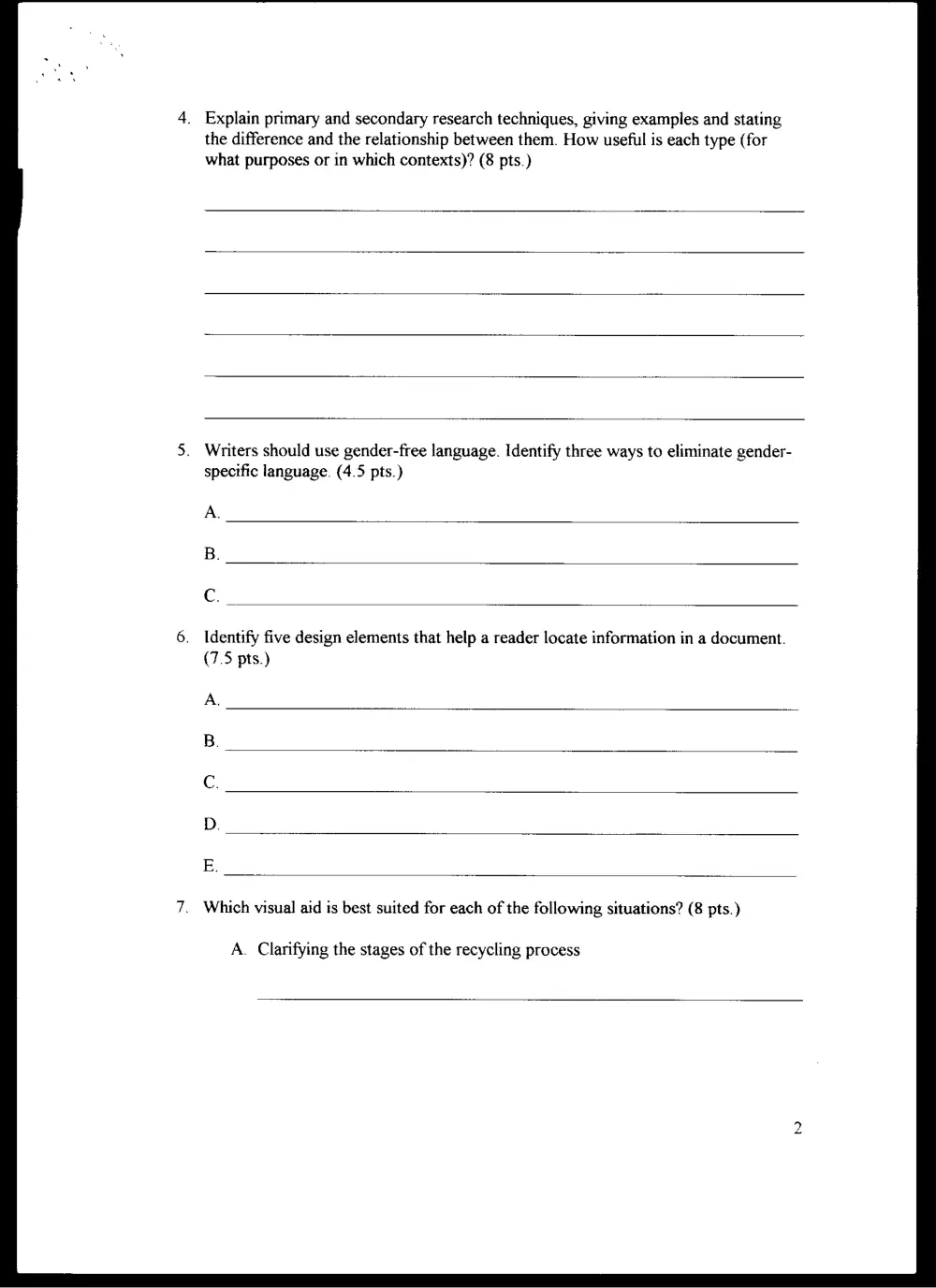
4. Explain primary and secondary research techniques, giving examples and stating
the difference and the relationship between them. How useful is each type (for
what purposes or in which contexts)? (8 pts.)
. Writers should use gender-free language. Identify three ways to eliminate gender-
specific language. (4.5 pts.)
A.
B.
C.
Identify five design elements that help a reader locate information in a document.
(7.5 pts.)
A.
B.
C.
D.
E.
. Which visual aid is best suited for each of the following situations? (8 pts.)
A. Clarifying the stages of the recycling process
8.
10.
11.
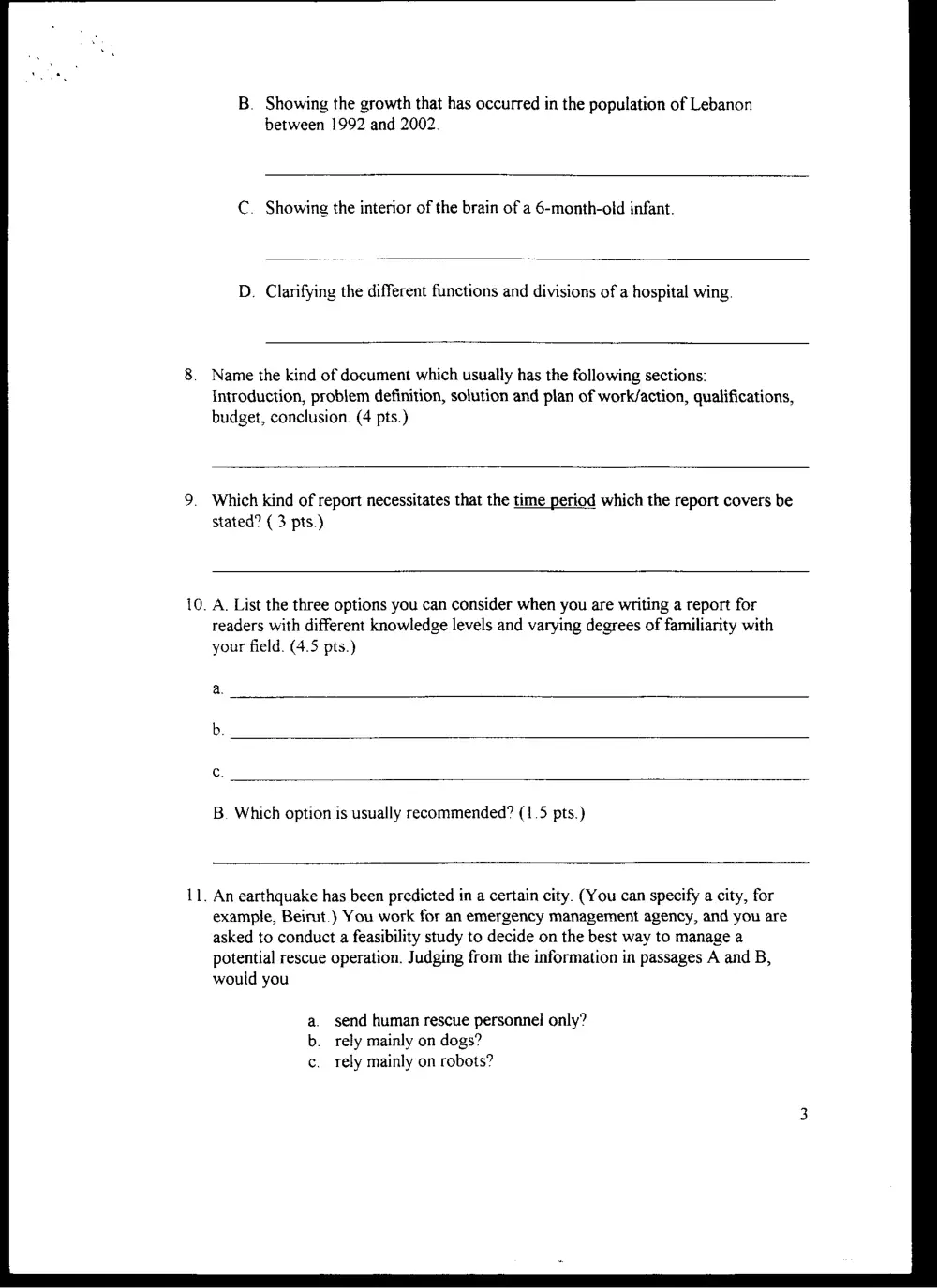
B. Showing the growth that has occurred in the population of Lebanon
between 1992 and 2002.
C. Showing the interior of the brain of a 6-month-old infant.
D. Clarifying the different functions and divisions of a hospital wing.
Name the kind of document which usually has the following sections:
introduction, problem definition, solution and plan of work/action, qualifications,
budget, conclusion. (4 pts.)
Which kind of report necessitates that the time period which the report covers be
stated? ( 3 pts.)
A. List the three options you can consider when you are writing a report for
readers with different knowledge levels and varying degrees of familiarity with
your field. (4.5 pts.)
a.
b.
Cc.
B. Which option is usually recommended? (1.5 pts.)
An earthquake has been predicted in a certain city. (You can specify a city, for
example, Beirut.) You work for an emergency management agency, and you are
asked to conduct a feasibility study to decide on the best way to manage a
potential rescue operation. Judging from the information in passages A and B,
would you
a. send human rescue personnel only?
b. rely mainly on dogs?
c. rely mainly on robots?
A. Analyze the situation based on your set criteria and report to your manager,
John Smith.
Include the relevant conventional elements of a feasibility report, and use the
organization plan (executive or standard) that is best suited for this situation:
Introduction, methods, results, discussion/conclusions, recommendations.
. Use the report format that is appropriate for this particular situation, and write
your report on page 5-6 paying special attention to layout and design. (25 pts.)
B.
12. The format and message of the following draft letter need revision. Edit and rewrite
this letter on page 8to make it clear, correct, consistent, courteous, concise, etc. Note
that there are no errors in the information inside the addresses. (22 pts.)
University of Leicester
School of Engineering
21 University Road
Leicester LE] 7 RF
UK
Dean Rana Khoury
Faculty of Engineering and Architecture
American University of Beirut
P.O. Box 11-0236
Riad El-Solh Beirut 1107 2020
Lebanon
January 4, 2002
Attention: Chairman
I would like to decline your invitation that I received from you inviting me to make a
speech to all graduating students on engineering ethics in Lebanon on January 30. The
long and short of it is that this talk would require advance pianning and preparation as
well as prior research and unfortunately you haven’t allowed for sufficient planning time.
I could, however, accept to address the students on something else for that occasion. I
will need the following in the lecture room: Copies of all enclosed handouts, and an
overhead projector, etc.
I will be arriving at Beirut’s international airport on January 29 on middle east airlines.
Please be kind to make reservations for me at a convenient hotel for a couple of days. I
also expect someone to pick me up from the airport.
I want to thank you, Mrs Khoury, for your concern about the future of our new generation
of engineers and I do understand that you are working under pressure and putting a lot of
effort in arranging such talks. Thus, 1 wish to extend my sincere advice concerning the
required planning, always having your best interest in mind. In the future, try to contact
speakers at least six months ahead of time.
Wishing you the best of luck in your endeavor,
Mathew Deeb
Mathew Deeb
Enclosure: Resume
c. Dr. Rana Khoury
14.
15.
have quantitative measurements.” The NIST, the NRL, and DARPA are working
together to address that problem. NIST engineers recently built the first
standardized test course, an urban disaster scene, to establish performance metrics
that would allow the reuse of algorithms and other system components.
Researchers have taken the portable ruin on the road; they plan to share ongoing
test results with robotics teams everywhere.
Test Course
The test course, which is approximately 60 square feet, has three increasingly
difficult modules, each a maze with “human” targets. Each area demands
increased mobility, such as the ability to climb piles of debris, stairs and ramps,
and sensing capabilities. The easiest has a flat surface, pieces of overturned
furniture, open doors and jutting walls. The two-floor intermediate stage has
ramps, stairways and holes to fall through. Level 3 simulates a collapsed building
complete with a section of floor propped perilously on piles of debris amid
jumbles of boards and pipes.
Creating artificial intelligence is the carrot for these researchers, but saving
human lives is the true goal. “We must balance between saving people and putting
fully functioning rescuers in harm’s way,” says Jacoff. “We can send robots into
the most dangerous and confined spaces. They are expendable.”
[Source: Forster, B. (2000, September 4). Heading
for disaster. Computerworld. (on-line). Available:
http;web | intotrac galegroup convitw: J