
ENG 206 Final, Spring 2005
American University of Beirut · Technical English · 7 pages



More ENG 206 files
Show the text of this final exam
English 206
Final Exam
Spring 2005
Name: Section:
Instructor: Time Allowed: 2 '? Hours “y
a
Passage A an
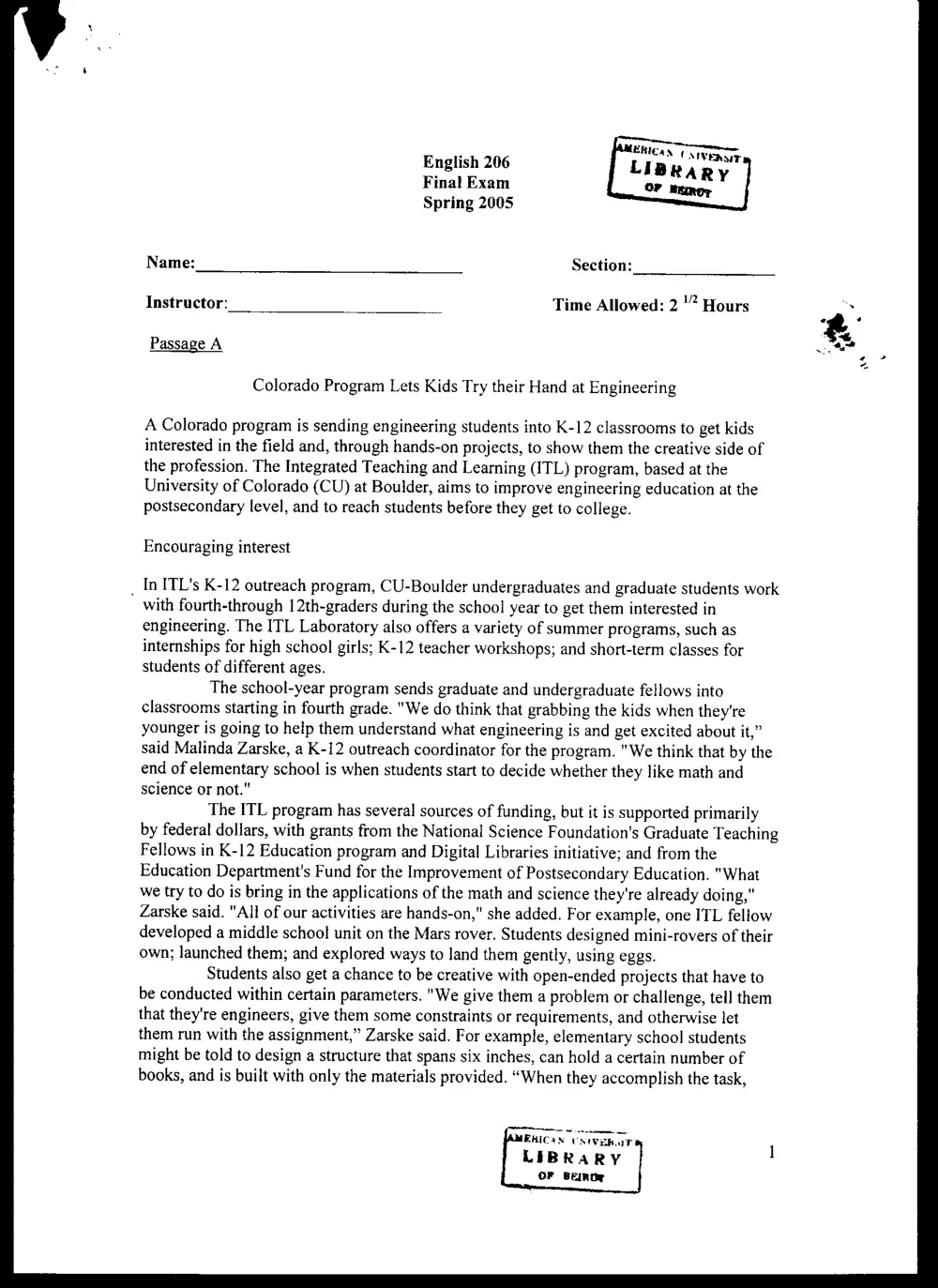
Colorado Program Lets Kids Try their Hand at Engineering
A Colorado program is sending engineering students into K-12 classrooms to get kids
interested in the field and, through hands-on projects, to show them the creative side of
the profession. The Integrated Teaching and Learning (ITL) program, based at the
University of Colorado (CU) at Boulder, aims to improve engineering education at the
postsecondary level, and to reach students before they get to college.
Encouraging interest
_ In ITL's K-12 outreach program, CU-Boulder undergraduates and graduate students work
with fourth-through 12th-graders during the school year to get them interested in
engineering. The ITL Laboratory also offers a variety of summer programs, such as
internships for high school girls; K-12 teacher workshops; and short-term classes for
students of different ages.
The school-year program sends graduate and undergraduate fellows into
classrooms starting in fourth grade. "We do think that grabbing the kids when they're
younger is going to help them understand what engineering is and get excited about it,”
said Malinda Zarske, a K-12 outreach coordinator for the program. "We think that by the
end of elementary school is when students start to decide whether they like math and
science or not."
The ITL program has several sources of funding, but it is supported primarily
by federal dollars, with grants from the National Science Foundation's Graduate Teaching
Fellows in K-12 Education program and Digital Libraries initiative; and from the
Education Department's Fund for the Improvement of Postsecondary Education. "What
we try to do is bring in the applications of the math and science they're already doing,"
Zarske said. "All of our activities are hands-on," she added. For example, one ITL fellow
developed a middle school unit on the Mars rover. Students designed mini-rovers of their
own; launched them; and explored ways to land them gently, using eggs.
Students also get a chance to be creative with open-ended projects that have to
be conducted within certain parameters. "We give them a problem or challenge, tell them
that they're engineers, give them some constraints or requirements, and otherwise let
them run with the assignment,” Zarske said. For example, elementary school students
might be told to design a structure that spans six inches, can hold a certain number of
books, and is built with only the materials provided. “When they accomplish the task,
anne one
MERIC AN 1 Yt ERSIT
LIBRARY
OF REV RICT
they get so excited," Zarske said. "When they succeed and they do something we didn't
even think of... it's even better."
The design projects also can teach students the value of trial and error. They
learn that "if it's not perfect the first time, you can go back and fix it,” Zarske said.
Broader goals
The ITL program and others like it were created with an eye toward not only recruiting
more students to engineering, but also to improving engineering education at the college
and university levels. A report issued this spring by the Lemelson-MIT program--which
recognizes inventors of all ages--lamented that education in general and engineering
education in particular do too little to foster inventiveness. "We're trying to explain to
students that engineering is not just somebody sitting in front of a computer. It's a
creative field," Zarske said.
Fellows in the ITL program stress the creative, yet practical, aspects of
engineering in an effort to draw in students who in the past have been less interested in
the field. “Applications that help other people and contribute to society are particularly
appealing to girls--who traditionally have been underrepresented in engineering,” Zarske
said. "We realize that not all kids are going to be engineers," she added. “But teaching
them what engineers do can help improve technological literacy in general.”
Excerpted and adapted from: What Works in Teaching and Learning, June 2004 v36 i6
pl(2).
Passage B
Purdue Counters Trend, Engineers Education From the Ground Up
WEST LAFAYETTE, Ind., April 9 (AScribe Newswire) -- Purdue University is
taking steps to stem the decline in high school students’ interest in careers in engineering.
The university's Board of Trustees voted today (Friday, 4/9) to create a new
Department of Engineering Education to increase younger students’ interest in
engineering while researching ways students learn engincering concepts. The
department is the first of its kind in the nation, but other universities across the nation
also are studying the problem.
The initiative is aimed not only at increasing student interest but also at
responding to the projected demand for more engineering professionals. One recent study
showed that the number of high school seniors planning on careers in engineering has
dropped more than 35 percent in the past 10 years. At the same time, the U.S. Bureau of
Labor estimates that the number of jobs to be filled in engineering and science will grow
at more than three times the rate of other professions. "There is a dramatic need for
engineers who will be able to lead this country and the world into new technologies and
innovations," said Purdue Provost Sally Mason. "As emerging fields such as
nanotechnology and biotechnology grow, it will become even more imperative for
AMERLO r dd
LIBR ORY
OF kepey
Lo.
wv
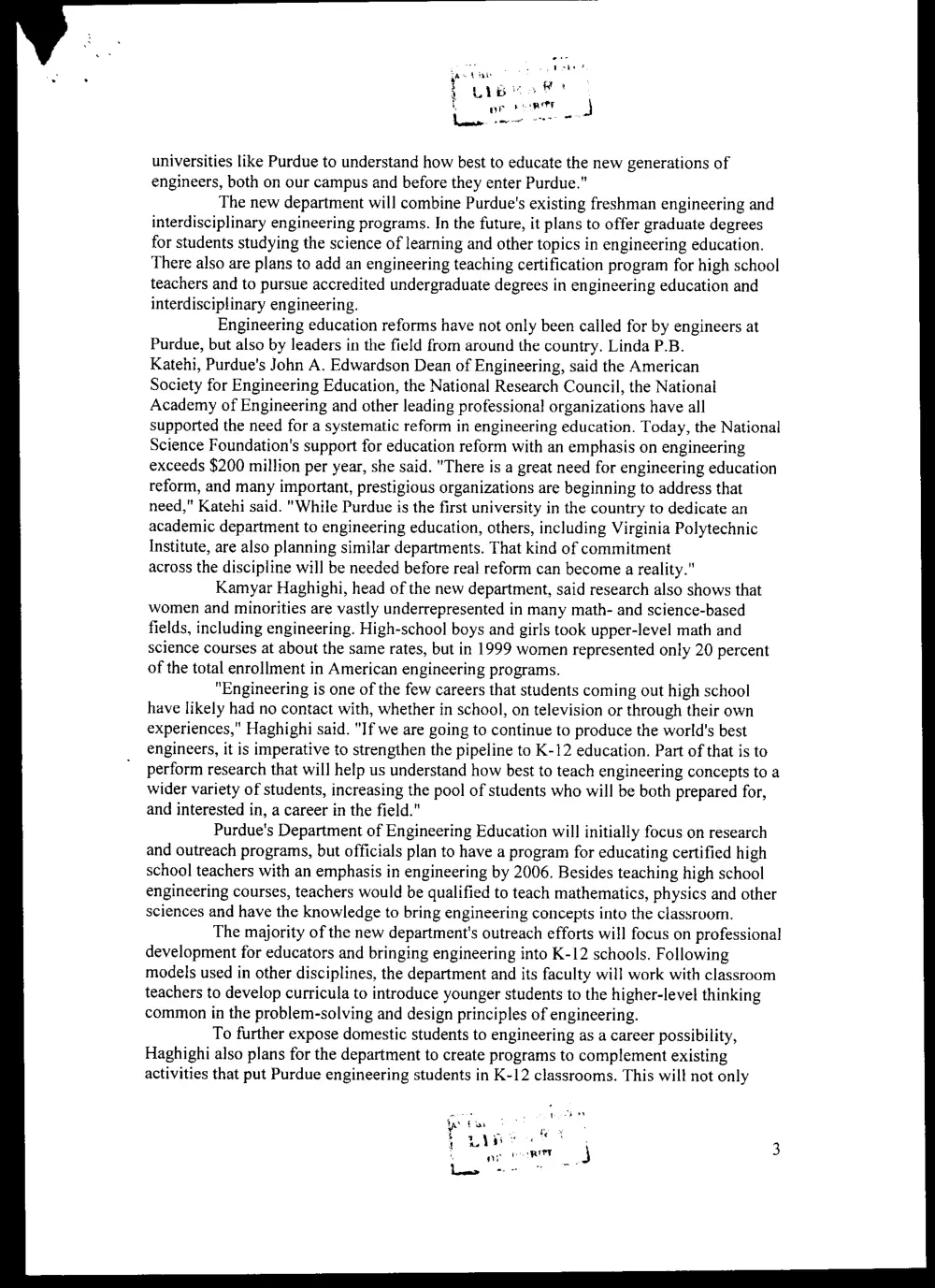
universities like Purdue to understand how best to educate the new generations of
engineers, both on our campus and before they enter Purdue."
The new department will combine Purdue's existing freshman engineering and
interdisciplinary engineering programs. In the future, it plans to offer graduate degrees
for students studying the science of learning and other topics in engineering education.
There also are plans to add an engineering teaching certification program for high school
teachers and to pursue accredited undergraduate degrees in engineering education and
interdisciplinary engineering.
Engineering education reforms have not only been called for by engineers at
Purdue, but also by leaders in the field from around the country. Linda P.B.
Katehi, Purdue's John A. Edwardson Dean of Engineering, said the American
Society for Engineering Education, the National Research Council, the National
Academy of Engineering and other leading professional organizations have all
supported the need for a systematic reform in engineering education. Today, the National
Science Foundation's support for education reform with an emphasis on engineering
exceeds $200 million per year, she said. "There is a great need for engineering education
reform, and many important, prestigious organizations are beginning to address that
need," Katehi said. "While Purdue is the first university in the country to dedicate an
academic department to engineering education, others, including Virginia Polytechnic
Institute, are also planning similar departments. That kind of commitment
across the discipline will be needed before real reform can become a reality.”
Kamyar Haghighi, head of the new department, said research also shows that
women and minorities are vastly underrepresented in many math- and science-based
fields, including engineering. High-school boys and girls took upper-level math and
science courses at about the same rates, but in 1999 women represented only 20 percent
of the total enrollment in American engineering programs.
"Engineering is one of the few careers that students coming out high school
have likely had no contact with, whether in school, on television or through their own
experiences,” Haghighi said. "If we are going to continue to produce the world's best
engineers, it is imperative to strengthen the pipeline to K-12 education. Part of that is to
perform research that will help us understand how best to teach engineering concepts to a
wider variety of students, increasing the pool of students who will be both prepared for,
and interested in, a career in the field."
Purdue's Department of Engineering Education will initially focus on research
and outreach programs, but officials plan to have a program for educating certified high
school teachers with an emphasis in engineering by 2006. Besides teaching high school
engineering courses, teachers would be qualified to teach mathematics, physics and other
sciences and have the knowledge to bring engineering concepts into the classroom.
The majority of the new department's outreach efforts will focus on professional
development for educators and bringing engineering into K-12 schools. Following
models used in other disciplines, the department and its faculty will work with classroom
teachers to develop curricula to introduce younger students to the higher-level thinking
common in the problem-solving and design principles of engineering.
To further expose domestic students to engineering as a career possibility,
Haghighi also plans for the department to create programs to complement existing
activities that put Purdue engineering students in K-12 classrooms. This will not only
z ey “
he
pe oT J
tebe
* hy
t
Le
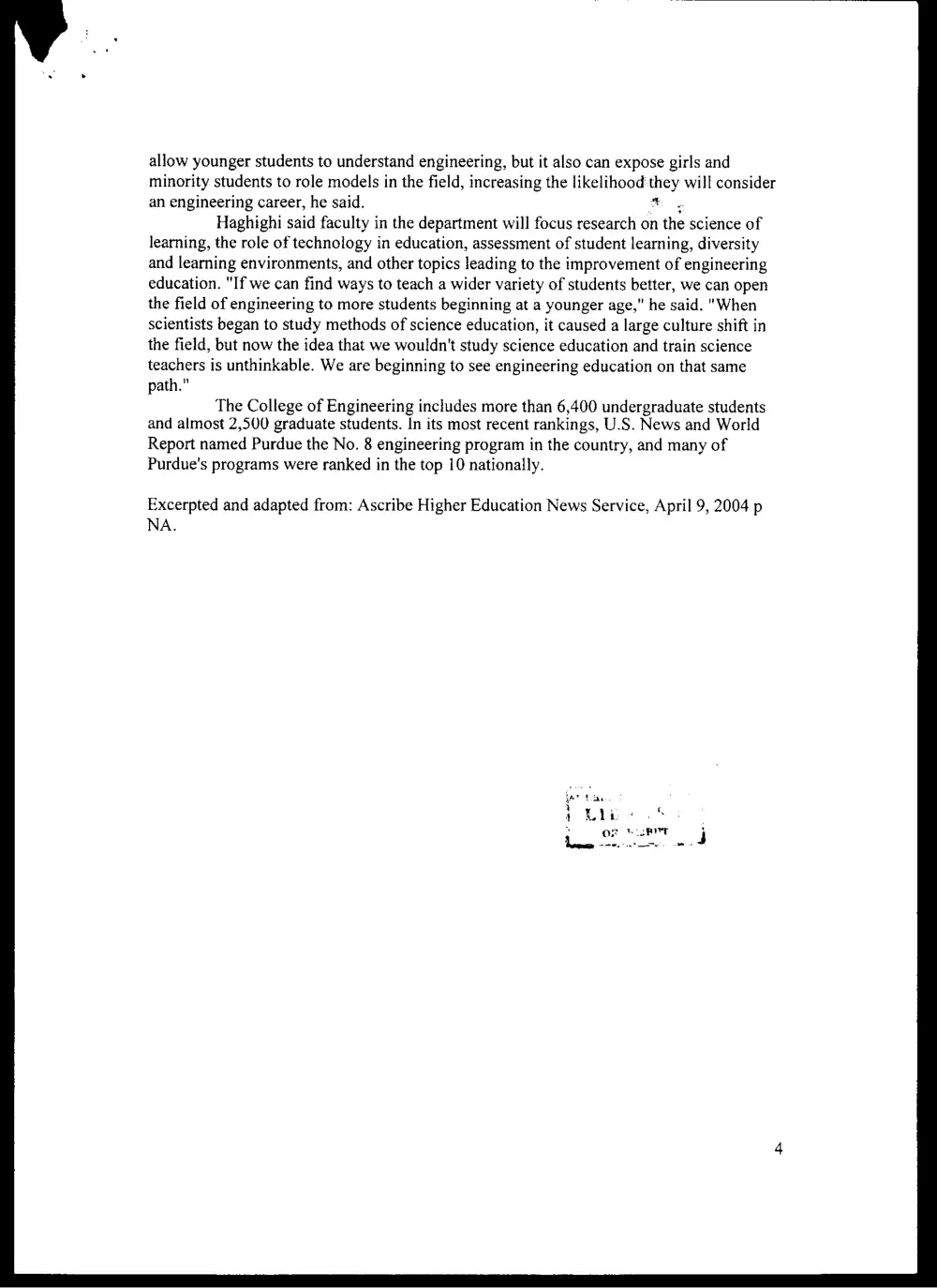
allow younger students to understand engineering, but it also can expose girls and
minority students to role models in the field, increasing the likelihood:they will consider
an engineering career, he said. ae
Haghighi said faculty in the department will focus research on the science of
learning, the role of technology in education, assessment of student learning, diversity
and learning environments, and other topics leading to the improvement of engineering
education. "If we can find ways to teach a wider variety of students better, we can open
the field of engineering to more students beginning at a younger age," he said. "When
scientists began to study methods of science education, it caused a large culture shift in
the field, but now the idea that we wouldn't study science education and train science
teachers is unthinkable. We are beginning to see engineering education on that same
path.”
The College of Engineering includes more than 6,400 undergraduate students
and almost 2,500 graduate students. In its most recent rankings, U.S. News and World
Report named Purdue the No. 8 engineering program in the country, and many of
Purdue's programs were ranked in the top 10 nationally.
Excerpted and adapted from: Ascribe Higher Education News Service, April 9, 2004 p
NA.
English 206
Final Exam
Spring 2005
Name:
Instructor: Time Allowed: 2 '? Hours
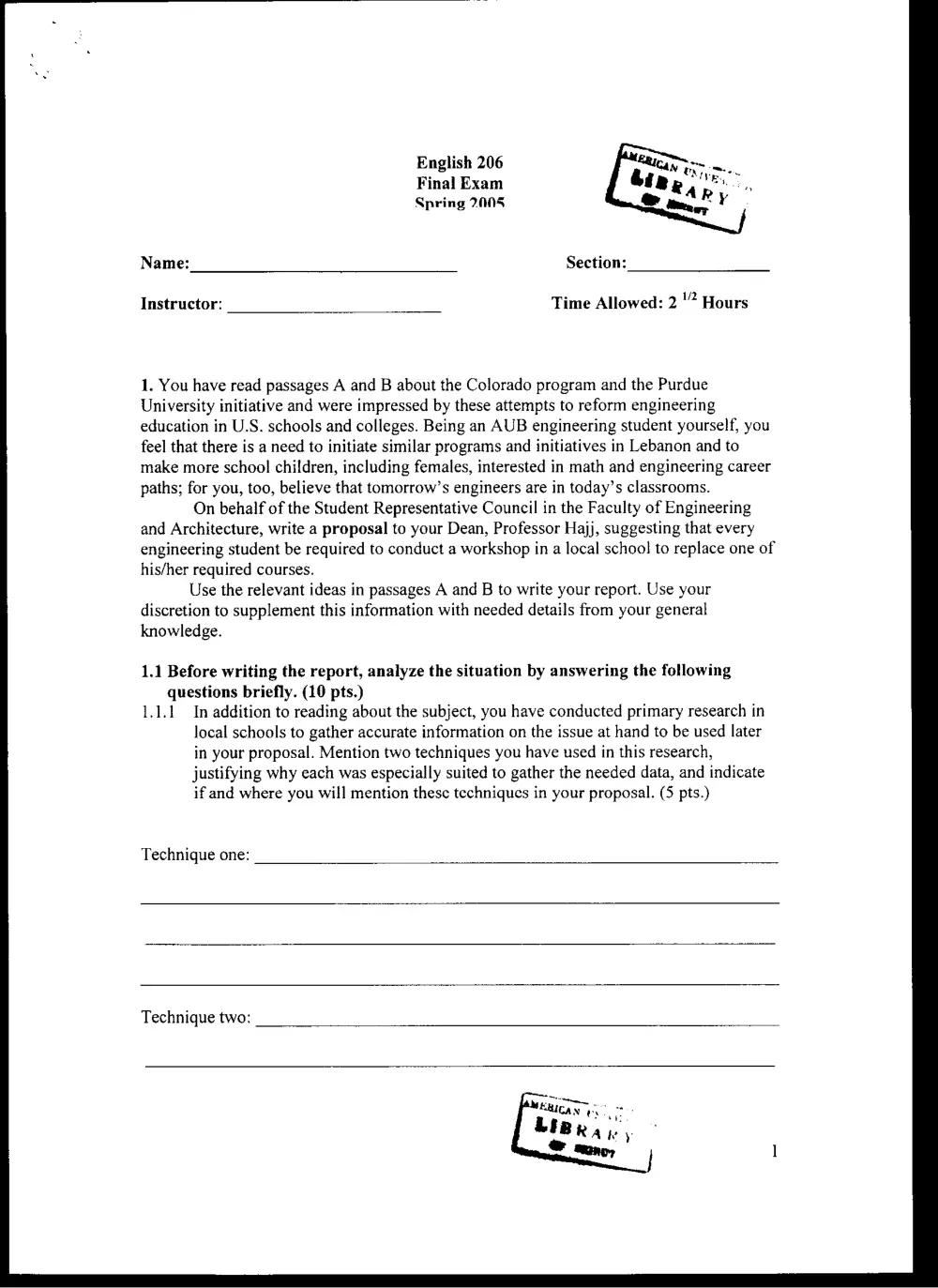
1. You have read passages A and B about the Colorado program and the Purdue
University initiative and were impressed by these attempts to reform engineering
education in U.S. schools and colleges. Being an AUB engineering student yourself, you
feel that there is a need to initiate similar programs and initiatives in Lebanon and to
make more school children, including females, interested in math and engineering career
paths; for you, too, believe that tomorrow’s engineers are in today’s classrooms.
On behalf of the Student Representative Council in the Faculty of Engineering
and Architecture, write a proposal to your Dean, Professor Hajj, suggesting that every
engineering student be required to conduct a workshop in a local schoo! to replace one of
his/her required courses.
Use the relevant ideas in passages A and B to write your report. Use your
discretion to supplement this information with needed details from your general
knowledge.
1.1 Before writing the report, analyze the situation by answering the following
questions briefly. (10 pts.)
1.1.1 In addition to reading about the subject, you have conducted primary research in
local schools to gather accurate information on the issue at hand to be used later
in your proposal. Mention two techniques you have used in this research,
justifying why each was especially suited to gather the needed data, and indicate
if and where you will mention these techniques in your proposal. (5 pts.)
Technique one:
Technique two:
1.1.2. As part of your proposal, you will be addressing the gender gap in engineering.
Explain how you can make sure that your own language in the proposal does not reflect
gender bias. Provide two examples (5 pts.).
1.2 Write your report in the memo format on pages 3 and on. (Use the back of the
sheets for drafting if needed. You will not be given extra sheets of paper for drafts.) (50
pts.)
Assume the role of Dean Hajj (to whom you addressed your proposal), and write a
memo as a reply, rejecting the Student Representative Council proposal. After
analyzing the situation and considering your audience, use the appropriate approach,
style and tone and include all necessary details.
Write your memo on page 8. (Use this page for drafting.) (40 pts.)