
ENG 206 Final, Fall 2002
American University of Beirut · Technical English · 7 pages


More ENG 206 files
Show the text of this final exam
£ iipatnenesememen nd
aE
- RUN UNTVERSIT!
vo LIBRARY
AMERICAN UNIVERSITY OF BEIRUT OF BaIRUT
DEPARTMENT OF ENGLISH
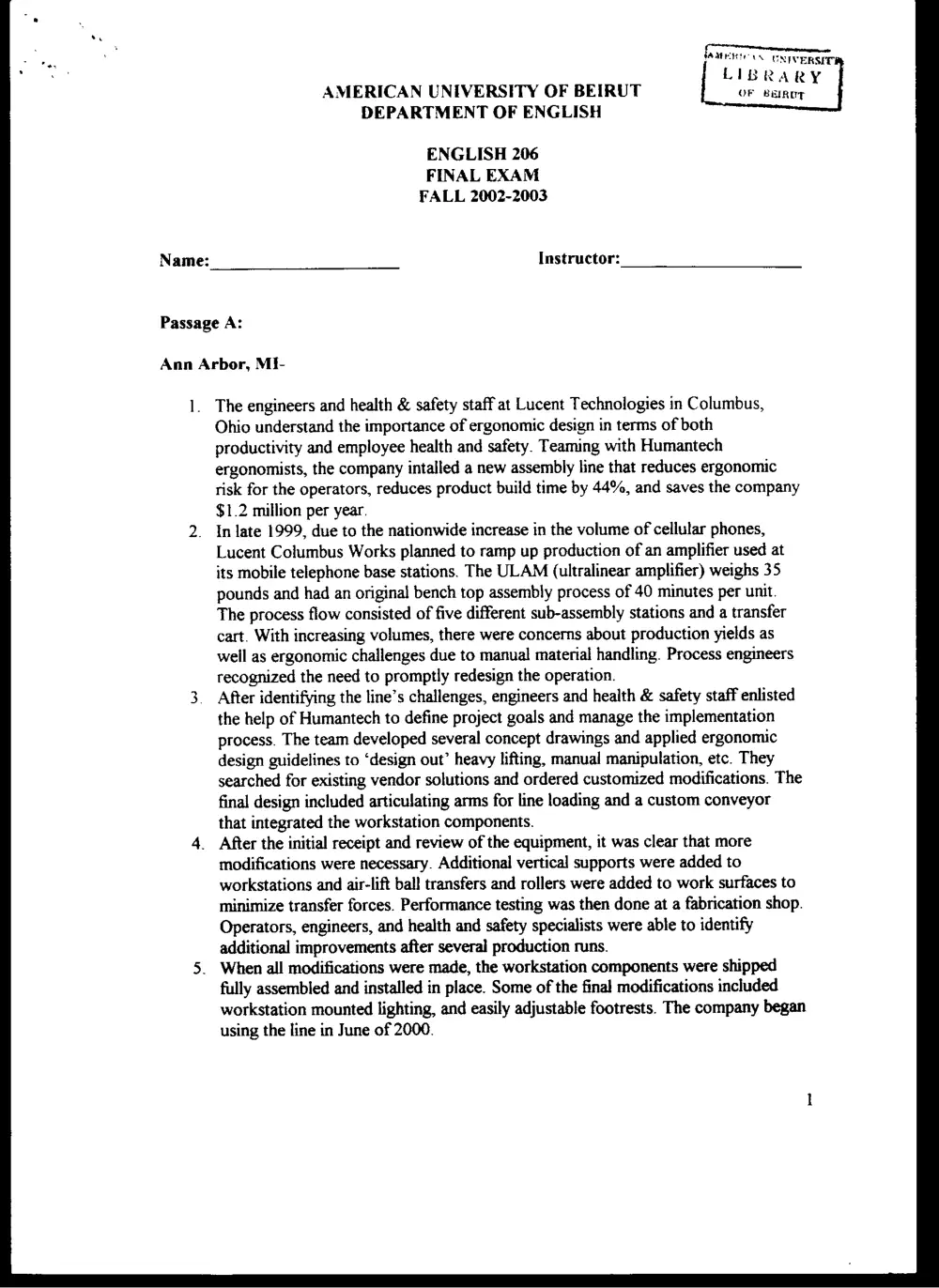
ENGLISH 206
FINAL EXAM
FALL 2002-2003
Name: Instructor:
Passage A:
Ann Arbor, MI-
1. The engineers and health & safety staff at Lucent Technologies in Columbus,
Ohio understand the importance of ergonomic design in terms of both
productivity and employee health and safety. Teaming with Humantech
ergonomists, the company intalled a new assembly line that reduces ergonomic
risk for the operators, reduces product build time by 44%, and saves the company
$1.2 million per year.
2. In late 1999, due to the nationwide increase in the volume of cellular phones,
Lucent Columbus Works planned to ramp up production of an amplifier used at
its mobile telephone base stations. The ULAM (ultralinear amplifier) weighs 35
pounds and had an original bench top assembly process of 40 minutes per unit.
The process flow consisted of five different sub-assembly stations and a transfer
cart. With increasing volumes, there were concerns about production yields as
well as ergonomic challenges due to manual material handling. Process engineers
recognized the need to promptly redesign the operation.
3. After identifying the line’s challenges, engineers and health & safety staff enlisted
the help of Humantech to define project goals and manage the implementation
process. The team developed several concept drawings and applied ergonomic
design guidelines to ‘design out’ heavy lifting, manual manipulation, etc. They
searched for existing vendor solutions and ordered customized modifications. The
final design included articulating arms for line loading and a custom conveyor
that integrated the workstation components.
4. After the initial receipt and review of the equipment, it was clear that more
modifications were necessary. Additional vertical supports were added to
workstations and air-lift ball transfers and rollers were added to work surfaces to
minimize transfer forces. Performance testing was then done at a fabrication shop.
Operators, engineers, and health and safety specialists were able to identify
additional improvements after several production runs.
5. When all modifications were made, the workstation components were shipped
fully assembled and installed in place. Some of the final modifications included
workstation mounted lighting, and easily adjustable footrests. The company began
using the line in June of 2000.
6.
HERICAN ONTVERSIT
LIBRARY
OF BUIRDT
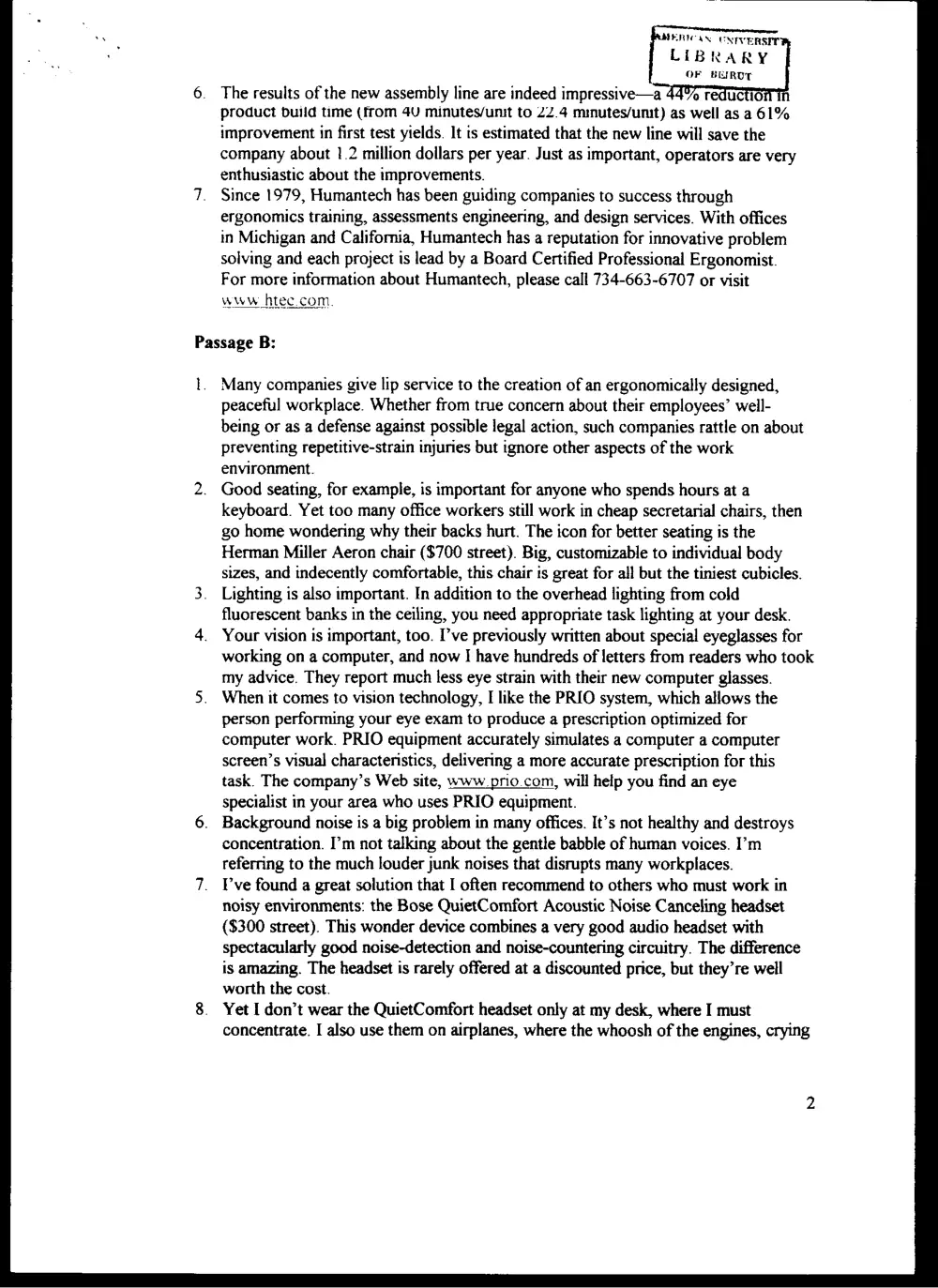
The results of the new assembly line are indeed impressive—a
product build time (from 4U minutes/unit to 22.4 minutes/unit) as well as a 61%
improvement in first test yields. It ts estimated that the new line will save the
company about 1.2 million dollars per year. Just as important, operators are very
enthusiastic about the improvements.
Since 1979, Humantech has been guiding companies to success through
ergonomics training, assessments engineering, and design services. With offices
in Michigan and California, Humantech has a reputation for innovative problem
solving and each project is lead by a Board Certified Professional Ergonomist.
For more information about Humantech, please call 734-663-6707 or visit
www htec com.
Passage B:
L.
ies)
Many companies give lip service to the creation of an ergonomically designed,
peaceful workplace. Whether from true concern about their employees’ well-
being or as a defense against possible legal action, such companies rattle on about
preventing repetitive-strain injuries but ignore other aspects of the work
environment.
Good seating, for example, is important for anyone who spends hours at a
keyboard. Yet too many office workers still work in cheap secretarial chairs, then
go home wondering why their backs hurt. The icon for better seating is the
Herman Miller Aeron chair ($700 street). Big, customizable to individual body
sizes, and indecently comfortable, this chair is great for all but the tiniest cubicles.
Lighting is also important. In addition to the overhead lighting from cold
fluorescent banks in the ceiling, you need appropriate task lighting at your desk.
Your vision is important, too. I’ve previously written about special eyeglasses for
working on a computer, and now I have hundreds of letters from readers who took
my advice. They report much less eye strain with their new computer glasses.
When it comes to vision technology, I like the PRIO system, which allows the
person performing your eye exam to produce a prescription optimized for
computer work. PRIO equipment accurately simulates a computer a computer
screen’s visual characteristics, delivering a more accurate prescription for this
task. The company’s Web site, www_prio.com, will help you find an eye
specialist in your area who uses PRIO equipment.
Background noise is a big problem in many offices. It’s not healthy and destroys
concentration. I’m not talking about the gentle babble of human voices. I’m
referring to the much louder junk noises that disrupts many workplaces.
P’ve found a great solution that I often recommend to others who must work in
noisy environments: the Bose QuietComfort Acoustic Noise Canceling headset
($300 street). This wonder device combines a very good audio headset with
spectacularly good noise-detection and noise-countering circuitry. The difference
is amazing. The headset is rarely offered at a discounted price, but they’re well
worth the cost.
Yet I don’t wear the QuietComfort headset only at my desk, where I must
concentrate. I also use them on airplanes, where the whoosh of the engines, crying
{Omenicws UNIWERSIT
LIBRARY
OF BEIRUT
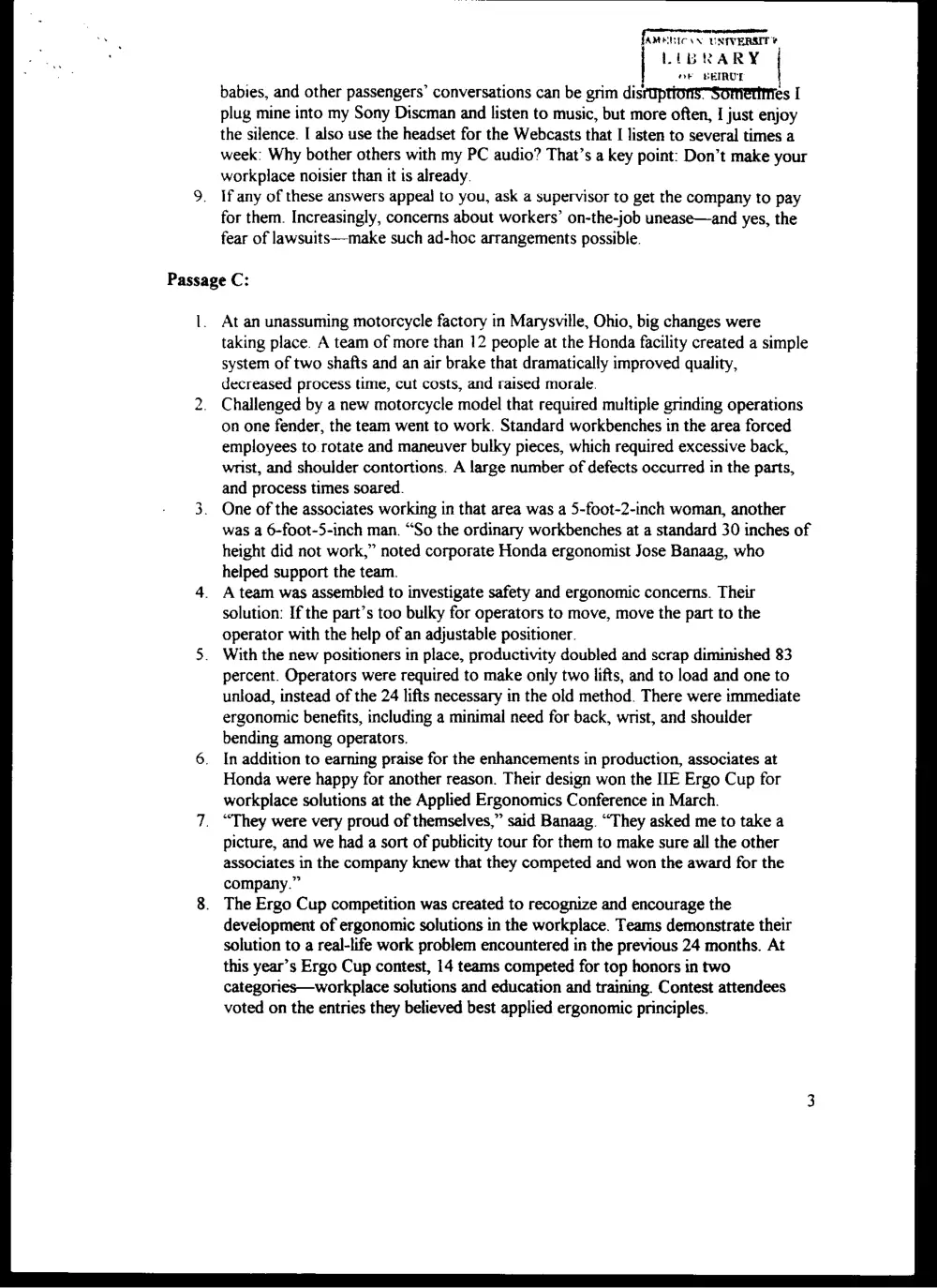
babies, and other passengers’ conversations can be grim disruptions~Somenrites I
plug mine into my Sony Discman and listen to music, but more often, I just enjoy
the silence. I also use the headset for the Webcasts that I listen to several times a
week: Why bother others with my PC audio? That’s a key point: Don’t make your
workplace noisier than it is already.
If any of these answers appeal to you, ask a supervisor to get the company to pay
for them. Increasingly, concerns about workers’ on-the-job unease—and yes, the
fear of lawsuits—make such ad-hoc arrangements possible.
Passage C:
L.
At an unassuming motorcycle factory in Marysville, Ohio, big changes were
taking place. A team of more than 12 people at the Honda facility created a simple
system of two shafts and an air brake that dramatically improved quality,
decreased process time, cut costs, and raised morale.
Challenged by a new motorcycle model that required multiple grinding operations
on one fender, the team went to work. Standard workbenches in the area forced
employees to.rotate and maneuver bulky pieces, which required excessive back,
wrist, and shoulder contortions. A large number of defects occurred in the parts,
and process times soared.
One of the associates working in that area was a 5-foot-2-inch woman, another
was a 6-foot-5-inch man. “So the ordinary workbenches at a standard 30 inches of
height did not work,” noted corporate Honda ergonomist Jose Banaag, who
helped support the team.
A team was assembled to investigate safety and ergonomic concerns. Their
solution: If the part’s too bulky for operators to move, move the part to the
operator with the help of an adjustable positioner.
With the new positioners in place, productivity doubled and scrap diminished 83
percent. Operators were required to make only two lifts, and to load and one to
unload, instead of the 24 lifts necessary in the old method. There were immediate
ergonomic benefits, including a minimal need for back, wrist, and shoulder
bending among operators.
In addition to earning praise for the enhancements in production, associates at
Honda were happy for another reason. Their design won the IIE Ergo Cup for
workplace solutions at the Applied Ergonomics Conference in March.
“They were very proud of themselves,” said Banaag. “They asked me to take a
picture, and we had a sort of publicity tour for them to make sure all the other
associates in the company knew that they competed and won the award for the
company.”
The Ergo Cup competition was created to recognize and encourage the
development of ergonomic solutions in the workplace. Teams demonstrate their
solution to a real-life work problem encountered in the previous 24 months. At
this year’s Ergo Cup contest, 14 teams competed for top honors in two
categories—workplace solutions and education and training. Contest attendees
voted on the entries they believed best applied ergonomic principles.
10
lI.
13.
ora nrrenenere weryenersnmret
fabtr ar +s CNIVERSIT
LIBRARY
OF BEIRUT
“It’s a great way to get enthusiasm into the attendé&3‘BeCause they really take
their entry very seriously,” commented conference co-chair Tim McGlothlin.
Also understandably enthusiastic was the Ergo Cup-winning team in the new
education and training category—Ford Motor Co. of Dearborn, Mich.
According to Camille Major, a member of Ford’s winning team, Ford employees
perceived the training as a fun project. “In addition to all the benefits we knew
about, now we [are] recognized by our peers,” she said.
. In an effort to educate manufacturing engineers at their assembly plants, Ford
developed a program called “Putting Engineers on the Line.” The three-day
session reviewed basic ergonomic principles with the students before placing
them on the production floor to work full shifts. Implemented successfully in five
plants (Chicago, Norfolk, Va.; Louisville, Ky., Wixom, Mich.; and Oakville,
Ontario) with plans to expand the program to other facilities, the program
educated more than 150 engineers about the importance of ergonomic
considerations when designing solutions.
“It was a huge morale booster,” Major said. “Overall, the end result was that
everybody had a better understanding of each other’s role and each other’s
function.”
Passage D:
1.
In an effort to minimize the possibility of injuries to operators at its Spring Hill,
Tenn., facility, engineers at a Saturn assembly plant have developed an ergonomic
tool handle for use by operators.
According to Saturn ergonomics engineer Gary Dumas, many plant operations
require the use of heavy right-angle tools that are operated with two hands: one to
hold the tool, the other to guide it. The new tool handle attaches to the mechanical
end of a power tool used to secure fasteners.
The nature of assembly operations such as securing fasteners into magnetic
sockets requires operators to wear gloves to protect their hands from cuts and
other injuries. But because the operators’ fingers get close to rotating sockets or
extensions when securing fasteners, the gloves could potentially become caught in
those sockets, resulting in injuries.
The lightweight tool, made of aluminum and plastic, provides a safe place for
Operators to put their guiding hand, keeping gloves and fingers out of harm’s way.
Adapted from: - www. humantech.com
-Institute of Industrial Engineers, Inc.
Ce eee ne ameamesnimedl
lanedie VA UNIVERSIT’
LIBRARY
English 206 OF BEIRUT
Final Exam
Fall 2002-2003
Name: Section:
Instructor: Time Allowed: 2’? Hours
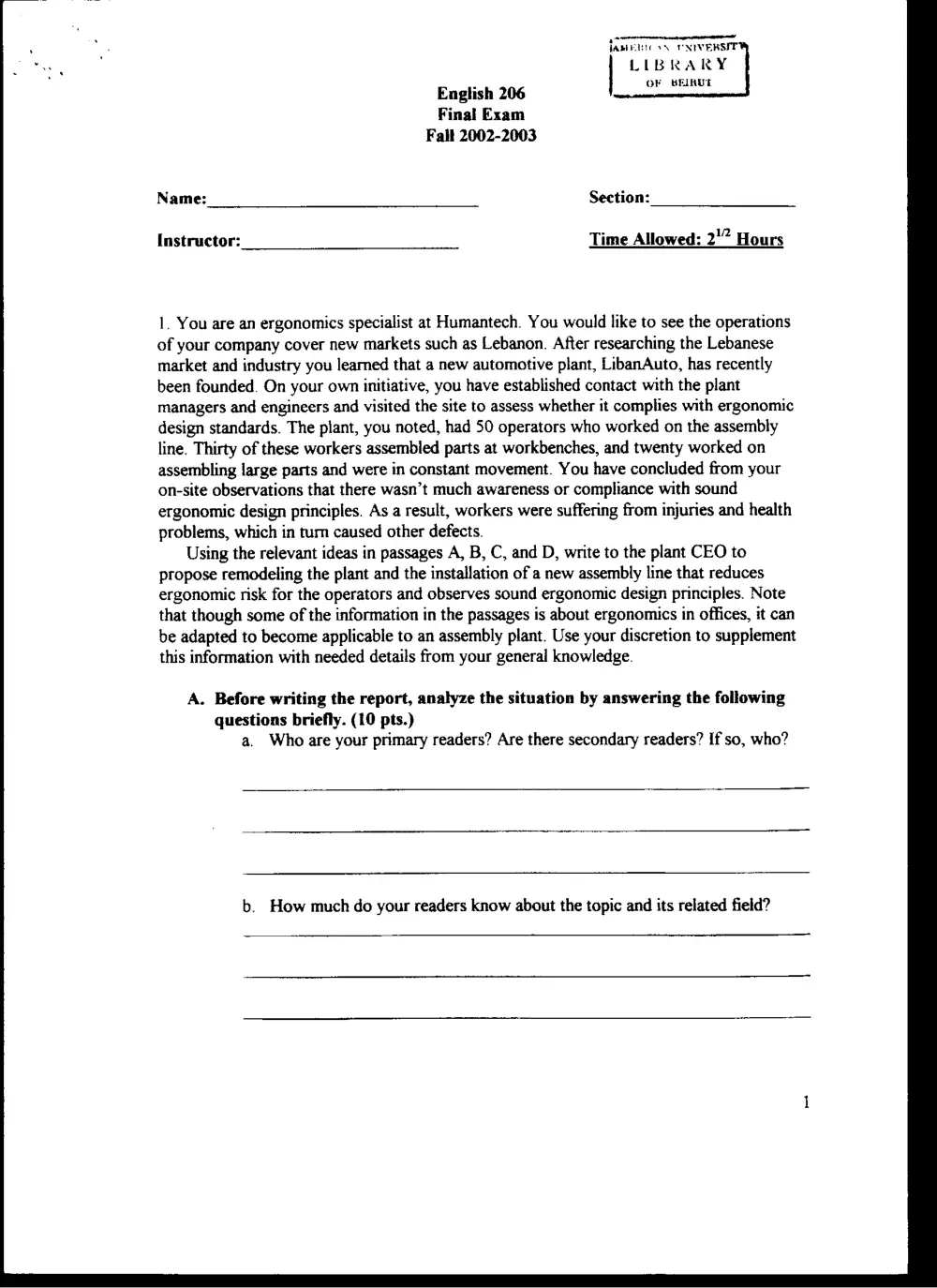
1. You are an ergonomics specialist at Humantech. You would like to see the operations
of your company cover new markets such as Lebanon. After researching the Lebanese
market and industry you learned that a new automotive plant, LibanAuto, has recently
been founded. On your own initiative, you have established contact with the plant
managers and engineers and visited the site to assess whether it complies with ergonomic
design standards. The plant, you noted, had 50 operators who worked on the assembly
line. Thirty of these workers assembled parts at workbenches, and twenty worked on
assembling large parts and were in constant movement. You have concluded from your
on-site observations that there wasn’t much awareness or compliance with sound
ergonomic design principles. As a result, workers were suffering from injuries and health
problems, which in tum caused other defects.
Using the relevant ideas in passages A, B, C, and D, write to the plant CEO to
propose remodeling the plant and the installation of a new assembly line that reduces
ergonomic risk for the operators and observes sound ergonomic design principles. Note
that though some of the information in the passages is about ergonomics in offices, it can
be adapted to become applicable to an assembly plant. Use your discretion to supplement
this information with needed details from your general knowledge.
A. Before writing the report, analyze the situation by answering the following
questions briefly. (10 pts.)
a. Who are your primary readers? Are there secondary readers? If so, who?
b. How much do your readers know about the topic and its related field?
a TI
AMERICAN UNIVERST
LIBRARY
~ Ay OF BEIRUT
oo
c. Noting that Lebanon has no clear ergonomic legislations that are legally
binding to companies, analyze the ethical dilemma that this situation
presents to managers at LibanAuto.
B. Write your report. (50 pts.)
a. Use the memo format and address it to Mr. John Smith, CEO of LibanAuto.
b. Write your report on page 3.
AMG AS CNTVERSIT!
LIBRARY
OF PEINOT
2. The format and message of the following draft letter need revision. Edit and rewrite
this letter on page 7 to make it clear, correct, consistent, courteous, concise, etc. Note that
there are no errors within the inside address or outside address; there may be errors in the
layout, however. (40 pts.)
Donald Vizano
201 Edge Drive
Timmins, Ontario P9T
John Smith, Personnel Director
Martin & Koffman (M&K)
393 University Avenue
Toronto, Ontario MSR
{ understand that M&K is making a major effort to build a full-scale equipment
development laboratory. That prospect interests me greatly because of my educational
background. At university, I took courses in several subjects that might be useful in the
lab’s work, and I worked as a lab monitor at Computer Services Company.
Also, related work at two firms has given me experience in electronics system. That is
where I was informed by my ex-academic advisor about an electronic engineering
opening at Martin & Koffman (M&K). He asked me to apply for the job. He thinks f am
the man for this job. Therefore, I would like the opportunity to apply my knowledge at
M&K. I have taken courses in microprocessor applications and fiber optics, and I have
worked as an assembler at Jones Energy and Automation, Inc. While in college, I have
also worked as a student assistant in the library.
Enclosed is a resume that highlights my credentials. I hope I will get the job though I
realize that you probably have more experienced applicants to consider. I am sure you
will make the right decision by selecting me if you know what is best for your company.
Thank you for your offer and I look forward to working with you.
Sincerely
Donald Vizano
Attachment