
ENG 206 Final, Spring 2004
American University of Beirut · Technical English · 9 pages



More ENG 206 files
Show the text of this final exam
Name:
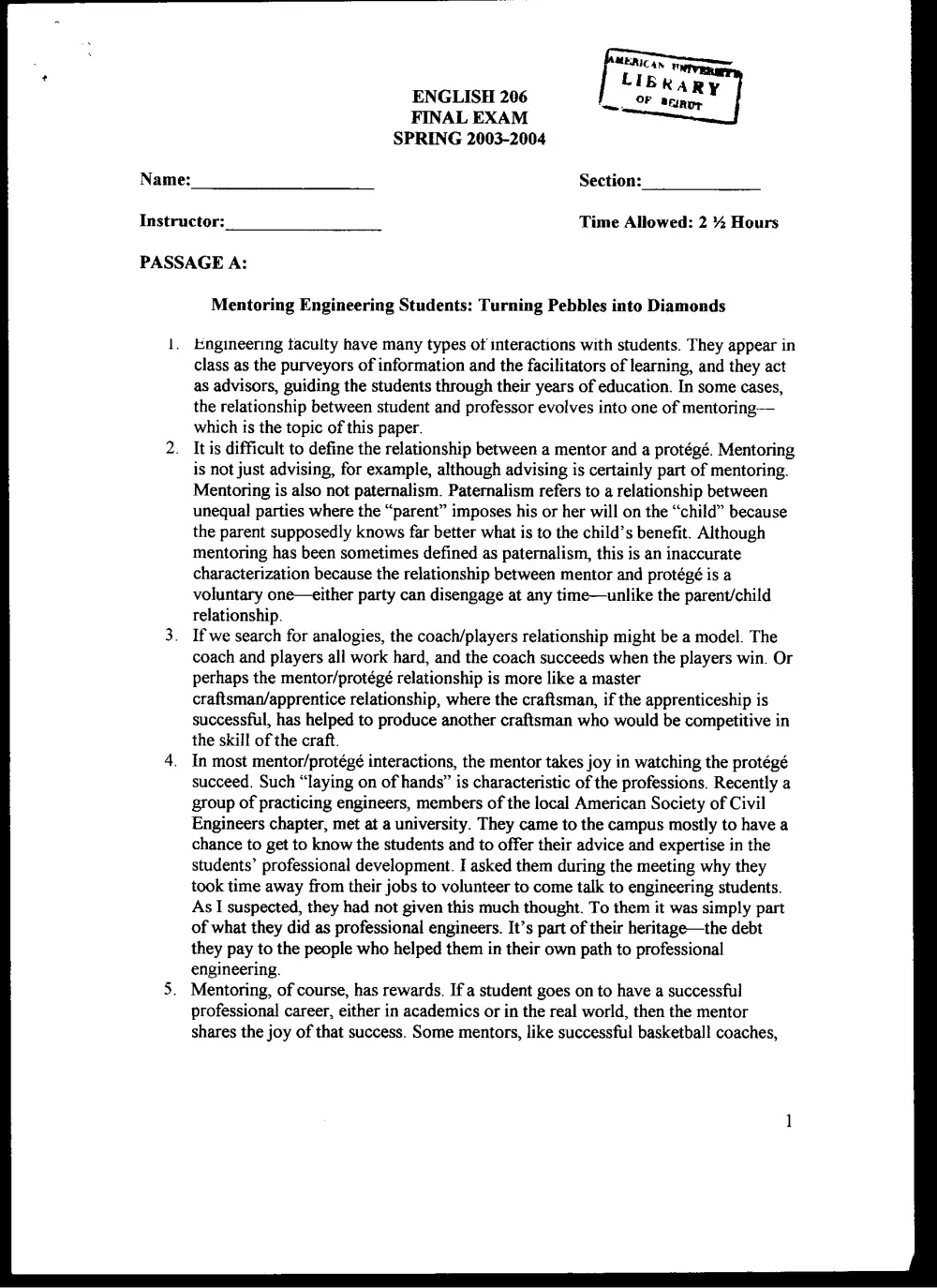
ENGLISH 206
FINAL EXAM
SPRING 2003-2004
Section:
Instructor: Time Allowed: 2 % Hours
PASSAGE A:
Mentoring Engineering Students: Turning Pebbles into Diamonds
Engineering taculty have many types of interactions with students. They appear in
class as the purveyors of information and the facilitators of learning, and they act
as advisors, guiding the students through their years of education. In some cases,
the relationship between student and professor evolves into one of mentoring—
which is the topic of this paper.
It is difficult to define the relationship between a mentor and a protégé. Mentoring
is not just advising, for example, although advising is certainly part of mentoring.
Mentoring is also not paternalism. Paternalism refers to a relationship between
unequal parties where the “parent” imposes his or her will on the “child” because
the parent supposedly knows far better what is to the child’s benefit. Although
mentoring has been sometimes defined as paternalism, this is an inaccurate
characterization because the relationship between mentor and protégé is a
voluntary one—either party can disengage at any time—aunlike the parent/child
relationship.
If we search for analogies, the coach/players relationship might be a model. The
coach and players all work hard, and the coach succeeds when the players win. Or
perhaps the mentor/protégé relationship is more like a master
craftsman/apprentice relationship, where the craftsman, if the apprenticeship is
successful, has helped to produce another craftsman who would be competitive in
the skill of the craft.
In most mentor/protégé interactions, the mentor takes joy in watching the protégé
succeed. Such “laying on of hands” is characteristic of the professions. Recently a
group of practicing engineers, members of the local American Society of Civil
Engineers chapter, met at a university. They came to the campus mostly to have a
chance to get to know the students and to offer their advice and expertise in the
students’ professional development. I asked them during the meeting why they
took time away from their jobs to volunteer to come talk to engineering students.
As I suspected, they had not given this much thought. To them it was simply part
of what they did as professional engineers. It’s part of their heritage—the debt
they pay to the people who helped them in their own path to professional
engineering.
Mentoring, of course, has rewards. If a student goes on to have a successful
professional career, either in academics or in the real world, then the mentor
shares the joy of that success. Some mentors, like successful basketball coaches,
man”
thay not have had brilliant careers themselves but know how to get the very best
_ out of their students.
So how does one become an effective mentor of engineering students? Perhaps
we can list the attributes of good mentors and simply say “do that.” This approach
is not without precedent. The widely distributed book from the National Academy
of Sciences, Adviser, Teacher, Role Model, Friend takes this approach. For
example, it gives advice for new mentors:
e Listen patiently.
Build relationship.
Don’t abuse your authority.
Nurture self-sufficiency.
Establish “protected time” together.
Share yourself.
Provide introductions.
Be constructive.
Don’t be overbearing.
e Find your own mentors.
But such lists are unsatisfying. Learning to be a good mentor also requires effort,
although knowing some of the rules, just as in learning to ride a bicycle, are
useful and helpful.
The Mentor as Friend
Some leaders in the collegiate teaching profession advise strongly about
maintaining a strict business-like relationship between the student protégé and the
professor mentor. A professor should not have any casual relationships with
students, that such relationships “conflict with our fundamental obligations as
professors,” and the ethics of the relationship require that the professor remain
“dispassionate,” avoiding any appearance of partiality. The professor should “not
seek to be their psychiatrist, friend, or lover.”
I firmly agree about the psychiatrist and lover part, but I am not sure about the
evil of friendships between students and professors. Too often we tend to be
overly cautious and to keep students at a distance, not offering them the
encouragement and support they need. One educator has observed that “there are
far too many students in our courses for whom learning has been a humiliating
experience... It is remarkable in how many ways teachers unwittingly exacerbate
[students’] lack of self-esteem”. One way of encouraging students to higher levels
of achievement is to offer friendship as a part of the professorial role.
Richard Baker, in a wonderful critique of the book A Small Room by May Sarton,
presents a convincing case for friendship between professor and student. There
are times and situations, he argues, where friendship is exactly what is needed in
the mentoring relationship. Such a friendship does not have to be destructive or
result in unjust impartiality. A small note of encouragement, a friendly gesture,
making time during a busy schedule for “hanging out,” asking an underachieving
student to chat, answering e-mail, paying attention to their extracurricular
activities and achievements, ... these are all indicators of friendship, and they
mean a great deal to students. As Baker concludes, “The key ethical point... is |
that the professor—both inside and outside the classroom—should act as a
friend.”
. But there is a difference between “friend” and “pal”. The
teacher/professor/mentor has a special power relationship with the student and the
professor will be called on to evaluate performance and to do this
“dispassionately”. An advisor or mentor cannot be a pal, shooting hoops with
students and drinking beer afterwards, or joining them in dancing the night away
at a sorority ball. A professor trying to be a pal will destroy the fragile
relationship between student and professor that is such an integral part of
education.
Student-Specific Mentoring
. The mentor’s relationship with the protégé must be student-specific because
different students need different kinds of mentoring. Sometimes these needs are
obvious, but often they are not. To get started, some gross generalizations are
useful. For example, there is a significant gender difference in what
undergraduate students expect from an advisor. The data are from a study with
engineering undergraduate students.
. Female students, on average, expect the advisor to get to know them as a person
and to establish a working relationship. Male students, on average, want to just
“get the facts, ma’am,” and depend on the advisor to be right about the facts.
. Although there is a stunning difference between what men and women expect
from an advisor, we have to be careful about unwarranted generalization. More
men than women want concrete and directive suggestions, but a significant
faction of women still expect such help. Similarly, one third of the men expect the
professor to take the time to get to know them personally. What this means is that
the advisor cannot easily predict, based on some characteristics such as gender,
how best to serve the students’ needs. All students should be treated as individuals
by allowing them to set the tone for what the relationship will be like. It is usually
best to allow the student to lead the way.
The Toxic Mentor
14. The relationship between the mentor and protégé can be a mutually satisfying and
even rewarding one, but it can also be the cause of great anguish and pain.
Perhaps it is wise to ask if the mentor/protégé system is a good one, or if some
other system would be better. Consider, taking the lead from John Rawls, an
“original position”, of both professors and students in a department where every
faculty member is to advise every student equally. With time, would students not
seek out one or several professors with whom they have the greatest rapport and
whose advice they begin to value? And would the professors not begin to identify
those students they most would like to work with and in whom they see the
greatest potential? In other words, the “original position” is an unstable situation,
and students will eventually migrate to those professors who they most want to
* have as their mentors. It therefore appears that the mentor/protégé system is a
natural outcome and is not one that is synthetically imposed on us.
15. Ideally, therefore, the student becomes a professor’s protégé by mutual consent.
But the world is often not ideal, and professors can become advisors by other
means. For example, the advising system at a university might force a student to
accept an advisor without mutual consent, or the availability of funds can force a
student to choose or change a primary advisor, or the professor may leave the
university or go on leave, again forcing a change in advisors. Finally, the process
is dynamic and a relationship that seemed to be excellent in the beginning of the
student’s program can sour as the student develops in maturity or as new
responsibilities and requirements are imposed. Thus, it is possible for students to
have what Stephanie Bird calls toxic mentors.
16. For example, one faculty member prominently displayed mildly suggestive
17.
18.
pictures of women in his office. The female students were unable to convince the
professor that the pictures made them feel uncomfortable, and eventually they
went to the departmental chair and asked him to intercede, which he did. The
pictures came down, but the relationship between the students and the advisor was
poisoned. The professor did not understand that the pictures were inappropriate
and resented the students going to the chair with their concerns. In this particular
case, the relationship between the senior graduate student and the professor
deteriorated to the point where she did not even ask him for a letter of
recommendation when she sought academic work after graduation. The chair had
to write a letter of explanation as to why no such recommendation from the
primary advisor was forthcoming.
Students caught in a trap with a toxic mentor can either suck it up and graduate
fast or try to change the primary advisor. Neither is easily done. If the students are
in graduate school, faculty often believe that they make investments in students
and that the student should then show loyalty in not shopping around for a new
primary advisor, taking the news of disloyal behavior personally and often
vindictively. In undergraduate school, changing advisors is often impossible due
to departmental or college rules on advising. An incompetent advisor is often
blamed for the failure to graduate from a science or engineering program.
The University’s Role in Improving the Quality of Mentoring
The university can enhance the quality of advising available to students and
increase the potential of having an adviser/advisee relationship turn into a much
more rewarding and lasting mentor/protégé relationship. Some suggestions, based
on experiences at some forward looking universities, are that universities should
1. establish policies that would allow students to have the option of selecting
advisors.
2. be the organizer for improving advising.
3. develop regular feedback sessions with students.
4. ask students to complete exit surveys, asking them to assess the
experiences they have had with their advisor and other faculty in their
department.
. AM Ri ok ARIVERS! ,
_ Litieary
- ov *aawer
These are all good ideas and if implemented can no doubt improve the advising
process at any university. But we have to be realistic. If a faculty member,
especially a senior faculty member, does not wish to spend time helping students,
then there is little a university can do to improve the situation. Mentoring does
not come from a guidebook, a set of rules, or even incentives. Mentoring comes
from the heart. Ya gotta love it. It’s kinda like the old saying: “Never try to teach
a pig to sing. It won’t work and it annoys the pig.”
Source: Vesilind, P.A. (2001, July). Mentoring engineering students:
Tuming pebbles into diamonds. Journal of Engineering Education, 407-410
PASSAGE B:
MentorNet
1. When you’re a female freshman engineering major at a prestigious technical
institute, the stresses can pile up, and having an objective someone on your side
can make a big difference in how you handle them.
2. When Erin McClain arrived at Rensselaer Polytechnic Institute in Troy, New
York, she realized the climate was quite different from high school. From most of
the male engineering students she met, she says, she experienced a condescension
that stopped her short.
3. “This campus is 77 percent male. There are very few women professors, and a lot
of the males think women are here because of affirmative action, not because
we’re as smart and capable as they are,” Erin says, in an observation common to
many female engineering students on campuses across the country. “Unless a
woman is a really great programmer, they act like she doesn’t know much. When
you work with people in groups, the men will ask of the women, ‘Are you sure
you know how to do this?’ They assume women don’t know what to do with a
computer, or how to fix it, that our knowledge is limited because we’re female.”
4. Erin had a campus mentor, who was helpful in many ways but unable to answer
questions about professional concerns. So she signed up with MentorNet,
indicating a preference to be matched with a female mentor who’d been an
electrical engineering major.
A Friend and Advisor
5. A few weeks later she was paired with Veronica DeHart, 33, a software engineer
in the IBM Enterprise Systems Group in Austin, Texas, who had informally
mentored new employees there. Prior to her three years with IBM, Veronica had
been an undergraduate researcher with the NASA “Hearts in Space” project at the
University of Utah, which studies the effects of zero gravity on the human
cardiovascular system. She had been a first-generation college student who earned
her bachelor’s degree in electrical engineering at the University of Utah with
part-time jobs as an engineering aide. She’d also completed internships and a co-
op placement and had mentored younger students on campus.
6. “Because I was a first-generation college student, most people in my family didn’t
understand what I was going through, especially as one of very few women in my
electrical engineering classes. I hoped that as a mentor, I could be an active
ov
oS th
roe &: 4
me
ancients vm
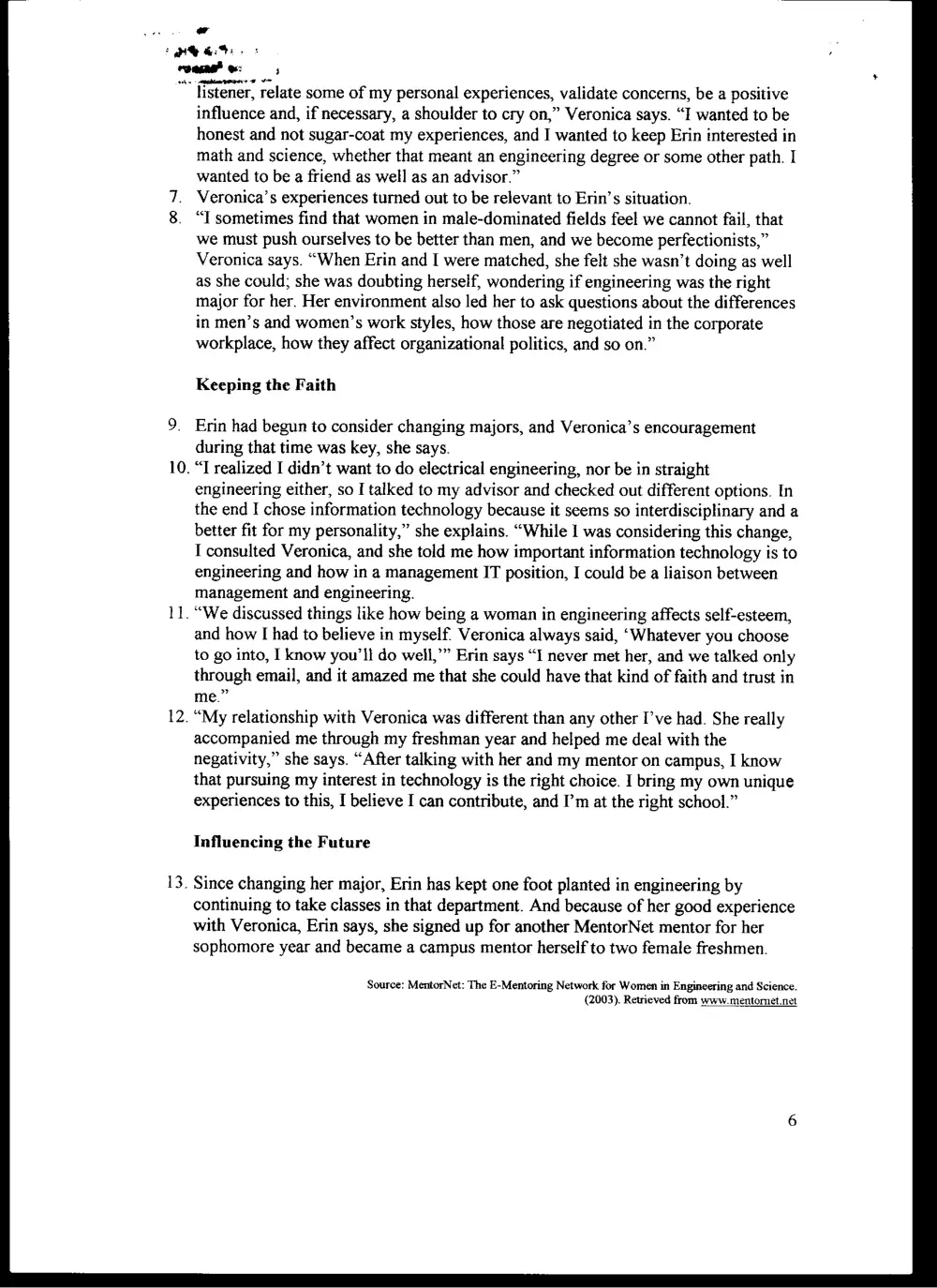
listener, relate some of my personal experiences, validate concerns, be a positive
influence and, if necessary, a shoulder to cry on,” Veronica says. “I wanted to be
honest and not sugar-coat my experiences, and I wanted to keep Erin interested in
math and science, whether that meant an engineering degree or some other path. I
wanted to be a friend as well as an advisor.”
Veronica’s experiences turned out to be relevant to Erin’s situation.
“I sometimes find that women in male-dominated fields feel we cannot fail, that
we must push ourselves to be better than men, and we become perfectionists,”
Veronica says. “When Erin and I were matched, she felt she wasn’t doing as well
as she could; she was doubting herself, wondering if engineering was the right
major for her. Her environment also led her to ask questions about the differences
in men’s and women’s work styles, how those are negotiated in the corporate
workplace, how they affect organizational politics, and so on.”
Keeping the Faith
Erin had begun to consider changing majors, and Veronica’s encouragement
during that time was key, she says.
. “realized I didn’t want to do electrical engineering, nor be in straight
engineering either, so I talked to my advisor and checked out different options. In
the end I chose information technology because it seems so interdisciplinary and a
better fit for my personality,” she explains. “While 1 was considering this change,
I consulted Veronica, and she told me how important information technology is to
engineering and how in a management IT position, I could be a liaison between
management and engineering.
. “We discussed things like how being a woman in engineering affects self-esteem,
and how I had to believe in myself. Veronica always said, ‘Whatever you choose
to go into, I know you'll do well,’” Erin says “I never met her, and we talked only
through email, and it amazed me that she could have that kind of faith and trust in
me”
. “My relationship with Veronica was different than any other I’ve had. She really
accompanied me through my freshman year and helped me deal with the
negativity,” she says. “After talking with her and my mentor on campus, I know
that pursuing my interest in technology is the right choice. I bring my own unique
experiences to this, I believe I can contribute, and I’m at the right school.”
Influencing the Future
. Since changing her major, Erin has kept one foot planted in engineering by
continuing to take classes in that department. And because of her good experience
with Veronica, Erin says, she signed up for another MentorNet mentor for her
sophomore year and became a campus mentor herself to two female freshmen.
Source: MentorNet: The E-Mentoring Network for Women in Engineering and Science.
(2003). Retrieved from www.mentormet.net
ENGLISH 206
FINAL EXAM
Spring 2003-2004
Name: Section:
Instructor: Time Allowed: 2 ’” Hours
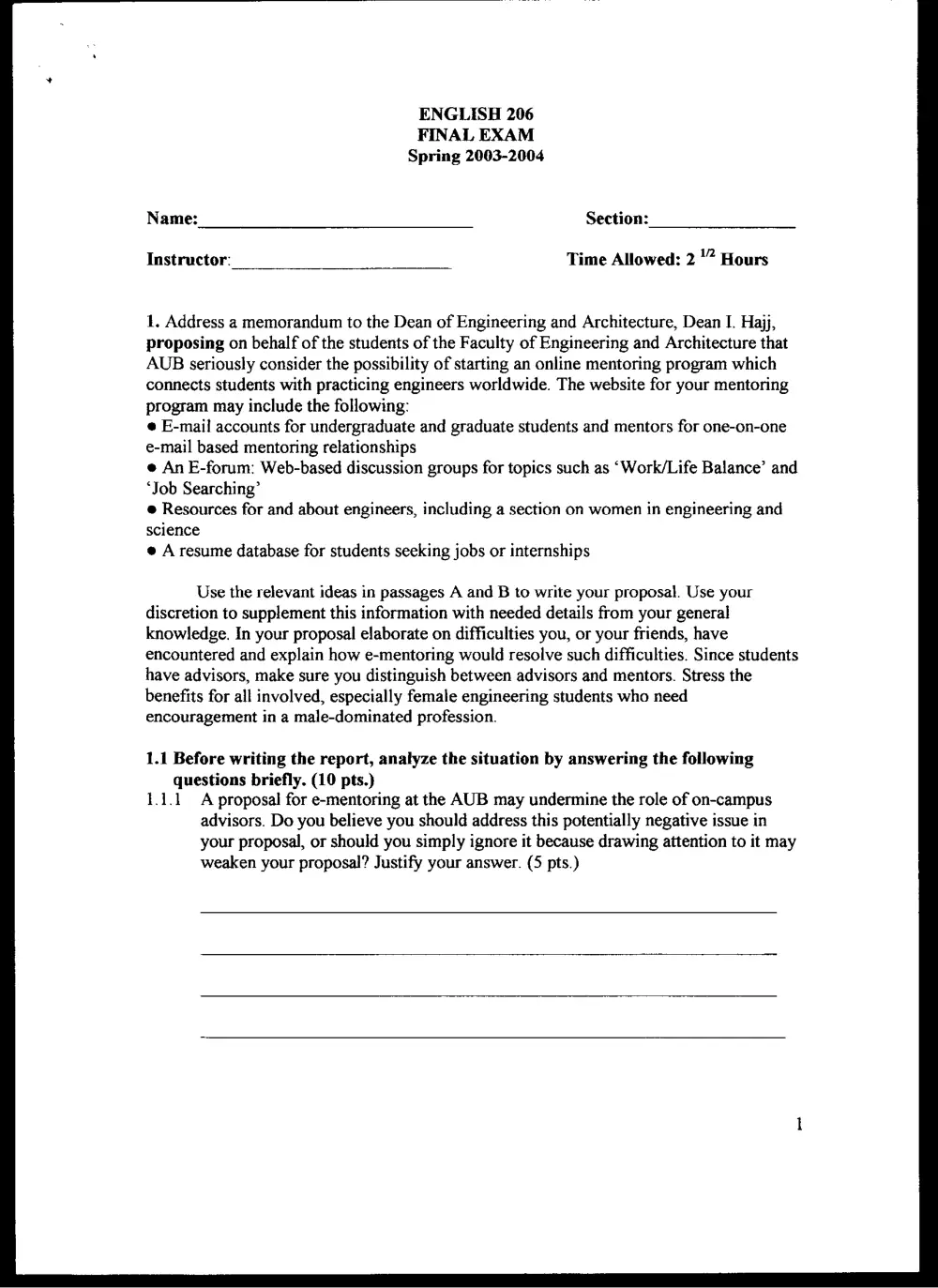
1. Address a memorandum to the Dean of Engineering and Architecture, Dean I. Hajj,
proposing on behalf of the students of the Faculty of Engineering and Architecture that
AUB seriously consider the possibility of starting an online mentoring program which
connects students with practicing engineers worldwide. The website for your mentoring
program may include the following:
e E-mail accounts for undergraduate and graduate students and mentors for one-on-one
e-mail based mentoring relationships
e@ An E-forum: Web-based discussion groups for topics such as ‘Work/Life Balance’ and
‘Job Searching’
@ Resources for and about engineers, including a section on women in engineering and
science
@ A resume database for students seeking jobs or internships
Use the relevant ideas in passages A and B to write your proposal. Use your
discretion to supplement this information with needed details from your general
knowledge. In your proposal elaborate on difficulties you, or your friends, have
encountered and explain how e-mentoring would resolve such difficulties. Since students
have advisors, make sure you distinguish between advisors and mentors. Stress the
benefits for all involved, especially female engineering students who need
encouragement in a male-dominated profession.
1.1 Before writing the report, analyze the situation by answering the following
questions briefly. (10 pts.)
1.1.1 A proposal for e-mentoring at the AUB may undermine the role of on-campus
advisors. Do you believe you should address this potentially negative issue in
your proposal, or should you simply ignore it because drawing attention to it may
weaken your proposal? Justify your answer. (5 pts.)
1.1.2 Identify two instances of inappropriate style (words, phrases or expressions) in
Passage A, knowing that the article was published in the Journal of Engineering
Education. Explain briefly why you find them inappropriate. (2.5 pts.)
7.1.3 Would you use such expressions in your proposal? Justify. (2.5 pts.)
1.2 Write your report on pages 3 and on. (Use the back of the sheets for drafting if
needed. You will not be given extra sheets of paper for drafts.) (50 pts.)
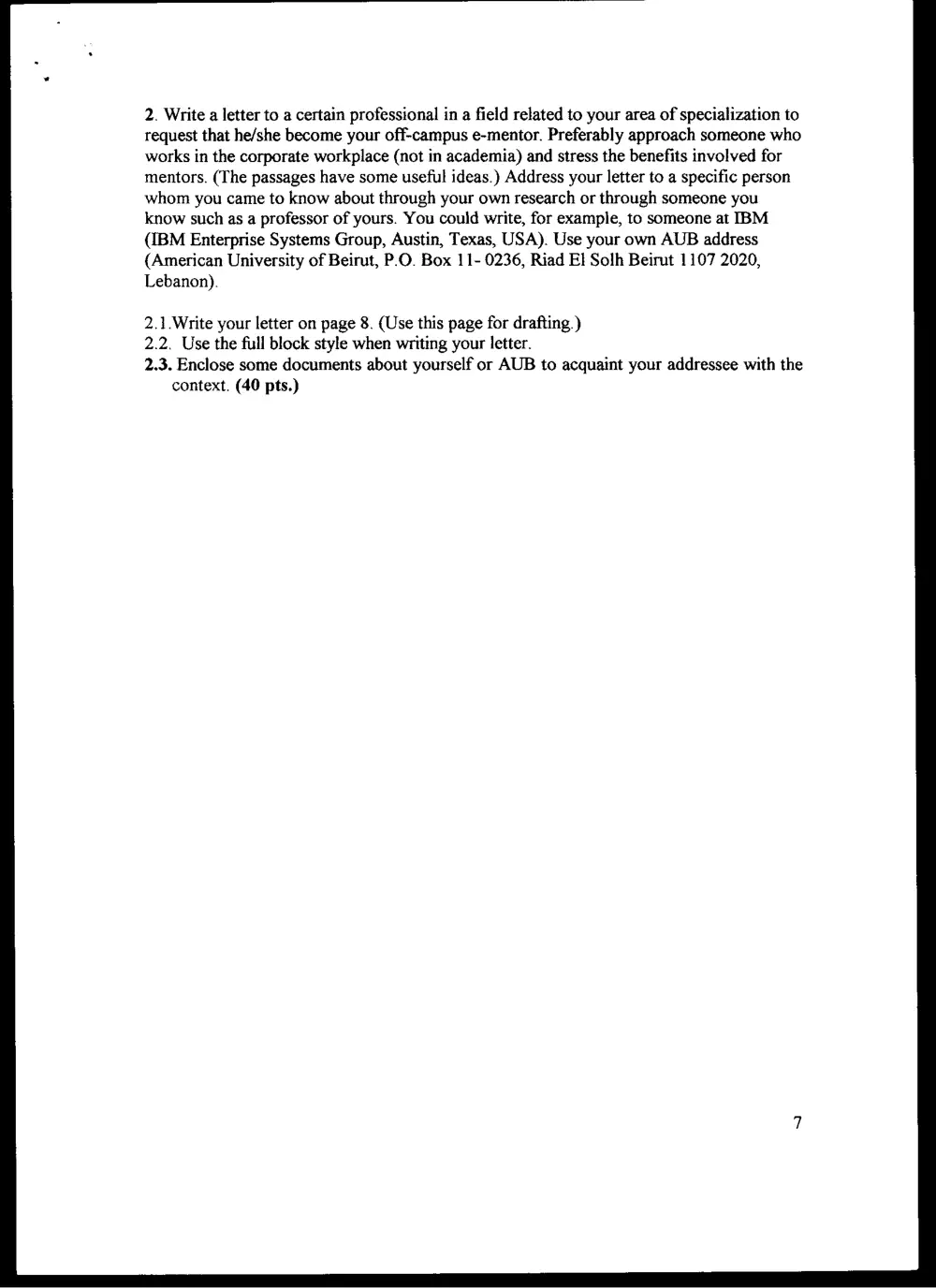
2. Write a letter to a certain professional in a field related to your area of specialization to
request that he/she become your off-campus e-mentor. Preferably approach someone who
works in the corporate workplace (not in academia) and stress the benefits involved for
mentors. (The passages have some useful ideas.) Address your letter to a specific person
whom you came to know about through your own research or through someone you
know such as a professor of yours. You could write, for example, to someone at IBM
(IBM Enterprise Systems Group, Austin, Texas, USA). Use your own AUB address
(American University of Beirut, P.O. Box 11- 0236, Riad El Solh Beirut 1107 2020,
Lebanon).
2.1.Write your letter on page 8. (Use this page for drafting.)
2.2, Use the full block style when writing your letter.
2.3. Enclose some documents about yourself or AUB to acquaint your addressee with the
context. (40 pts.)