
ENG 206 Final, Summer 2001
American University of Beirut · Technical English · 9 pages


More ENG 206 files
Show the text of this final exam
AMERICAN UNIVERSITY OF BEIRUT ~
DEPARTMENT OF ENGLISH
a Pb eae
ENGLISH 206 Sant ;
FINAL EXAM Pas 6
SUMMER 2001
Name: Instructor:
Time: 2 Hours 45 Minutes Section:
TEXTA
Kinematics: A Subsystem of Industrial Robots
Kinematics refer to the spatial arrangement, according to the sequence and structure, of
the axes of movement in relation to each other. There are four basic types of movement
that an industrial robot may have: (1) Cartesian, (2) cylindrical, (3) polar, and (4) jointed-
arm.
Cartesian Co-Ordinate Robot. The Cartesian co-ordinate robot is one that consists of a
column and an arm. It is sometimes called an x-y-z robot, indicating the axes of motion.
The x-axis is lateral motion, the y-axis is longitudinal motion, and the z-axis is vertical
motion. Thus, the arm can move up and down on the z-axis; the arm can slide along its
base on the x-axis; and then it can telescope to move to and from the work area on the y-
axis. The Cartesian co-ordinate robot was developed mainly for arc welding, but it 1s also
suited for many other assembly operations.
Cylindrical Co-Ordinate Robot. The cylindrical co-ordinate robot ts a variation of the
Cartesian robot. This robot consists of a base and a column, but the column is able to
rotate. It also carries an extending arm that can move up and down on the column to
provide more freedom of movement. The cylindrical co-ordinate robot is designed for
handling machine tools and assembly.
Polar Co-Ordinate Robot. The polar co-ordinate, or spherical co-ordinate robot consists
of a rotary base, an elevation pivot, and a telescoping extend-and-retract boom axis.
These robots operate according to spherical co-ordinates and offer greater flexibility.
They are used particularly in spot welding.
Jointed-Arm Robot. The jointed-arm robot resembles a human arm. It usually stands on
a base on which it can rotate, while it can articulate at the “shoulder” joint, which is just
above the base. The robot can also rotate about its “elbow” and “wrist” joints. With the
swiveling and bending at the wrist, six degrees of freedom can be obtained. The jointed-
arm robot is the most popular form for a robot and is capable in welding and painting
Text B
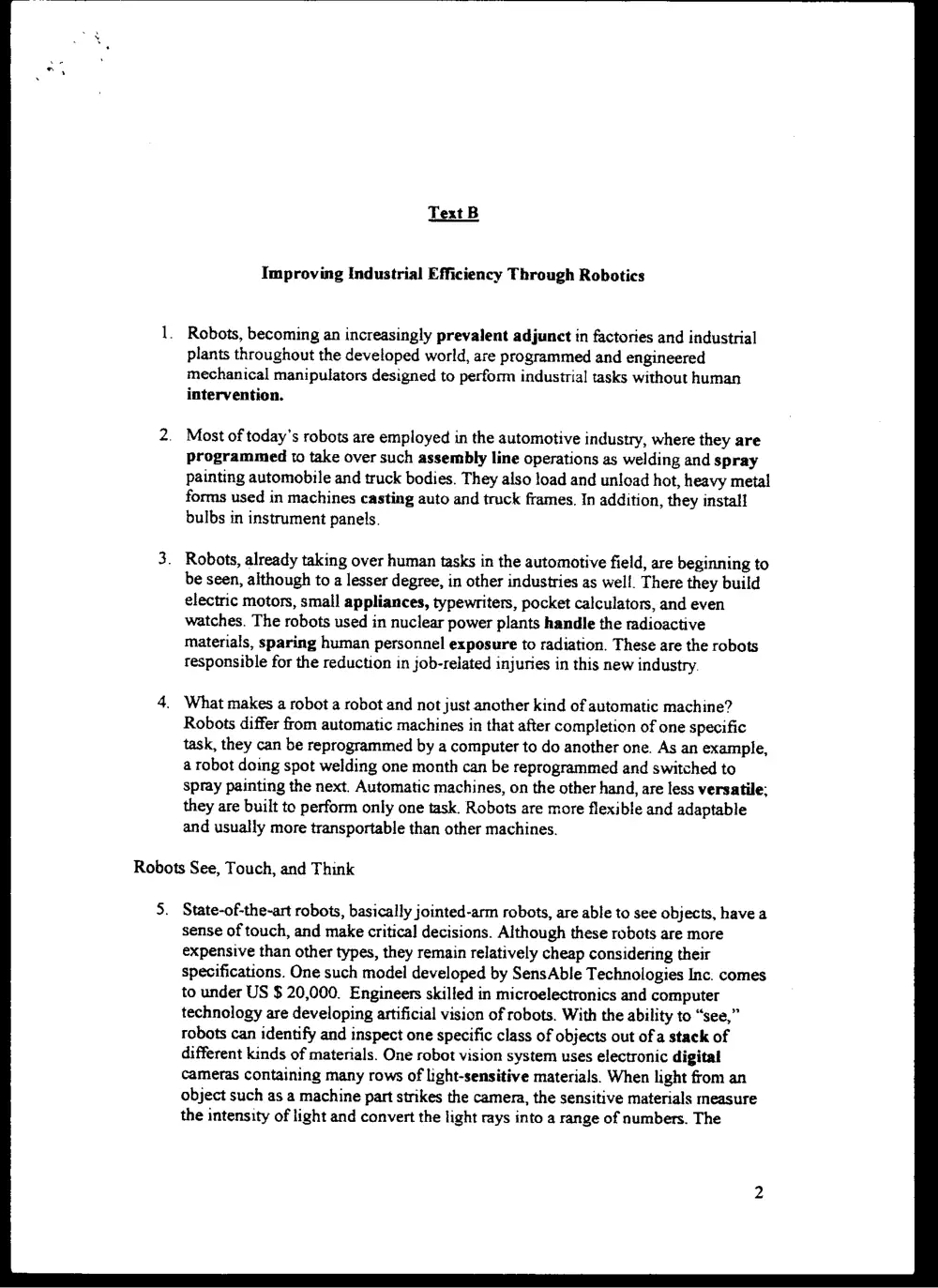
Improving Industrial Efficiency Through Robotics
Robots, becoming an increasingly prevalent adjunct in factories and industrial
plants throughout the developed world, are programmed and engineered
mechanical manipulators designed to perform industrial tasks without human
intervention.
Most of today’s robots are employed in the automotive industry, where they are
programmed to take over such assembly line operations as welding and spray
painting automobile and truck bodies. They also load and unload hot, heavy meta!
forms used in machines casting auto and truck frames. In addition, they install
bulbs in instrument panels.
. Robots, already taking over human tasks in the automotive field, are beginning to
be seen, although to a lesser degree, in other industries as well. There they build
electric motors, small appliances, typewriters, pocket calculators, and even
watches. The robots used in nuclear power plants handle the radioactive
materials, sparing human personnel exposure to radiation. These are the robots
responsible for the reduction in job-related injuries in this new industry.
What makes a robot a robot and not just another kind of automatic machine?
Robots differ from automatic machines in that after completion of one specific
task, they can be reprogrammed by a computer to do another one. As an example,
a robot doing spot welding one month can be reprogrammed and switched to
spfay painting the next. Automatic machines, on the other hand, are less versatile:
they are built to perform only one task. Robots are more flexible and adaptable
and usually more transportable than other machines.
Robots See, Touch, and Think
5. State-of-the-art robots, basically jointed-arm robots, are able to see objects, have a
sense of touch, and make critical decisions. Although these robots are more
expensive than other types, they remain relatively cheap considering their
specifications. One such model developed by SensAble Technologies Inc. comes
to under US $ 20,000. Engineers skilled in microelectronics and computer
technology are developing artificial vision of robots. With the ability to “see,”
robots can identify and inspect one specific class of objects out ofa stack of
different kinds of materials. One robot vision system uses electronic digital
cameras containing many rows of light-sensitive materials. When light from an
object such as a machine part strikes the camera, the sensitive materials measure
the intensity of light and convert the light rays into a range of numbers. The
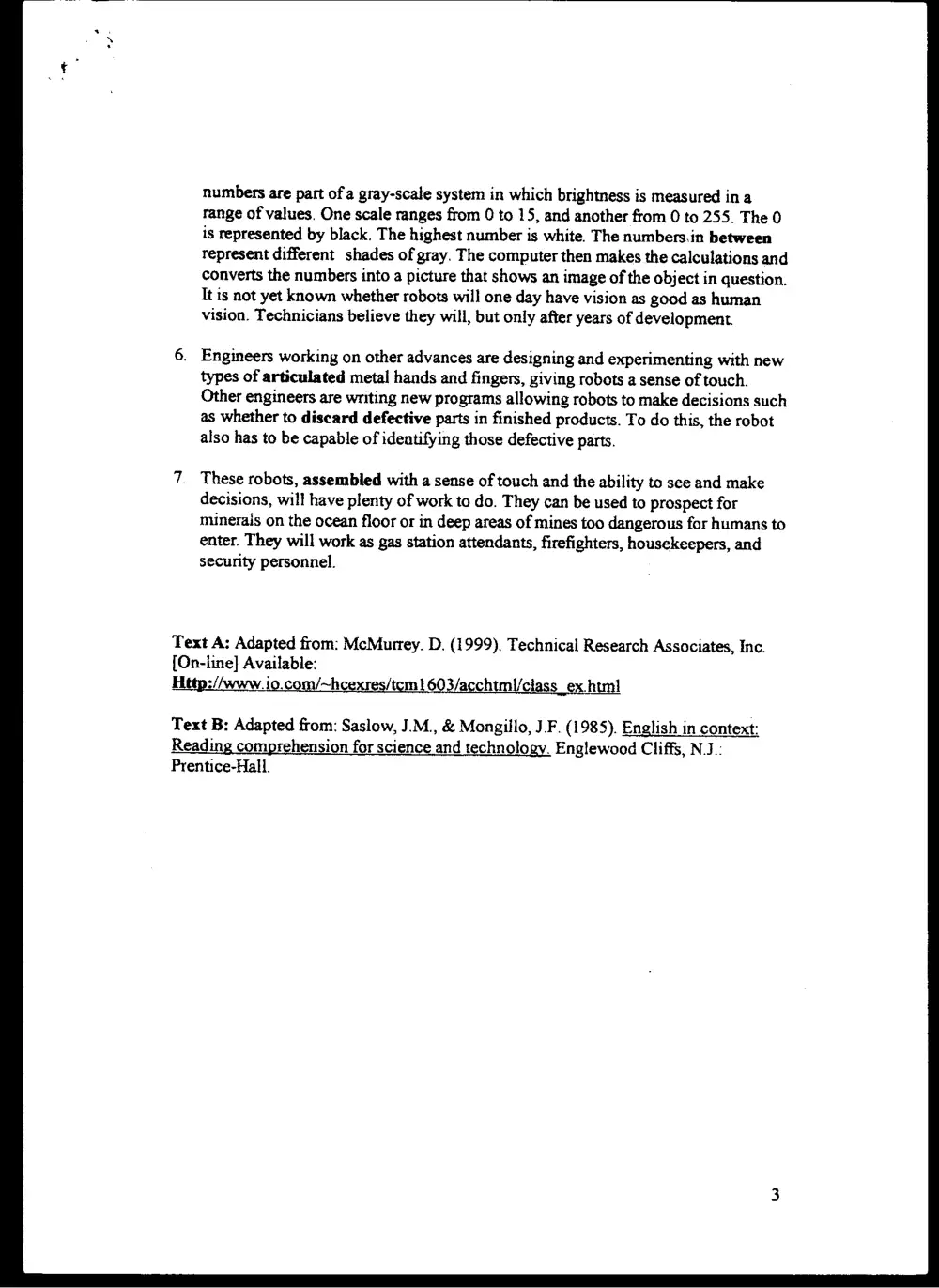
numbers are part of a gray-scale system in which brightness is measured in a
range of values. One scale ranges from 0 to 15, and another from 0 to 255. The 0
is represented by black. The highest number is white. The numbers.in between
represent different shades of gray. The computer then makes the calculations and
converts the numbers into a picture that shows an image of the object in question.
It is not yet known whether robots will one day have vision as good as human
vision. Technicians believe they will, but only after years of development.
6. Engineers working on other advances are designing and experimenting with new
types of articulated metal hands and fingers, giving robots a sense of touch.
Other engineers are writing new programs allowing robots to make decisions such
as whether to discard defective parts in finished products. To do this, the robot
also has to be capable of identifying those defective parts.
7. These robots, assembled with a sense of touch and the ability to see and make
decisions, will have plenty of work to do. They can be used to prospect for
minerals on the ocean floor or in deep areas of mines too dangerous for humans to
enter. They will work as gas station attendants, firefighters, housekeepers, and
security personnel.
Text A: Adapted from: McMurtey. D. (1999), Technical Research Associates, Inc.
[On-line] Available:
Hetp://www.io.com/~hcexres/tem1603/acchtml/class_ex.html
Text B: Adapted from: Saslow, J.M., & Mongillo, JF. (1985). English in context:
Reading comprehension for science and technology. Englewood Cliffs, N.J.:
Prentice-Hall.
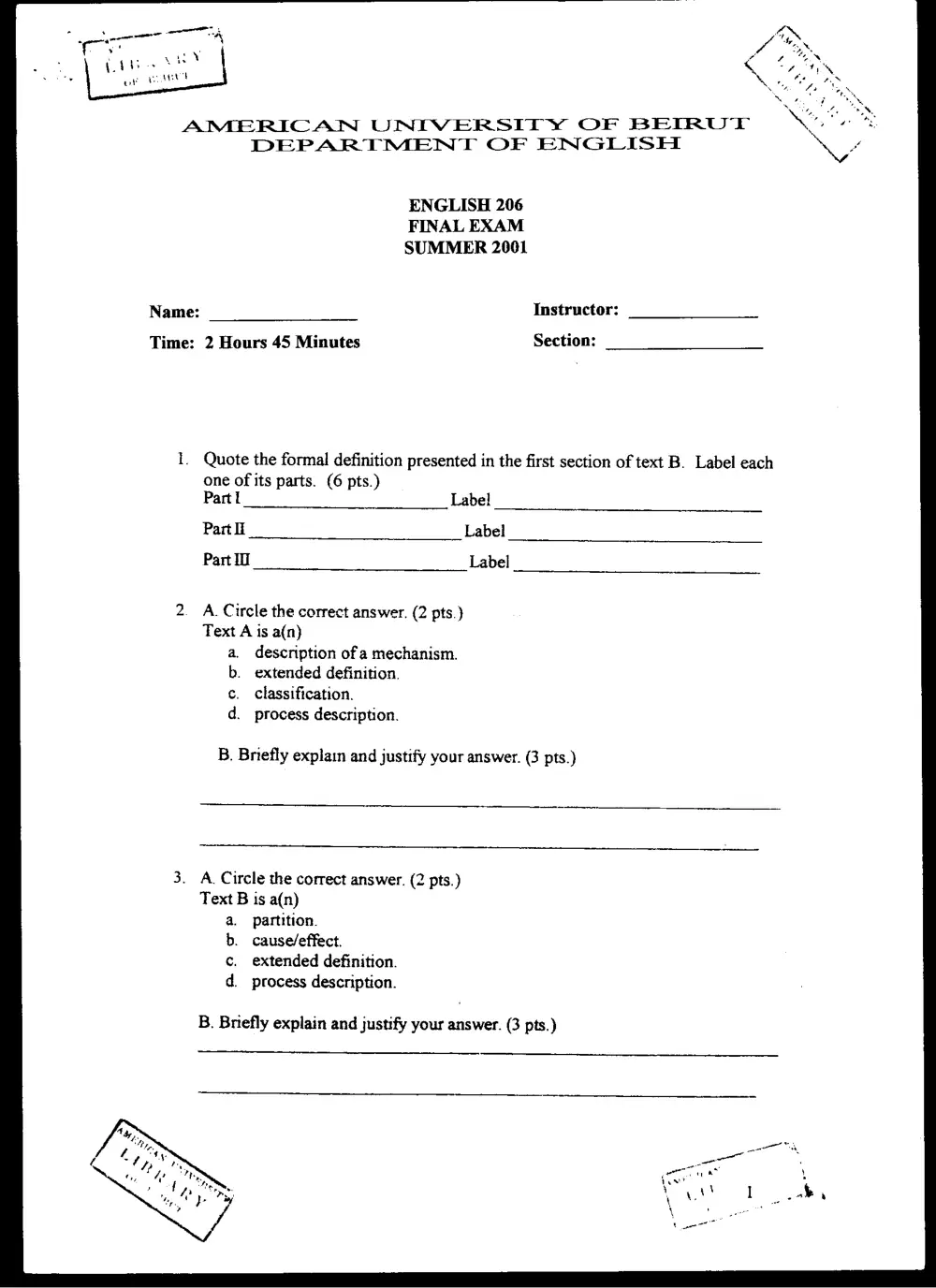
AMERICAN UNIVERSITY OF BEIRUT
DEPARTMENT OF ENGLISH
ENGLISH 206
FINAL EXAM
SUMMER 2001
Name: Instructor:
Time: 2 Hours 45 Minutes Section:
1. Quote the formal definition presented in the first section of text B. Label each
one of its parts. (6 pts.)
Partl Label
Part I Label
Part 1 Label
A. Circle the correct answer. (2 pts.)
Text A is a(n)
description of a mechanism.
. extended definition.
. ¢lassification.
. process description.
B. Briefly expiain and justify your answer. (3 pts.)
3. A. Circle the correct answer. (2 pts.)
Text B is a(n)
a. partition.
b. cause/effect.
c. extended definition.
d. process description.
B. Briefly explain and justify your answer. (3 pts.)
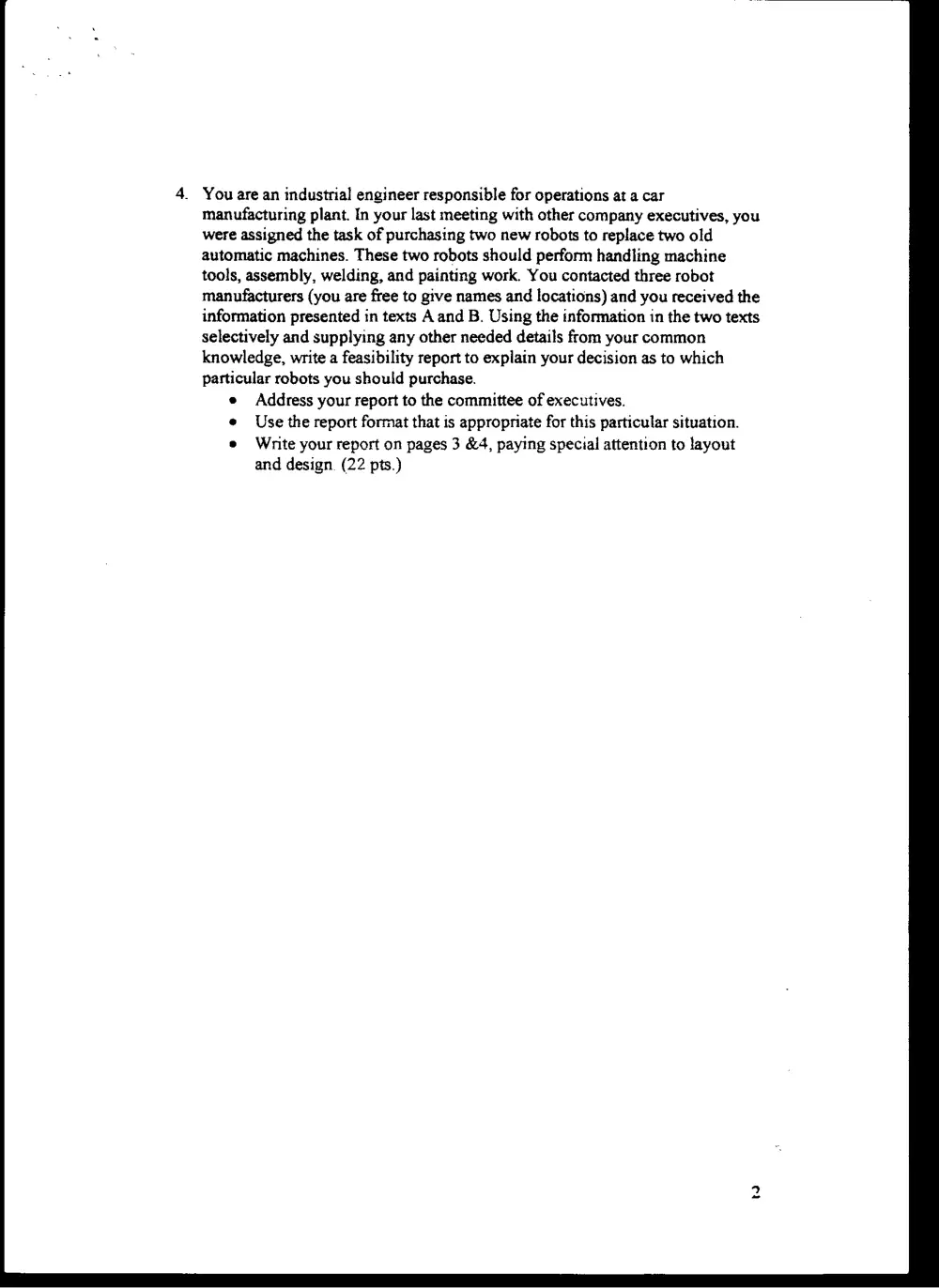
4. You are an industrial engineer responsible for operations at a car
manufacturing plant. In your last meeting with other company executives, you
were assigned the task of purchasing two new robots to replace two old
automatic machines. These two robots should perform handling machine
tools, assembly, welding, and painting work. You contacted three robot
manufacturers (you are free to give names and locations) and you received the
information presented in texts A and B. Using the information in the two texts
selectively and supplying any other needed details from your common
knowledge, write a feasibility report to explain your decision as to which
particular robots you should purchase.
e Address your report to the committee of executives.
e Use the report format that is appropriate for this particular situation.
e White your report on pages 3 &4, paying special attention to layout
and design. (22 pts.)
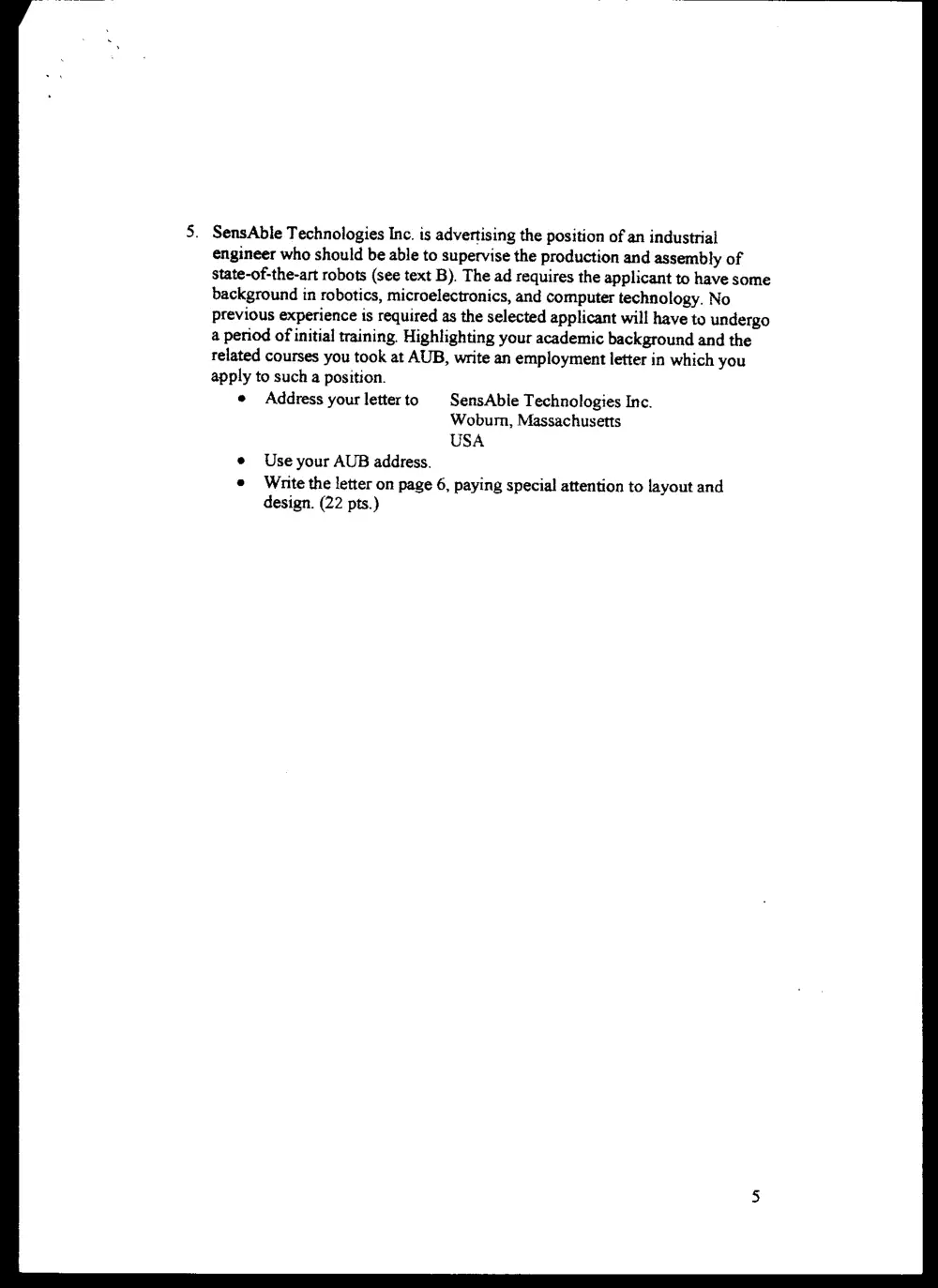
5. SensAble Technologies Inc. is advertising the position of an industrial
engineer who should be able to supervise the production and assembly of
state-of-the-art robots (see text B). The ad requires the applicant to have some
background in robotics, microelectronics, and computer technology. No
previous experience is required as the selected applicant will have to undergo
a period of initial training. Highlighting your academic background and the
related courses you took at AUB, write an employment letter in which you
apply to such a position.
e Address your letterto | SensAbie Technologies Inc.
Wobum, Massachusetts
USA
Use your AUB address.
e White the letter on page 6, paying special attention to layout and
design. (22 pts.)
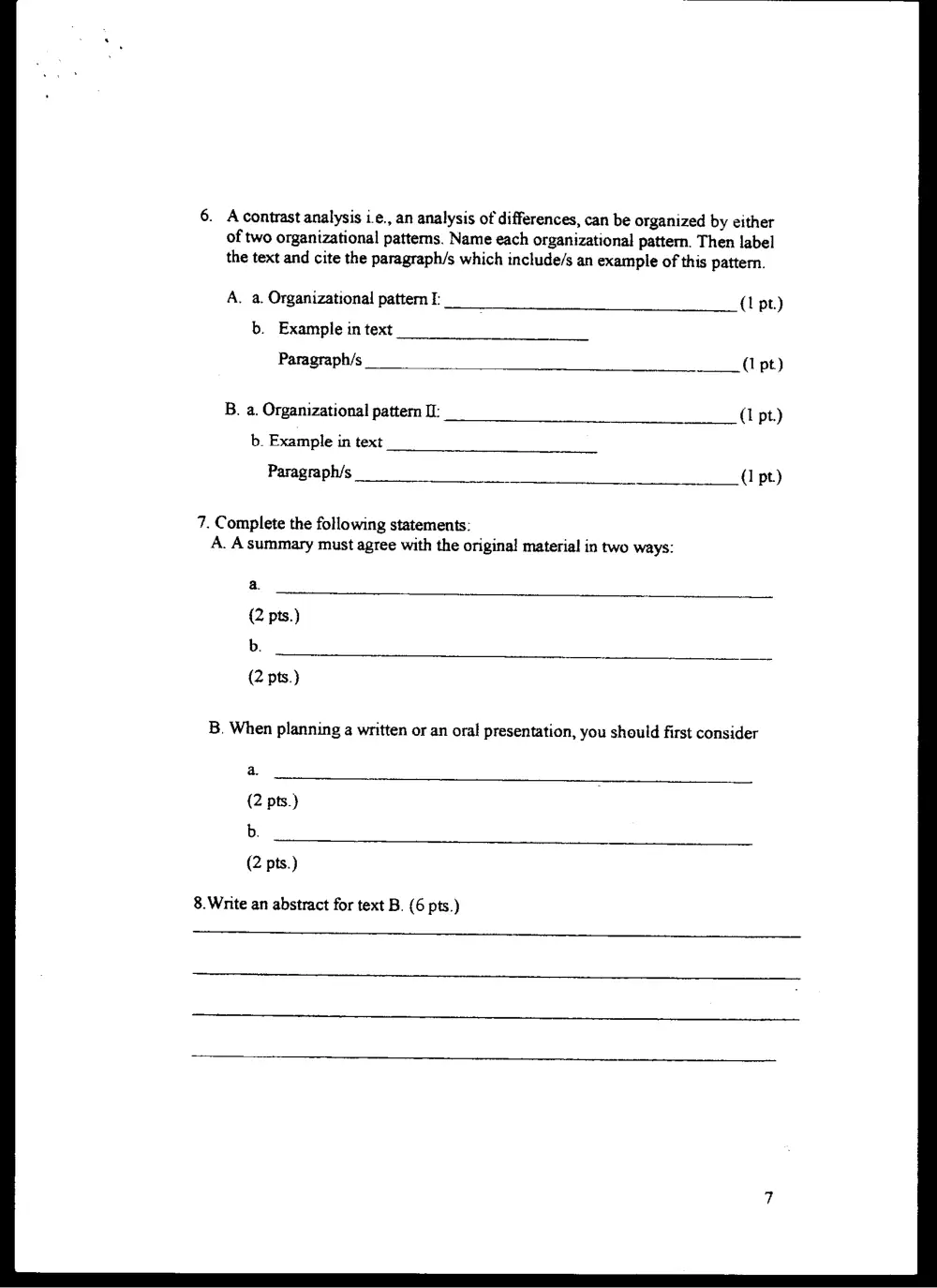
6. A contrast analysis i.e., an analysis of differences, can be organized by either
of two organizational pattems. Name each organizational pattern. Then label
the text and cite the paragraph/s which include/s an example of this pattern.
A. a. Organizational pattern I: _ (1 pt.)
b. Example in text
Paragraph/s (1 pt.)
B. a. Organizational pattern I: (1 pt.)
b. Example in text
Paragraph/s . (1 pt.)
7. Complete the following statements:
A. Asummary must agree with the origina! material in two ways:
a.
(2 pts.)
b.
(2 pts.)
B. When planning a written or an oral presentation, you should first consider
a.
(2 pts.)
b.
(2 pts.)
8.Wnite an abstract for text B. (6 pts.)
9.Circle the incorrect answers. (3 pts.)
Conciseness necessitates
being brief.
saying much in a few words.
omitting nonessential words.
using simple words and direct word patterns.
combining sentence elements.
using brief sentences and avoiding long complex ones.
making every word count.
mmesangre
10. List the most typical ways of allowing for plenty of white space on a page in
order to enhance layout.
a.
(1 pt.)
b.
(1 pt.)
c.
(1 pt)
11. Explain the difference between classification and partition. ( 4 pts.)
12. To make the most effective use of visuals in a written or an oral presentation,
several conditions must be met when pteparing these visuals.
List three of them.
a,
(2 pts.)
(2 pts.)
(2 pts.)
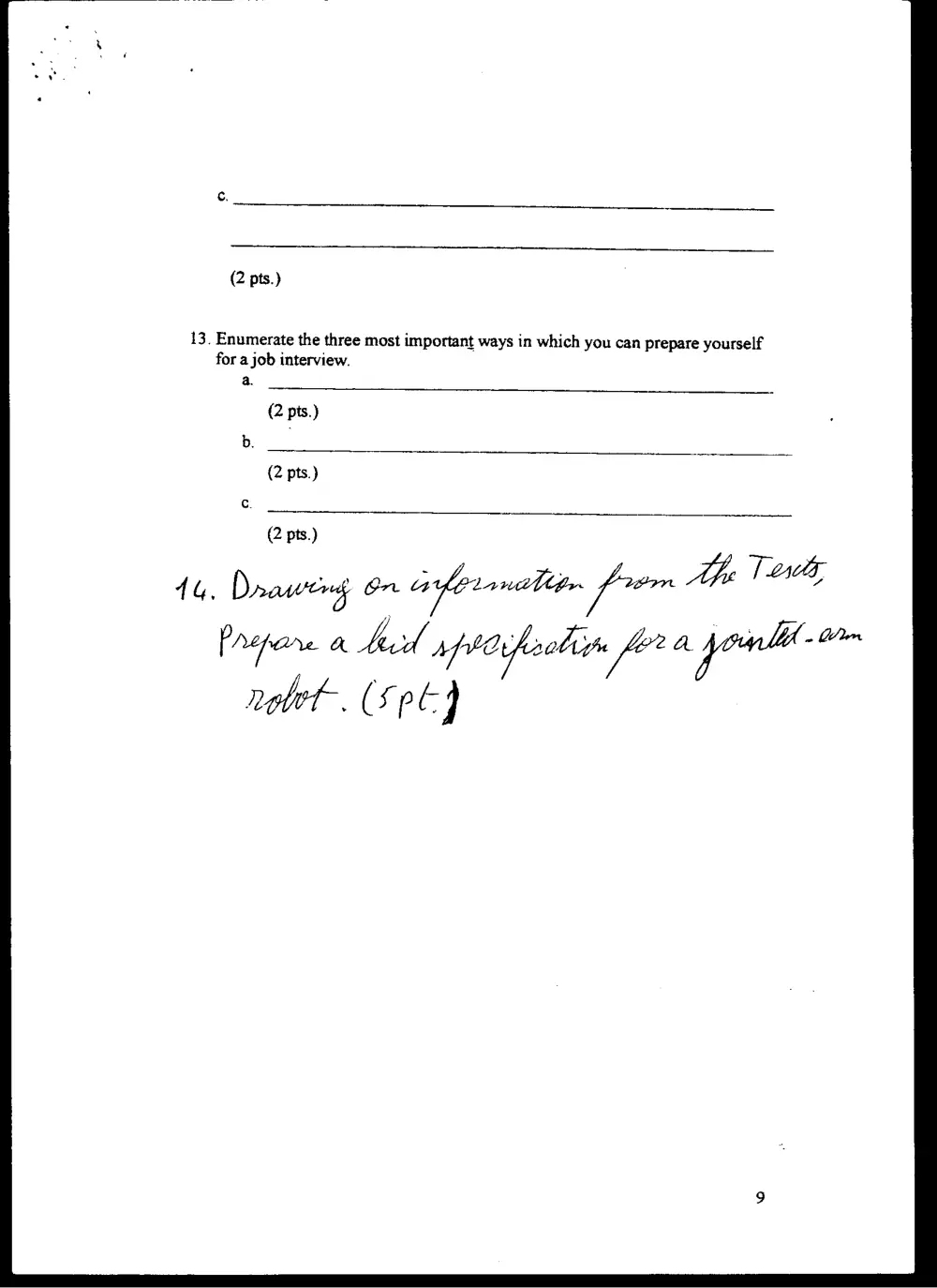
13. Enumerate the three most important ways in which you can prepare yourself
for a job interview.
a.
(2 pts.)
(2 pts.)
(2 pts.)
4,
14, Draweng On tanation fromm Ae Tes
[rpare a Saad upiorfooliin, fe? 7
rolet. (Spey