
ENG 206 Final, Summer 2004
American University of Beirut · Technical English · 5 pages


More ENG 206 files
Show the text of this final exam
ERICAN BNTVERS:
AMERICAN UNIVERSITY OF BEIRUT LIBRARY
English 206 OF Bruner
Final Exam
Summer 2003 — 2004 fr mp
Name: Time Allowed: 2% Hours
Instructor:
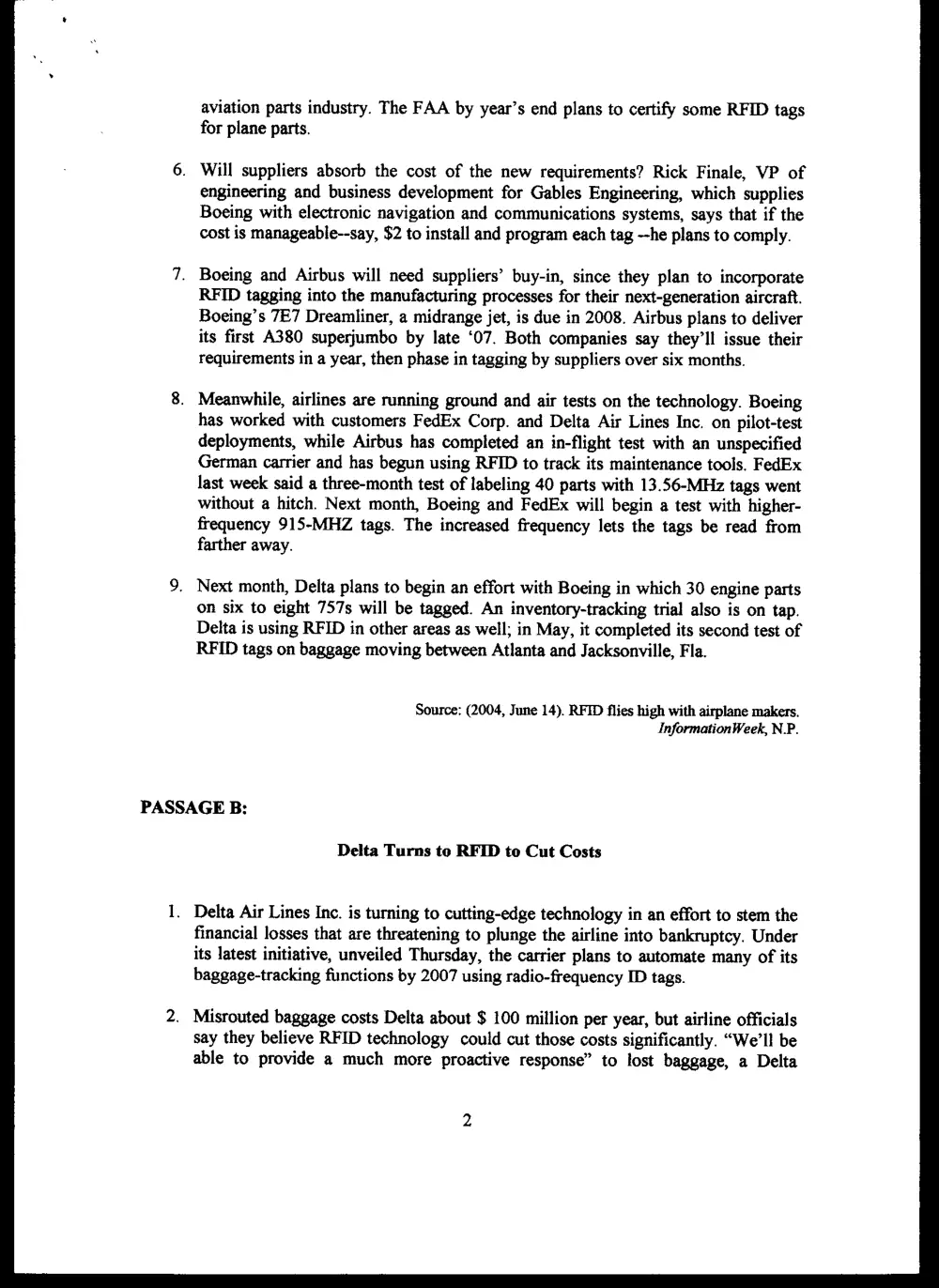
PASSAGE A:
RFID Flies High With Airplane Makers
1. Boeing Co. and Airbus S.A.S, the world’s largest airplane makers, plan to require
more than 2,000 of their suppliers to begin tagging aircraft and engine parts with
tadio-frequency identification technology by this time next year.
2. Speaking at an industry conference in Atlanta last week, executives from the rival
companies said cooperating on requirements for those suppliers was the only way
to ensure they can cut costly errors and delays from their manufacturing
processes. The RFID tags, which emit high-frequency signals that remote readers
can detect, are being tested by companies from Wal-Mart Stores Inc. to Johnson
Controls Inc. to track goods and parts more efficiently.
3. “We really need to stand up and change some processes to make our industry
competitive,” said Airbus VP Pierre Steffen at the conference. Seventy percent of
the purchase orders that Airbus receives from its customers contain incorrect
pricing data and part numbers. If parts on Airbus planes contained RFID tags,
they could be scanned to generate accurate replacement orders. Using RFID to
track parts could save Airbus $400 million a year, Steffen said.
4. Tagging airplane parts will provide Boeing customers with more reliable
information than what mechanics enter manually and prevent unapproved parts
from finding their way into finished products, a problem that costs Boeing
customers $100 million a year in Federal Aviation Administration fines and
replacement time, says Kenneth Porad, a manager for RFID at Boeing. Bob
Parker, an analyst at consulting firm AMR Research, says airline mechanics can
spend 70% of their time locating parts.
5. Industry standards already are taking shape. The Air Transport Association, an
industry trade group, recently added an RFID standard to its specifications for the
aviation parts industry. The FAA by year’s end plans to certify some RFID tags
for plane parts.
6. Will suppliers absorb the cost of the new requirements? Rick Finale, VP of
engineering and business development for Gables Engineering, which supplies
Boeing with electronic navigation and communications systems, says that if the
cost is manageable--say, $2 to install and program each tag --he plans to comply.
7. Boeing and Airbus will need suppliers’ buy-in, since they plan to incorporate
RFID tagging into the manufacturing processes for their next-generation aircraft.
Boeing’s 7E7 Dreamliner, a midrange jet, is due in 2008. Airbus plans to deliver
its first A380 superjumbo by late ‘07. Both companies say they'll issue their
requirements in a year, then phase in tagging by suppliers over six months.
8. Meanwhile, airlines are running ground and air tests on the technology. Boeing
has worked with customers FedEx Corp. and Delta Air Lines Inc. on pilot-test
deployments, while Airbus has completed an in-flight test with an unspecified
German carrier and has begun using RFID to track its maintenance tools. FedEx
last week said a three-month test of labeling 40 parts with 13.56-MHz tags went
without a hitch. Next month, Boeing and FedEx will begin a test with higher-
frequency 915-MHZ tags. The increased frequency lets the tags be read from
farther away.
9. Next month, Delta plans to begin an effort with Boeing in which 30 engine parts
on six to eight 757s will be tagged. An inventory-tracking trial also is on tap.
Delta is using RFID in other areas as well; in May, it completed its second test of
RFID tags on baggage moving between Atlanta and Jacksonville, Fla.
Source: (2004, June 14). RFID flies high with airplane makers.
InformationWeek, N.P.
PASSAGE B:
Delta Turns to RFID to Cut Costs
1. Delta Air Lines Inc. is turning to cutting-edge technology in an effort to stem the
financial losses that are threatening to plunge the airline into bankruptcy. Under
its latest initiative, unveiled Thursday, the carrier plans to automate many of its
baggage-tracking functions by 2007 using radio-frequency ID tags.
2. Misrouted baggage costs Deita about $ 100 million per year, but airline officials
say they believe RFID technology could cut those costs significantly. “We'll be
able to provide a much more proactive response” to lost baggage, a Delta
spokesman says. Asa result, Delta could save money by reducing the need to hire
expensive couriers to deliver delayed bags to customers.
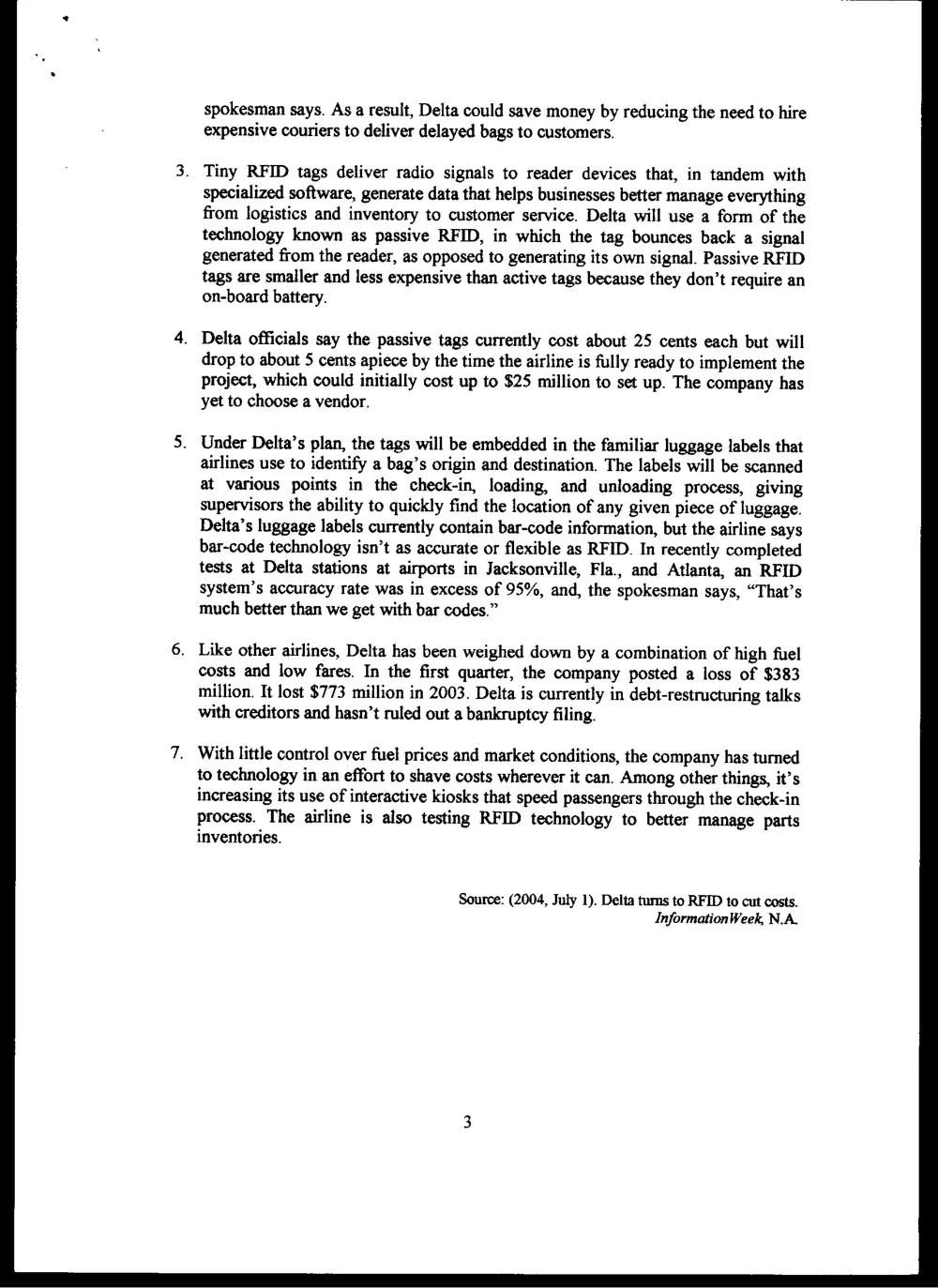
. Tiny RFID tags deliver radio signals to reader devices that, in tandem with
specialized software, generate data that helps businesses better manage everything
from logistics and inventory to customer service. Delta will use a form of the
technology known as passive RFID, in which the tag bounces back a signal
generated from the reader, as opposed to generating its own signal. Passive RFID
tags are smaller and less expensive than active tags because they don’t require an
on-board battery.
. Delta officials say the passive tags currently cost about 25 cents each but will
drop to about 5 cents apiece by the time the airline is fully ready to implement the
project, which could initially cost up to $25 million to set up. The company has
yet to choose a vendor.
. Under Delta’s plan, the tags will be embedded in the familiar luggage labels that
airlines use to identify a bag’s origin and destination. The labels will be scanned
at various points in the check-in, loading, and unloading process, giving
supervisors the ability to quickly find the location of any given piece of luggage.
Delta’s luggage labels currently contain bar-code information, but the airline says
bar-code technology isn’t as accurate or flexible as RFID. In recently completed
tests at Delta stations at airports in Jacksonville, Fla., and Atlanta, an RFID
system’s accuracy rate was in excess of 95%, and, the spokesman says, “That’s
much better than we get with bar codes.”
. Like other airlines, Delta has been weighed down by a combination of high fuel
costs and low fares. In the first quarter, the company posted a loss of $383
million. It lost $773 million in 2003. Delta is currently in debt-restructuring talks
with creditors and hasn’t ruled out a bankruptcy filing.
. With little control over fuel prices and market conditions, the company has turned
to technology in an effort to shave costs wherever it can, Among other things, it’s
increasing its use of interactive kiosks that speed passengers through the check-in
process. The airline is also testing RFID technology to better manage parts
inventories.
Source: (2004, July 1). Delta turns to RFID to cut costs.
InformationWeek, N.A.
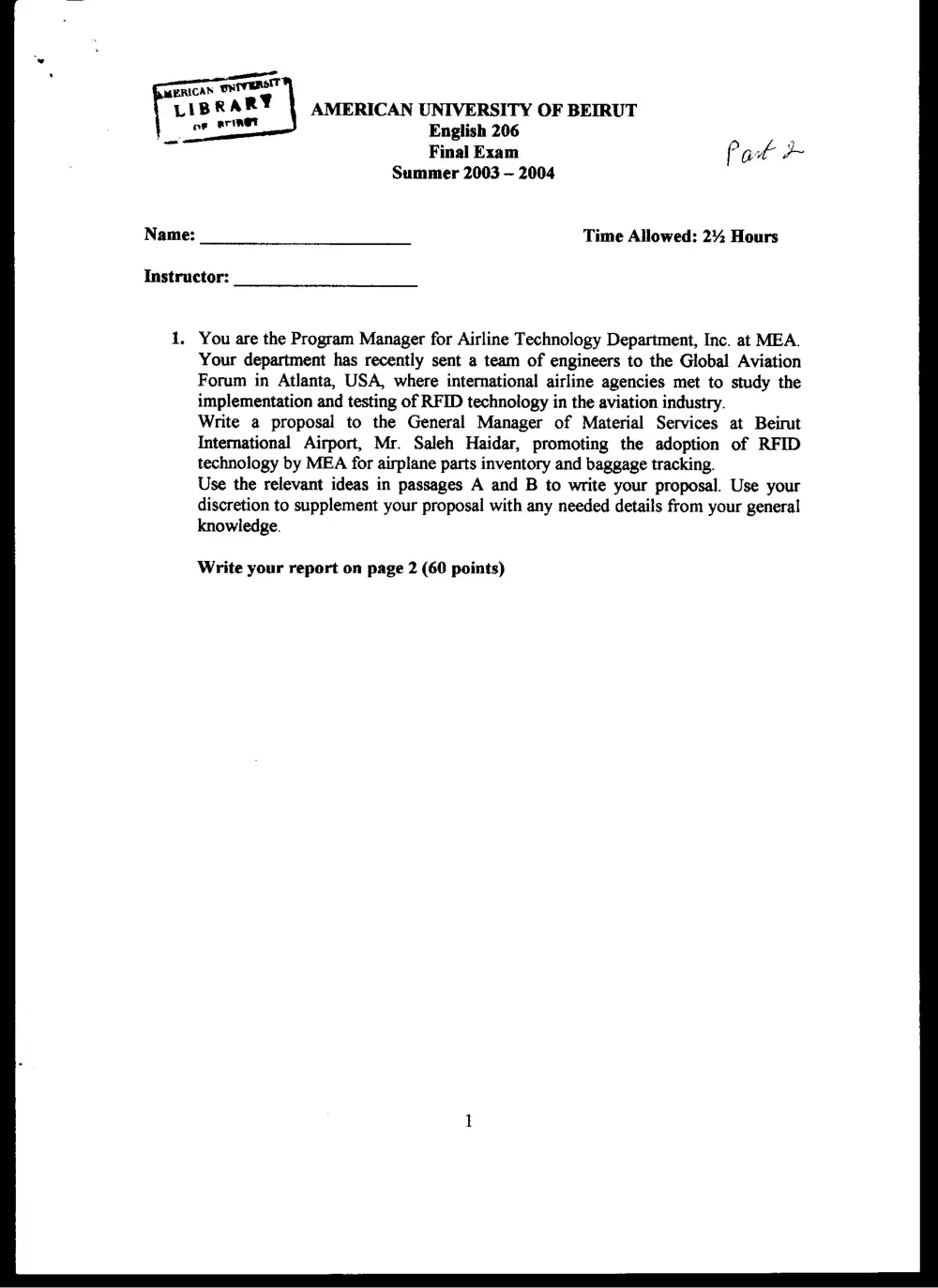
English 206
Final Exam Pr at a
Summer 2003 — 2004
Name: Time Allowed: 2% Hours
Instructor:
1, You are the Program Manager for Airline Technology Department, Inc. at MEA.
Your department has recently sent a team of engineers to the Global Aviation
Forum in Atlanta, USA, where international airline agencies met to study the
implementation and testing of RFID technology in the aviation industry.
Write a proposal to the General Manager of Material Services at Beirut
International Airport, Mr. Saleh Haidar, promoting the adoption of RFID
technology by MEA for airplane parts inventory and baggage tracking.
Use the relevant ideas in passages A and B to write your proposal. Use your
discretion to supplement your proposal with any needed details from your general
knowledge.
Write your report on page 2 (60 points)
2. You are the Customer Services Manager at Southern Airlines Headquarters at the
Beirut International Airport. You have received the following letter of complaint
from Ms. Maya Ramona, a dissatisfied customer.
Write Ms. Ramona a tactful letter, declining her request. (40 points)
HiTech, Inc.
Verdun Street
Beirut, Lebanon
July 28, 2004
Southern Airlines Headquarters
Beirut International Airport
Beirut, Lebanon
Dear Sir or Madam!
I am a frequent traveler on Southern Airlines. On a recent business flight from
Beirut to Rome, your company misplaced my luggage.
I was disappointed to reach Rome Airport and not find my suitcase, which
contained, among other valuable things, the business suit that I was supposed to
wear for a very important conference I was attending that night.
When I finally received my lost suitcase three days later, I noticed, to my great
consternation, that it was mishandled. The handle of my suitcase was ripped off:
there were horrible stretch marks on the leather and ugly dents in different places.
In short, I demand that your company pay me for the price of the new suit I had to
buy (3008), and for the new suitcase to replace the one your airport personnel
damaged. So all in all, you owe me 500$.
I hope we can solve this problem in a mutually agreeable way. Please respond by
August 20, 2004. If I have no response by then, I will look for help from a third
party, such as a consumer rights organization or an attorney.
eer
Maya Ramona
Executive Manager