
ENG 206 Notes Audience Analysis, Spring 2018
American University of Beirut · Technical English · 3 pages
More ENG 206 files
- Notes Summary · Fall 2016NotesView
- Syllabus · Summer 2015LabView
- Report Feasibility Report · Fall 2012FileView
- Exam 1 · Spring 2011ExamView
- Report Feasibility Study of BMW's Green Project · Fall 2011ProjectView
- Report · Fall 2011FileView
- Final · Spring 2011Final examView
- Useful File · Spring 2011FileView
Show the text of this notes
Audience & Context Analysis
Identifying Audiences
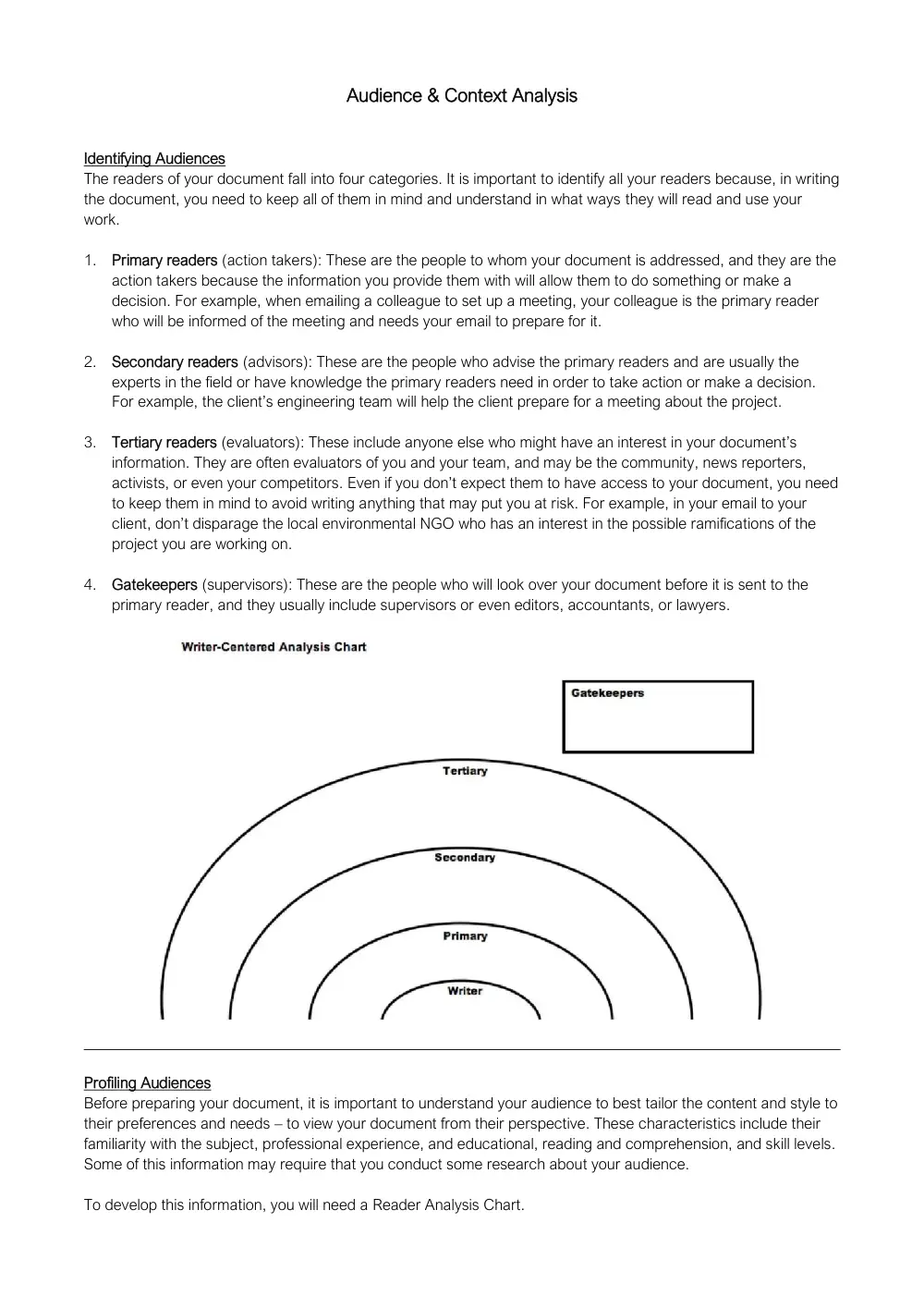
The readers of your document fall into four categories. It is important to identify all your readers because, in writing
the document, you need to keep all of them in mind and understand in what ways they will read and use your
work.
1. Primary readers (action takers): These are the people to whom your document is addressed, and they are the
action takers because the information you provide them with will allow them to do something or make a
decision. For example, when emailing a colleague to set up a meeting, your colleague is the primary reader
who will be informed of the meeting and needs your email to prepare for it.
2. Secondary readers (advisors): These are the people who advise the primary readers and are usually the
experts in the field or have knowledge the primary readers need in order to take action or make a decision.
For example, the client’s engineering team will help the client prepare for a meeting about the project.
3. Tertiary readers (evaluators): These include anyone else who might have an interest in your document’s
information. They are often evaluators of you and your team, and may be the community, news reporters,
activists, or even your competitors. Even if you don’t expect them to have access to your document, you need
to keep them in mind to avoid writing anything that may put you at risk. For example, in your email to your
client, don’t disparage the local environmental NGO who has an interest in the possible ramifications of the
project you are working on.
4. Gatekeepers (supervisors): These are the people who will look over your document before it is sent to the
primary reader, and they usually include supervisors or even editors, accountants, or lawyers.
Profiling Audiences
Before preparing your document, it is important to understand your audience to best tailor the content and style to
their preferences and needs – to view your document from their perspective. These characteristics include their
familiarity with the subject, professional experience, and educational, reading and comprehension, and skill levels.
Some of this information may require that you conduct some research about your audience.
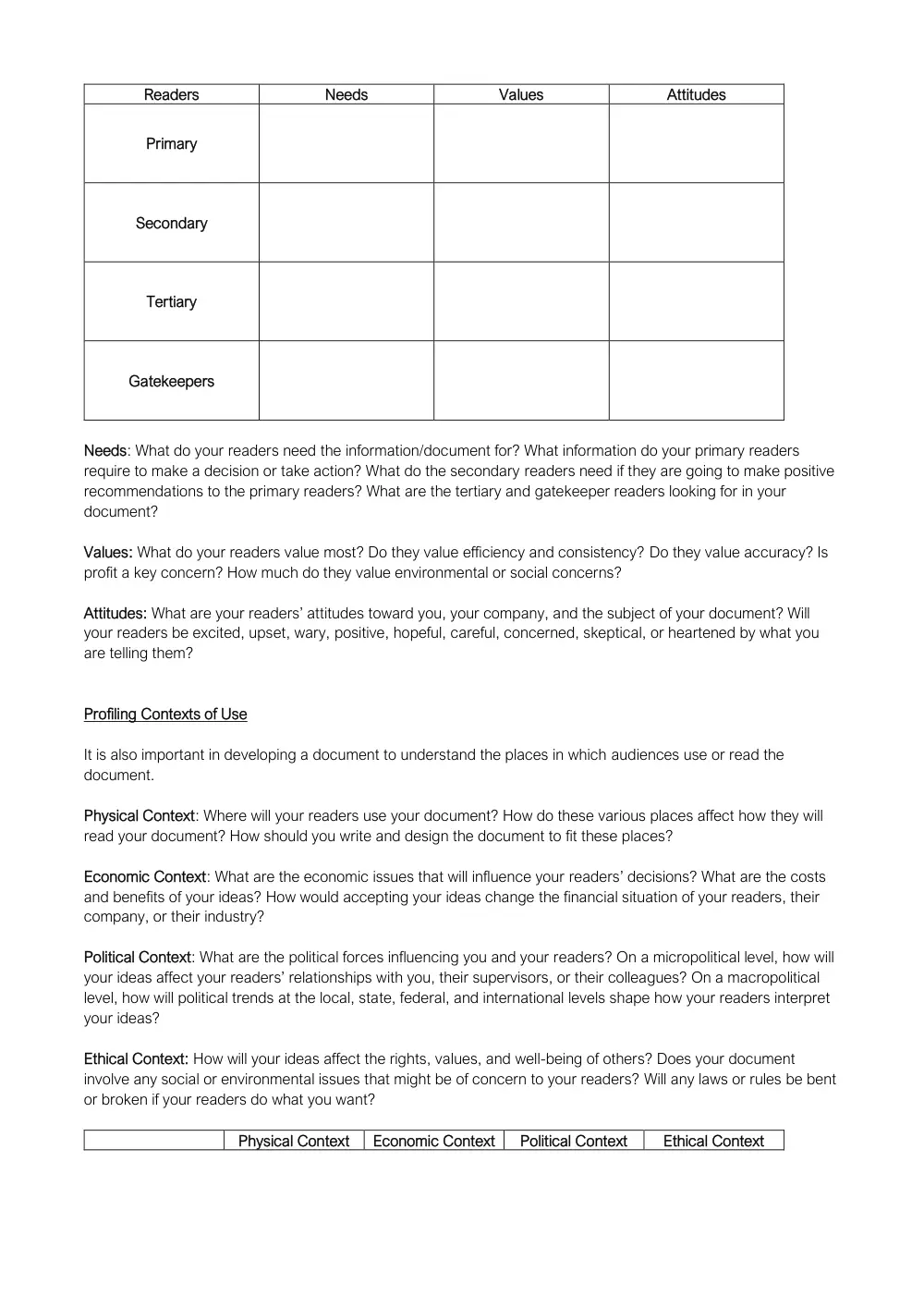
To develop this information, you will need a Reader Analysis Chart.
Readers
Needs
Values
Attitudes
Primary
Secondary
Tertiary
Gatekeepers
Needs: What do your readers need the information/document for? What information do your primary readers
require to make a decision or take action? What do the secondary readers need if they are going to make positive
recommendations to the primary readers? What are the tertiary and gatekeeper readers looking for in your
document?
Values: What do your readers value most? Do they value efficiency and consistency? Do they value accuracy? Is
profit a key concern? How much do they value environmental or social concerns?
Attitudes: What are your readers’ attitudes toward you, your company, and the subject of your document? Will
your readers be excited, upset, wary, positive, hopeful, careful, concerned, skeptical, or heartened by what you
are telling them?
Profiling Contexts of Use
It is also important in developing a document to understand the places in which audiences use or read the
document.
Physical Context: Where will your readers use your document? How do these various places affect how they will
read your document? How should you write and design the document to fit these places?
Economic Context: What are the economic issues that will influence your readers’ decisions? What are the costs
and benefits of your ideas? How would accepting your ideas change the financial situation of your readers, their
company, or their industry?
Political Context: What are the political forces influencing you and your readers? On a micropolitical level, how will
your ideas affect your readers’ relationships with you, their supervisors, or their colleagues? On a macropolitical
level, how will political trends at the local, state, federal, and international levels shape how your readers interpret
your ideas?
Ethical Context: How will your ideas affect the rights, values, and well-being of others? Does your document
involve any social or environmental issues that might be of concern to your readers? Will any laws or rules be bent
or broken if your readers do what you want?
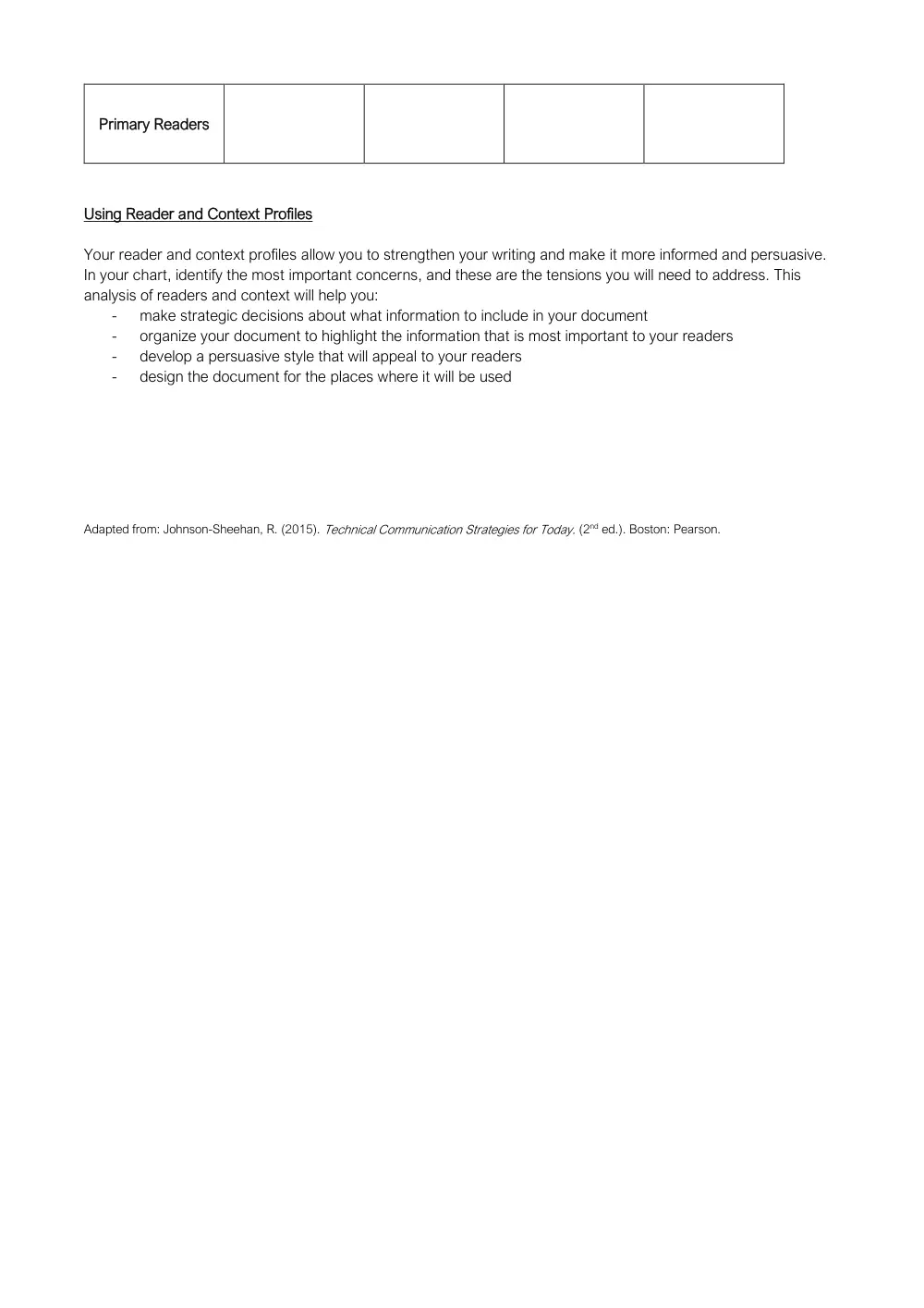
Physical Context
Economic Context
Political Context
Ethical Context
Primary Readers
Using Reader and Context Profiles
Your reader and context profiles allow you to strengthen your writing and make it more informed and persuasive.
In your chart, identify the most important concerns, and these are the tensions you will need to address. This
analysis of readers and context will help you:
-
make strategic decisions about what information to include in your document
-
organize your document to highlight the information that is most important to your readers
-
develop a persuasive style that will appeal to your readers
-
design the document for the places where it will be used
Adapted from: Johnson-Sheehan, R. (2015). Technical Communication Strategies for Today. (2nd ed.). Boston: Pearson.