
ENG 210 Final, Spring 2005
American University of Beirut · Literature of the Middle Ages · 3 pages

More ENG 210 files
Show the text of this final exam
‘English 210 7
: 2005 -DriWrisley
"Saturday, Jnue4,3pin, Nicely 101.
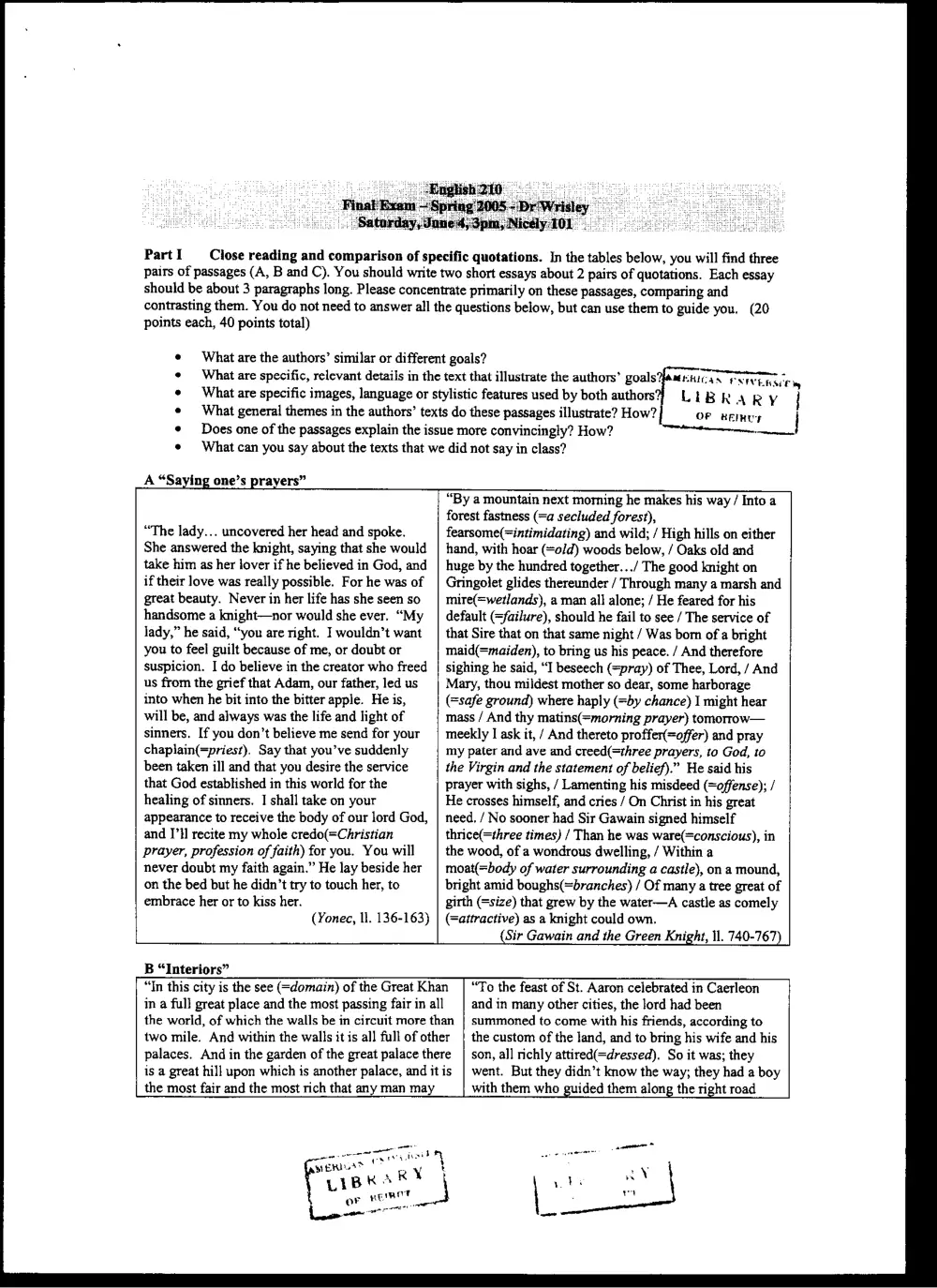
Part I
Close reading and comparison of specific quotations. In the tables below, you will find three
pairs of passages (A, B and C). You should write two short essays about 2 pairs of quotations. Each essay
should be about 3 paragraphs long. Please concentrate primarily on these passages, comparing and
contrasting them. You do not need to answer all the questions below, but can use them to guide you. (20
points each, 40 points total)
What are the authors’ similar or different goals?
What are specific, relevant details in the text that illustrate the authors’ goals?
What are specific images, language or stylistic features used by both authors?
What general themes in the authors’ texts do these passages illustrate? How?
Does one of the passages explain the issue more convincingly? How?
een
MEHICAN PNIVERST Ey
LIBRARY {
OF BERUT |
een!
What can you say about the texts that we did not say in class?
A “Saying one’s prayers”
“The lady... uncovered her head and spoke.
She answered the knight, saying that she would
take him as her lover if he believed in God, and
if their love was really possible. For he was of
great beauty. Never in her life has she seen so
handsome a knight—nor would she ever. “My
lady,” he said, “you are right. I wouldn’t want
you to feel guilt because of me, or doubt or
suspicion. I do believe in the creator who freed
us from the grief that Adam, our father, led us
into when he bit into the bitter apple. He is,
will be, and always was the life and light of
sinners. If you don’t believe me send for your
chaplain(=priest). Say that you’ve suddenly
been taken ill and that you desire the service
that God established in this world for the
healing of sinners. I shall take on your
appearance to receive the body of our lord God,
and I'll recite my whole credo(=Christian
prayer, profession of faith) for you. You will
never doubt my faith again.” He lay beside her
on the bed but he didn’t try to touch her, to
embrace her or to kiss her.
(Yoneec, ll. 136-163)
“By a mountain next morning he makes his way / Into a
forest fastness (=a secluded forest),
fearsome(=intimidating) and wild; / High hills on either
hand, with hoar (=o/d) woods below, / Oaks old and
huge by the hundred together.../ The good knight on
Gringolet glides thereunder / Through many a marsh and
mire(=wetlands), a man all alone; / He feared for his
default (=failure), should he fail to see / The service of
that Sire that on that same night / Was bom of a bright
maid(=maiden), to bring us his peace. / And therefore
sighing he said, “I beseech (=pray) of Thee, Lord, / And
Mary, thou mildest mother so dear, some harborage
(=safe ground) where haply (=by chance) I might hear
mass / And thy matins(=morning prayer) tomorrow—
meekly I ask it, / And thereto proffer(=offer) and pray
my pater and ave and creed(=three prayers, to God, to
the Virgin and the statement of belief).” He said his
prayer with sighs, / Lamenting his misdeed (offense); /
He crosses himself, and cries / On Christ in his great
need. / No sooner had Sir Gawain signed himself
thrice(=three times) / Than he was ware(=conscious), in
the wood, of a wondrous dwelling, / Within a
moat(=body of water surrounding a castle), on a mound,
bright amid boughs(=branches) / Of many a tree great of
girth (=size) that grew by the water—A castle as comely
(=attractive) as a knight could own.
(Sir Gawain and the Green Knight, \l. 740-767)
B “Interiors”
“In this city is the see (=domain) of the Great Khan
in a full great place and the most passing fair in all
the world, of which the walls be in circuit more than
two mile. And within the walls it is all full of other
palaces. And in the garden of the great palace there
is a great hill upon which is another palace, and it is
the most fair and the most rich that any man may
“To the feast of St. Aaron celebrated in Caerleon
and in many other cities, the lord had been
summoned to come with his friends, according to
the custom of the land, and to bring his wife and his
son, all richly attired(=dressed). So it was; they
went. But they didn’t know the way; they had a boy
with them who guided them along the right road
jane hu
LIRICA on
ce
or eet ENGL 210- Final — Spring 2005 -2
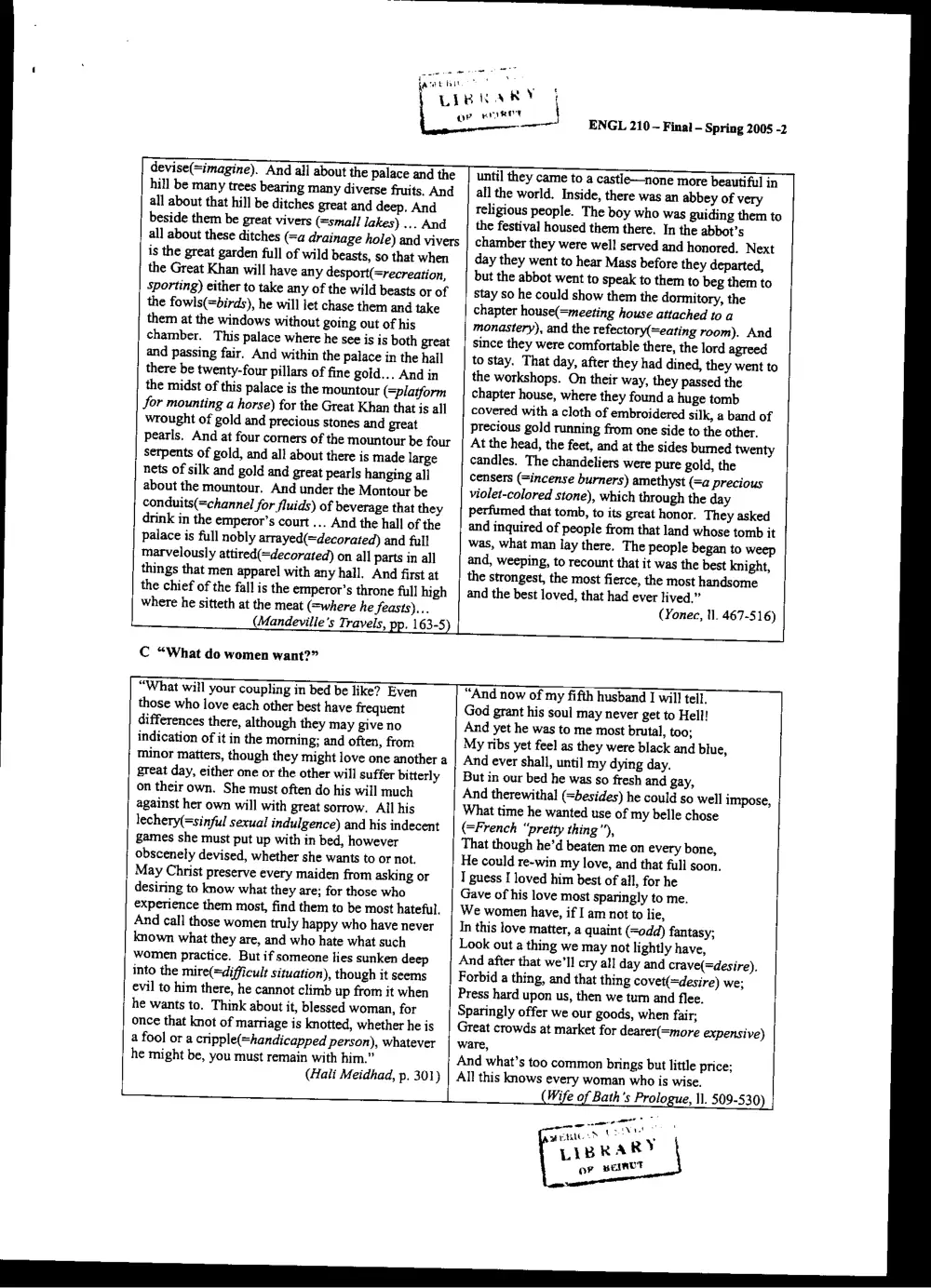
devise(=imagine). And all about the palace and the
hill be many trees bearing many diverse fruits. And
all about that hill be ditches great and deep. And
beside them be great vivers (=small lakes) ... And
all about these ditches (=a drainage hole) and vivers
is the great garden full of wild beasts, so that when
the Great Khan will have any desport(=recreation,
Sporting) either to take any of the wild beasts or of
the fowls(=birds), he will let chase them and take
them at the windows without going out of his
chamber. This palace where he see is is both great
and passing fair. And within the palace in the hall
there be twenty-four pillars of fine gold... And in
the midst of this palace is the mountour (=platform
Jor mounting a horse) for the Great Khan that is all
wrought of gold and precious stones and great
pearls. And at four corners of the mountour be four
serpents of gold, and all about there is made large
nets of silk and gold and great pearls hanging all
about the mountour. And under the Montour be
conduits(=channel for fluids) of beverage that they
drink in the emperor’s court ... And the hall of the
palace is full nobly arrayed(=decorated) and full
marvelously attired(=decorated) on all Parts in all
things that men apparel with any hall. And first at
the chief of the fall is the emperor’s throne full high
where he sitteth at the meat (=where he feasts)...
(Mandeville’s Travels, pp. 163-5)
until they came to a castle—none more beautiful in
all the world. Inside, there was an abbey of very
religious people. The boy who was guiding them to
the festival housed them there. In the abbot’s
chamber they were well served and honored. Next
day they went to hear Mass before they departed,
but the abbot went to speak to them to beg them to
stay so he could show them the dormitory, the
chapter house(=meeting house attached to a
monastery), and the Tefectory(=eating room). And
since they were comfortable there, the lord agreed
to stay. That day, after they had dined, they went to
the workshops. On their way, they passed the
chapter house, where they found a huge tomb
covered with a cloth of embroidered silk, a band of
precious gold running from one side to the other.
At the head, the feet, and at the sides bumed twenty
candles. The chandeliers were pure gold, the
censers (=incense burners) amethyst (=a precious
violet-colored stone), which through the day
perfumed that tomb, to its great honor. They asked
and inquired of people from that land whose tomb it
was, what man lay there. The people began to weep
and, weeping, to recount that it was the best knight,
the strongest, the most fierce, the most handsome
and the best loved, that had ever lived.”
(Yonec, ll. 467-516)
C “What do women want?”
“What will your coupling in bed be like? Even
those who love each other best have frequent
differences there, although they may give no
indication of it in the morning; and often, from
minor matters, though they might love one another a
great day, either one or the other will suffer bitterly
on their own. She must often do his will much
against her own will with great sorrow. All his
lechery(=sinful sexual indulgence) and his indecent
games she must put up with in bed, however
obscenely devised, whether she wants to or not.
May Christ preserve every maiden from asking or
desiring to know what they are; for those who
experience them most, find them to be most hateful.
And call those women truly happy who have never
known what they are, and who hate what such
women practice. But if someone lies sunken deep
into the mire(=difficult situation), though it seems
evil to him there, he cannot climb up from it when
he wants to. Think about it, blessed woman, for
once that knot of marriage is knotted, whether he is
a fool or a cripple(=handicapped person), whatever
he might be, you must remain with him.”
(Hali Meidhad, p. 301)
“And now of my fifth husband I will tell,
God grant his soul may never get to Hell!
And yet he was to me most brutal, too;
My ribs yet feel as they were black and blue,
And ever shall, until my dying day.
But in our bed he was so fresh and gay,
And therewithal (=besides) he could so well impose,
What time he wanted use of my belle chose
(=French “pretty thing”),
That though he’d beaten me on every bone,
He could re-win my love, and that full soon.
I guess I loved him best of all, for he
Gave of his love most sparingly to me.
We women have, if I am not to lie,
In this love matter, a quaint (=odd) fantasy;
Look out a thing we may not lightly have,
And after that we'll cry all day and crave(=desire).
Forbid a thing, and that thing covet(=desire) we;
Press hard upon us, then we tum and flee.
Sparingly offer we our goods, when fair;
Great crowds at market for dearer(=more expensive)
ware,
And what’s too common brings but little Price;
All this knows every woman who is wise.
(Wife of Bath's Prologue, ll. 509-530)
ar”
—— Nae
MERIC . |
LIBRARY
or BEIRct
ENGL 210 — Final — Spring 2005 -3
Part II : Essay (60 points total)
Please choose one of the two essay topics listed below and write an analytical, well-organized essay of
several pages length. You should discuss three different works in your essay. The sub-questions are only
Suggestions. You are not required to answer them directly. Use them only if they are useful to you.
1 The question of courtliness.
¢ Romance or romance-inspired texts promote certain kinds of special behavior, What are these
forms of behavior?
How do those ideals match--or not match--the reality of behaviors that we find?
How is the court described as a place where values are debated?
Do characters learn their values? If so, how? If not, what is the origin of the "courtly" behavior?
Is being courtly the same as being noble?
What does the court seem to think about other people’s situations: poverty, churlishness,
wickedness, clothing or other marks of identity?
Are politeness and courtliness presented as just a cover up? If so, then, for what?
What are the limits of a courtly society?
(Choose three of the following texts : Apollonius of Tyre, Bisclavret, Yonec, Sir Gawain,
Wife of Bath's Tale, Squire's Tale)
2 Transformations and metamorphoses. Over the term, we have read different stories in which
the limits of human and animal (or non-human) behavior are tested.
© When do human beings transform themselves?
Sometimes it is into another kind of human altogether. Other times they become even animal
like. When, and how, are characters represented in forms other than their true nature?
Are their ever hybrids?
Why does one change shape’? To hide? To represent a spiritual (or other) transformation?
When do characters change for good? When is the transformation temporary?
If appropriate, what does the time of year (particularly spring) have to do with their
transformations?
{Choose three of the following texts: The Phoenix, Wonders of the East, Bisclavret, Hali
Meidhad, Yonec, Sir Gawain, Mandeville)
In your essay, you will be graded not only on
© the thoroughness of your answer
your synthesis of the various authors' thought
the quality of your written English
the originality of your argument, and
the reformulation of the ideas you have been exposed to, that is, how far you go beyond what
was said in class,
Essays which simply have one paragraph for each author and lack synthesis will not receive as
many points as more synthetic ones.
Cane
Lien wy
i OF ficniy i
iw se!
RR ey