
ENG 211 Final, Fall 2007
American University of Beirut · Renaissance and Restoration · 4 pages

More ENG 211 files
Show the text of this final exam
Mark Bayer
English 211 (2007)
TOTAL MARKS: 50
FINAL EXAMINATION
PART ONE-SHORT ANSWER (Do ten of twelve)
(One mark each for a total of ten)
1. In what year was Charles I beheaded by Cromwell and the New Model Army?
2. What is the name given to the kind of poetry written by John Donne and his 17" Century imitators?
3. Where did Milton go to college?
4. What country’s social ills is Swift’s Modest Proposal satirically designed to ameliorate?
5. Who is Gray’s “Elegy on a Country Churchyard” written for?
6. What do “I’ Allegro” and “II Penseroso” mean?
7. What was the predominant verse form throughout the eighteenth century?
8. What was Donne’s religious occupation? (HINT: it was later in his life)
9. Who compiled the first English dictionary?
10. In what prose tract does Milton argue for the freedom of the press?
11. Name the two types of sonnets and give the rhyme scheme for each.
12. What is the name of Sir Philip Sidney’s sonnet sequence?
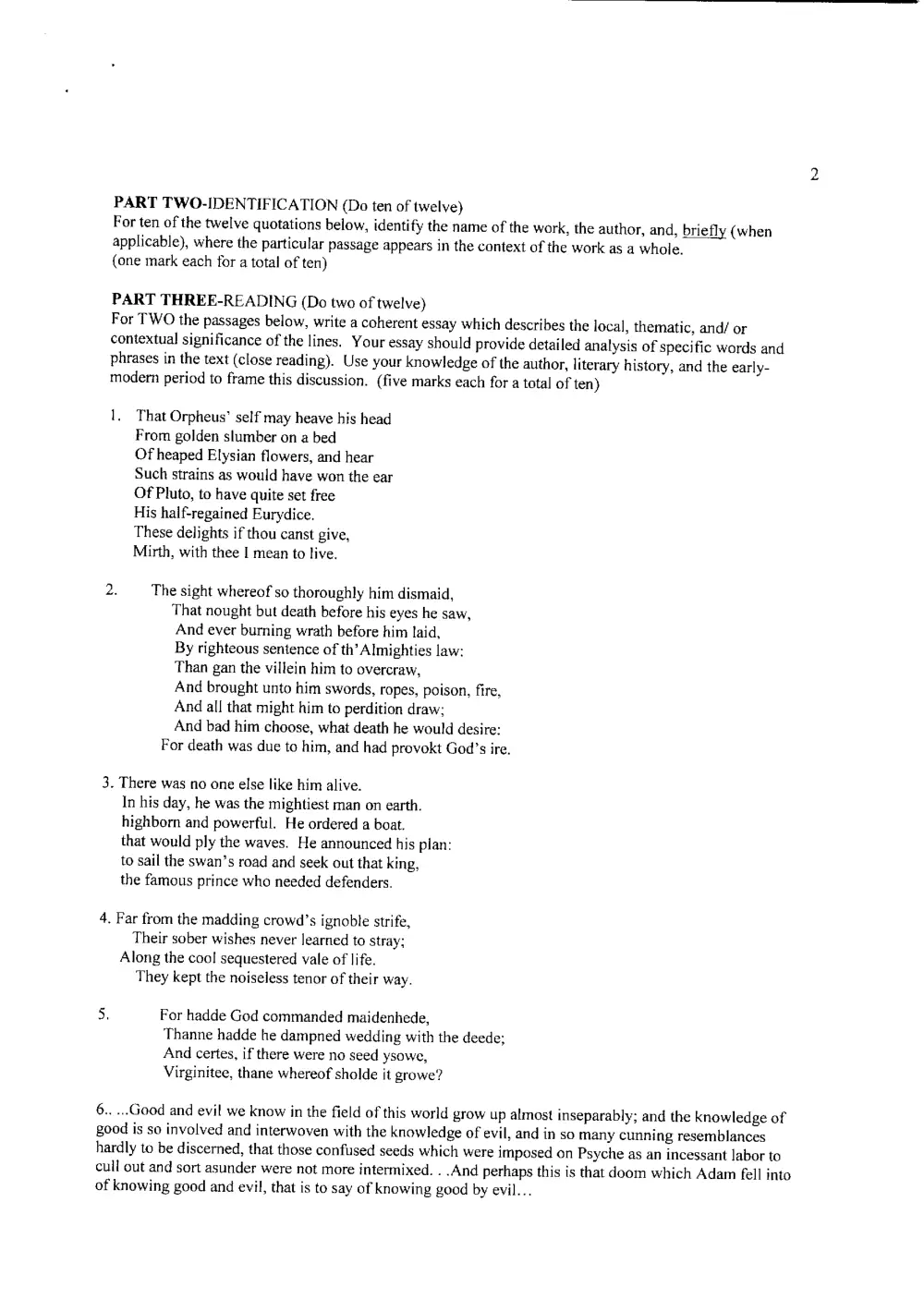
PART TWO-IDENTIFICATION (Do ten of twelve)
For ten of the twelve quotations below, identify the name of the work, the author, and, briefly (when
applicable), where the particular passage appears in the context of the work as a whole.
{one mark each for a total of ten)
PART THREE-READING (Do two of twelve)
For TWO the passages below, write a coherent essay which describes the local, thematic, and/ or
contextual significance of the lines. Your essay should provide detailed analysis of specific words and
phrases in the text (close reading). Use your knowledge of the author, literary history, and the early-
modern period to frame this discussion. (five marks each for a total of ten)
1. That Orpheus’ self may heave his head
From golden slumber on a bed
Of heaped Elysian flowers, and hear
Such strains as would have won the ear
Of Pluto, to have quite set free
His half-regained Eurydice.
These delights if thou canst give,
Mirth, with thee I mean to live.
2. The sight whereof so thoroughly him dismaid,
That nought but death before his eyes he saw,
And ever burning wrath before him laid,
By righteous sentence of th’ Almighties law:
Than gan the villein him to overcraw,
And brought unto him swords, ropes, poison, fire,
And all that might him to perdition draw:
And bad him choose, what death he would desire:
For death was due to him, and had provokt God’s ire.
3. There was no one else like him alive.
In his day, he was the mightiest man on earth.
highborn and powerful. He ordered a boat.
that would ply the waves. He announced his plan:
to sail the swan’s road and seek out that king,
the famous prince who needed defenders.
4. Far from the madding crowd’s ignoble strife,
Their sober wishes never learned to stray;
Along the cool sequestered vale of life.
They kept the noiseless tenor of their way.
5. For hadde God commanded maidenhede,
Thanne hadde he dampned wedding with the deede;
And certes, if there were no seed ysowe,
Virginitee, thane whereof sholde it growe?
6.. ...Good and evil we know in the field of this world grow up almost inseparably; and the knowledge of
good is so involved and interwoven with the knowledge of evil, and in so many cunning resemblances
hardly to be discerned, that those confused seeds which were imposed on Psyche as an incessant labor to
cull out and sort asunder were not more intermixed. . .And perhaps this is that doom which Adam fell into
of knowing good and evil, that is to say of knowing good by evil...
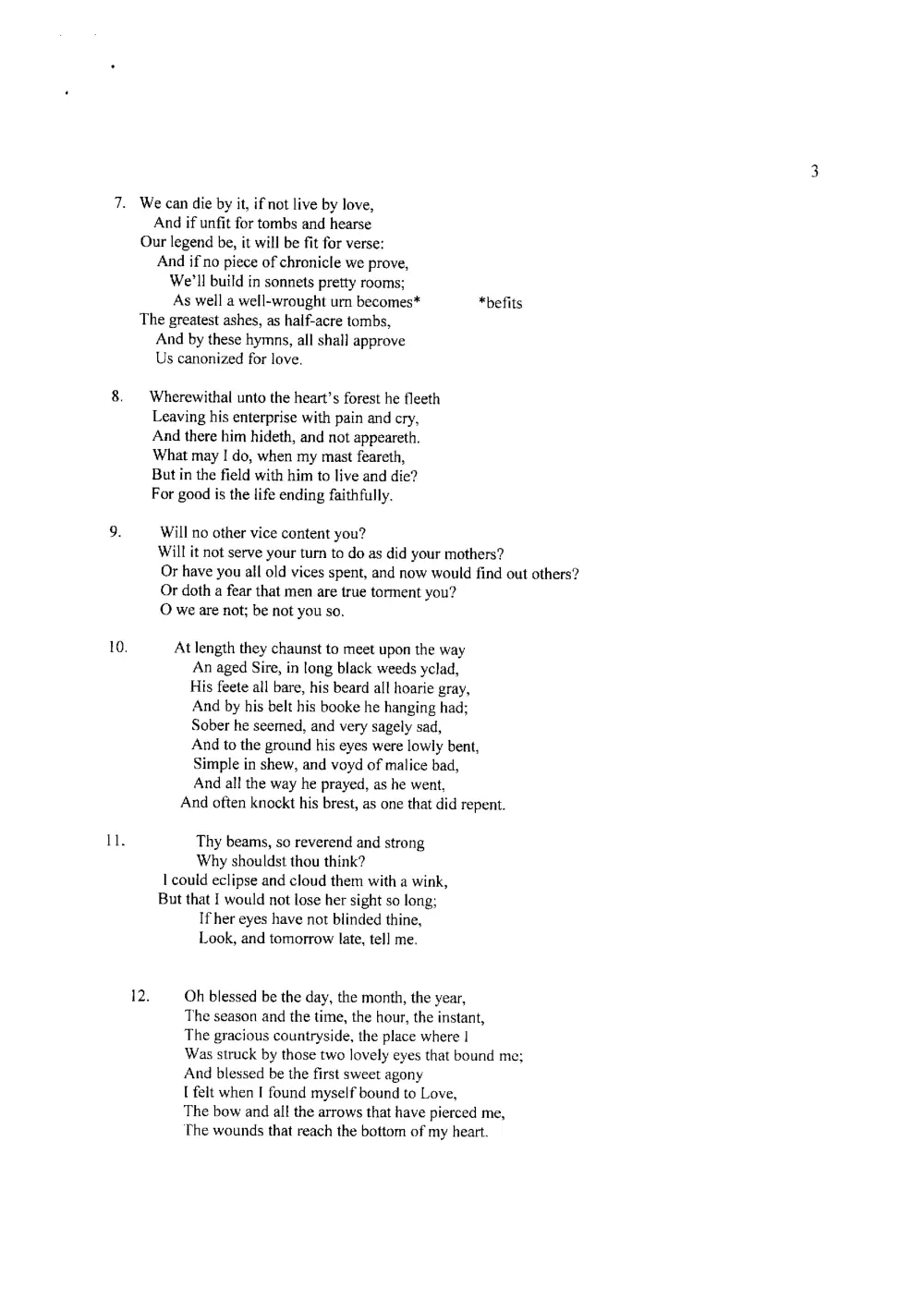
7. We can die by it, if not live by love,
And if unfit for tombs and hearse
Our legend be, it will be fit for verse:
And if no piece of chronicle we prove,
We’ll build in sonnets pretty rooms;
As well a well-wrought urn becomes* *befits
The greatest ashes, as half-acre tombs,
And by these hymns, all shall approve
Us canonized for love.
8. Wherewithal unto the heart’s forest he fleeth
Leaving his enterprise with pain and cry,
And there him hideth, and not appeareth.
What may I do, when my mast feareth,
But in the field with him to live and die?
For good is the life ending faithfully.
9. Will no other vice content you?
Will it not serve your turn to do as did your mothers?
Or have you all old vices spent, and now would find out others?
Or doth a fear that men are true torment you?
O we are not; be not you so.
10. At length they chaunst to meet upon the way
An aged Sire, in long black weeds yclad,
His feete all bare, his beard all hoarie gray,
And by his belt his booke he hanging had;
Sober he seemed, and very sagely sad,
And to the ground his eyes were lowly bent,
Simple in shew, and voyd of malice bad,
And all the way he prayed, as he went,
And often knockt his brest, as one that did repent.
ll. Thy beams, so reverend and strong
Why shouldst thou think?
I could eclipse and cloud them with a wink,
But that I would not lose her sight so long;
If her eyes have not blinded thine,
Look, and tomorrow late, tel] me.
12. Oh blessed be the day, the month, the year,
The season and the time, the hour, the instant,
The gracious countryside, the place where |
Was struck by those two lovely eyes that bound me;
And blessed be the first sweet agony
I felt when I found myself bound to Love,
The bow and all the arrows that have pierced me,
The wounds that reach the bottom of my heart.
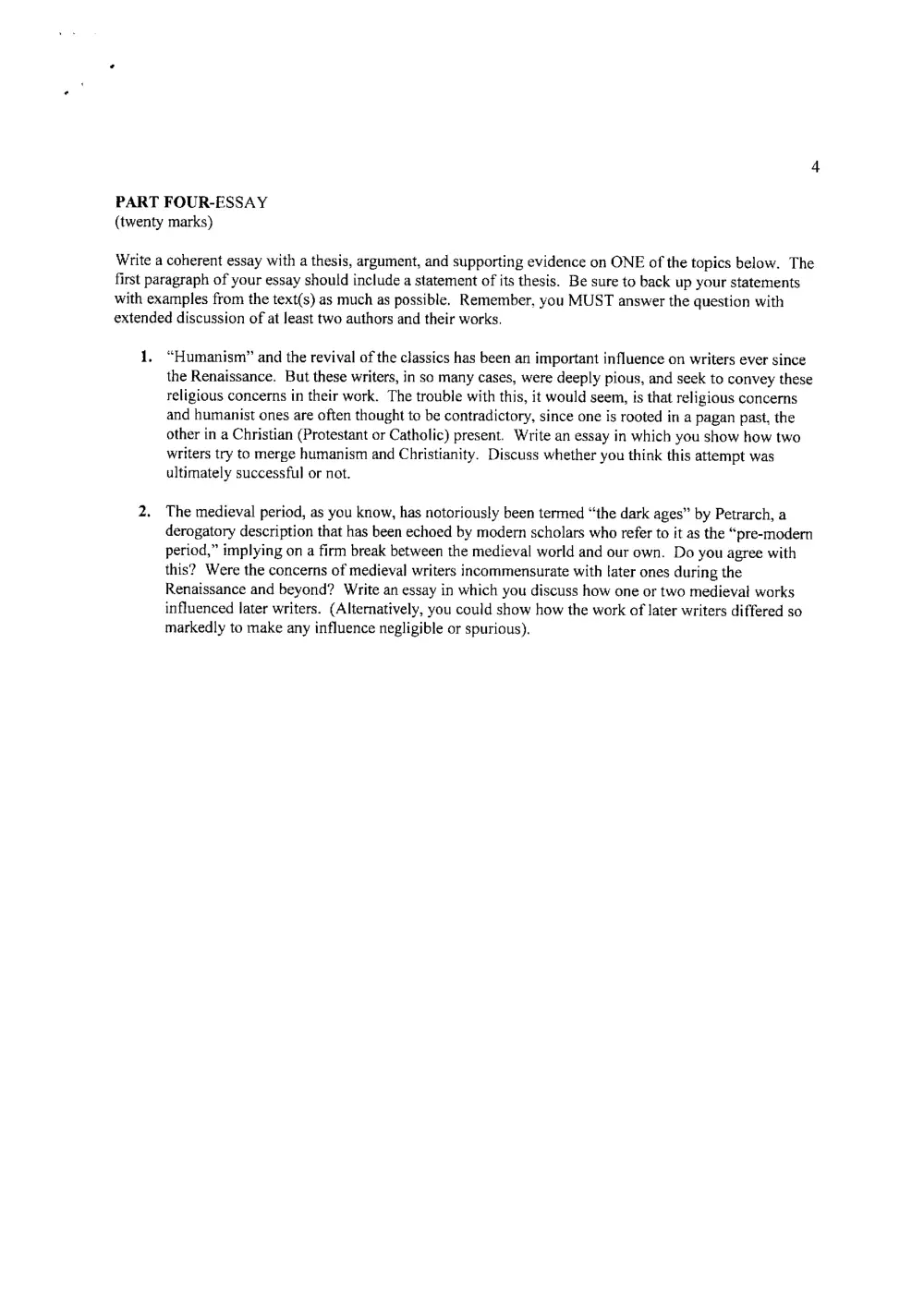
PART FOUR-ESSAY
(twenty marks)
Write a coherent essay with a thesis, argument, and supporting evidence on ONE of the topics below. The
first paragraph of your essay should include a statement of its thesis. Be sure to back up your statements
with examples from the text(s) as much as possible. Remember, you MUST answer the question with
extended discussion of at least two authors and their works.
1. “Humanism” and the revival of the classics has been an important influence on writers ever since
the Renaissance. But these writers, in so many cases, were deeply pious, and seek to convey these
religious concerns in their work. The trouble with this, it would seem, is that religious concerns
and humanist ones are often thought to be contradictory, since one is rooted in a pagan past, the
other in a Christian (Protestant or Catholic) present. Write an essay in which you show how two
writers try to merge humanism and Christianity. Discuss whether you think this attempt was
ultimately successful or not.
2. The medieval period, as you know, has notoriously been termed “the dark ages” by Petrarch, a
derogatory description that has been echoed by modern scholars who refer to it as the “pre-modern
period,” implying on a firm break between the medieval world and our own. Do you agree with
this? Were the concerns of medieval writers incommensurate with later ones during the
Renaissance and beyond? Write an essay in which you discuss how one or two medieval works
influenced later writers. (Alternatively, you could show how the work of later writers differed so
markedly to make any influence negligible or spurious).