
ENG 211 Final, Spring 2003
American University of Beirut · Renaissance and Restoration · 1 page
Stuck on a question? A tutor can walk you through it.
More ENG 211 files
Show the text of this final exam
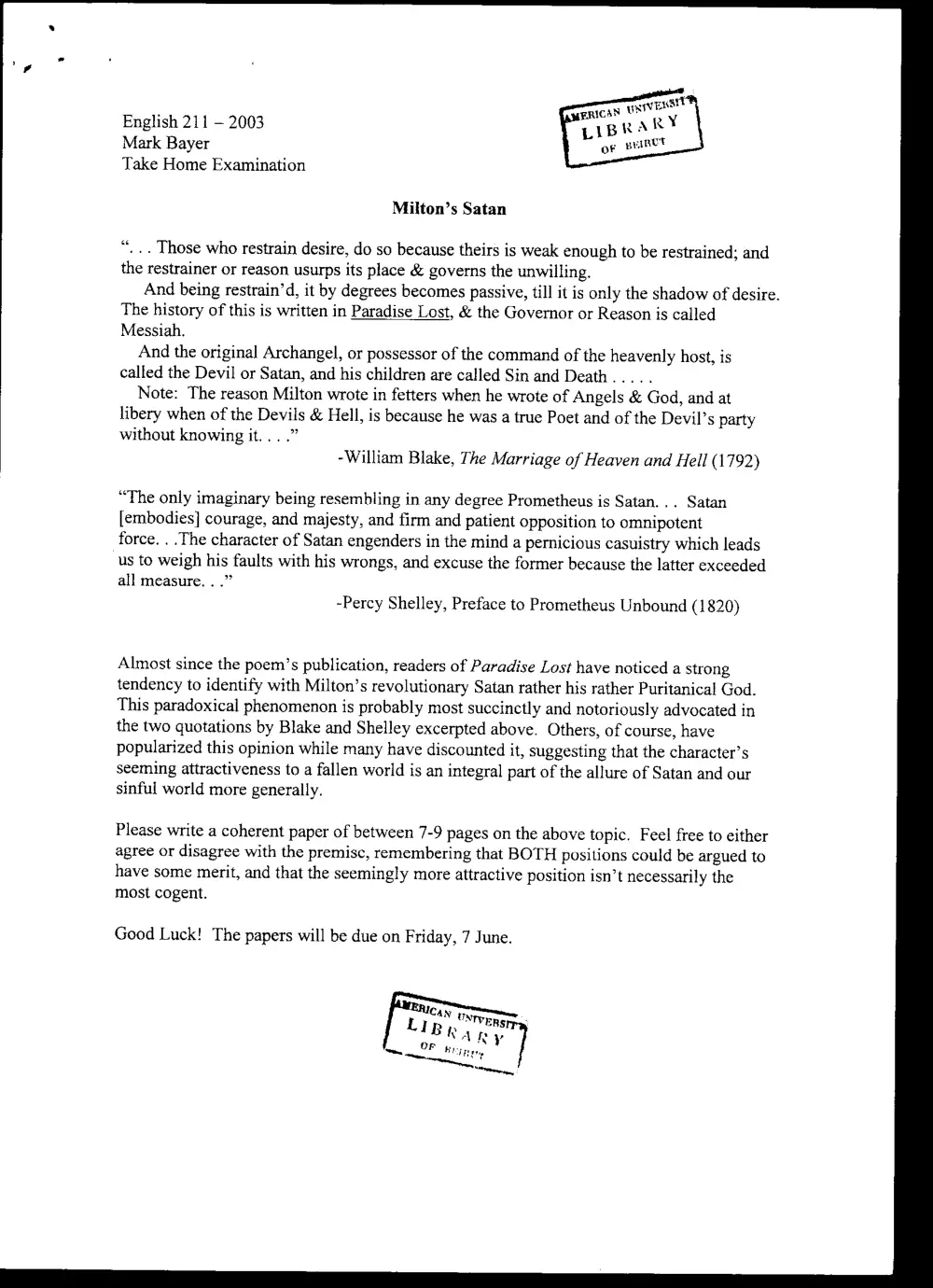
English 211 — 2003
Mark Bayer
Take Home Examination
Milton’s Satan
“... Those who restrain desire, do so because theirs is weak enough to be restrained; and
the restrainer or reason usurps its place & governs the unwilling.
And being restrain’d, it by degrees becomes passive, till it is only the shadow of desire.
The history of this is written in Paradise Lost, & the Governor or Reason is called
Messiah.
And the original Archangel, or possessor of the command of the heavenly host, is
called the Devil or Satan, and his children are called Sin and Death.....
Note: The reason Milton wrote in fetters when he wrote of Angels & God, and at
libery when of the Devils & Hell, is because he was a true Poet and of the Devil’s party
without knowing it... .”
-William Blake, The Marriage of Heaven and Hell (1792)
“The only imaginary being resembling in any degree Prometheus is Satan... Satan
[embodies] courage, and majesty, and firm and patient opposition to omnipotent
force. . .The character of Satan engenders in the mind a pernicious casuistry which leads
us to weigh his faults with his wrongs, and excuse the former because the latter exceeded
all measure. . .”
-Percy Shelley, Preface to Prometheus Unbound (1820)
Almost since the poem’s publication, readers of Paradise Lost have noticed a strong
tendency to identify with Milton’s revolutionary Satan rather his rather Puritanical God.
This paradoxical phenomenon is probably most succinctly and notoriously advocated in
the two quotations by Blake and Shelley excerpted above. Others, of course, have
popularized this opinion while many have discounted it, suggesting that the character’s
seeming attractiveness to a fallen world is an integral part of the allure of Satan and our
sinful world more generally.
Please write a coherent paper of between 7-9 pages on the above topic. Feel free to either
agree or disagree with the premisc, remembering that BOTH positions could be argued to
have some merit, and that the seemingly more attractive position isn’t necessarily the
most cogent.
Good Luck! The papers will be due on Friday, 7 June.