
ENG 227 Final, Fall 1999
American University of Beirut · Introduction to Language · 5 pages

More ENG 227 files
Show the text of this final exam
Eng 227
Fall 2000
Prof. Lina Choueirt
Final Exam
+ of a verb, its noun phrase
L. The following sentences consis
Please identify the thematic roles ae
subject, and various objects.
of the underlined noun phrases. 6 prs ae
1. Mary saw a ball in the garden.
2. The children ran from the playground to the classroom.
3. With a telescope, the spy observed the politician.
4. The sun melted the ice.
5. The hay was loaded on the truck by the farmer.
II. for each group of words given below, state what semantic
property distinguishes between the classes of (a) words and (b)
words. Indicate also a semantic property shared by the (a)
words and the (b) words. 6 pfs
1. (a) bachelor, man, son, pope, chief
(b)bull, rooster, stallion, lion
The (a) words are
The (b) words are
The (a) and (b) words are all
2. (a) walk, run, swim, jump, hop
(b)fly, skate, ski, ride, cycle
The (a) words are
The (b) words are
The (a) and (b) words are all
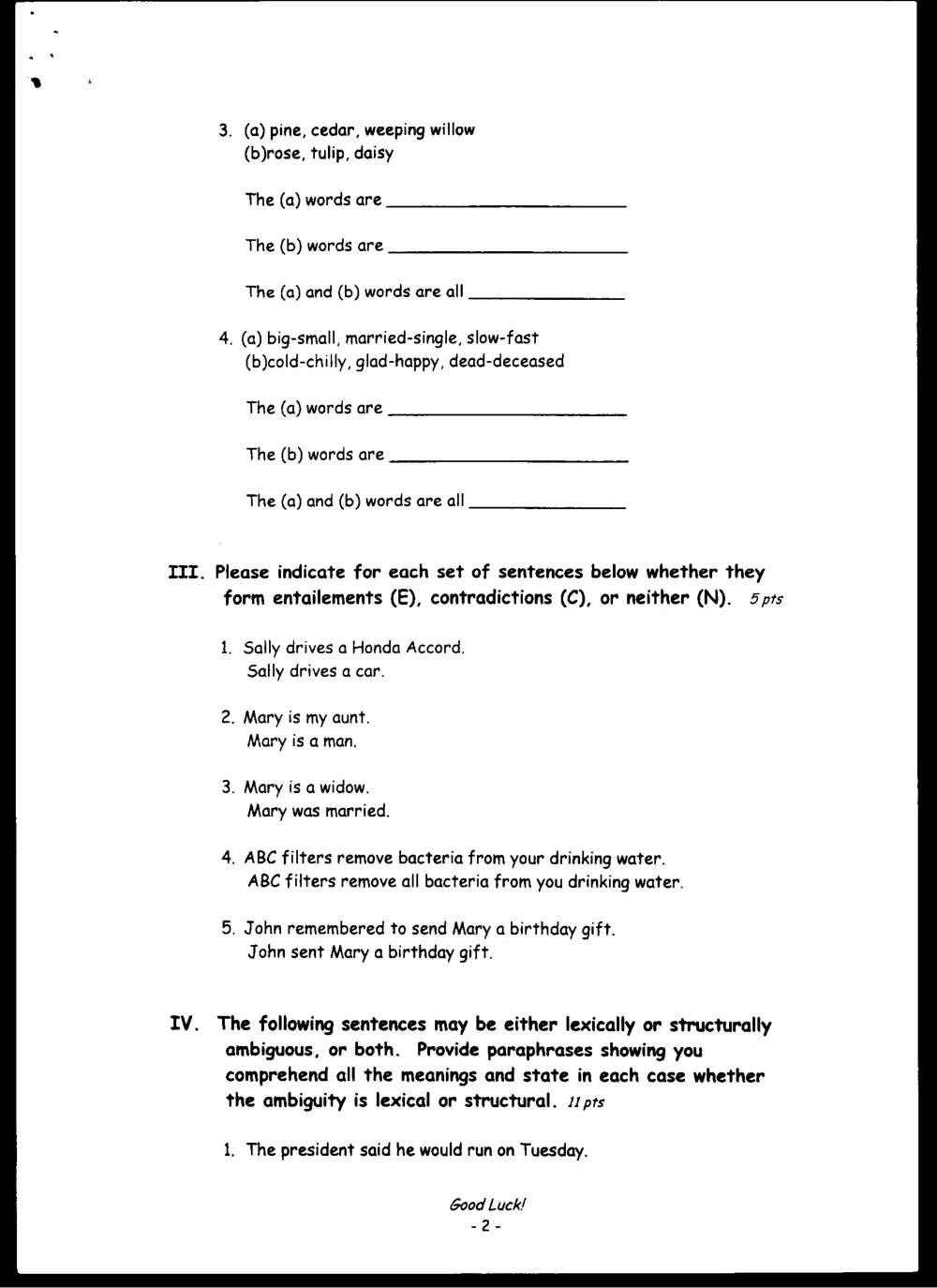
3. (a) pine, cedar, weeping willow
(b)rose, tulip, daisy
The (a) words are
The (b) words are
The (a) and (b) words are all
4. (a) big-small, married-single, slow-fast
(b)cold-chilly, glad-happy, dead-deceased
The (a) words are
The (b) words are
The (a) and (b) words are alll
III. Please indicate for each set of sentences below whether they
form entailements (E), contradictions (C), or neither (N). Sprs
1. Sally drives a Honda Accord.
Sally drives a car.
2. Mary is my aunt.
Mary is a man.
3. Mary is a widow.
Mary was married.
4. ABC filters remove bacteria from your drinking water.
ABC filters remove all bacteria from you drinking water.
5. John remembered to send Mary a birthday gift.
John sent Mary a birthday gift.
IV. The following sentences may be either lexically or structurally
ambiguous, or both. Provide paraphrases showing you
comprehend all the meanings and state in each case whether
the ambiguity is lexical or structural. 11 pts
i. The president said he would run on Tuesday.
Good Luck!
-2-
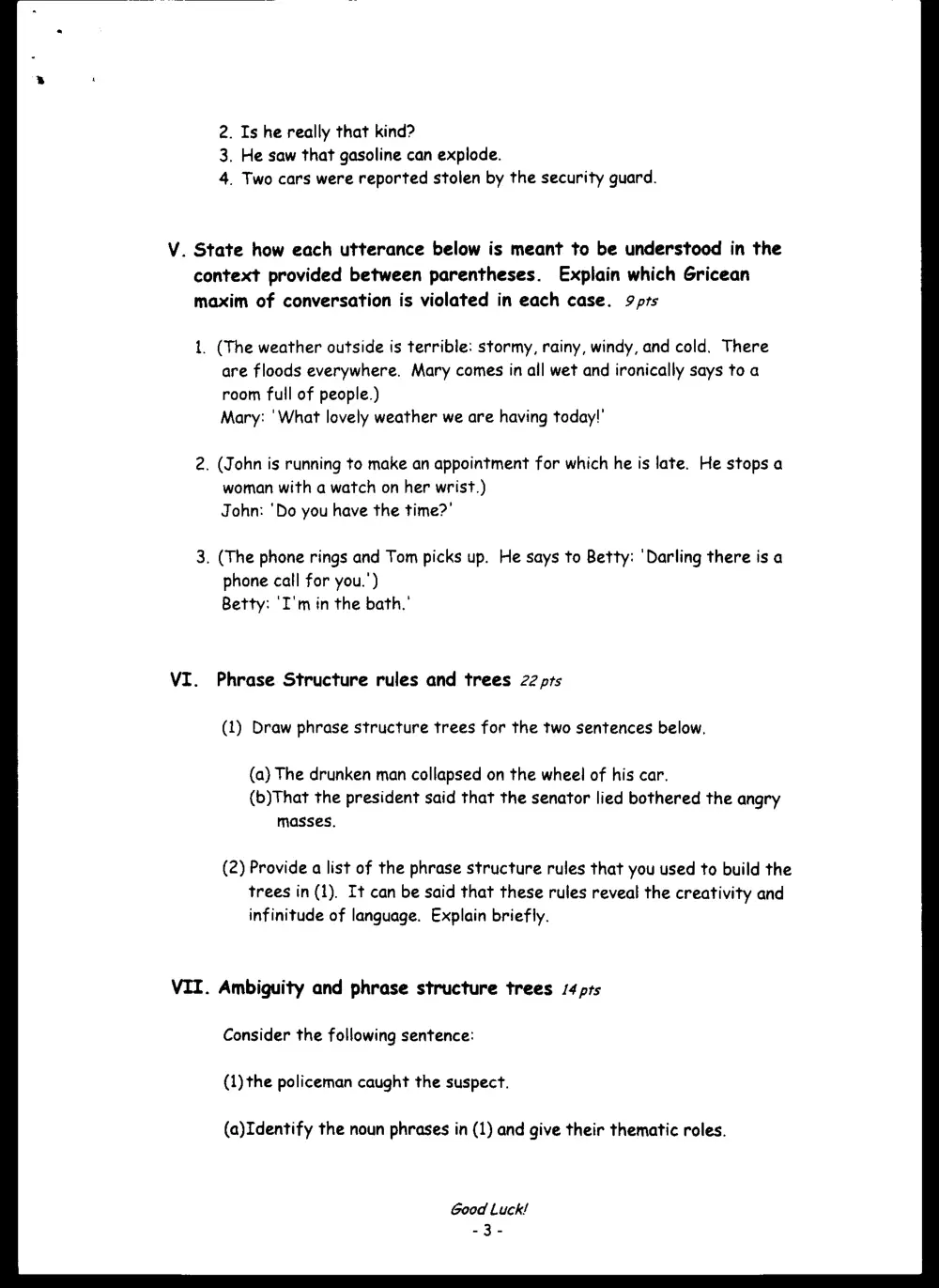
2. Is he really that kind?
3. He saw that gasoline can explode.
4. Two cars were reported stolen by the security guard.
V. State how each utterance below is meant to be understood in the
context provided between parentheses. Explain which Gricean
maxim of conversation is violated in each case. 9prs
1. (The weather outside is terrible: stormy, rainy, windy, and cold. There
are floods everywhere. Mary comes in all wet and ironically says toa
room full of people.)
Mary: 'What lovely weather we are having today!’
2. (John is running to make an appointment for which he is late. He stops a
woman with a watch on her wrist.)
John: ‘Do you have the time?’
3. (The phone rings and Tom picks up. He says to Betty: ‘Darling there is a
phone call for you.’)
Betty: ‘I'm in the bath.’
VI. Phrase Structure rules and trees 22 prs
(1) Draw phrase structure trees for the two sentences below.
(a) The drunken man collapsed on the wheel of his car.
(b)That the president said that the senator lied bothered the angry
masses.
(2) Provide a list of the phrase structure rules that you used to build the
trees in (1). It can be said that these rules reveal the creativity and
infinitude of language. Explain briefly.
VII. Ambiguity and phrase structure trees 14 prs
Consider the following sentence:
(1) the policeman caught the suspect.
(a)Identify the noun phrases in (1) and give their thematic roles.
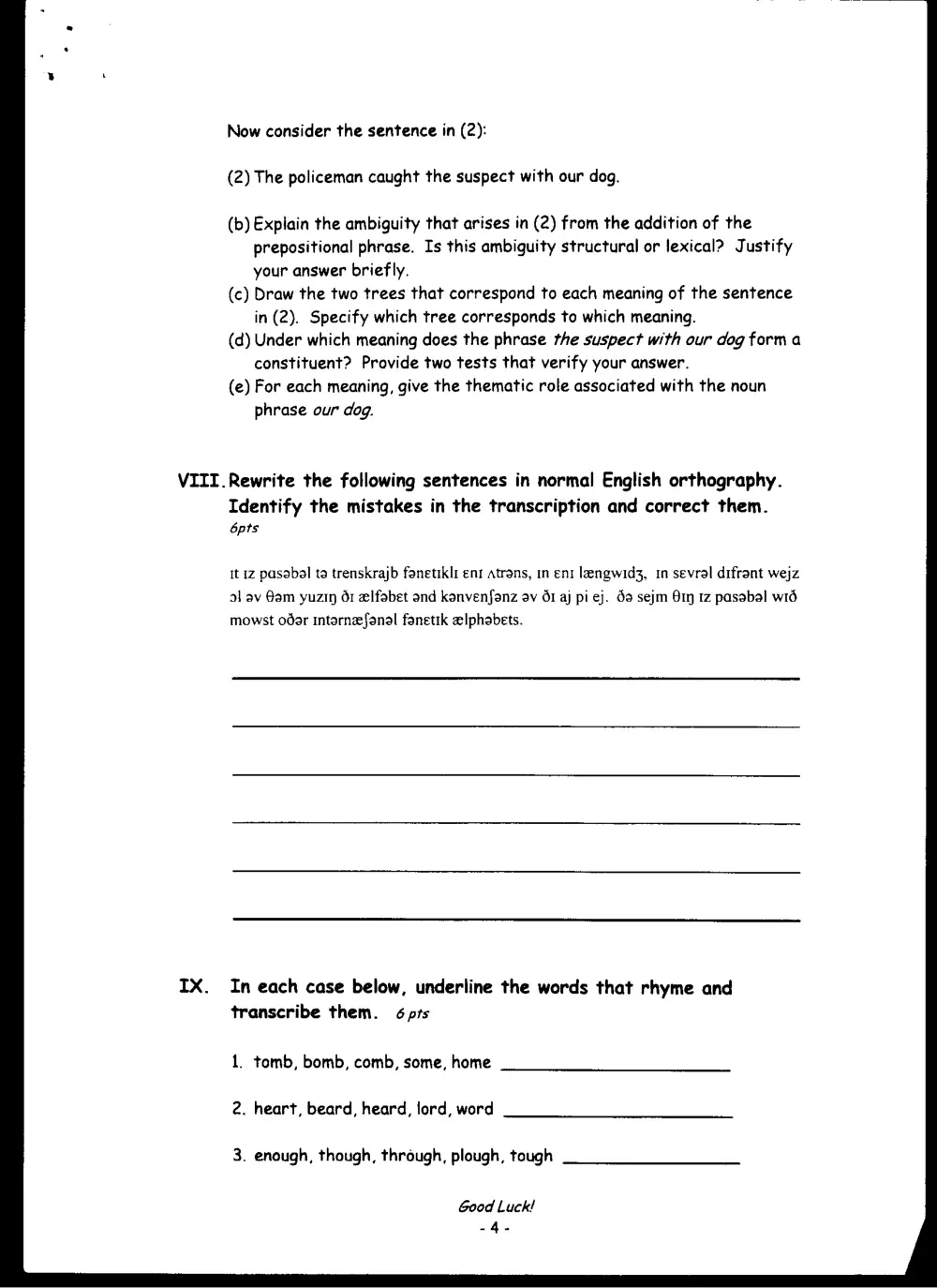
Now consider the sentence in (2):
(2) The policeman caught the suspect with our dog.
(b) Explain the ambiguity that arises in (2) from the addition of the
prepositional phrase. Is this ambiguity structural or lexical? Justify
your answer briefly.
(c) Draw the two trees that correspond to each meaning of the sentence
in (2). Specify which tree corresponds to which meaning.
(d) Under which meaning does the phrase the suspect with our dog form a
constituent? Provide two tests that verify your answer.
(e) For each meaning, give the thematic role associated with the noun
phrase our dog.
VIII. Rewrite the following sentences in normal English orthography.
Identify the mistakes in the transcription and correct them.
6pts
It 1Z pasabal ta trenskrajb fanetikli ent trons, in ent lengwid3, in sevral difrant wejz
al av Gam yuzin 1 zlfabet and kanvenJanz av 61 aj pi ej. 6a sejm O1n Iz pasabal wid
mowst odar Intarnefanal fanettk elphabets.
IX. In each case below, underline the words that rhyme and
transcribe them. 6 prs
1. tomb, bomb, comb, some, home
2. heart, beard, heard, lord, word
3. enough, though, through, plough, tough
Good Luck!
-4-
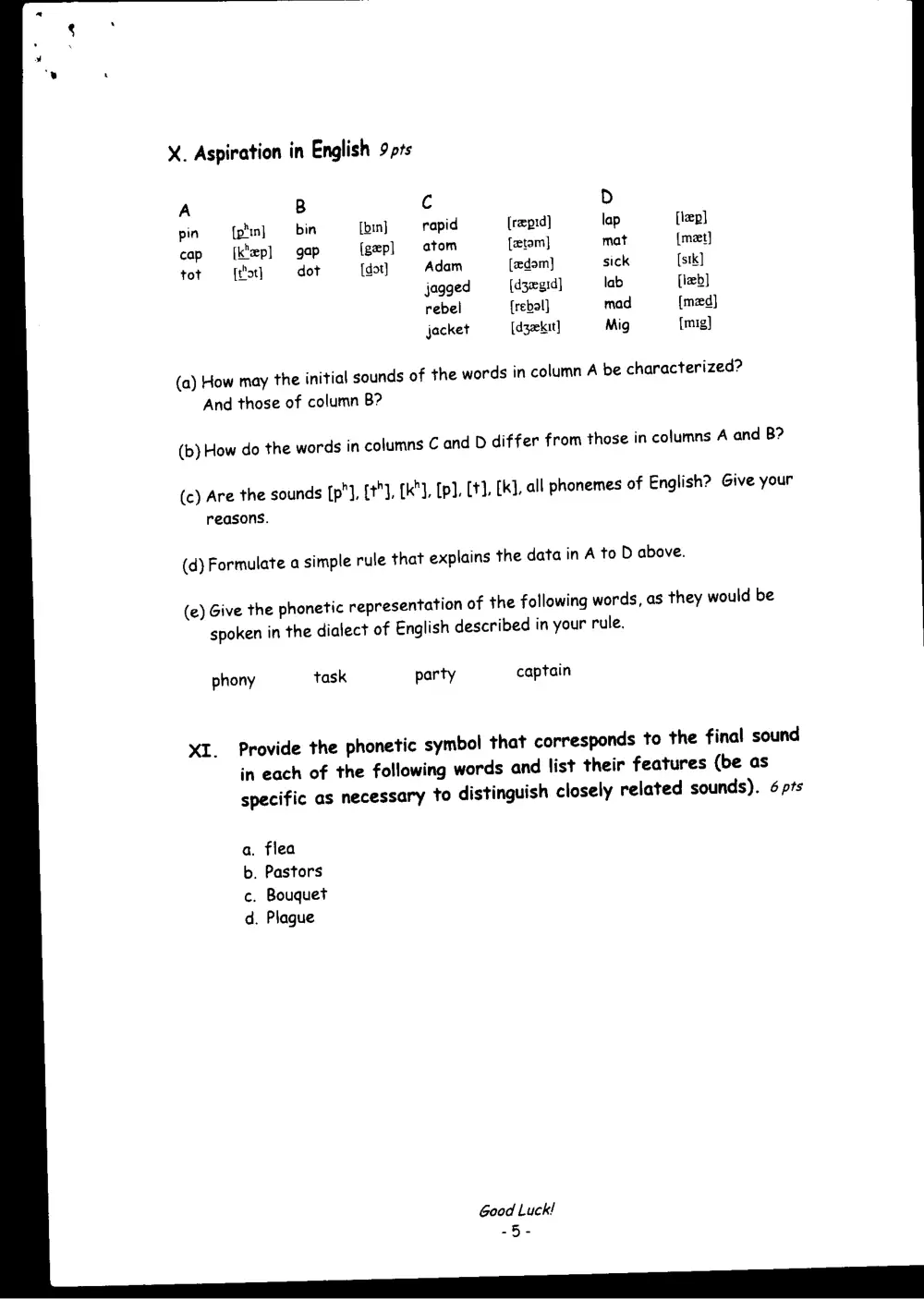
X. Aspiration in English 9 prs
A B Cc D
pin {p'in] bin [bin] rapid [repid] lap [lp]
cap {k"ep] gap (gep] atom [ztem] mat {meet]
tot [Pot] dot [dot] Adam [zdom] sick {stk}
jogged [d3cegid] lab [lzb]
rebel {rebal] mad {meed]
jacket [dgaekit] Mig {mig}
(a) How may the initial sounds of the words in column A be characterized?
And those of column B?
(b) How do the words in columns C and D differ from those in columns A and B?
(c) Are the sounds [p"], (t"], (k"J, [p]. (+1. [k], all phonemes of English? Give your
reasons.
(d) Formulate a simple rule that explains the data in A to D above.
(e) Give the phonetic representation of the following words, as they would be
spoken in the dialect of English described in your rule.
phony task party captain
XI. Provide the phonetic symbol that corresponds to the final sound
in each of the following words and list their features (be as
specific as necessary to distinguish closely related sounds). 6 pts
a, flea
b. Pastors
c. Bouquet
d. Plague
Good Luck!
-5-