
ENG 227 Final, Spring 2002
American University of Beirut · Introduction to Language · 5 pages

More ENG 227 files
Show the text of this final exam
” . ‘y
a . English 227 2™4 Semester 2001-2002
° “/ Introduction to Language Prof. Kassim A. Shaaban
ANAL EXAMINATION (Tie Hours)
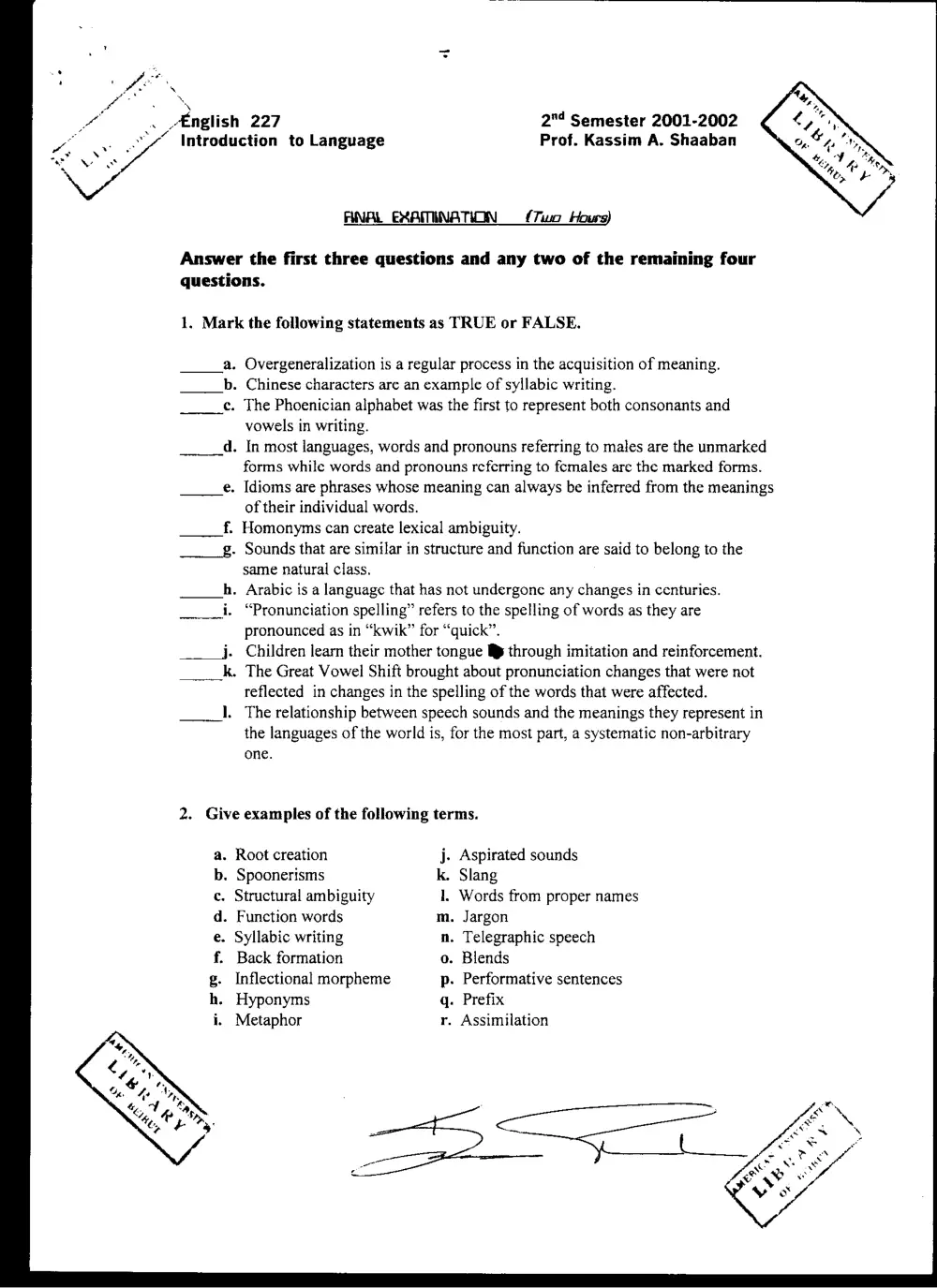
Answer the first three questions and any two of the remaining four
questions.
1. Mark the following statements as TRUE or FALSE.
a.
b.
c.
ee
f.
—_8
__h
i
—_I
____k
]
d.
Overgeneralization is a regular process in the acquisition of meaning.
Chinese characters are an example of syllabic writing.
The Phoenician alphabet was the first to represent both consonants and
vowels in writing.
In most languages, words and pronouns referring to males are the unmarked
forms while words and pronouns referring to females are the marked forms.
Idioms are phrases whose meaning can always be inferred from the meanings
of their individual words.
. Homonyms can create lexical ambiguity.
. Sounds that are similar in structure and function are said to belong to the
same natural class.
. Arabic is a language that has not undergone any changes in centuries.
i. “Pronunciation spelling” refers to the spelling of words as they are
pronounced as in “kwik” for “quick”.
j. Children learn their mother tongue § through imitation and reinforcement.
. The Great Vowel Shift brought about pronunciation changes that were not
reflected in changes in the spelling of the words that were affected.
. The relationship between speech sounds and the meanings they represent in
the languages of the world is, for the most part, a systematic non-arbitrary
one.
2. Give examples of the following terms.
r PRE me ae op
. Spoonerisms
Root creation j. Aspirated sounds
k. Slang
Structural ambiguity 1. Words from proper names
Function words m. Jargon
Syllabic writing n. Telegraphic speech
Back formation o. Blends
p. Performative sentences
q. Prefix
r.
. Assimilation
Inflectional morpheme
Hyponyms
Metaphor
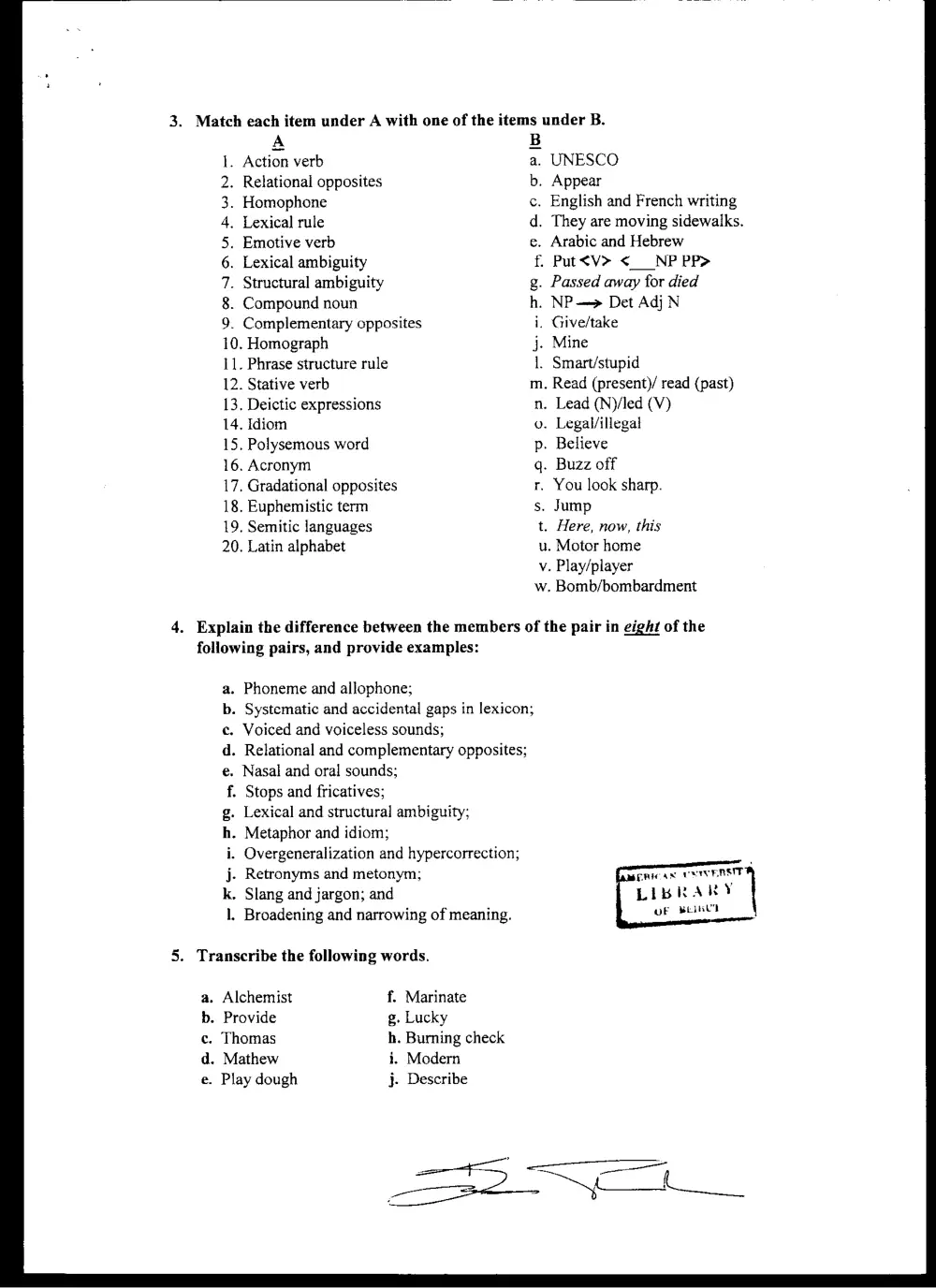
3. Match each item under A with one of the items under B.
A B
1. Action verb a. UNESCO
2. Relational opposites b. Appear
3. Homophone c. English and French writing
4. Lexical rule d. They are moving sidewalks.
5. Emotive verb e. Arabic and Hebrew
6. Lexical ambiguity f. Put<V> <__NP PP>
7. Structural ambiguity g. Passed away for died
8. Compound noun h. NP—» Det Adj N
9. Complementary opposites i. Give/take
10. Homograph j. Mine
11. Phrase structure rule 1. Smart/stupid
12. Stative verb m. Read (present)/ read (past)
13. Deictic expressions n. Lead (N)/led (V)
14. Idiom o. Legal/illegal
15. Polysemous word p. Believe
16, Acronym q. Buzz off
17. Gradational opposites r. You look sharp.
18. Euphemistic term s. Jump
19, Semitic languages t. Here, now, this
20. Latin alphabet u. Motor home
v. Play/player
w. Bomb/bombardment
4. Explain the difference between the members of the pair in eight of the
following pairs, and provide examples:
pe
. Phoneme and allophone;
. Systematic and accidental gaps in lexicon;
Voiced and voiceless sounds;
. Relational and complementary opposites;
Nasal and oral sounds;
Stops and fricatives;
Lexical and structural ambiguity;
Metaphor and idiom;
Overgeneralization and hypercorrection;
Retronyms and metonym;
Slang and jargon; and
Broadening and narrowing of meaning.
in”
ap
ERICAN UNTVERSIT
LIBRARY
oF BEABLD
rR or FE mn ©
5. Transcribe the following words.
a. Alchemist f. Marinate
b. Provide g. Lucky
c. Thomas h. Burning check
d. Mathew i. Modern
e. Play dough j. Describe
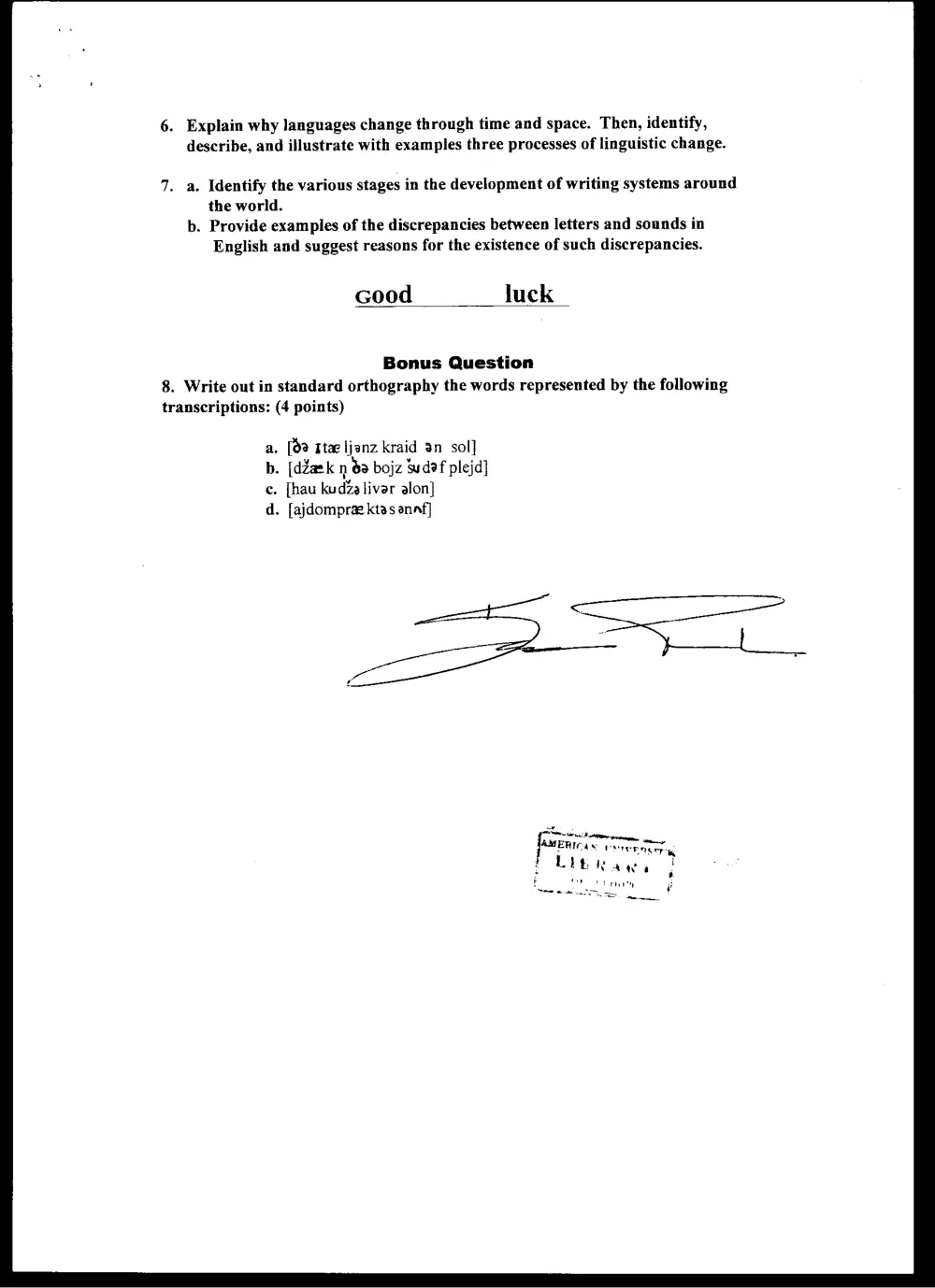
6. Explain why languages change through time and space. Then, identify,
describe, and illustrate with examples three processes of linguistic change.
7. a. Identify the various stages in the development of writing systems around
the world.
b. Provide examples of the discrepancies between letters and sounds in
English and suggest reasons for the existence of such discrepancies.
Good luck
Bonus Question
8. Write out in standard orthography the words represented by the following
transcriptions: (4 points)
a. [02 itae ljanz kraid an sol]
b. [dzatk n 68 bojz Sudef plejd]
¢. [hau kudza liver alon]
d. [ajdompra ktas anaf]
i
PRs
fapatiethieteh eee
fomzricas Cerner,
Lithag,
t he aa aty
“Nee ee i
Labial Coronal Dorsal
bilabial | labio- | dental | alveolar | post- / retro- | palatal | velar glottal | labial-velar |
_ dental alveolar | flex
voiceless
oral stop | 22¥ P to t key k uh-oh 2
voiced ~
|
oral stop be b do d _ go g i
voiced . «©
nasal stop | @Y m no sing 1 a
voiced Otto £ fue
Oo Ce
flap 5 = rea
voiceless Eas
fricative fl f) thin @| sass S | show f hat b z58
voiced . to . ; 7
fricative vim V | this ) zip Z \Asia 3
voiceless _ an
affricate _ chew tf _
voiced . d
affricate jam a3 _ |
voiced . ; :
approx. ip J tip I | yes J wacky W
voiced i 1] ~
lateral low
approx. _ -
¢: ts: +f Jedee dg English Consonants
As
aA
Ne
Cn
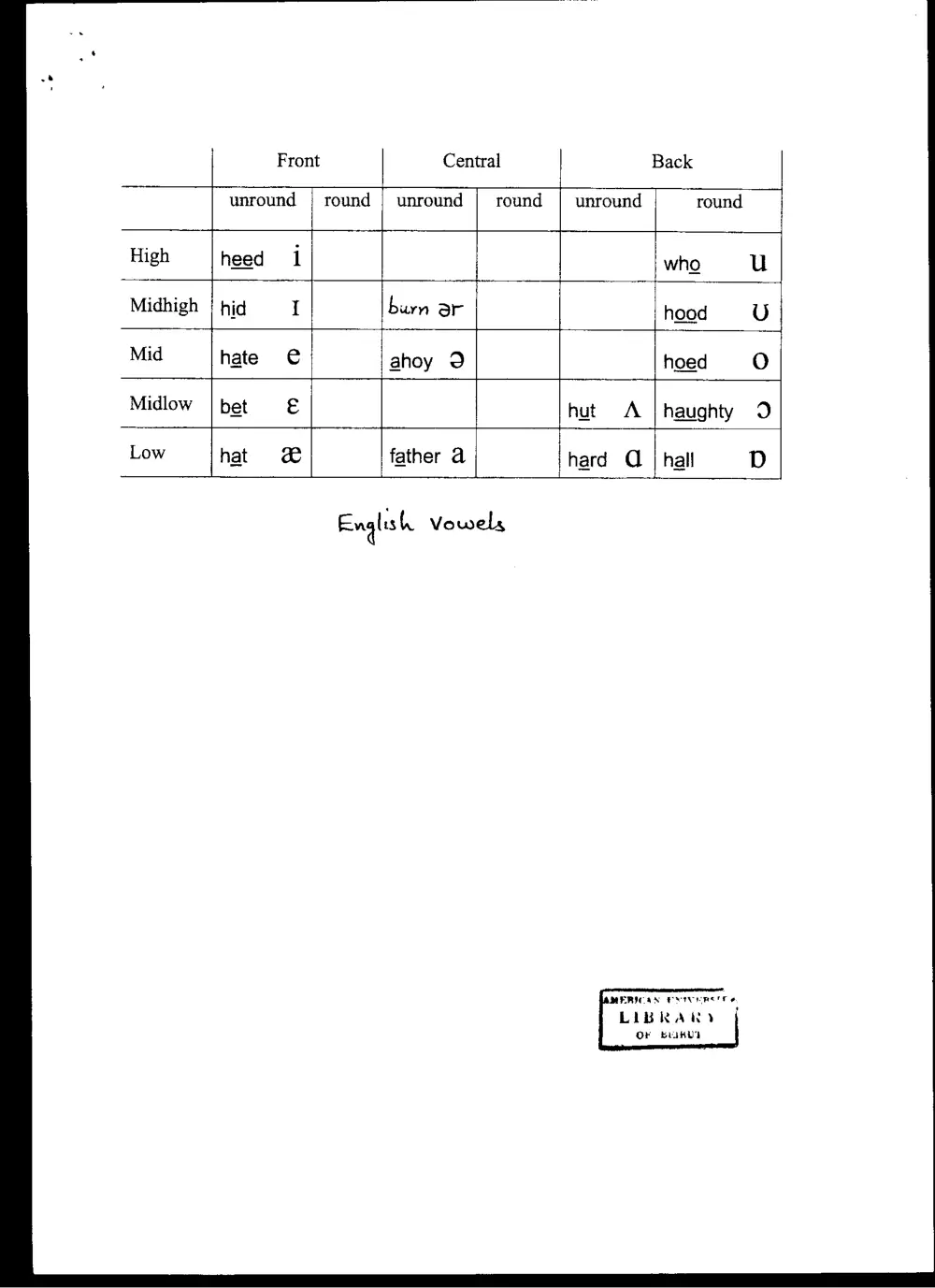
Front Central Back
round | unround | round | unround round
who Uu
Midhigh jhid =I bum ar hood U
Mid hate € ahoy 9 hoed O
Midlow |bet €& hut <A |haughty 3
Low hat & father a hard C1 | hall D
English Vowels
ERICAN PRIveRs' fo.
:
LIBRARY
OF BUH