
ENG 227 Final, Summer 2000
American University of Beirut · Introduction to Language · 1 page
Stuck on a question? A tutor can walk you through it.
More ENG 227 files
Show the text of this final exam
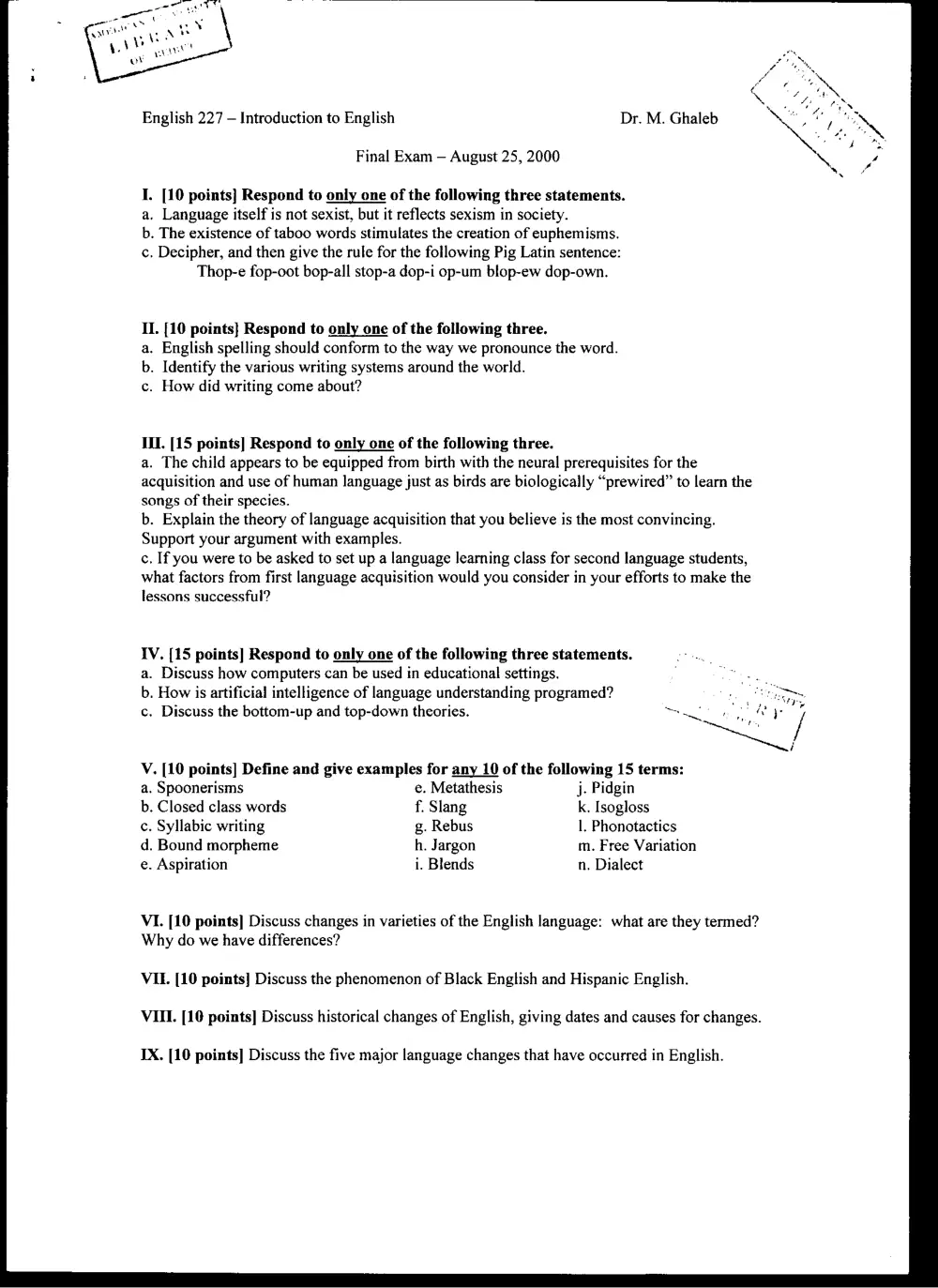
English 227 — Introduction to English Dr. M. Ghaleb
Final Exam — August 25, 2000
I. [10 points] Respond to only one of the following three statements.
a, Language itself is not sexist, but it reflects sexism in society.
b. The existence of taboo words stimulates the creation of euphemisms.
c. Decipher, and then give the rule for the following Pig Latin sentence:
Thop-e fop-oot bop-all stop-a dop-i op-um blop-ew dop-own.
II. [10 points} Respond to only one of the following three.
a. English spelling should conform to the way we pronounce the word.
b. Identify the various writing systems around the world.
c. How did writing come about?
II. [15 points] Respond to only one of the following three.
a. The child appears to be equipped from birth with the neural prerequisites for the
acquisition and use of human language just as birds are biologically “prewired” to learn the
songs of their species.
b. Explain the theory of language acquisition that you believe is the most convincing.
Support your argument with examples.
c. If you were to be asked to set up a language learning class for second language students,
what factors from first language acquisition would you consider in your efforts to make the
lessons successful?
IV. [15 points] Respond to only one of the following three statements.
a. Discuss how computers can be used in educational settings.
b. How is artificial intelligence of language understanding programed?
c. Discuss the bottom-up and top-down theories.
V. [10 points] Define and give examples for any 10 of the following 15 terms:
a. Spoonerisms e. Metathesis j. Pidgin
b. Closed class words f. Slang k. Isogloss
c. Syllabic writing g. Rebus 1. Phonotactics
d. Bound morpheme h. Jargon m. Free Variation
e. Aspiration i. Blends n. Dialect
VI. [10 points] Discuss changes in varieties of the English language: what are they termed?
Why do we have differences?
VIL. [10 points] Discuss the phenomenon of Black English and Hispanic English.
VIII. [10 points] Discuss historical changes of English, giving dates and causes for changes.
IX. [10 points] Discuss the five major language changes that have occurred in English.