
ENG 227 Final, Summer 2002
American University of Beirut · Introduction to Language · 4 pages

More ENG 227 files
Show the text of this final exam
English 227 Summer 2002
Introduction to Language Prof. Shaaban
FINAL EXAMINATION {4 1/2_Hours)
August 23, 2002
Answer question six and four of the remaining five questions.
1. Comment briefly on three of the following statements, and provide examples.
(22 points)
a. Euphemisms are terms that tend to be used in certain aspects of our lives more
than in others as they are used to replace terms that are not to be used in “polite
company.”
b. Feminists believe that language is a major tool used by the male-dominated
establishment to “keep women in their place.”
c. The human child appears to be equipped from birth with the neural
prerequisites for the acquisition and use of human language just as bees are
biologically “predisposed” to learn the dances of their species.
d. Dialectal diversity develops when people are separated from each other
geographically and socially.
2. Define and give examples of seven of the following terms. (22 points)
a. Lingua franca f. Style
b. Creole g. Politically correct language
c. Natural phonetic class h. Obstruents
d. Closed class of words i, Jargon
e. Approximants j. Telegraphic speech
3. a. Identify the stages in acquiring negation or interrogation (questions).
Explain the implications of the existence of these stages to the process of
language acquisition. (11 points)
b. Which theory of language acquisition do you believe provides the best
explanation for how children learn their first language. Justify your
answer. (11 points)
4. a. Transcribe the following words phonemically. (11 points)
Mister Plastic
Physical Major
Describe Interaction
Phoneme Morphology
Though Creature
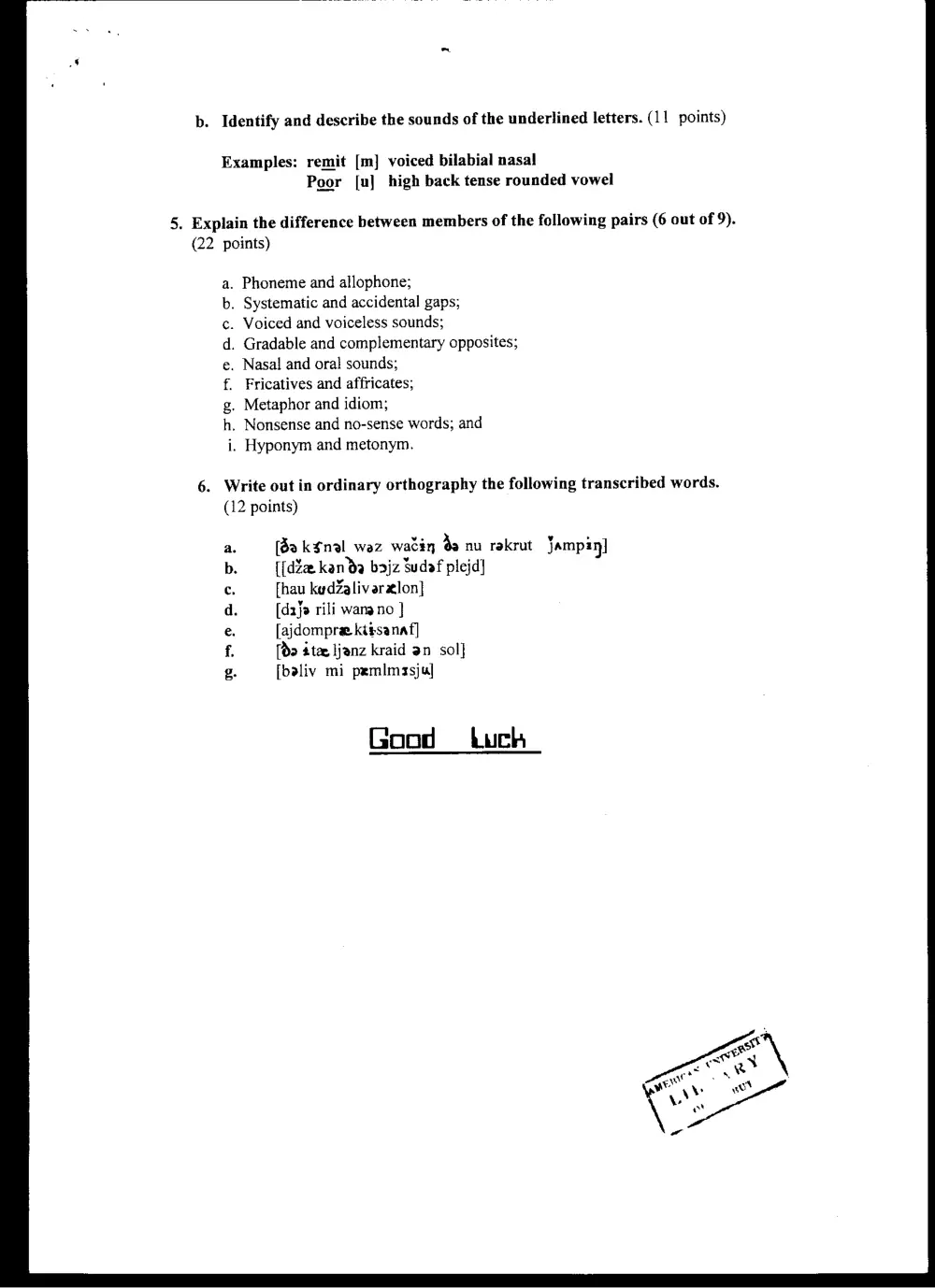
b. Identify and describe the sounds of the underlined letters. (11 points)
Examples: remit [m] voiced bilabial nasal
Poor [u] high back tense rounded vowel
5. Explain the difference between members of the following pairs (6 out of 9).
(22 points)
Phoneme and allophone;
Systematic and accidental gaps,
Voiced and voiceless sounds;
Gradable and complementary opposites;
Nasal and oral sounds;
Fricatives and affricates;
Metaphor and idiom;
Nonsense and no-sense words; and
Hyponym and metonym.
pre mone se
6. Write out in ordinary orthography the following transcribed words.
(12 points)
[Sa kgnal waz waciy 3a nu rakrut Jampan]
[[dta kan Ba bajz Sudef plejd]
[hau kudZaliv aralon]
[daje rili wana no ]
[ajdomprae kttsanaf]
[de dtae ljanz kraid an sol]
[baliv mi pemlmasju]
game ange
Good buch
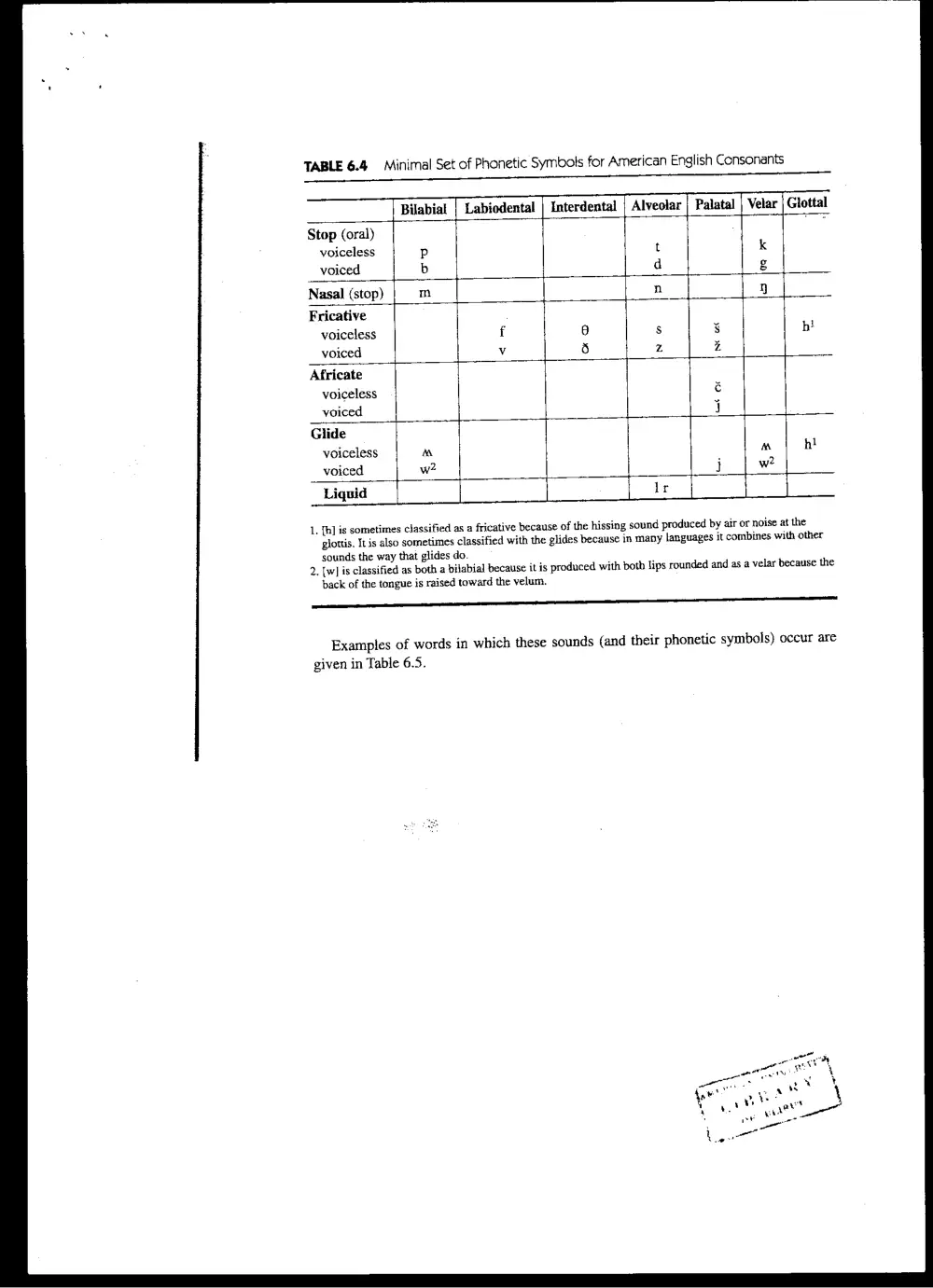
TABLE 6.4 Minimal Set of Phonetic Symbols for American English Consonants
Bilabial | Labiodental | Interdental | Alveolar | Palatal | Velar Glottal
Stop (oral)
voiceless
voiced
Nasal (stop)
Fricative
voiceless
voiced
Africate
voiceless
voiced
Glide
voiceless
voiced
Liquid \r
. {h] is sometimes classified as a fricative because of the hissing sound produced by air or noise at the
glottis. It is also sometimes classified with the glides because in many languages it combines with other
sounds the way that glides do.
2. [w] is classified as both a bilabial because it is produced with both lips rounded and as a velar because the
back of the tongue is raised toward the velum.
nena
Examples of words in which these sounds (and their phonetic symbols) occur are
given in Table 6.5.
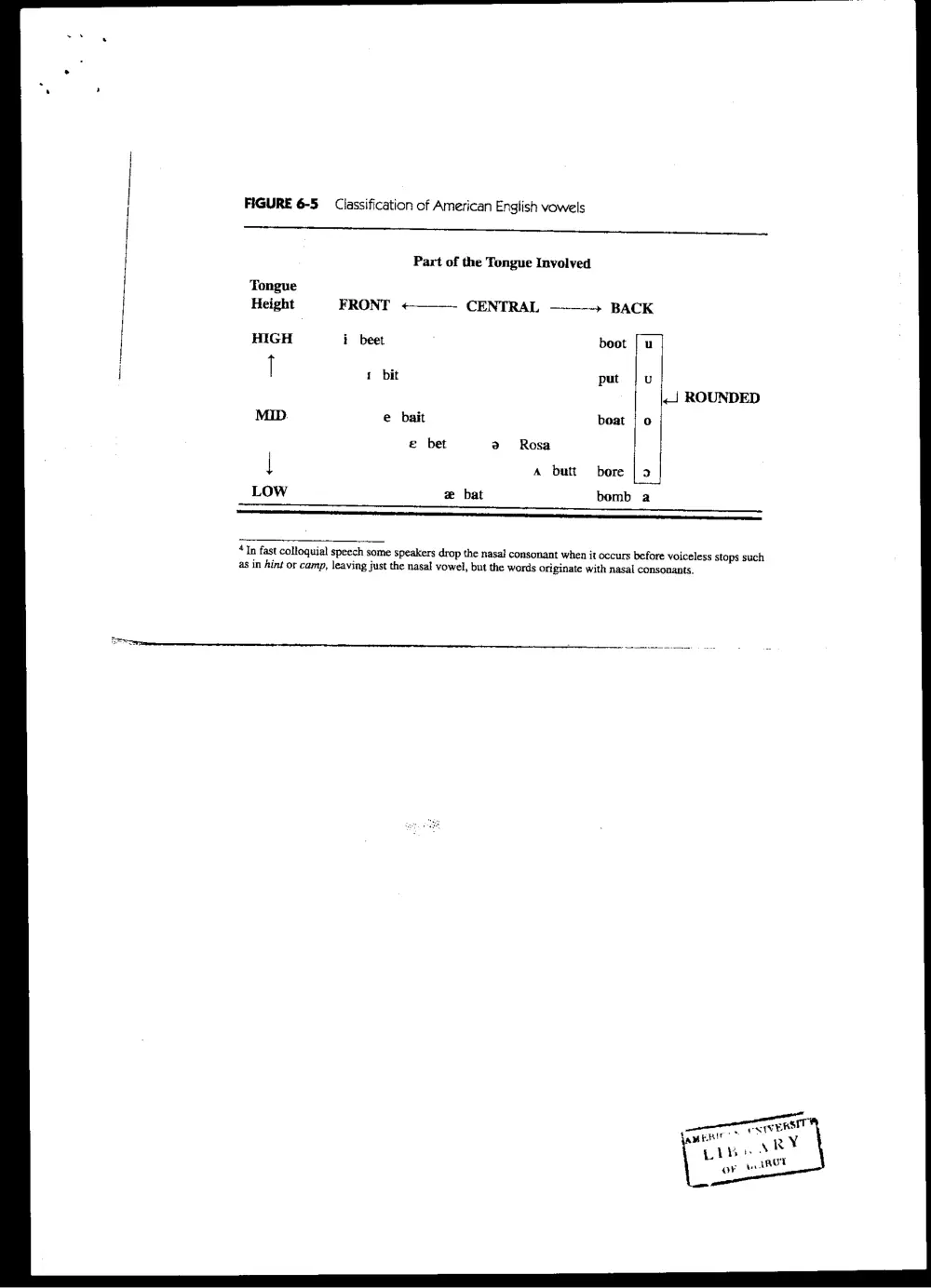
Classification of American English vowels
Part of the Tongue Involved
FRONT «———~ CENTRAL ————+ BACK
i beet boot
1 bit put
|_| ROUNDED
e bait boat
e bet a Rosa
A butt bore | 9
ze bat bomb a
Renee a SS ay
4 In fast colloquial speech some speakers drop the nasal consonant when it occurs before voiceless stops such
as in hint or camp, leaving just the nasal vowel, but the words originate with nasal consonants.