
ENG 229 Final, Spring 1996
American University of Beirut · History of the English Language · 3 pages


More ENG 229 files
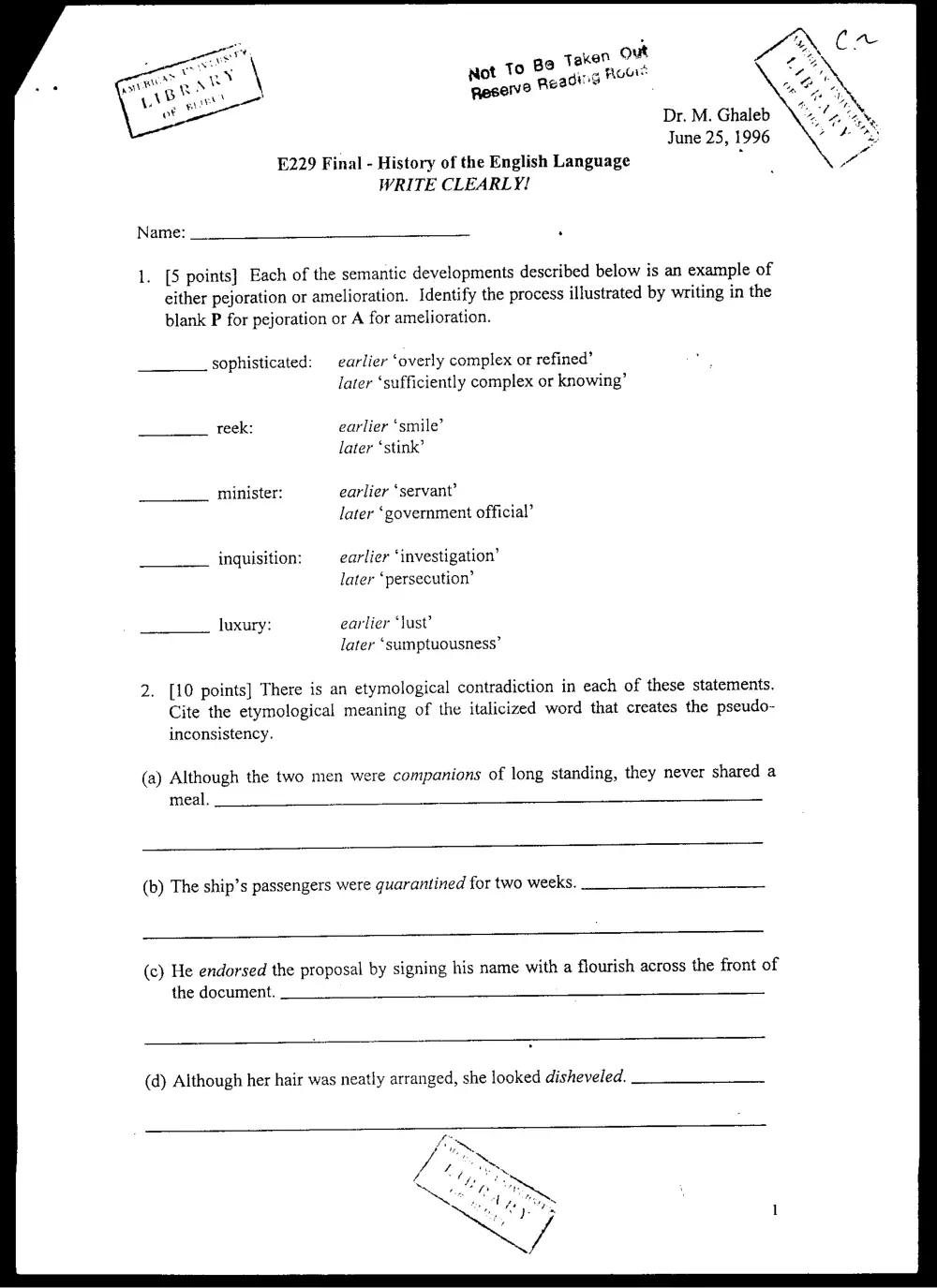
Show the text of this final exam
Dr. M. Ghaleb
June 25, 1996
£229 Final - History of the English Language
WRITE CLEARLY!
Name: ‘
1. [5 points] Each of the semantic developments described below is an example of
either pejoration or amelioration. Identify the process illustrated by writing in the
blank P for pejoration or A for amelioration.
sophisticated: earlier ‘overly complex or refined’
later ‘sufficiently complex or knowing’
reek: earlier ‘smile’
later ‘stink’
minister: earlier ‘servant?
later ‘government official’
inquisition: earlier ‘investigation’
later ‘persecution’
luxury: earlier ‘lust
later ‘sumptuousness’
2. [10 points] There is an etymological contradiction in each of these statements.
Cite the etymological meaning of the italicized word that creates the pseudo-
inconsistency.
(a) Although the two men were companions of long standing, they never shared a
meal.
(b) The ship’s passengers were quarantined for two weeks.
(c) He endorsed the proposal by signing his name with a flourish across the front of
the document.
(d) Although her hair was neatly arranged, she looked disheveled.
(e) The team scampered onto the field, eager to meet their opponents.
12)
3. [% points] What language has had an influence on the English vocabulary over
the longest period of time? Why has that language, more than any other, had such
an influence?
4. [@ points] These trade names were suggested by already existing words or word
elements in the English language. Identify the earlier forms which underlie the
trade name.
automat
Band-aid
Frigidaire
mimeograph
escalator
5. [10 points] From what language was the prefix in each of these words originally
derived? Label each work G (Greek), L (Latin), or OE (Old English) according to
the source of the prefix.
circumnavigate stepchild
retrospect retrospect
twilight- malformed
parapsychology midday
sumame . ultraviolet
ap
{@ points} Translate the following Old English selection into Modern English.
Then, point out and describe the phases of change for three features of OE found
in the selection. Note: J have provided root translations immediately after words .
which I do not expect you to be able to know; you have to provide the correct form
of the root word, when necessary!.
Sum man ferde fram Hierusalem to Hiericho, and becom on éa sceadan (thief);
pa hine bereafodon (to rob) and tintregodon (to torment) hine, and
forleton (to leave) hine samcucene (half-alive). ba gebyrode (to happen) hit pat
sum sacerd ferde (priest) on bam ylcan wege, and pa he pzet geseah (fo see),
he hine forbeah (to pass by). And eall (also) swa se diacon (deacon),
pa he wees wid ba stowe (place) and pet geseah, he hyne eac forbeah.