
ENG 229 Final, Spring 2000
American University of Beirut · History of the English Language · 3 pages
More ENG 229 files
Show the text of this final exam
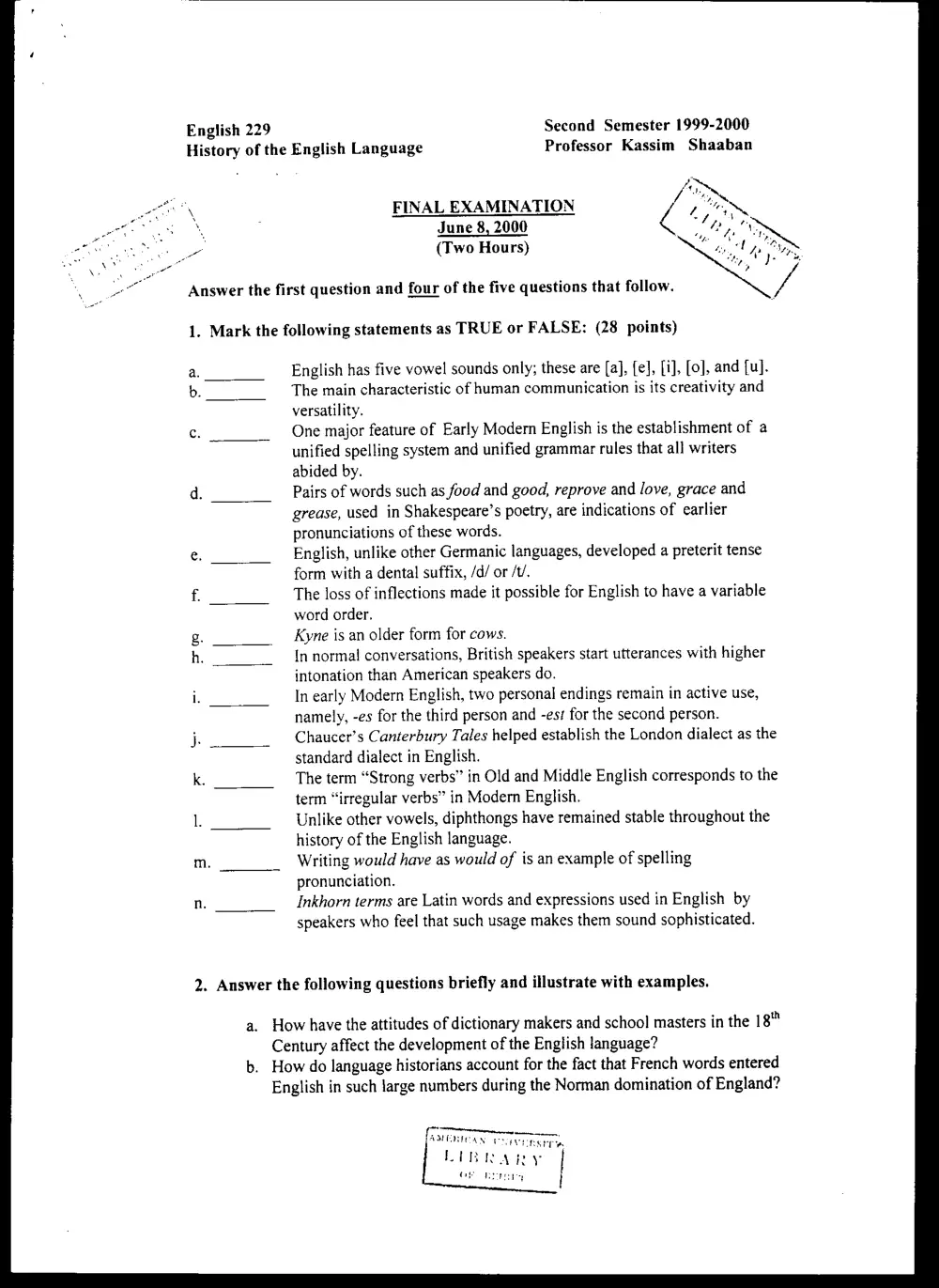
English 229 Second Semester 1999-2000
History of the English Language Professor Kassim Shaaban
my FINAL EXAMINATION De
ent : June 8, 2000 .
7 (Two Hours)
Answer the first question and four of the five questions that follow.
1. Mark the following statements as TRUE or FALSE: (28 points)
P
English has five vowel sounds only; these are (a], {e], [i], [o], and [u].
b. The main characteristic of human communication is its creativity and
versatility.
c. One major feature of Early Modern English is the establishment of a
unified spelling system and unified grammar rules that all writers
abided by.
d. Pairs of words such as food and good, reprove and love, grace and
grease, used in Shakespeare’s poetry, are indications of earlier
pronunciations of these words.
e. English, unlike other Germanic languages, developed a preterit tense
form with a dental suffix, /d/ or /t/.
f. The loss of inflections made it possible for English to have a variable
word order.
g. Kyne is an older form for cows.
h. In normal conversations, British speakers start utterances with higher
intonation than American speakers do.
In early Modern English, two personal endings remain in active use,
namely, -es for the third person and -est for the second person.
Chaucer’s Canterbury Tales helped establish the London dialect as the
standard dialect in English.
k. The term “Strong verbs” in Old and Middle English corresponds to the
term “irregular verbs” in Modern English.
L Unlike other vowels, diphthongs have remained stable throughout the
history of the English language.
m. Writing would have as would of is an example of spelling
pronunciation.
n. Inkhorn terms are Latin words and expressions used in English by
speakers who feel that such usage makes them sound sophisticated.
2. Answer the following questions briefly and illustrate with examples.
a. How have the attitudes of dictionary makers and school masters in the 13"
Century affect the development of the English language?
b. How do language historians account for the fact that French words entered
English in such large numbers during the Norman domination of England?
a,
OV ERSTE
LIBRaRy
oy
B
TAMEMICAN (
EPpy
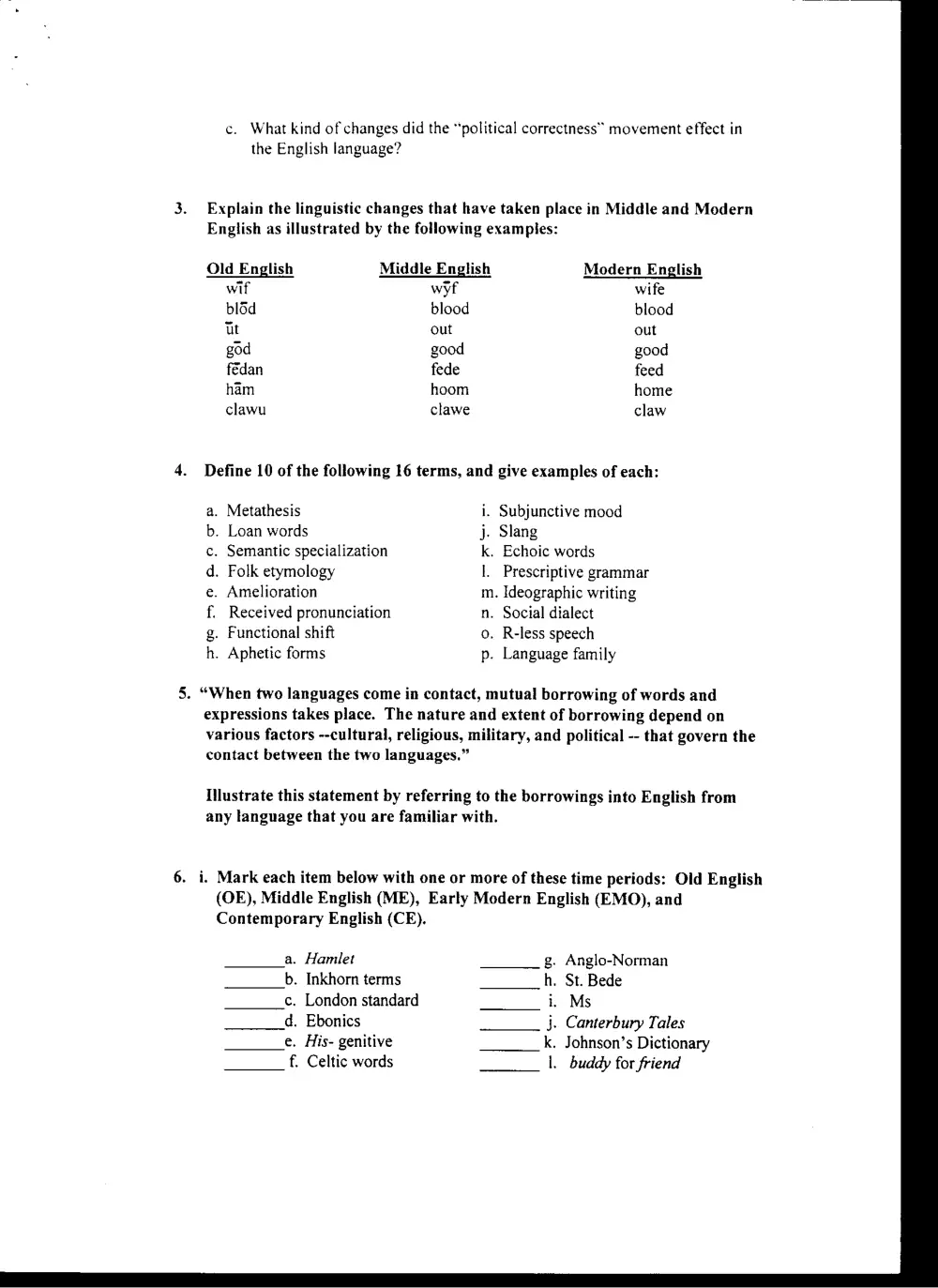
c. What kind of changes did the “political correctness” movement effect in
the English language?
3. Explain the linguistic changes that have taken place in Middle and Modern
English as illustrated by the following examples:
Old English Middle English Modern English
wif wyf wife
blod blood blood
tt out out
god good good
fédan fede feed
ham hoom home
clawu clawe claw
4. Define 10 of the following 16 terms, and give examples of each:
a. Metathesis i. Subjunctive mood
b. Loan words j. Slang
c. Semantic specialization k. Echoic words
d. Folk etymology |. Prescriptive grammar
e. Amelioration m. Ideographic writing
f. Received pronunciation n. Social dialect
g. Functional shift o, R-less speech
h. Aphetic forms p. Language family
5. “When two languages come in contact, mutual borrowing of words and
expressions takes place. The nature and extent of borrowing depend on
various factors --cultural, religious, military, and political -- that govern the
contact between the two languages.”
Illustrate this statement by referring to the borrowings into English from
any language that you are familiar with.
6. i. Mark each item below with one or more of these time periods: Old English
(OE), Middle English (ME), Early Modern English (EMO), and
Contemporary English (CE).
a. Hamlet g. Anglo-Norman
b. Inkhorn terms h. St. Bede
c. London standard i. Ms
d. Ebonics j. Canterbury Tales
e. His- genitive k. Johnson’s Dictionary
f. Celtic words |. buddy for friend
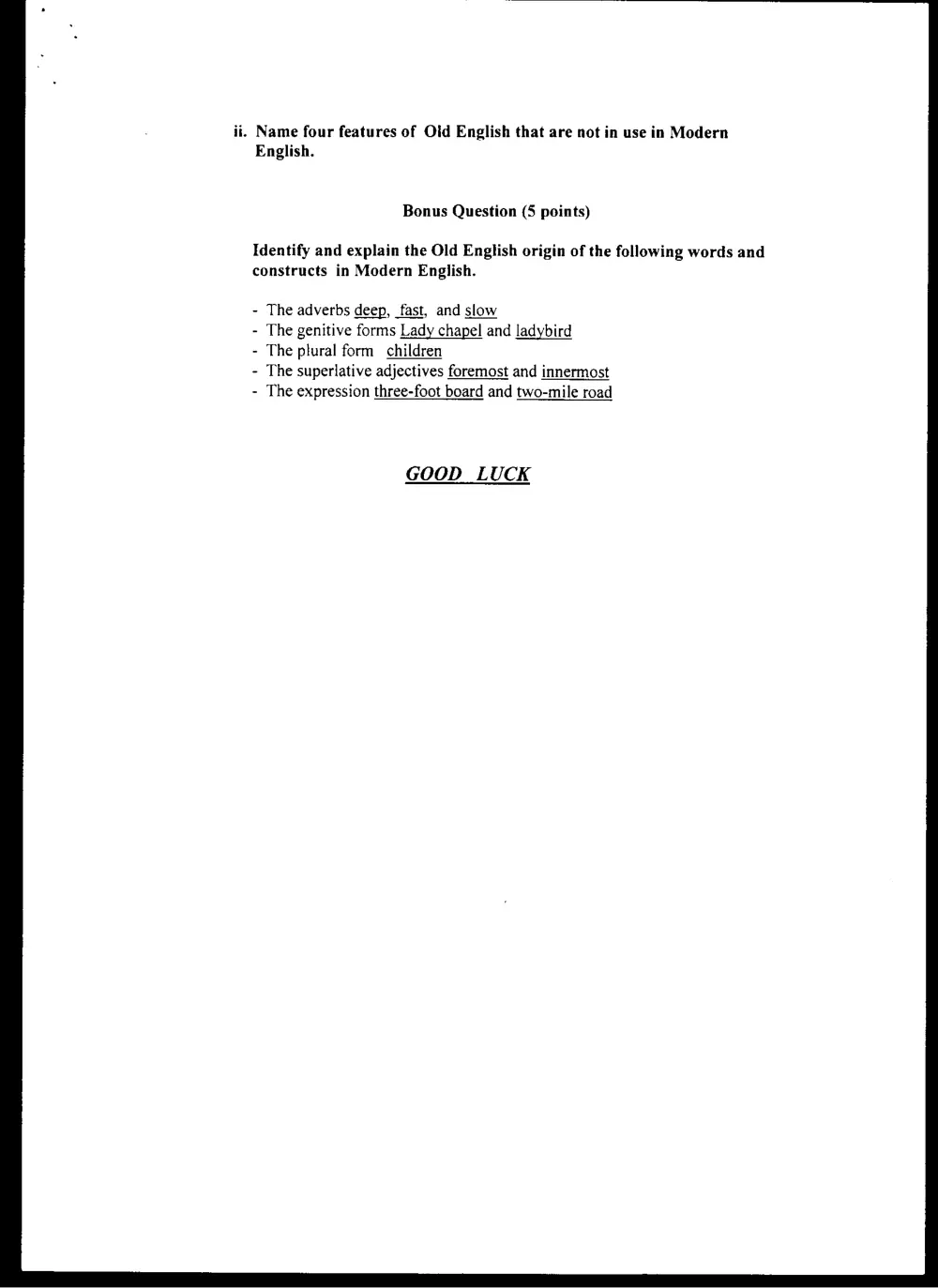
ii. Name four features of Oid English that are not in use in Modern
English.
Bonus Question (5 points)
Identify and explain the Old English origin of the following words and
constructs in Modern English.
The adverbs deep, fast, and slow
The genitive forms Lady chapel and ladybird
The plural form children
The superlative adjectives foremost and innermost
The expression three-foot board and two-mile road
GOOD LUCK