
ENG 231 Final, Fall 1997
American University of Beirut · Modern English Grammar · 7 pages


More ENG 231 files
Show the text of this final exam
Modern English Grammar
E 231
Friday, the 13111!
Your name:
Answer questions I and II in your booklet.
Dr. Mary L. Ghaleb
February 13, 1998
I. [25 points] Consider the following groups of words/sentences. Comment on their
grammaticality or non-grammaticality (you don’t necessarily have to explain each
sentence). Be sure to clearly indicate the group you are referring to.
Group One Group Two
John knew the answer slowly. signaling
b) The girl is now a student carefully. travelling
c) This tank holds four gallons noisily. Developing
d) Peter looks like his dad gradually. programming
worshipping
enveloping
Group Four
The registrar suggests that this applicant apply next year.
We demand that the prisoner eat all he is given
Be that as it may, our lives have changed.
It is necessary that our teacher inform us of the rules.
Suffice it to say that he was wrong.
They suggest that each person walk the entire distance.
The committee recommends that the annual fees be raised.
Heaven forbid that it should happen.
Group Five
a) When I said she ought to listen, I was wrong.
b) He must leave in a hurry yesterday.
c) Bob said the children need to eat better.
-d) She ought to drank the wine.
e) Last year, they need to go after the criminals.
Group Six
a) There’s hundreds of dollars in the safe.
b) The public are tired of the old programs.
c) The audience is enjoying the play.
Group Three
baring
permiting
draging
d) When ask them, they said the Committee are still studying the case.
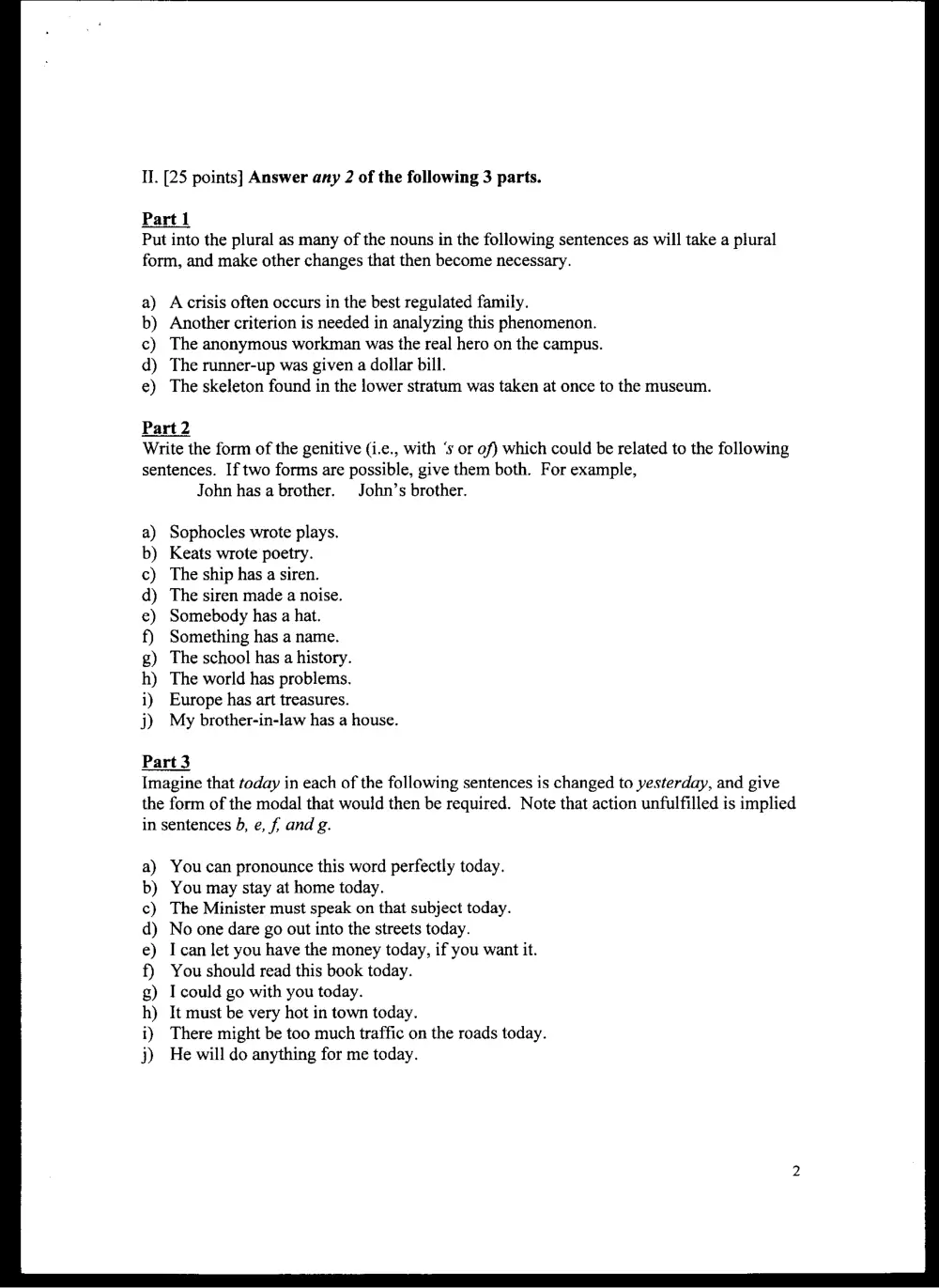
II. [25 points] Answer any 2 of the following 3 parts.
Part 1
Put into the plural as many of the nouns in the following sentences as will take a plural
form, and make other changes that then become necessary.
a) Accrisis often occurs in the best regulated family.
b) Another criterion is needed in analyzing this phenomenon.
c) The anonymous workman was the real hero on the campus.
d) The runner-up was given a dollar bill.
e) The skeleton found in the lower stratum was taken at once to the museum.
Part 2
Write the form of the genitive (i.e., with ‘s or of) which could be related to the following
sentences. If two forms are possible, give them both. For example,
John has a brother. John’s brother.
a) Sophocles wrote plays.
b) Keats wrote poetry.
c) The ship has a siren.
d) The siren made a noise.
e) Somebody has a hat.
f) Something has a name.
g) The school has a history.
h) The world has problems.
i) Europe has art treasures.
j) My brother-in-law has a house.
Part 3
Imagine that feday in each of the following sentences is changed to yesterday, and give
the form of the modal that would then be required. Note that action unfulfilled is implied
in sentences 5, e, f, and g.
a) You can pronounce this word perfectly today.
b) You may stay at home today.
c) The Minister must speak on that subject today.
d) No one dare go out into the streets today.
e) I can let you have the money today, if you want it.
f) You should read this book today.
g) I could go with you today.
h) It must be very hot in town today.
i) There might be too much traffic on the roads today.
j) He will do anything for me today.
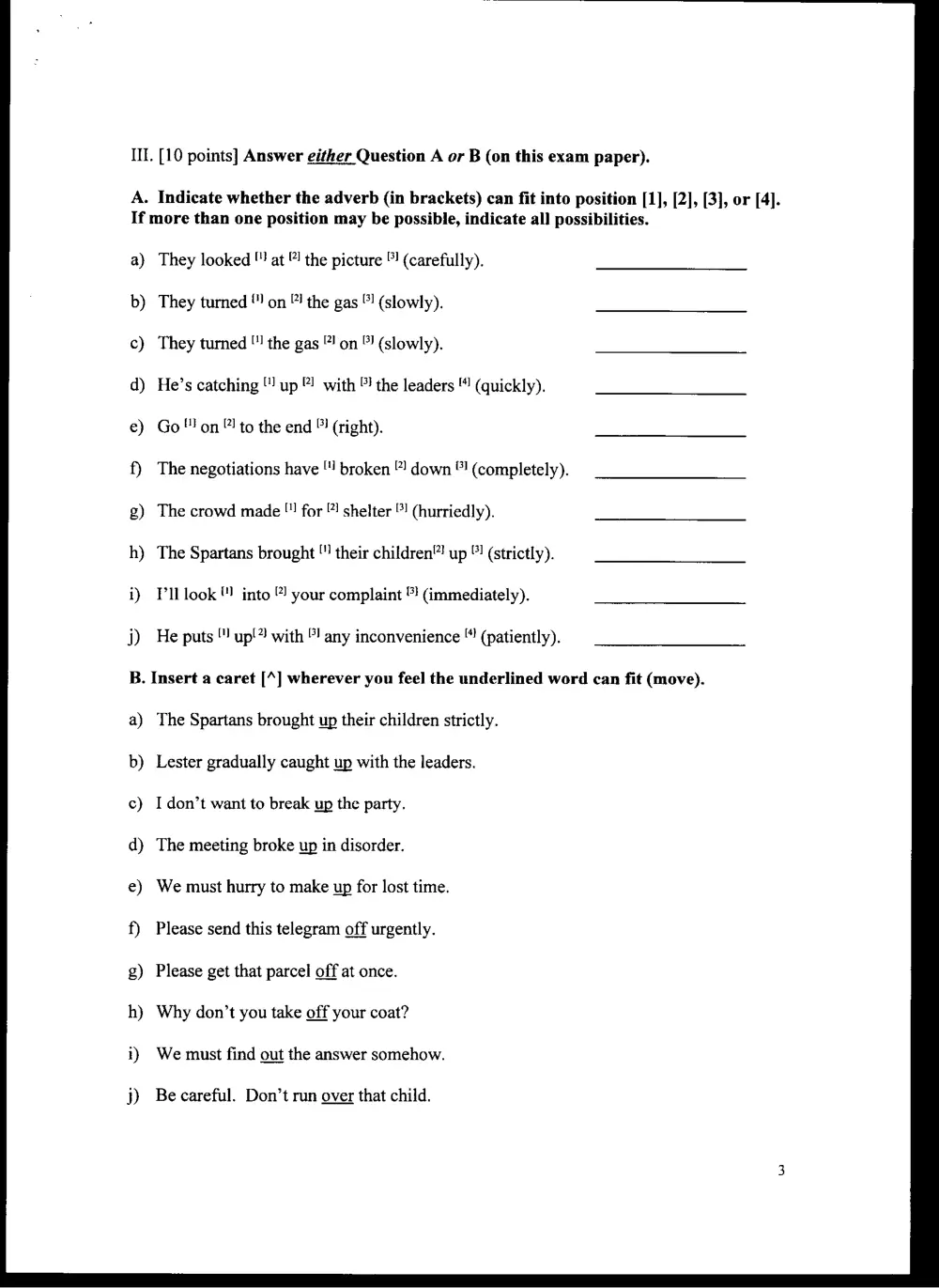
III. [10 points] Answer either Question A or B (on this exam paper).
A. Indicate whether the adverb (in brackets) can fit into position [1], [2], [3], or [4].
If more than one position may be possible, indicate all possibilities.
a) They looked "! at "! the picture ©! (carefully).
b) They turned on ! the gas "! (slowly).
c) They turned "! the gas ?! on ©! (slowly).
d) He’s catching"! up ®! with ©! the leaders ™! (quickly).
e) Go!" on”! to the end ®! (right).
f) The negotiations have '! broken ®! down ©! (completely).
g) The crowd made "! for?! shelter ! (hurriedly).
h) The Spartans brought ™ their children”! up ©! (strictly).
i) Pll look" into ?! your complaint ©} (immediately).
j) He puts "! up! with °! any inconvenience “! (patiently).
B. Insert a caret [*] wherever you feel the underlined word can fit (move).
a) The Spartans brought up their children strictly.
b) Lester gradually caught up with the leaders.
c) I don’t want to break up the party.
d) The meeting broke up in disorder.
e) We must hurry to make up for lost time.
f) Please send this telegram off urgently.
Please get that parcel off at once.
Why don’t you take off your coat?
We must find out the answer somehow.
Be careful. Don’t run over that child.
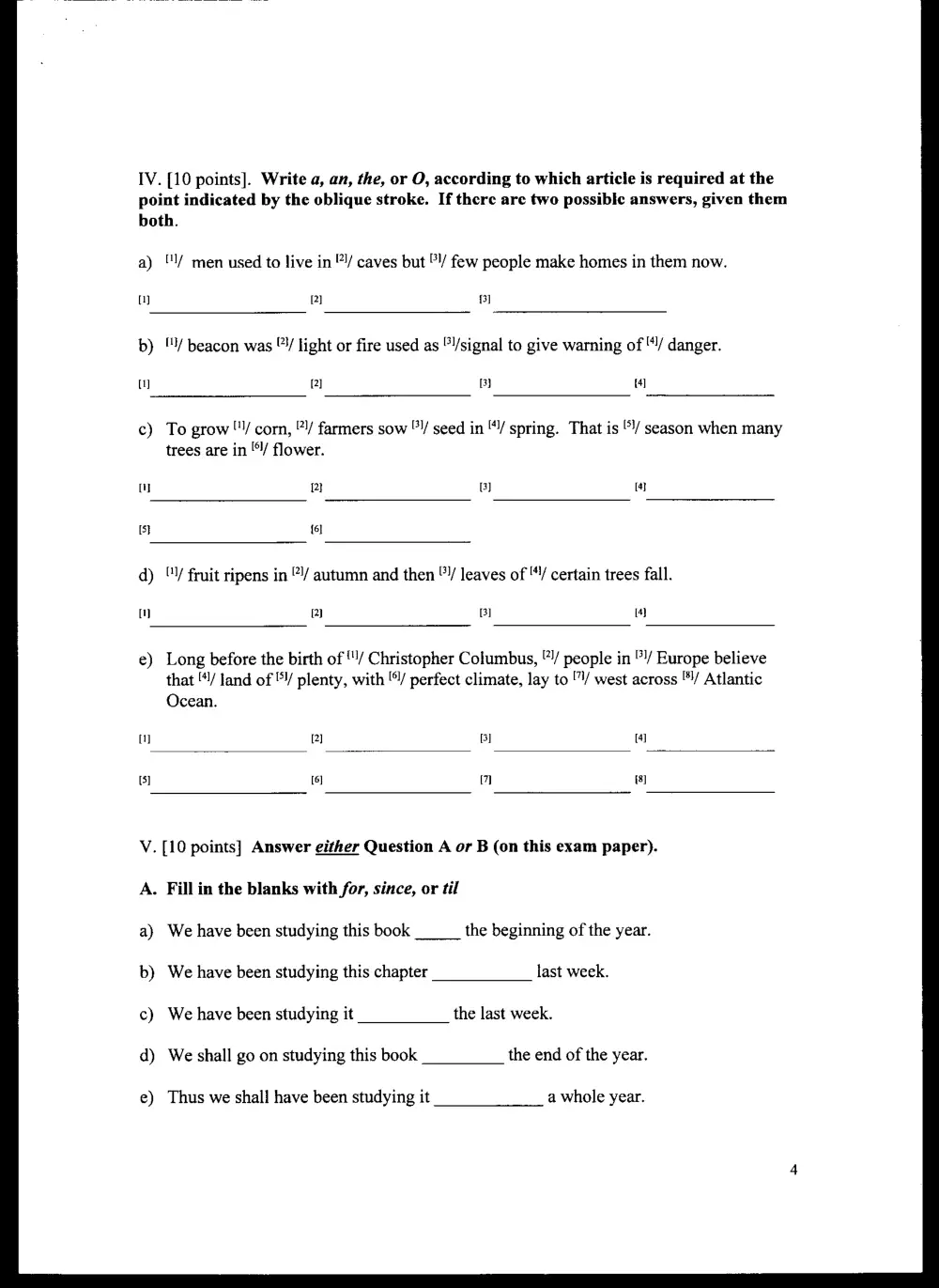
IV. [10 points]. Write a, an, the, or O, according to which article is required at the
point indicated by the oblique stroke. If there are two possible answers, given them
both.
a) "I/ men used to live in ”/ caves but °!/ few people make homes in them now.
0) 2] 3]
b) " beacon was ”/ light or fire used as "/signal to give warning of “!/ danger.
0) [2] 13) 4]
c) To grow"! corn, "!/ farmers sow °!/ seed in “!/ spring. That is '*!/ season when many
trees are in "!/ flower.
( (2) GB) [4]
(5} {6]
d) "Y fruit ripens in ?/ autumn and then "!/ leaves of “Y certain trees fall.
iu] R) B] (4)
e) Long before the birth of '"/ Christopher Columbus, "! people in "/ Europe believe
that '!/ land of © plenty, with '"/ perfect climate, lay to "!/ west across "!/ Atlantic
Ocean.
0] Q] B] 4]
(5] [6] i] [8]
V. [10 points] Answer either Question A or B (on this exam paper).
A. Fill in the blanks with for, since, or til
a) We have been studying this book the beginning of the year.
b) We have been studying this chapter last week.
c) We have been studying it the last week.
d) We shall go on studying this book the end of the year.
e) Thus we shall have been studying it a whole year.
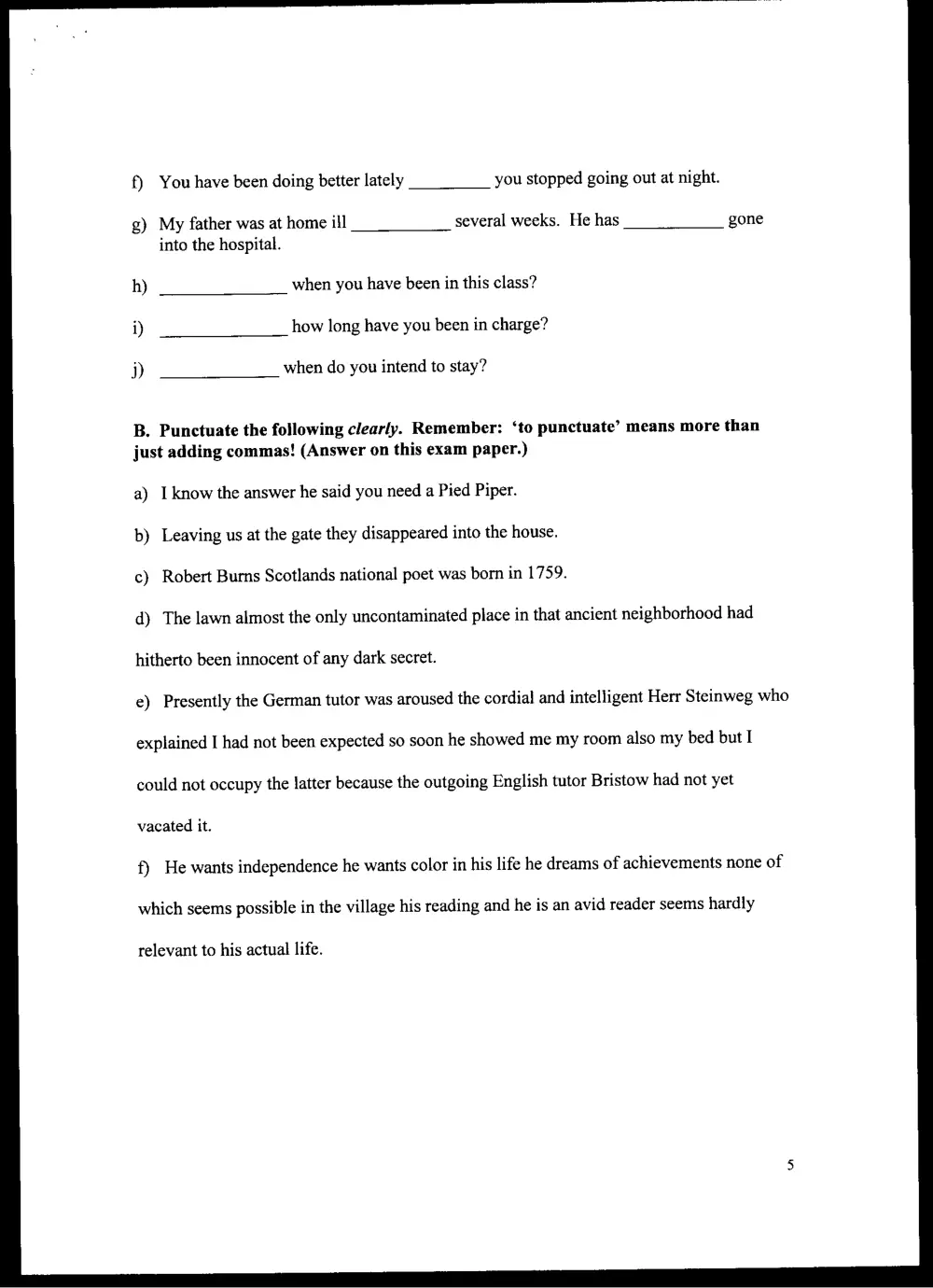
f) You have been doing better lately you stopped going out at night.
g) My father was at home ill several weeks. He has gone
into the hospital.
h) when you have been in this class?
i) how long have you been in charge?
j) when do you intend to stay?
B. Punctuate the following clearly. Remember: ‘to punctuate’ means more than
just adding commas! (Answer on this exam paper.)
a) I know the answer he said you need a Pied Piper.
b) Leaving us at the gate they disappeared into the house.
c) Robert Burns Scotlands national poet was born in 1759.
d) The lawn almost the only uncontaminated place in that ancient neighborhood had
hitherto been innocent of any dark secret.
e) Presently the German tutor was aroused the cordial and intelligent Herr Steinweg who
explained I had not been expected so soon he showed me my room also my bed but I
could not occupy the latter because the outgoing English tutor Bristow had not yet
vacated it.
f) He wants independence he wants color in his life he dreams of achievements none of
which seems possible in the village his reading and he is an avid reader seems hardly
relevant to his actual life.
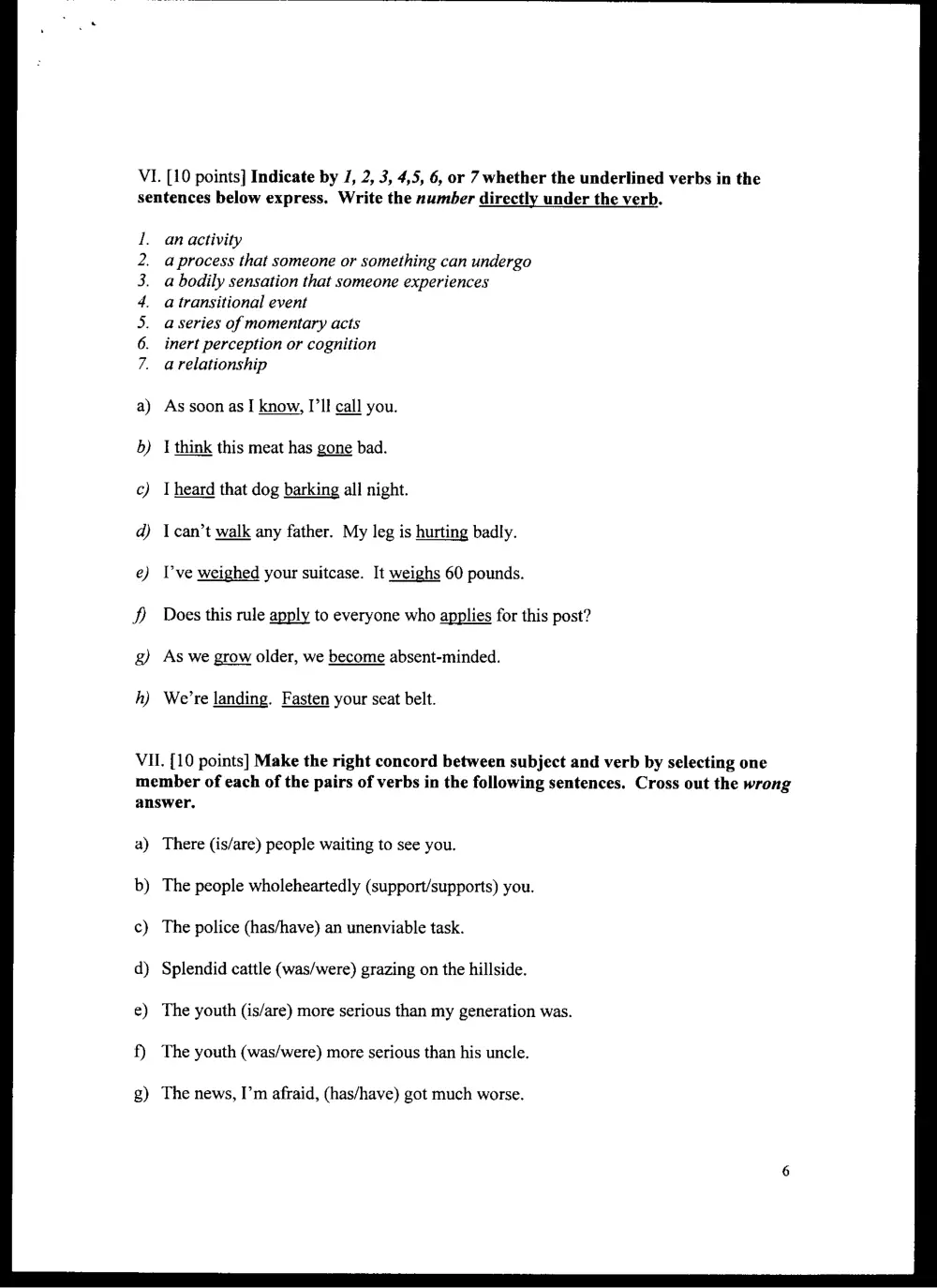
VI. [10 points] Indicate by /, 2, 3, 4,5, 6, or 7 whether the underlined verbs in the
sentences below express. Write the number directly under the verb.
an activity
a process that someone or something can undergo
a bodily sensation that someone experiences
a transitional event
a series of momentary acts
inert perception or cognition
a relationship
As soon as I know, I’ II call you.
I think this meat has gone bad.
I heard that dog barking all night.
I can’t walk any father. My leg is hurting badly.
I’ve weighed your suitcase. It weighs 60 pounds.
Does this rule apply to everyone who applies for this post?
g) As we grow older, we become absent-minded.
h) We’re landing, Fasten your seat belt.
VII. [10 points] Make the right concord between subject and verb by selecting one
member of each of the pairs of verbs in the following sentences. Cross out the wrong
answer.
a) There (is/are) people waiting to see you.
b) The people wholeheartedly (support/supports) you.
c) The police (has/have) an unenviable task.
d) Splendid cattle (was/were) grazing on the hillside.
e) The youth (is/are) more serious than my generation was.
f) The youth (was/were) more serious than his uncle.
The news, I’m afraid, (has/have) got much worse.
h) The acoustics of this hall (is/are) excellent.
i) The archives of this society (is/are) kept in the basement.
j) Bacteria of the harmful kind (cause/causes) disease.