
ENG 231 Final, Fall 2003
American University of Beirut · Modern English Grammar · 2 pages
More ENG 231 files
Show the text of this final exam
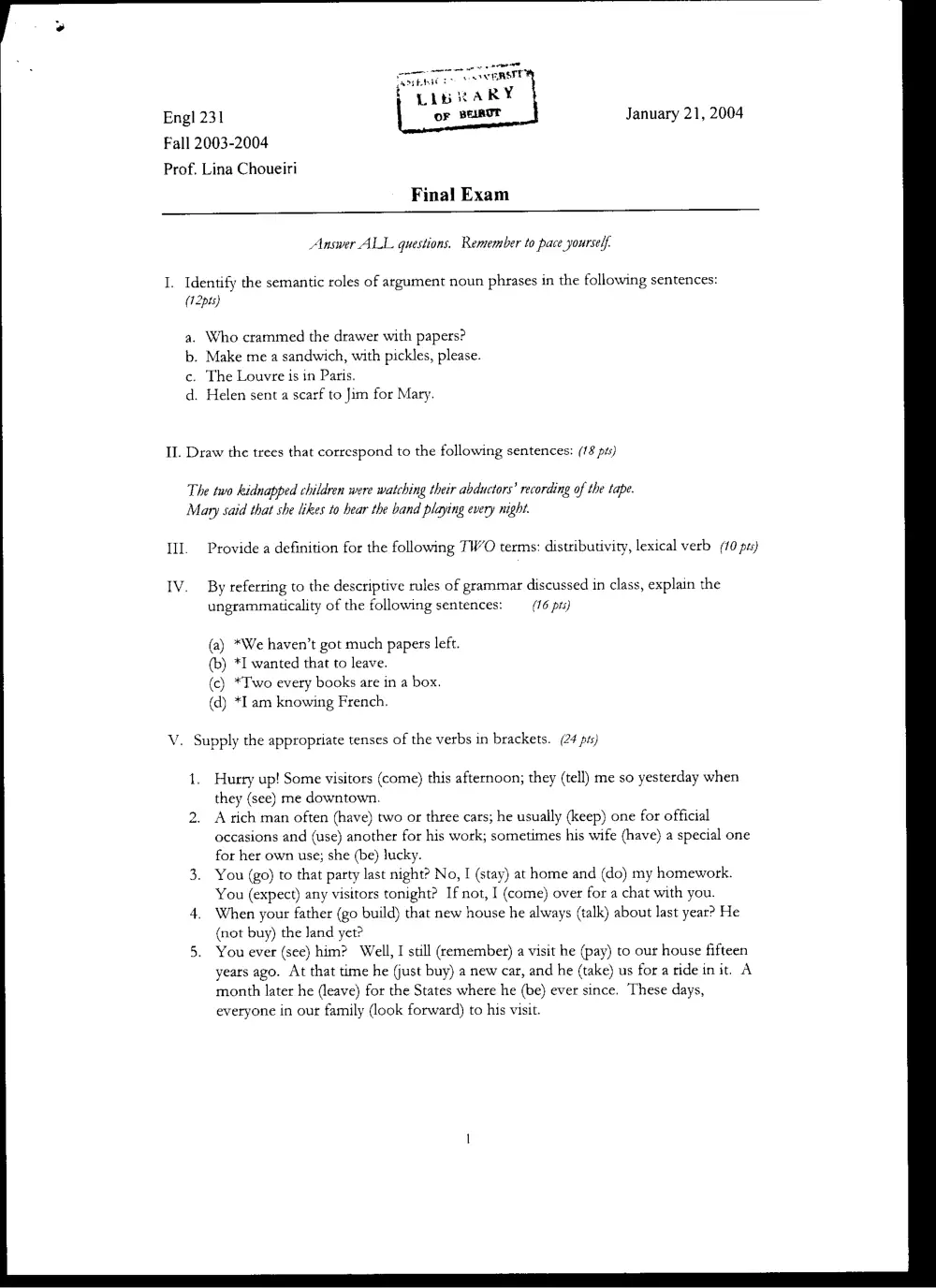
Engl 231
Fall 2003-2004
Prof. Lina Choueiri
January 21, 2004
Final Exam
Answer ALL questions. Remember to pace yourself:
I. Identify the semantic roles of argument noun phrases in the following sentences:
(12pts)
a. Who crammed the drawer with papers?
b. Make me a sandwich, with pickles, please.
c. The Louvre is in Paris.
d. Helen sent a scarf to Jim for Mary.
IL. Draw the trees that correspond to the following sentences: (18 py)
The two kidnapped children were watching their abductors’ recording of the tape.
Mary said that she likes to hear the band playing every night.
Ill. Provide a definition for the following TWO terms: distributivity, lexical verb (10 pts)
IV. By referring to the descriptive rules of grammar discussed in class, explain the
ungrammaticality of the following sentences: (16 pts)
(a) *We haven’t got much papers left.
(b) *I wanted that to leave.
(c) *Two every books are in a box.
(d) *1 am knowing French.
V. Supply the appropriate tenses of the verbs in brackets. (24 pss)
1. Hurry up! Some visitors (come) this afternoon; they (tell) me so yesterday when
they (see) me downtown.
2. A rich man often (have) two or three cars; he usually (keep) one for official
occasions and (use) another for his work; sometimes his wife (have) a special one
for her own use; she (be) lucky.
3. You (go) to that party last night? No, I (stay) at home and (do) my homework.
You (expect) any visitors tonight? If not, I (come) over for a chat with you.
4. When your father (go build) that new house he always (talk) about last year? He
(not buy) the land yet?
5. You ever (see) him? Well, I still (temember) a visit he (pay) to our house fifteen
years ago. At that time he (just buy) a new car, and he (take) us for a ride in it. A
month later he (leave) for the States where he (be) ever since. These days,
everyone in out family (look forward) to his visit.
VI.
Liew. KY.
OF SEIRDT
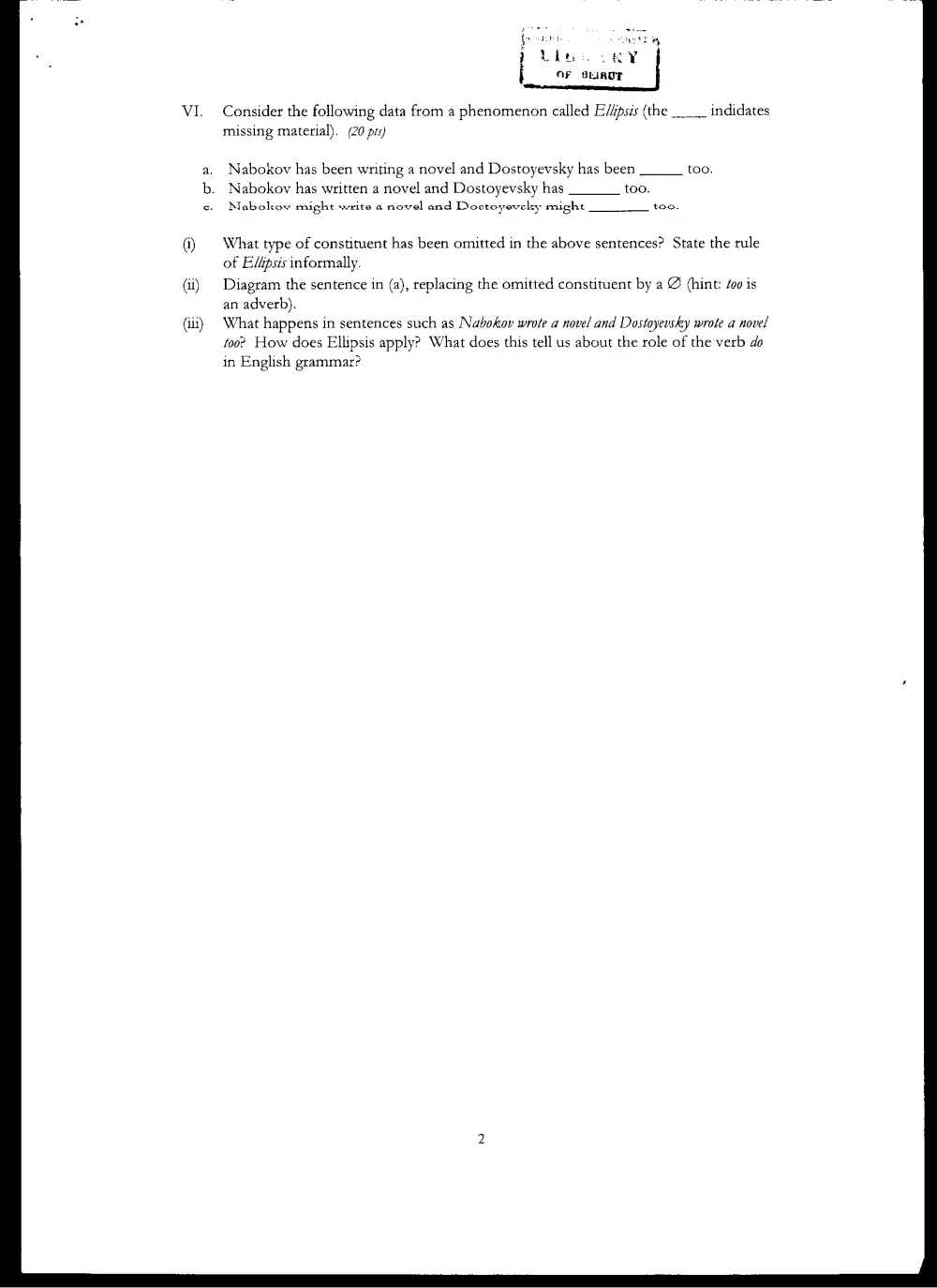
Consider the following data from a phenomenon called E/ipsis (the indidates
missing material). (20 prs)
Nabokov has been writing a novel and Dostoyevsky has been too.
Nabokov has written a novel and Dostoyevsky has too.
Mabokov might write a novel and Doctoyevehy might too.
What type of constituent has been omitted in the above sentences? State the rule
of Edipsis informally.
Diagram the sentence in (a), replacing the omitted constituent by a © (hint: vo is
an adverb).
What happens in sentences such as Nabokov wrote a novel and Dostoyevsky wrote a novel
too? How does Ellipsis apply? What does this tell us about the role of the verb do
in English grammar?