
ENG 235 Final, Fall 2007
American University of Beirut · Politics of Language · 2 pages
More ENG 235 files
Show the text of this final exam
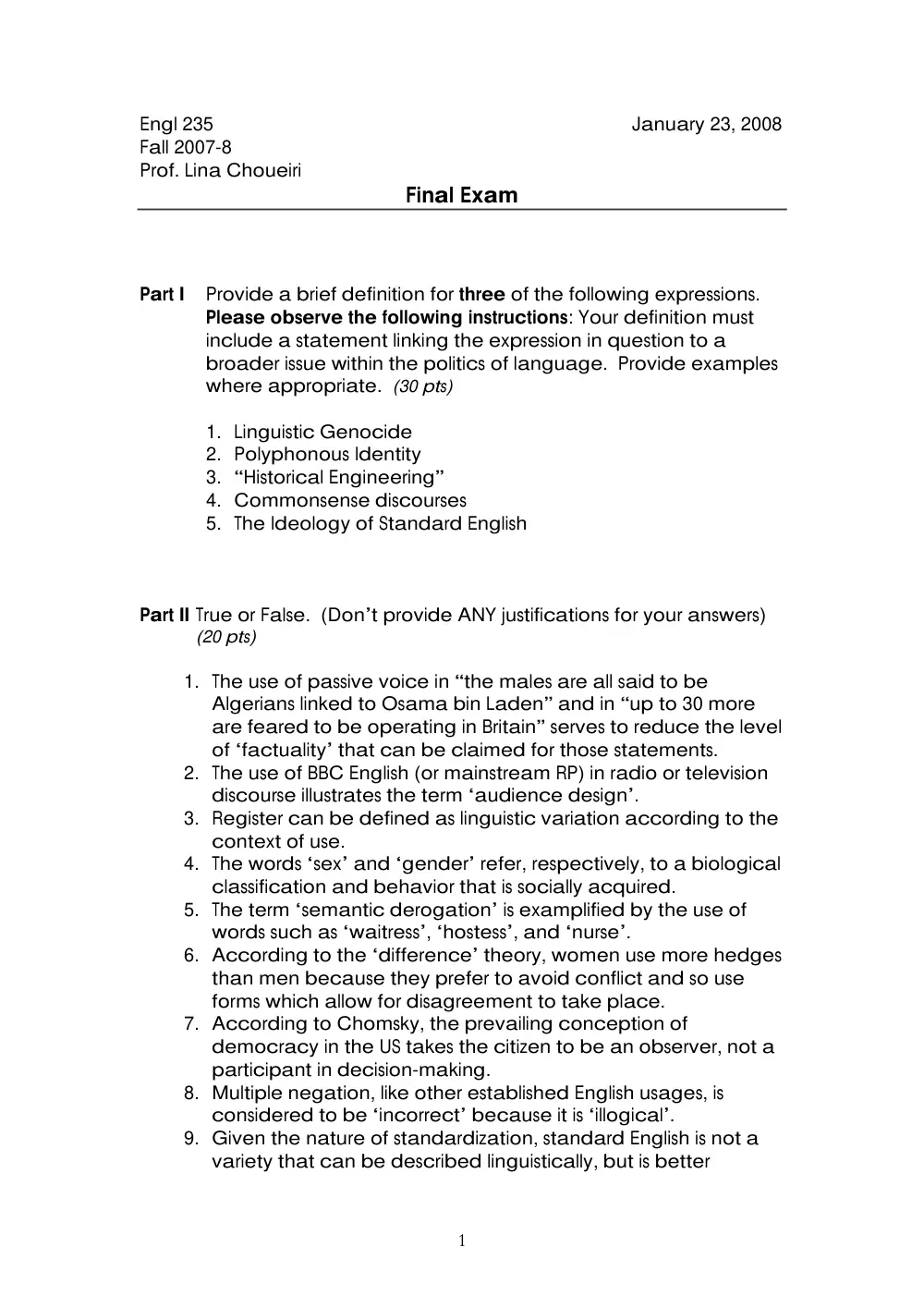
Engl 235
January 23, 2008
Fall 2007-8
Prof. Lina Choueiri
Final Exam
Part I
Provide a brief definition for three of the following expressions.
Please observe the following instructions: Your definition must
include a statement linking the expression in question to a
broader issue within the politics of language. Provide examples
where appropriate. (30 pts)
1. Linguistic Genocide
2. Polyphonous Identity
3. “Historical Engineering”
4. Commonsense discourses
5. The Ideology of Standard English
Part II True or False. (Don’t provide ANY justifications for your answers)
(20 pts)
1. The use of passive voice in “the males are all said to be
Algerians linked to Osama bin Laden” and in “up to 30 more
are feared to be operating in Britain” serves to reduce the level
of ‘factuality’ that can be claimed for those statements.
2. The use of BBC English (or mainstream RP) in radio or television
discourse illustrates the term ‘audience design’.
3. Register can be defined as linguistic variation according to the
context of use.
4. The words ‘sex’ and ‘gender’ refer, respectively, to a biological
classification and behavior that is socially acquired.
5. The term ‘semantic derogation’ is examplified by the use of
words such as ‘waitress’, ‘hostess’, and ‘nurse’.
6. According to the ‘difference’ theory, women use more hedges
than men because they prefer to avoid conflict and so use
forms which allow for disagreement to take place.
7. According to Chomsky, the prevailing conception of
democracy in the US takes the citizen to be an observer, not a
participant in decision-making.
8. Multiple negation, like other established English usages, is
considered to be ‘incorrect’ because it is ‘illogical’.
9. Given the nature of standardization, standard English is not a
variety that can be described linguistically, but is better
1
2
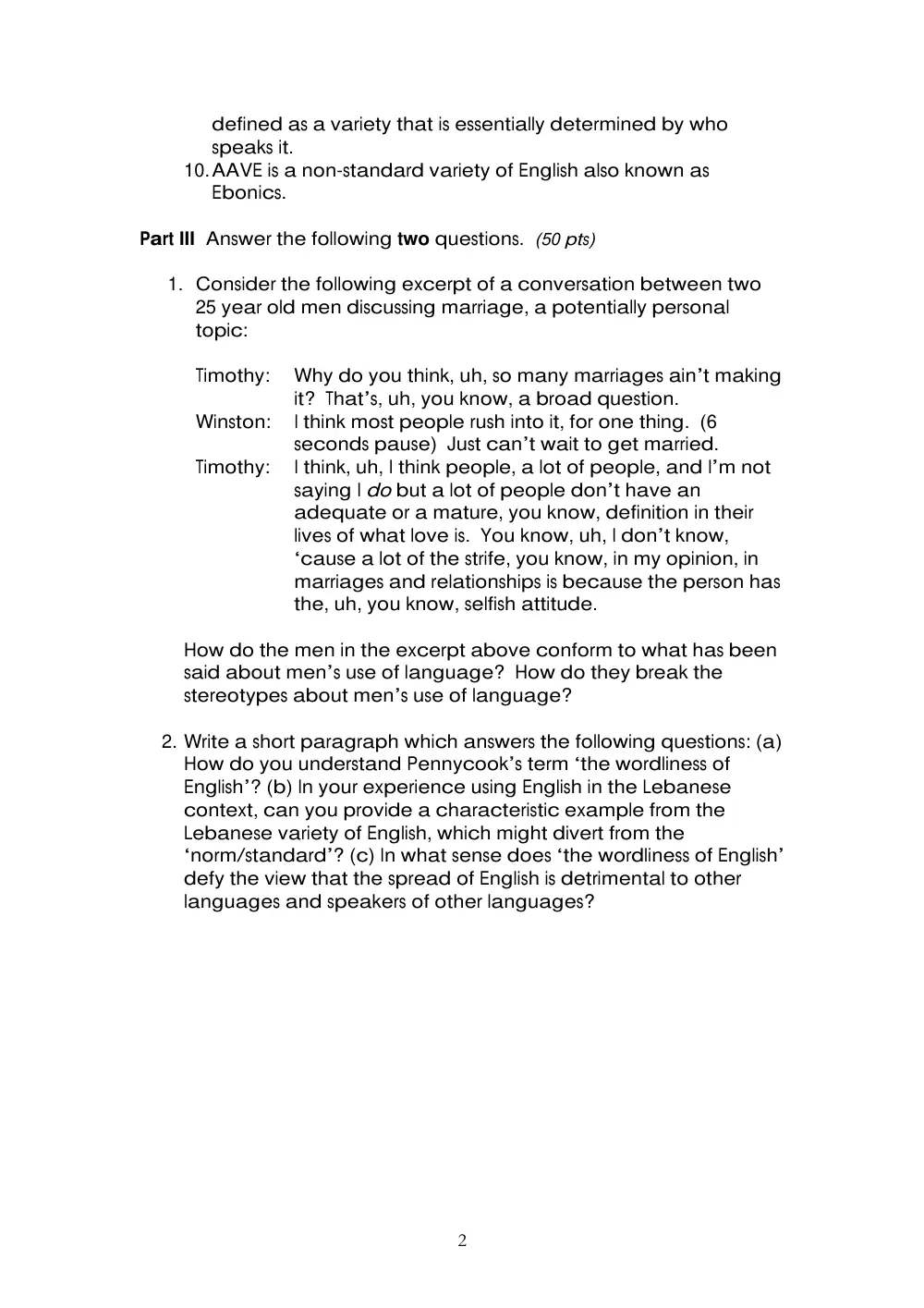
defined as a variety that is essentially determined by who
speaks it.
10. AAVE is a non-standard variety of English also known as
Ebonics.
Part III Answer the following two questions. (50 pts)
1. Consider the following excerpt of a conversation between two
25 year old men discussing marriage, a potentially personal
topic:
Timothy:
Why do you think, uh, so many marriages ain’t making
it? That’s, uh, you know, a broad question.
Winston:
I think most people rush into it, for one thing. (6
seconds pause) Just can’t wait to get married.
Timothy:
I think, uh, I think people, a lot of people, and I’m not
saying I do but a lot of people don’t have an
adequate or a mature, you know, definition in their
lives of what love is. You know, uh, I don’t know,
‘cause a lot of the strife, you know, in my opinion, in
marriages and relationships is because the person has
the, uh, you know, selfish attitude.
How do the men in the excerpt above conform to what has been
said about men’s use of language? How do they break the
stereotypes about men’s use of language?
2. Write a short paragraph which answers the following questions: (a)
How do you understand Pennycook’s term ‘the wordliness of
English’? (b) In your experience using English in the Lebanese
context, can you provide a characteristic example from the
Lebanese variety of English, which might divert from the
‘norm/standard’? (c) In what sense does ‘the wordliness of English’
defy the view that the spread of English is detrimental to other
languages and speakers of other languages?