
ENG 247 Final, Fall 2002
American University of Beirut · Discourse Analysis · 2 pages

More ENG 247 files
Show the text of this final exam
English 247: Discourse Analysis
Fall 2002-2003
Dr. R. Diab
FINAL EXAM (Time: 3 hours)
Provide an appropriate definition for each of the following expressions.
(26 points)
1. Utterance incompleter
2. Commissive speech act
3. Austin’s felicity conditions
4. Gricean maxim of quality
5. Incompletion marker
6. Expressive speech act
7. Gricean maxim of manner
8. Dispreferred seconds
9. Speech exchange system
10. Contextualization cue
Il. Answer the two following questions concerning Conversation Analysis:
(15 points)
1. What does Sacks suggest concerning degrees of control in turn-taking and
how does he explain the low incidence of overlap and silence (compared
to continuous speech) in spoken discourse?
Describe and give examples of three techniques speakers may use to “keep
the floor” in a conversation. Also discuss two possible techniques for non-
speakers who wish to speak and are not offered the floor and one
technique for non-speakers who are offered the floor but who do not wish
to speak.
In your opinion, do Sacks’ conversational techniques and Grice’s maxims
of conversation apply universally? In other words, would individuals from
different cultural backgrounds share similar assumptions concerning turn-
taking, interruption, back channeling, body language...ete.? Discuss,
supporting your argument with examples. (15 points)
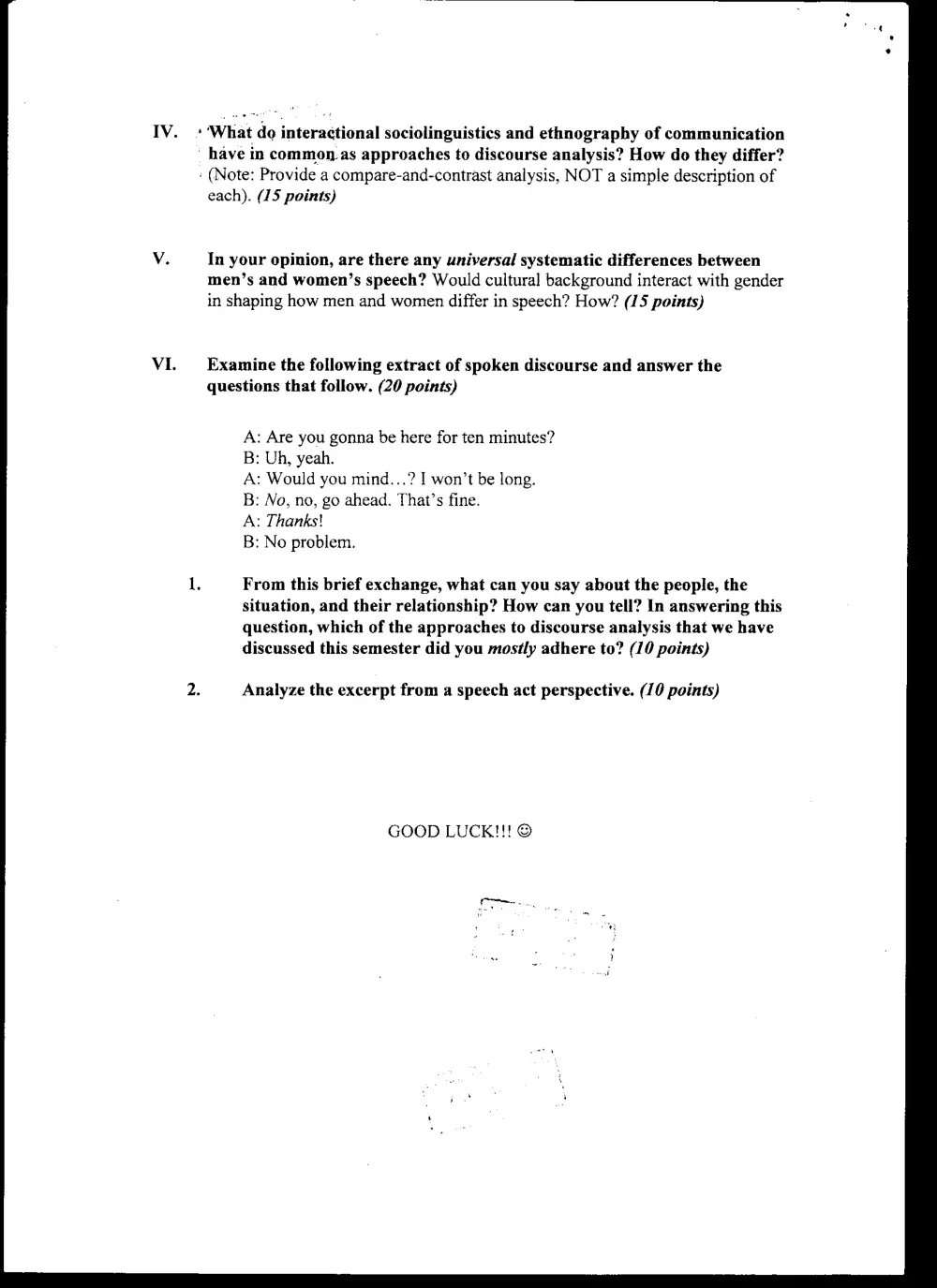
IV. + ‘What do interactional sociolinguistics and ethnography of communication
have in common.as approaches to discourse analysis? How do they differ?
: (Note: Provide a compare-and-contrast analysis, NOT a simple description of
each). (15 points)
V. In your opinion, are there any universal systematic differences between
men’s and women’s speech? Would cultural background interact with gender
in shaping how men and women differ in speech? How? (15 points)
VI. Examine the following extract of spoken discourse and answer the
questions that follow. (20 points)
A: Are you gonna be here for ten minutes?
B: Uh, yeah.
A: Would you mind...? I won’t be long.
B: No, no, go ahead. That’s fine.
A: Thanks!
B: No problem.
1. From this brief exchange, what can you say about the people, the
situation, and their relationship? How can you tell? In answering this
question, which of the approaches to discourse analysis that we have
discussed this semester did you mostly adhere to? (10 points)
2. Analyze the excerpt from a speech act perspective. (/0 points)
GOOD LUCK!!! ©
pe