
ENG 247 Final, Fall 2003
American University of Beirut · Discourse Analysis · 2 pages

More ENG 247 files
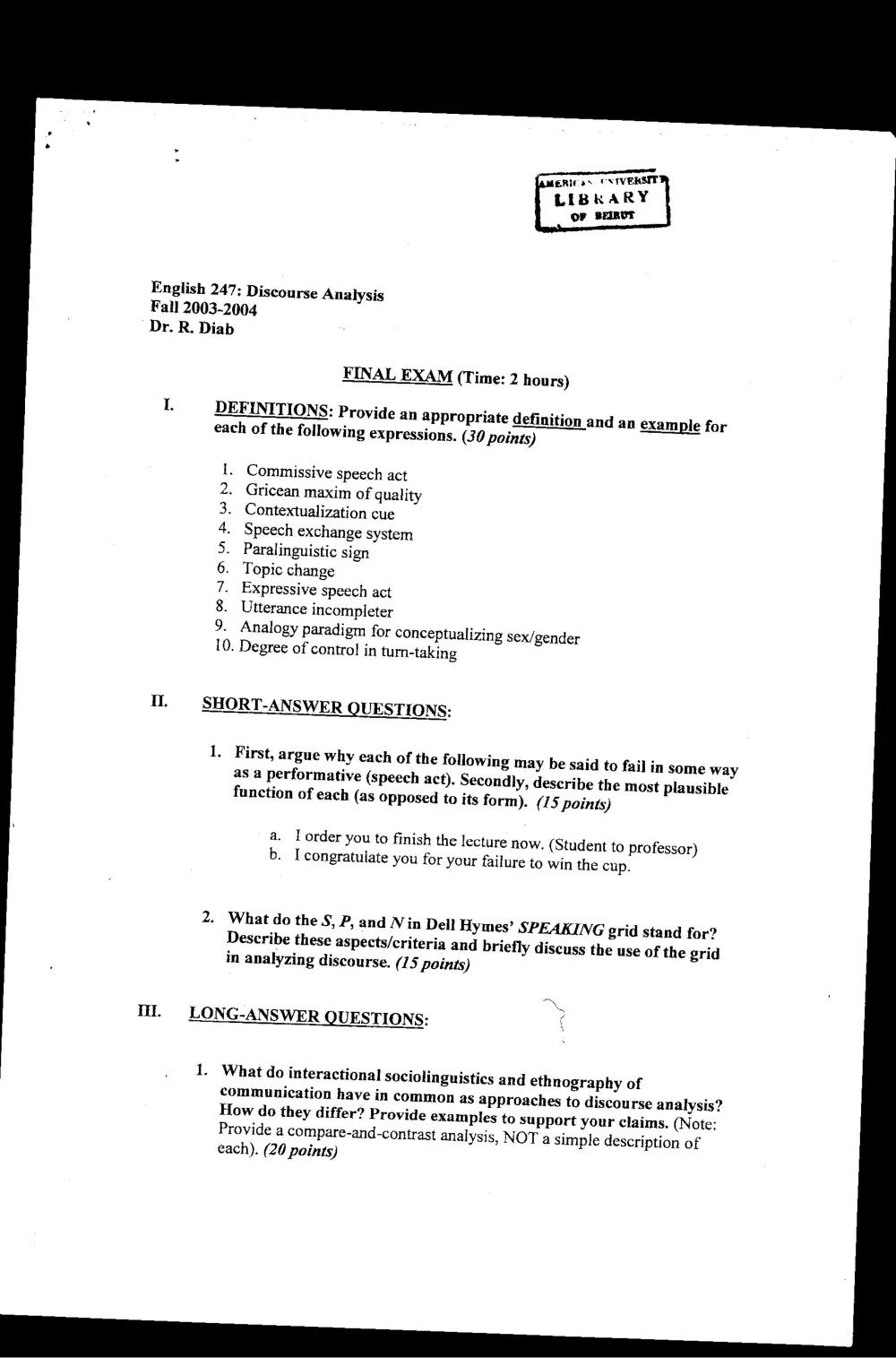
Show the text of this final exam
ER os CNIVERSIT
LIBKARY
OF BEIRUT
English 247; Discourse Analysis
Fall 2003-2004
Dr. R. Diab
FINAL EXAM (Time: 2 hours)
I. DEFINITIONS: Provide an appropriate definition and an example for
each of the following expressions. (39 points)
lL.
2. Gricean maxim of quality
3.
9
1
0.
Commissive speech act
Contextualization cue
4. Speech exchange system
5. Paralinguistic sign
6.
7
8
Topic change
- Expressive speech act
- Utterance incompleter
Analogy paradigm for conceptualizing sex/gender
Degree of contro! in turn-taking
1. SHORT-ANSWER QUESTIONS:
1. First, argue why each of the following may be said to fail in some way
il. LONG-ANSWER QUESTIONS:
as a performative (speech act). Secondly, describe the most plausible
function of each (as Opposed to its form). (15 points)
a. T order you to finish the lecture now. (Student to professor)
b. I congratulate you for your failure to win the cup.
What do the S, P, and N in Dell Hymes’ SPEAKING grid stand for?
Describe these aspects/criteria and briefly discuss the use of the grid
in analyzing discourse. (15 points)
~
each). (20 points)
2. Choose ONE of the two following questions (20 points):
a. What is women’s language? What did feminist linguist Robin Lakoff
suggest concerning the development and shaping of women’s
language? (i.e. how a girl learns how to “speak like a girl”). What is
Deborah Tannen’s view concerning this issue? What is your own
opinion?
. In your opinion, are there any universal systematic differences
between men’s and women’s speech? Would cultural background
interact with gender in shaping how men and women differ in speech?
How? (In answering this question, it might help to think about a
hypothetical gender and discourse study set in the Lebanese context as
opposed to a typical Lakoff study of “white, relatively privileged
Anglophone US suburbanites”).
GOOD LUCK!!! ©