
ENMG 400 Problems, Spring 2011
American University of Beirut · Engineering Economy · 303 pages



Showing the first 10 of 303 pages. Download the PDF to see all of it.
More ENMG 400 files
Show the text of this problems
Chapter 1
1
PROPRIETARY MATERIAL. © The McGraw-Hill Companies, Inc. All rights reserved. No part of this Manual may be
displayed, reproduced or distributed in any form or by any means, without the prior written permission of the publisher, or used
beyond the limited distribution to teachers and educators permitted by McGraw-Hill for their individual course preparation. If you are
a student using this Manual, you are using it without permission.
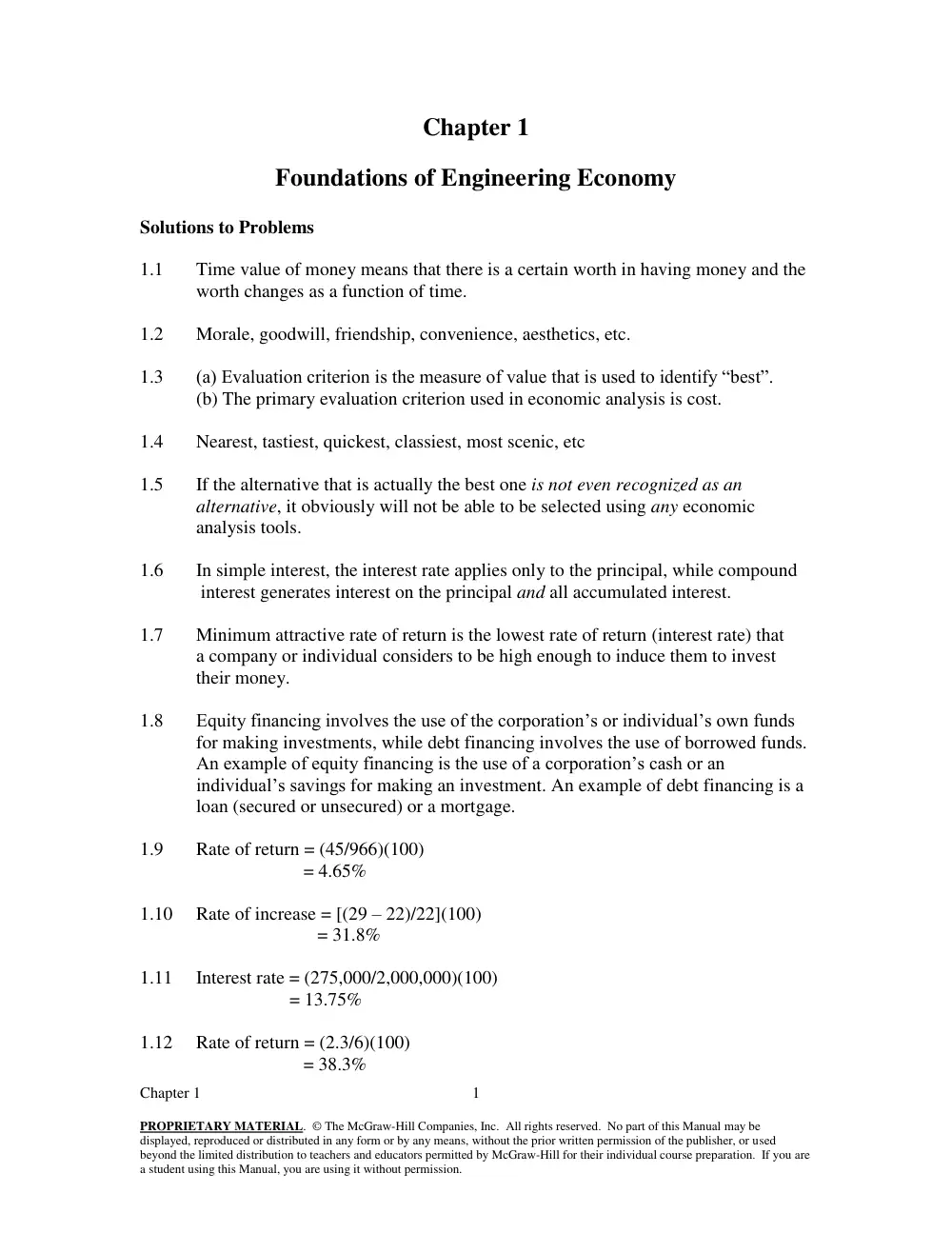
Chapter 1
Foundations of Engineering Economy
Solutions to Problems
1.1
Time value of money means that there is a certain worth in having money and the
worth changes as a function of time.
1.2
Morale, goodwill, friendship, convenience, aesthetics, etc.
1.3
(a) Evaluation criterion is the measure of value that is used to identify “best”.
(b) The primary evaluation criterion used in economic analysis is cost.
1.4
Nearest, tastiest, quickest, classiest, most scenic, etc
1.5
If the alternative that is actually the best one is not even recognized as an
alternative, it obviously will not be able to be selected using any economic
analysis tools.
1.6
In simple interest, the interest rate applies only to the principal, while compound
interest generates interest on the principal and all accumulated interest.
1.7
Minimum attractive rate of return is the lowest rate of return (interest rate) that
a company or individual considers to be high enough to induce them to invest
their money.
1.8
Equity financing involves the use of the corporation’s or individual’s own funds
for making investments, while debt financing involves the use of borrowed funds.
An example of equity financing is the use of a corporation’s cash or an
individual’s savings for making an investment. An example of debt financing is a
loan (secured or unsecured) or a mortgage.
1.9
Rate of return = (45/966)(100)
= 4.65%
1.10 Rate of increase = [(29 – 22)/22](100)
= 31.8%
1.11 Interest rate = (275,000/2,000,000)(100)
= 13.75%
1.12 Rate of return = (2.3/6)(100)
= 38.3%
Chapter 1
2
PROPRIETARY MATERIAL. © The McGraw-Hill Companies, Inc. All rights reserved. No part of this Manual may be
displayed, reproduced or distributed in any form or by any means, without the prior written permission of the publisher, or used
beyond the limited distribution to teachers and educators permitted by McGraw-Hill for their individual course preparation. If you are
a student using this Manual, you are using it without permission.
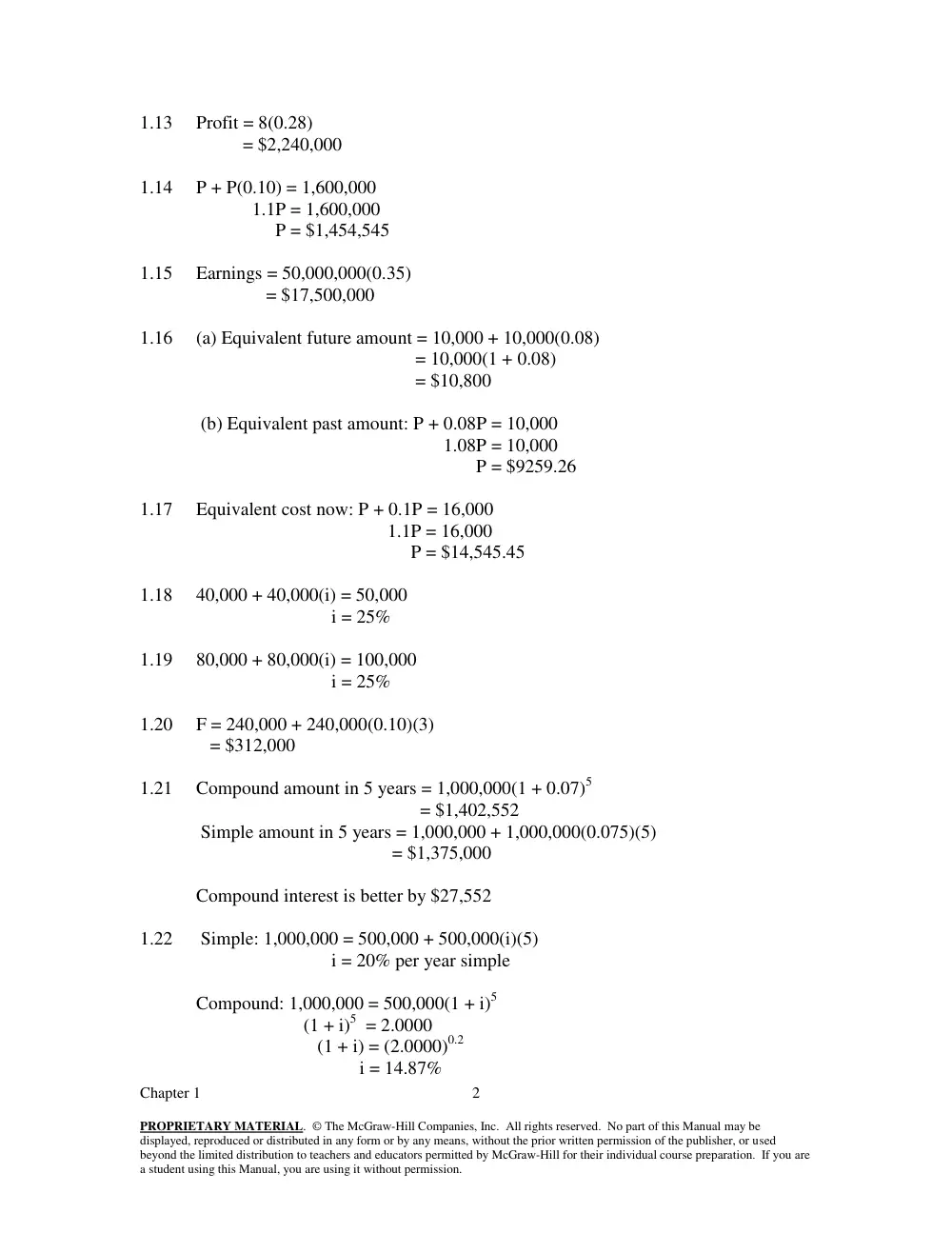
1.13 Profit = 8(0.28)
= $2,240,000
1.14 P + P(0.10) = 1,600,000
1.1P = 1,600,000
P = $1,454,545
1.15 Earnings = 50,000,000(0.35)
= $17,500,000
1.16
(a) Equivalent future amount = 10,000 + 10,000(0.08)
= 10,000(1 + 0.08)
= $10,800
(b) Equivalent past amount: P + 0.08P = 10,000
1.08P = 10,000
P = $9259.26
1.17
Equivalent cost now: P + 0.1P = 16,000
1.1P = 16,000
P = $14,545.45
1.18
40,000 + 40,000(i) = 50,000
i = 25%
1.19
80,000 + 80,000(i) = 100,000
i = 25%
1.20
F = 240,000 + 240,000(0.10)(3)
= $312,000
1.21 Compound amount in 5 years = 1,000,000(1 + 0.07)5
= $1,402,552
Simple amount in 5 years = 1,000,000 + 1,000,000(0.075)(5)
= $1,375,000
Compound interest is better by $27,552
1.22
Simple: 1,000,000 = 500,000 + 500,000(i)(5)
i = 20% per year simple
Compound: 1,000,000 = 500,000(1 + i)5
(1 + i)5 = 2.0000
(1 + i) = (2.0000)0.2
i = 14.87%
Chapter 1
3
PROPRIETARY MATERIAL. © The McGraw-Hill Companies, Inc. All rights reserved. No part of this Manual may be
displayed, reproduced or distributed in any form or by any means, without the prior written permission of the publisher, or used
beyond the limited distribution to teachers and educators permitted by McGraw-Hill for their individual course preparation. If you are
a student using this Manual, you are using it without permission.
1.23
Simple: 2P = P + P(0.05)(n)
P = P(0.05)(n)
n = 20 years
Compound:
2P = P(1 + 0.05)n
(1 + 0.05)n = 2.0000
n = 14.2 years
1.24
(a) Simple: 1,300,000 = P + P(0.15)(10)
2.5P = 1,300,000
P = $520,000
(b) Compound: 1,300,000 = P(1 + 0.15)10
4.0456P = 1,300,000
P = $321,340
1.25
Plan 1: Interest paid each year = 400,000(0.10)
= $40,000
Total paid = 40,000(3) + 400,000
= $520,000
Plan 2: Total due after 3 years = 400,000(1 + 0.10)3
= $532,400
Difference paid = 532,400 – 520,000
= $12,400
1.26
(a) Simple interest total amount = 1,750,000(0.075)(5)
= $656,250
Compound interest total = total amount due after 4 years – amount borrowed
= 1,750,000(1 + 0.08)4 – 1,750,000
= 2,380856 – 1,750,000
= $630,856
(b) The company should borrow 1 year from now for a savings of $656,250 –
$630,856 = $25,394
1.27
The symbols are F = ?; P = $50,000; i = 15%; n = 3
1.28
(a) FV(i%,n,A,P) finds the future value, F
(b) IRR(first_cell:last_cell) finds the compound interest rate, i
(c) PMT(i%,n,P,F) finds the equal periodic payment, A
(d) PV(i%,n,A,F) finds the present value, P
Chapter 1
4
PROPRIETARY MATERIAL. © The McGraw-Hill Companies, Inc. All rights reserved. No part of this Manual may be
displayed, reproduced or distributed in any form or by any means, without the prior written permission of the publisher, or used
beyond the limited distribution to teachers and educators permitted by McGraw-Hill for their individual course preparation. If you are
a student using this Manual, you are using it without permission.
1.29 (a) F = ?; i = 7%; n = 10; A = $2000; P = $9000
(b) A = ?; i = 11%; n = 20; P = $14,000; F = 0
(c) P = ?; i = 8%; n = 15; A = $1000; F = $800
1.30 (a) PV = P (b) PMT = A (c) NPER = n (d) IRR = i (e) FV = F
1.31 For built-in Excel functions, a parameter that does not apply can be left blank
when it is not an interior one. For example, if there is no F involved when using
the PMT function to solve a particular problem, it can be left blank because it is
an end function. When the function involved is an interior one (like P in the PMT
function), a comma must be put in its position.
1.32 (a) Risky
(b) Safe
(c) Safe
(d) Safe
(e) Risky
1.33 (a) Equity
(b) Equity
(c) Equity
(d) Debt
(e) Debt
1.34 Highest to lowest rate of return is as follows: Credit card, bank loan to new
business, corporate bond, government bond, interest on checking account
1.35 Highest to lowest interest rate is as follows: rate of return on risky investment,
minimum attractive rate of return, cost of capital, rate of return on safe
investment, interest on savings account, interest on checking account.
1.36 WACC = (0.25)(0.18) + (0.75)(0.10) = 12%
Therefore, MARR = 12%
Select the last three projects: 12.4%, 14%, and 19%
1.37
End of period convention means that the cash flows are assumed to have occurred
at the end of the period in which they took place.
1.38
The following items are inflows: salvage value, sales revenues, cost reductions
The following items are outflows: income taxes, loan interest, rebates to dealers,
accounting services
Chapter 1
5
PROPRIETARY MATERIAL. © The McGraw-Hill Companies, Inc. All rights reserved. No part of this Manual may be
displayed, reproduced or distributed in any form or by any means, without the prior written permission of the publisher, or used
beyond the limited distribution to teachers and educators permitted by McGraw-Hill for their individual course preparation. If you are
a student using this Manual, you are using it without permission.
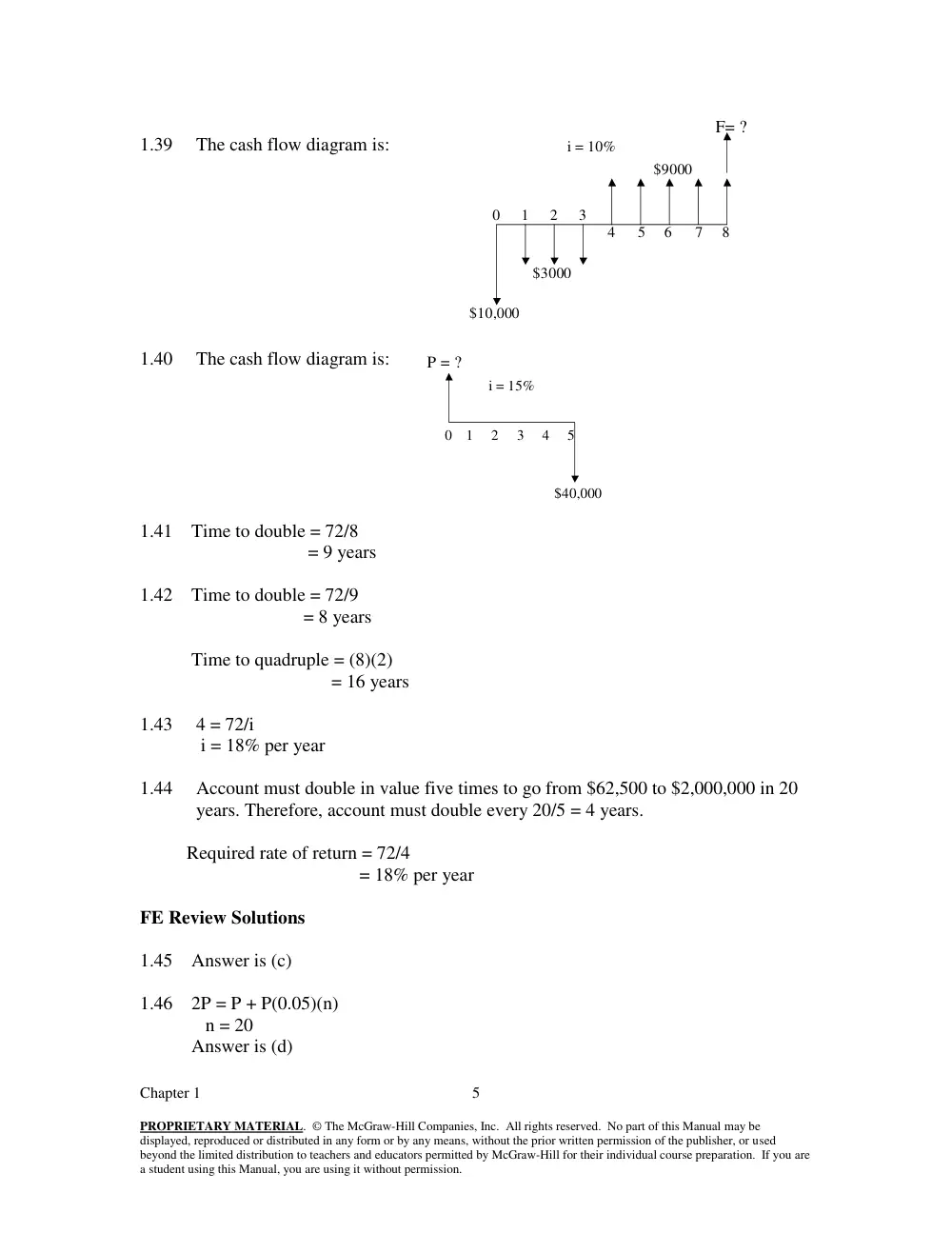
1.39
The cash flow diagram is:
1.40
The cash flow diagram is:
1.41 Time to double = 72/8
= 9 years
1.42 Time to double = 72/9
= 8 years
Time to quadruple = (8)(2)
= 16 years
1.43 4 = 72/i
i = 18% per year
1.44 Account must double in value five times to go from $62,500 to $2,000,000 in 20
years. Therefore, account must double every 20/5 = 4 years.
Required rate of return = 72/4
= 18% per year
FE Review Solutions
1.45 Answer is (c)
1.46 2P = P + P(0.05)(n)
n = 20
Answer is (d)
0
1
2
3
4
5 6 7 8
F= ?
$9000
$3000
$10,000
i = 10%
0 1 2 3 4 5
P = ?
$40,000
i = 15%
Chapter 1
6
PROPRIETARY MATERIAL. © The McGraw-Hill Companies, Inc. All rights reserved. No part of this Manual may be
displayed, reproduced or distributed in any form or by any means, without the prior written permission of the publisher, or used
beyond the limited distribution to teachers and educators permitted by McGraw-Hill for their individual course preparation. If you are
a student using this Manual, you are using it without permission.
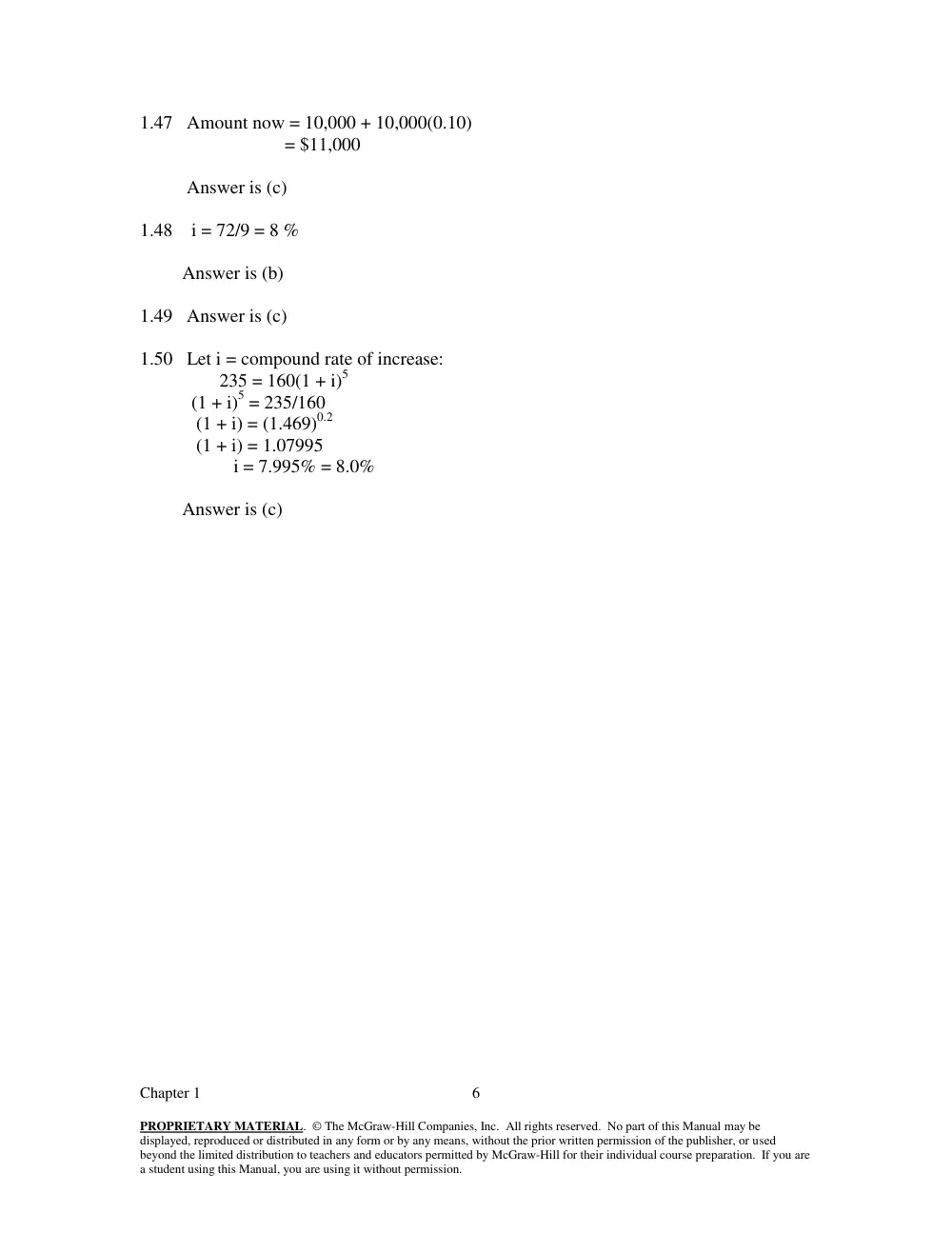
1.47 Amount now = 10,000 + 10,000(0.10)
= $11,000
Answer is (c)
1.48 i = 72/9 = 8 %
Answer is (b)
1.49 Answer is (c)
1.50 Let i = compound rate of increase:
235 = 160(1 + i)5
(1 + i)5 = 235/160
(1 + i) = (1.469)0.2
(1 + i) = 1.07995
i = 7.995% = 8.0%
Answer is (c)
Chapter 1
7
PROPRIETARY MATERIAL. © The McGraw-Hill Companies, Inc. All rights reserved. No part of this Manual may be
displayed, reproduced or distributed in any form or by any means, without the prior written permission of the publisher, or used
beyond the limited distribution to teachers and educators permitted by McGraw-Hill for their individual course preparation. If you are
a student using this Manual, you are using it without permission.
Extended Exercise Solution
F = ?
1.
$2000
0 1 2 3 4
$500 $500 $500
$9000
F = [{[–9000(1.08) – 500] (1.08)} – 500] (1.08) + (2000–500)
= $–10,960.60
or F = –9000(F/P,8%,3) – 500(F/A,8%,3) + 2000
2. A spreadsheet uses the FV function as shown in the formula bar. F = $–10,960.61.
Chapter 1
8
PROPRIETARY MATERIAL. © The McGraw-Hill Companies, Inc. All rights reserved. No part of this Manual may be
displayed, reproduced or distributed in any form or by any means, without the prior written permission of the publisher, or used
beyond the limited distribution to teachers and educators permitted by McGraw-Hill for their individual course preparation. If you are
a student using this Manual, you are using it without permission.
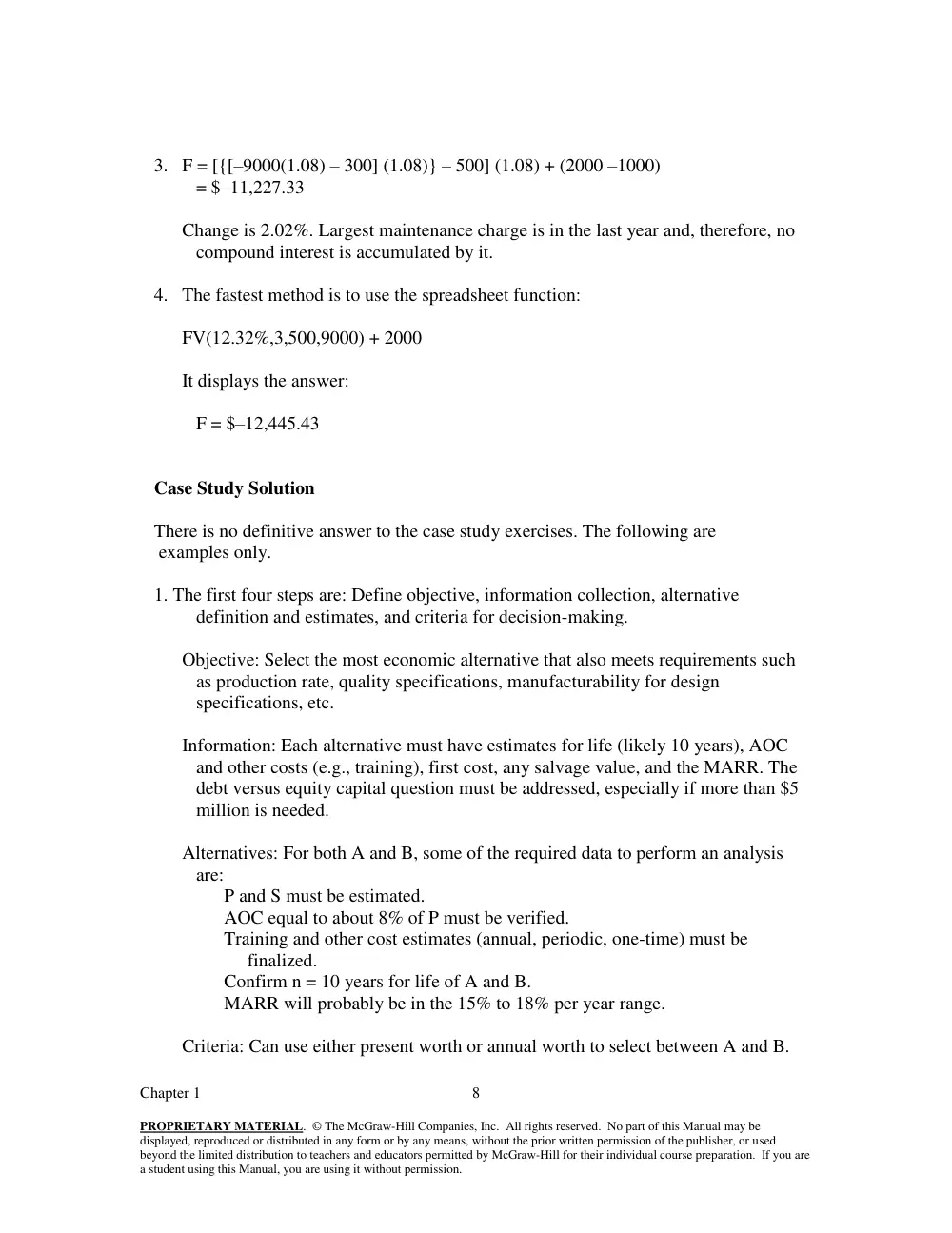
3. F = [{[–9000(1.08) – 300] (1.08)} – 500] (1.08) + (2000 –1000)
= $–11,227.33
Change is 2.02%. Largest maintenance charge is in the last year and, therefore, no
compound interest is accumulated by it.
4. The fastest method is to use the spreadsheet function:
FV(12.32%,3,500,9000) + 2000
It displays the answer:
F = $–12,445.43
Case Study Solution
There is no definitive answer to the case study exercises. The following are
examples only.
1. The first four steps are: Define objective, information collection, alternative
definition and estimates, and criteria for decision-making.
Objective: Select the most economic alternative that also meets requirements such
as production rate, quality specifications, manufacturability for design
specifications, etc.
Information: Each alternative must have estimates for life (likely 10 years), AOC
and other costs (e.g., training), first cost, any salvage value, and the MARR. The
debt versus equity capital question must be addressed, especially if more than $5
million is needed.
Alternatives: For both A and B, some of the required data to perform an analysis
are:
P and S must be estimated.
AOC equal to about 8% of P must be verified.
Training and other cost estimates (annual, periodic, one-time) must be
finalized.
Confirm n = 10 years for life of A and B.
MARR will probably be in the 15% to 18% per year range.
Criteria: Can use either present worth or annual worth to select between A and B.
Chapter 1
9
PROPRIETARY MATERIAL. © The McGraw-Hill Companies, Inc. All rights reserved. No part of this Manual may be
displayed, reproduced or distributed in any form or by any means, without the prior written permission of the publisher, or used
beyond the limited distribution to teachers and educators permitted by McGraw-Hill for their individual course preparation. If you are
a student using this Manual, you are using it without permission.
2. Consider these and others like them:
Debt capital availability and cost
Competition and size of market share required
Employee safety of plastics used in processing
3. With the addition of C, this is now a make/buy decision. Economic estimates
needed are:
Cost of lease arrangement or unit cost, whatever is quoted.
Amount and length of time the arrangement is available.
Some non-economic factors may be:
Guarantee of available time as needed.
Compatibility with current equipment and designs.
Readiness of the company to enter the market now versus later.
Chapter 10
1
PROPRIETARY MATERIAL. © The McGraw-Hill Companies, Inc. All rights reserved. No part of this Manual may be displayed, reproduced
or distributed in any form or by any means, without the prior written permission of the publisher, or used beyond the limited distribution to teachers
and educators permitted by McGraw-Hill for their individual course preparation. If you are a student using this Manual, you are using it without
permission.
Chapter 10
Making Choices: the Method, MARR, and Multiple Attributes
Solutions to Problems
10.1 The circumstances are when the lives for all alternatives are: (1) finite and equal, or (2)
considered infinite. It is also correct when (3) the evaluation will take place over a specified
study period.
10.2 Incremental cash flow analysis is mandatory for the ROR method and B/C method. (It is
noteworthy that if unequal-life cash flows are evaluated by ROR using an AW-based
relation that reflects the differences in cash flows between two alternatives, the breakeven
i* will be the same as the incremental i*. (See Table 10.2 and Section 10.1 for comments.)
10.3 Numerically largest means the alternative with the largest PW, AW or FW identifies the
selected alternative. For both revenue and service alternatives, the largest number is chosen.
For example, $-5000 is selected over $-10,000, and $+100 is selected over $-50.
10.4 (a) Hand solution: After consulting Table 10.1, choose the AW or PW method at 8% for
equal lives of 8 years.
Computer solution: either the PMT function or the PV function can give single-cell
solutions for each alternative.
In either case, select the alternative with the numerically largest value of AW or PW.
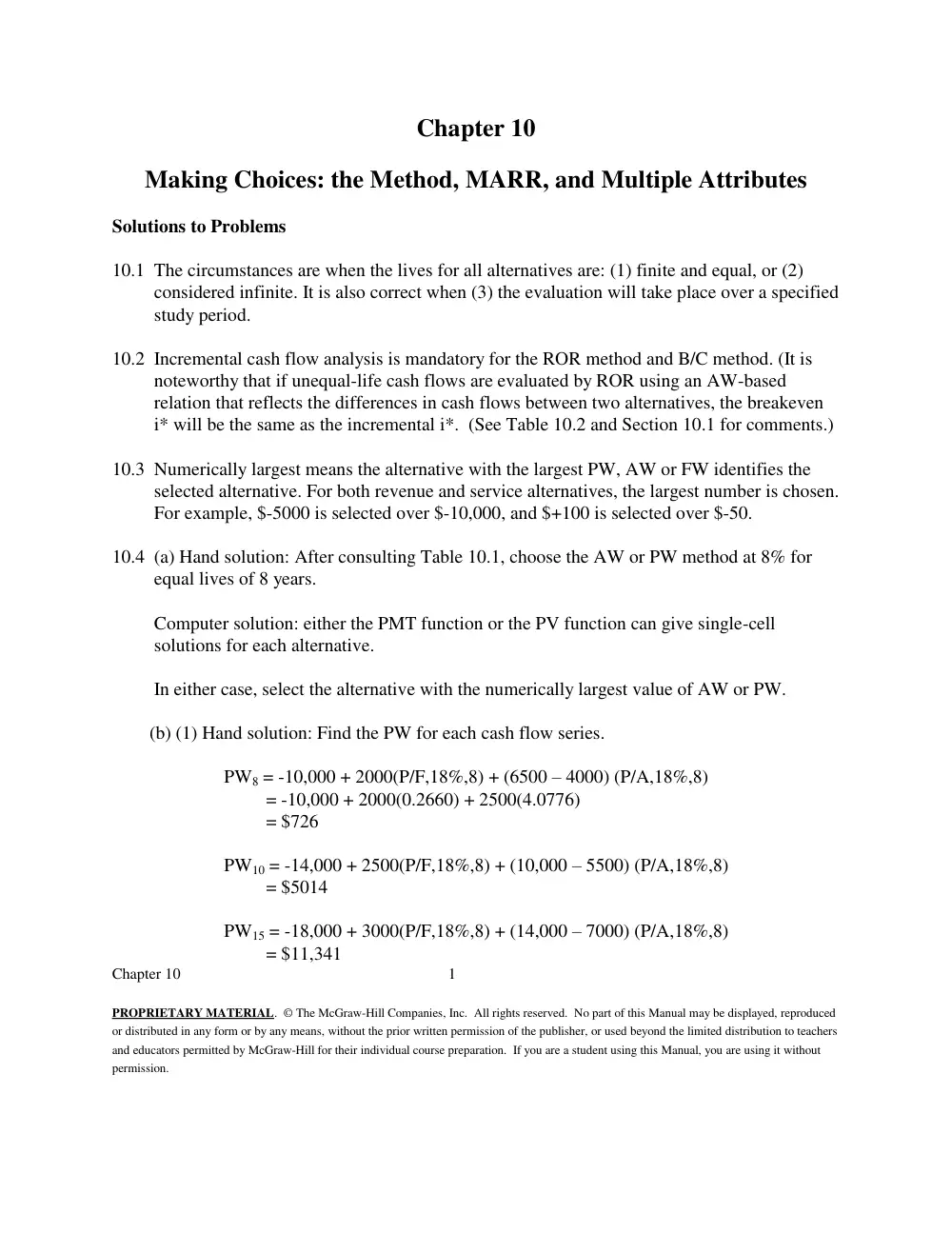
(b) (1) Hand solution: Find the PW for each cash flow series.
PW8 = -10,000 + 2000(P/F,18%,8) + (6500 – 4000) (P/A,18%,8)
= -10,000 + 2000(0.2660) + 2500(4.0776)
= $726
PW10 = -14,000 + 2500(P/F,18%,8) + (10,000 – 5500) (P/A,18%,8)
= $5014
PW15 = -18,000 + 3000(P/F,18%,8) + (14,000 – 7000) (P/A,18%,8)
= $11,341
Chapter 10
2
PROPRIETARY MATERIAL. © The McGraw-Hill Companies, Inc. All rights reserved. No part of this Manual may be displayed, reproduced
or distributed in any form or by any means, without the prior written permission of the publisher, or used beyond the limited distribution to teachers
and educators permitted by McGraw-Hill for their individual course preparation. If you are a student using this Manual, you are using it without
permission.
PW20 = -24,000 + 3500(P/F,18%,8) + (20,500 – 11,000) (P/A,18%,8)
= $15,668
PW25 = -33,000 + 6000(P/F,18%,8) + (26,500 – 16,000) (P/A,18%,8)
= $11,411
Select the 20 cubic meter size.
Computer solution: Use the PV function to find the PW in a separate spreadsheet cell for
each alternative. Select the 20 cubic meter alternative.
(b) (2) Buy another 20 cubic meter truck, not a smaller size, because it is always correct to
spend the largest amount that is economically justified.
10.5 (a) Hand solution: Choose the AW or PW method at 0.5% for equal lives over 60 months.
Computer solution: Either the PMT function or the PV function can give single-cell
solutions for each alternative.
(b) The B/C method was the evaluation method in chapter 9, so rework it using AW.
Hand solution: Find the AW for each cash flow series on a per household per month
basis.
Chapter 10
3
PROPRIETARY MATERIAL. © The McGraw-Hill Companies, Inc. All rights reserved. No part of this Manual may be displayed, reproduced
or distributed in any form or by any means, without the prior written permission of the publisher, or used beyond the limited distribution to teachers
and educators permitted by McGraw-Hill for their individual course preparation. If you are a student using this Manual, you are using it without
permission.
AW1 = 1.25 – 60(A/P,0.5%,60)
= 1.25 – 60(0.01933)
= 1.25 - 1.16
= $0.09
AW2 = 8.00 - 500(A/P,0.5%,60)
= 8.00 – 9.67
= $-1.67
Select program 1.
Computer solution: Develop the AW value using the PMT function in a separate cell for
each program. Select program 1.
10.6 Long to infinite life alternatives. Examples are usually public sector projects such as
dams, highways, buildings, railroads, etc.
10.7 (a) The expected return is 12 - 8 = 4% per year.
(b) Retain MARR = 12% and then estimate the project i*. Take the risk-related return
expectation into account before deciding on the project. If 12% < i* < 17%, John must
decide if the risk is worth less than 5% over MARR = 12%.
10.8
(a)
Bonds are debt financing
(b)
Stocks are always equity
(c)
Equity
(d)
Equity loans are debt financing, like house mortgage loan
Chapter 10
4
PROPRIETARY MATERIAL. © The McGraw-Hill Companies, Inc. All rights reserved. No part of this Manual may be displayed, reproduced
or distributed in any form or by any means, without the prior written permission of the publisher, or used beyond the limited distribution to teachers
and educators permitted by McGraw-Hill for their individual course preparation. If you are a student using this Manual, you are using it without
permission.
10.9
The project that is rejected, say B, and has the next highest ROR measure, i*B, in effect
sets the MARR, because it‟s rate of return is a lost opportunity rate of return. Were any
second alternative selected, project B would be it and the effective MARR would be i*B.
10.10 Before-tax opportunity cost is the 16.6% forgone rate. Determine the after-tax percentage
after the effective tax rate (Te ) is calculated.
Te = 0.06 + (0.94)(0.20) = 0.248
After-tax MARR = Before-tax MARR (1- Te ) = 16.6 (1 – 0.248)
= 12.48%
10.11 (a) Select 2. It is the alternative investing the maximum available with incremental
i* > 9%.
(b) Select 3.
(c) Select 3.
(d) MARR = 10% for alternative 4 is opportunity cost at $400,000 level, since 4 is
the first unfunded project due to unavailability of funds.
10.12 Set the MARR at the cost of capital. Determine the rate of return for the cash flow
estimates and select the best alternative. Examine the difference between the return and
MARR to separately determine if it is large enough to cover the other factors for this
selected alternative. (This is different than increasing the MARR before the evaluation to
accommodate the factors.)
10.13 (a) MARR may tend to be set lower, based on the success of the last purchase.
(b) Set the MARR and then treat the risk associated with the purchase separately
from the MARR.
10.14 (a) Calculate the two WACC values.
WACC1 = 0.6(12%) + 0.4 (9%) = 10.8%
WACC2 = 0.2(12%) + 0.8(12.5%) = 12.4%
Use approach 1, with a D-E mix of 40%-60%
Chapter 10
5
PROPRIETARY MATERIAL. © The McGraw-Hill Companies, Inc. All rights reserved. No part of this Manual may be displayed, reproduced
or distributed in any form or by any means, without the prior written permission of the publisher, or used beyond the limited distribution to teachers
and educators permitted by McGraw-Hill for their individual course preparation. If you are a student using this Manual, you are using it without
permission.
10.14 (cont)
(b)
Let x1 and x2 be the maximum costs of debt capital.
Alternative 1: 10% = WACC1 = 0.6(12%) + 0.4(x1)
x1 = [10% - 0.6(12%)]/0.4
= 7%
Debt capital cost would have to decrease from 9% to 7%.
Alternative 2: 10% = WACC2 = 0.2(12%) + 0.8(x2)
x2 = [10% - 0.2(12%)]/0.8
= 9.5%
Debt capital cost would, again, have to decrease; now from 12.5% to 9.5%
Chapter 10
6
PROPRIETARY MATERIAL. © The McGraw-Hill Companies, Inc. All rights reserved. No part of this Manual may be displayed, reproduced
or distributed in any form or by any means, without the prior written permission of the publisher, or used beyond the limited distribution to teachers
and educators permitted by McGraw-Hill for their individual course preparation. If you are a student using this Manual, you are using it without
permission.
10.15 The lowest WACC value of 7.9% occurs at the D-E mixes of $10,000 and $25,000 loan.
This translates into funding between $75,000 and $90,000 from their own funds.
10.16 WACC = cost of debt capital + cost of equity capital
= (0.4)[0.667(8%) + 0.333(10%)] + (0.6)[(0.4)(5%) + (0.6)(9%)]
= 0.4[8.667%] + 0.6 [7.4%]
= 7.907%
10.17 (a) Compute and plot WACC for each D-E mix.
D-E Mix
WACC
100-0
14.50%
70-30
11.44
65-35
10.53
50-50
9.70
35-65
9.84
20-80
12.48
0-100
12.50
(b)
D-E mix of 50%-50% has the lowest WACC value.
Chapter 10
7
PROPRIETARY MATERIAL. © The McGraw-Hill Companies, Inc. All rights reserved. No part of this Manual may be displayed, reproduced
or distributed in any form or by any means, without the prior written permission of the publisher, or used beyond the limited distribution to teachers
and educators permitted by McGraw-Hill for their individual course preparation. If you are a student using this Manual, you are using it without
permission.
10.18 (a) The spreadsheet shows a 50% - 50% mix to have the lowest WACC at 9.70%.
(b) Change the debt rate column (C to D) to add the 10% and observe the new plot.
Now debt of 35% (D-E of 35-65) has the lowest WACC = 10.18%.
Chapter 10
8
PROPRIETARY MATERIAL. © The McGraw-Hill Companies, Inc. All rights reserved. No part of this Manual may be displayed, reproduced
or distributed in any form or by any means, without the prior written permission of the publisher, or used beyond the limited distribution to teachers
and educators permitted by McGraw-Hill for their individual course preparation. If you are a student using this Manual, you are using it without
permission.
10.19 Solve for the cost of debt capital, x.
WACC = 10.7% = 0.8(6%) + (1-0.8) (x)
x = (10.7 – 4.8)/0.2
= 29.5%
The rate of 29.5% for debt capital (loans, bonds, etc.) seems very high.
10.20 Before-taxes:
WACC = 0.4(9%) + 0.6(12%) = 10.8% per year
After-tax: Insert Equation [10.3] into the before-tax WACC relation.
After-tax WACC = (equity)(equity rate) + (debt)(before-tax debt rate)(1–Te )
= 0.4(9%) + 0.6(12%)(1-0.35)
= 8.28% per year
The tax advantage reduces the WACC from 10.8% to 8.28% per year, or 2.52% per year.
10.21 (a) Face value = $2,500,000 = $2,577,320
0.97
(b) Bond interest = 0.042(2,577,320) = $27,062 every 3 months
4
Dividend quarterly net cash flow = $27,062(1 - 0.35) = $17,590
The rate of return equation per 3-months over 20(4) quarters is:
0 = 2,500,000 – 17,590(P/A,i*,80) – 2,577,320(P/F,i*,80)
i* = 0.732% per 3 months
(RATE function)
Nominal i* = 2.928% per year
Effective i* = (1.00732)4 – 1 = 2.96% per year
10.22 (a) Annual loan payment is the cost of the $160,000 debt capital. First, determine the
after-tax cost of debt capital.
Chapter 10
9
PROPRIETARY MATERIAL. © The McGraw-Hill Companies, Inc. All rights reserved. No part of this Manual may be displayed, reproduced
or distributed in any form or by any means, without the prior written permission of the publisher, or used beyond the limited distribution to teachers
and educators permitted by McGraw-Hill for their individual course preparation. If you are a student using this Manual, you are using it without
permission.
10.22 (cont)
Debt cost of capital: before-tax (1-Te) = 9%(1-0.22) = 7.02%
Annual interest 160,000(0.0702) = $11,232
Annual principal re-payment = 160,000/15 = $10,667
Total annual payment = $21,899
(b) Equity cost of capital: 6.5% per year on $40,000 is $2600 annually.
Set up the spreadsheet with the three series. Equity rate is 6.5%, loan interest rate is
7.02%, and principle re-payment rate is 6.5% since the annual amount will not earn
interest at the equity rate of 6.5%. The difference in PW values is:
Difference = 200,000 - PW equity lost – PW of loan interest paid
– PW of loan principle re-payment not saved as equity
= $-26, 916
This means the PW of the selling price in the future must be at least $26,916 more
than the current purchase price to make a positive return on the investment, assuming
all the current numbers remain stable.
Chapter 10
10
PROPRIETARY MATERIAL. © The McGraw-Hill Companies, Inc. All rights reserved. No part of this Manual may be displayed, reproduced
or distributed in any form or by any means, without the prior written permission of the publisher, or used beyond the limited distribution to teachers
and educators permitted by McGraw-Hill for their individual course preparation. If you are a student using this Manual, you are using it without
permission.
(c) After-tax WACC = 0.2(6.5%) + 0.8(9%(1-0.22)
= 6.916%
10.23 Equity cost of capital is stated as 6%. Debt cost of capital benefits from tax savings.
Before-tax bond annual interest = 4 million (0.08) = $320,000
Annual bond interest NCF = 320,000(1 – 0.4) = $192,000
Effective quarterly dividend = 192,000/4 = $48,000
Find quarterly i* using a PW relation.
0 = 4,000,000 - 48,000(P/A,i*,40) - 4,000,000(P/F,i*,40)
i* = 1.2% per quarter
= 4.8% per year (nominal)
Debt financing at 4.8% per year is cheaper than equity funds at 6% per year.
(Note: The correct answer is also obtained if the before-tax debt cost of 8% is used to
estimate the after-tax debt cost of 8%(1 - 0.4) = 4.8% from Equation [10.3].)
10.24 (a) Bank loan:
Annual loan payment = 800,000(A/P,8%,8)
= 800,000(0.17401)
= $139,208
Principal payment = 800,000/8 = $100,000
Annual interest = 139,208 – 100,000 = $39,208
Tax saving = 39,208(0.40) = $15,683
Effective interest payment = 39,208 – 15,683 = $23,525
Effective annual payment = 23,525 + 100,000 = $123,525
The AW-based i* relation is:
0 = 800,000(A/P,i*,8) –123,525
(A/P,i*,8) = 123,525 = 0.15441
800,000
i* = 4.95%
Chapter 10
11
PROPRIETARY MATERIAL. © The McGraw-Hill Companies, Inc. All rights reserved. No part of this Manual may be displayed, reproduced
or distributed in any form or by any means, without the prior written permission of the publisher, or used beyond the limited distribution to teachers
and educators permitted by McGraw-Hill for their individual course preparation. If you are a student using this Manual, you are using it without
permission.
Bond issue:
Annual bond interest = 800,000(0.06) = $48,000
Tax saving = 48,000(0.40) = $19,200
Effective bond interest = 48,000 – 19,200 = $28,800
The AW-based i* relation is:
0 = 800,000(A/P,i*,10) - 28,800 - 800,000(A/F,i*,10)
i* = 3.6%
(RATE or IRR function)
Bond financing is cheaper.
(b) Bonds cost 6% per year, which is less than the 8% loan. The answer is the same
before-taxes.
10.25 Face value of bond issue = (10,000,000)/ 0.975 = $10,256,410
Annual bond interest = 0.0975(10,256,410) = $1,000,000
Interest net cash flow = $1,000,000(1 - 0.32) = $680,000
The PW-based rate of return equation is:
0 = 10,000,000 – 680,000(P/A,i*,30) –10,256,410(P/F,i*,30)
i* = 6.83% per year
(Excel RATE function)
Bonds are cheaper than the bank loan at 7.5% with no tax advantage.
10.26 Dividend method:
Re = DV1/P + g
= 0.93/18.80 + 0.015
= 6.44%
Chapter 10
12
PROPRIETARY MATERIAL. © The McGraw-Hill Companies, Inc. All rights reserved. No part of this Manual may be displayed, reproduced
or distributed in any form or by any means, without the prior written permission of the publisher, or used beyond the limited distribution to teachers
and educators permitted by McGraw-Hill for their individual course preparation. If you are a student using this Manual, you are using it without
permission.
CAPM: (The return values are in percents.)
Re = Rf + β(Rm - Rf)
= 4.5 + 1.19(4.95 – 4.5)
= 5.04%
CAPM estimate of cost of equity capital is 1.4% lower.
10.27 Debt capital cost: 9.5% for $6 million (60% of total capital)
Equity -- common stock: 100,000(32) = $3.2 million or 32% of total capital
Re = 1.10/ 32 + 0.02
= 5.44%
Equity -- retained earnings: cost is 5.44% for this 8% of total capital.
WACC = 0.6(9.5%) + 0.32(5.44%) + 0.08(5.44%)
= 7.88%
10.28 Last year CAPM computation: Re = 4.0 + 1.10(5.1 – 4.0)
= 4.0 + 1.21 = 5.21%
This year CAPM computation: Re = 3.9 + 1.18(5.1 – 3.9)
= 3.9 + 1.42 = 5.32%
Equity costs slightly more in part because the company‟s stock became more volatile
based on an increase in beta. The safe return rate stayed about the same in the switch from
US to Euro bonds.
10.29 Determine the effective annual interest rate ia for each plan using the effective interest rate
equation in chapter 4. All the dollar values can be neglected.
Plan 1:
ia for debt = (1 + 0.00583)12 -1 = 7.225%
ia for equity = (1 + 0.03)2 - 1 = 6.09%
Chapter 10
13
PROPRIETARY MATERIAL. © The McGraw-Hill Companies, Inc. All rights reserved. No part of this Manual may be displayed, reproduced
or distributed in any form or by any means, without the prior written permission of the publisher, or used beyond the limited distribution to teachers
and educators permitted by McGraw-Hill for their individual course preparation. If you are a student using this Manual, you are using it without
permission.
WACCA = 0.5(7.225%) + 0.5(6.09%) = 6.66%
Plan 2:
ia for 100% equity = WACCB = (1 + 0.03)2 - 1 = 6.09%
Plan 3:
ia for 100% debt = WACCC = (1 + 0.00583)12 -1 = 7.225%
Plan 2: 100% equity has the lowest before-tax WACC.
10.30 (a)
Equity capital: 50% of capital at 15% per year.
Debt capital: 15% in bonds and 35% in loans.
Cost of loans: 10.5% per year
Cost of bonds: 6% from the problem statement, or determine i*.
Bond annual interest per bond = $10,000(0.06) = $600
0 = 10,000 - 600(P/A,i*,15) - 10,000(P/F,i*,15)
i* = 6.0%
(RATE function)
Before-tax WACC = 0.5(15%) + 0.15(6%) + 0.35(10.5%)
= 12.075%
(b)
Use Te = 35% to calculate after-tax WACC with Equation [10.3] inserted into
Equation [10.1], as mentioned at the end of Section 10.3 in the text.
After-tax WACC = (equity)(equity rate) + (debt)(before-tax debt rate)(1–Te )
= 0.5(15%) + [0.15(6%) + 0.35(