
FINA 210 Problems, Spring 2011
American University of Beirut · Business Finance · 46 pages
Showing the first 10 of 46 pages. Download the PDF to see all of it.
More FINA 210 files
- Problems Chap 7 · Spring 2015ProblemsView
- Problems Chap 8 · Spring 2015ProblemsView
- Problems Solution Manual 9th Ed · Spring 2011Problems · with solutionView
- Homework Chap 6 · Spring 2015HomeworkView
- Lecture Capital Budgeting · Spring 2015LabView
- Homework Chap 6 · Fall 2013HomeworkView
- Homework Chap 5 · Fall 2013HomeworkView
- Homework Chap 3 · Fall 2013HomeworkView
Show the text of this problems
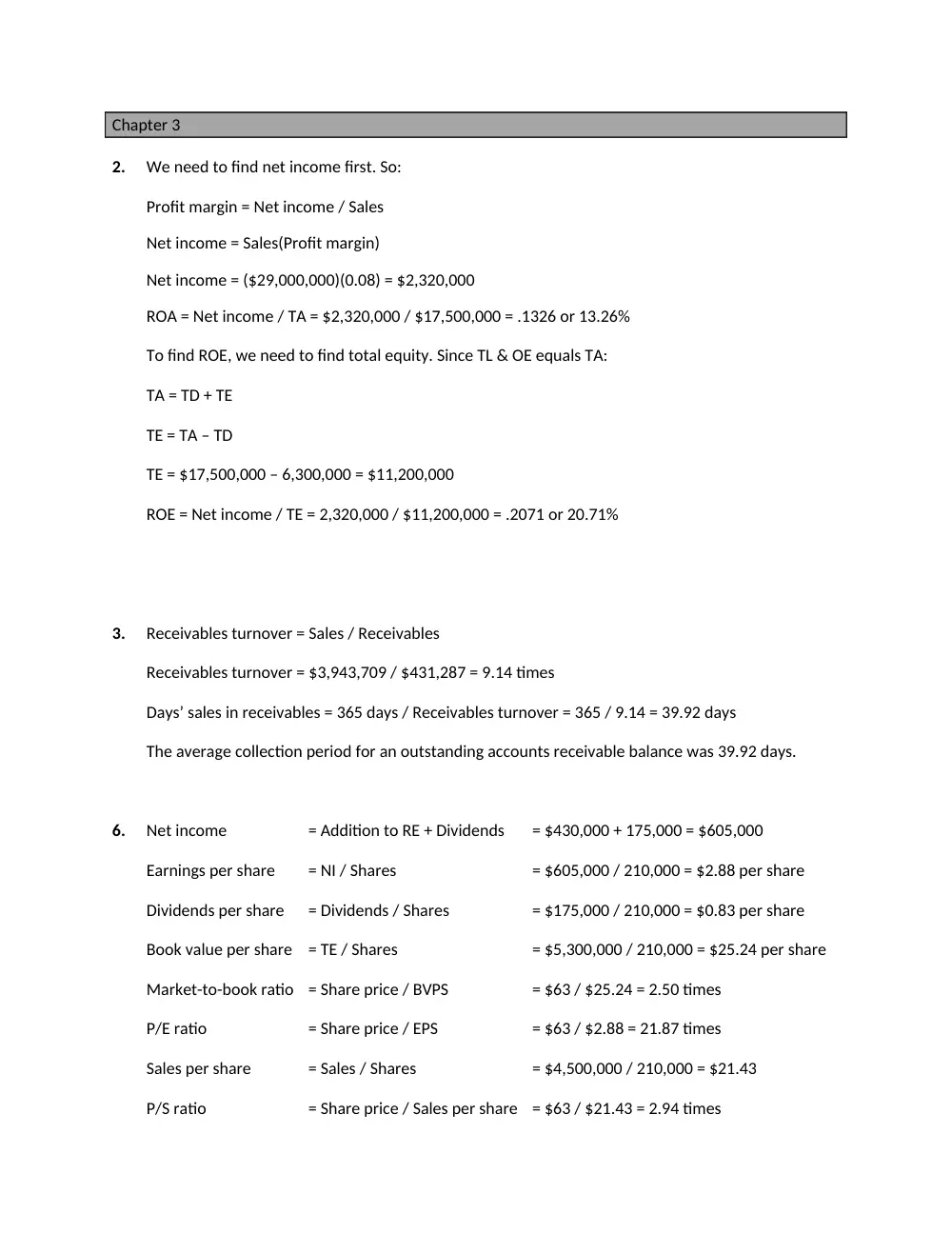
Chapter 3
2.
We need to find net income first. So:
Profit margin = Net income / Sales
Net income = Sales(Profit margin)
Net income = ($29,000,000)(0.08) = $2,320,000
ROA = Net income / TA = $2,320,000 / $17,500,000 = .1326 or 13.26%
To find ROE, we need to find total equity. Since TL & OE equals TA:
TA = TD + TE
TE = TA – TD
TE = $17,500,000 – 6,300,000 = $11,200,000
ROE = Net income / TE = 2,320,000 / $11,200,000 = .2071 or 20.71%
3.
Receivables turnover = Sales / Receivables
Receivables turnover = $3,943,709 / $431,287 = 9.14 times
Days’ sales in receivables = 365 days / Receivables turnover = 365 / 9.14 = 39.92 days
The average collection period for an outstanding accounts receivable balance was 39.92 days.
6.
Net income
= Addition to RE + Dividends
= $430,000 + 175,000 = $605,000
Earnings per share
= NI / Shares
= $605,000 / 210,000 = $2.88 per share
Dividends per share
= Dividends / Shares
= $175,000 / 210,000 = $0.83 per share
Book value per share
= TE / Shares
= $5,300,000 / 210,000 = $25.24 per share
Market-to-book ratio = Share price / BVPS
= $63 / $25.24 = 2.50 times
P/E ratio
= Share price / EPS
= $63 / $2.88 = 21.87 times
Sales per share
= Sales / Shares
= $4,500,000 / 210,000 = $21.43
P/S ratio
= Share price / Sales per share
= $63 / $21.43 = 2.94 times
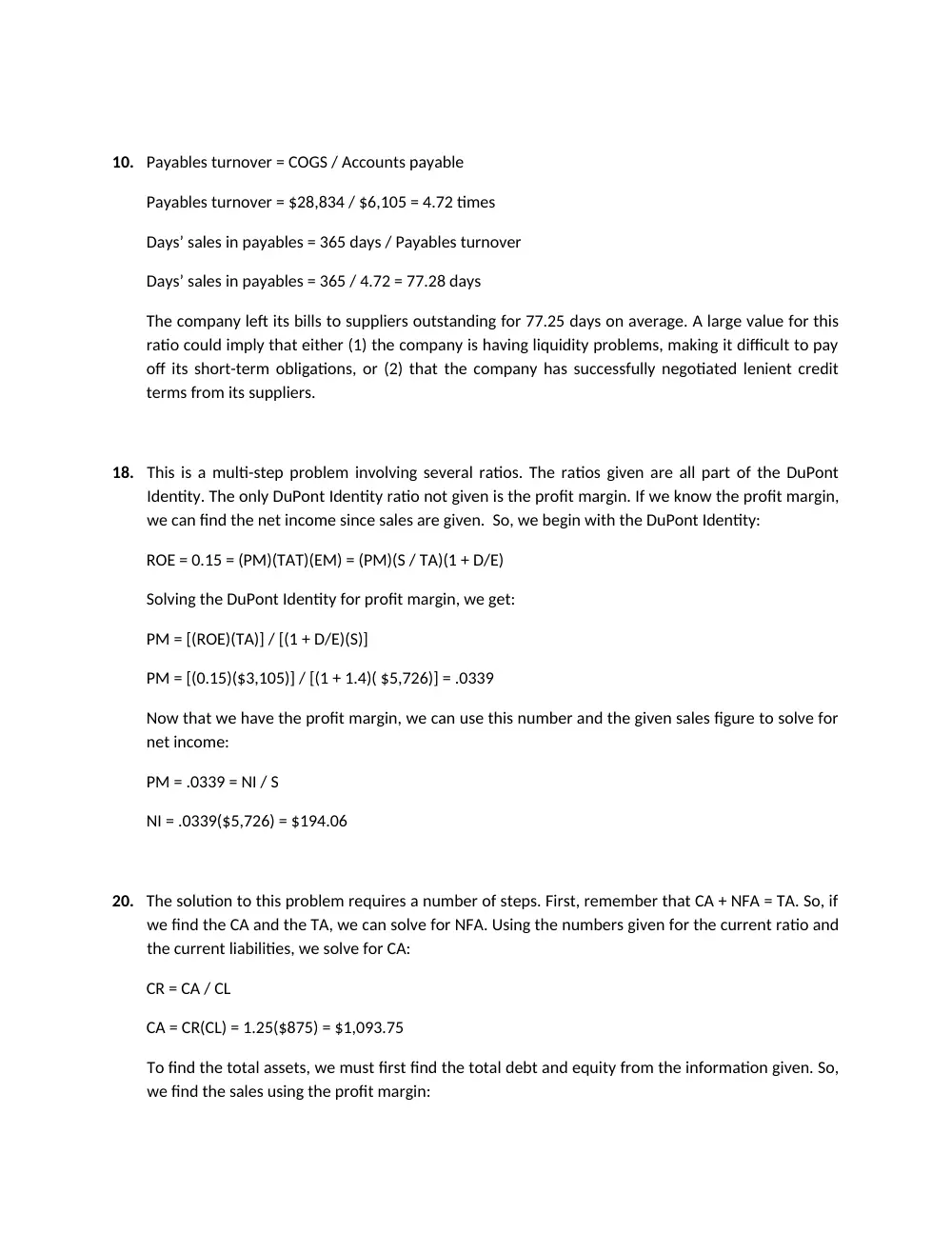
10. Payables turnover = COGS / Accounts payable
Payables turnover = $28,834 / $6,105 = 4.72 times
Days’ sales in payables = 365 days / Payables turnover
Days’ sales in payables = 365 / 4.72 = 77.28 days
The company left its bills to suppliers outstanding for 77.25 days on average. A large value for this
ratio could imply that either (1) the company is having liquidity problems, making it difficult to pay
off its short-term obligations, or (2) that the company has successfully negotiated lenient credit
terms from its suppliers.
18. This is a multi-step problem involving several ratios. The ratios given are all part of the DuPont
Identity. The only DuPont Identity ratio not given is the profit margin. If we know the profit margin,
we can find the net income since sales are given. So, we begin with the DuPont Identity:
ROE = 0.15 = (PM)(TAT)(EM) = (PM)(S / TA)(1 + D/E)
Solving the DuPont Identity for profit margin, we get:
PM = [(ROE)(TA)] / [(1 + D/E)(S)]
PM = [(0.15)($3,105)] / [(1 + 1.4)( $5,726)] = .0339
Now that we have the profit margin, we can use this number and the given sales figure to solve for
net income:
PM = .0339 = NI / S
NI = .0339($5,726) = $194.06
20. The solution to this problem requires a number of steps. First, remember that CA + NFA = TA. So, if
we find the CA and the TA, we can solve for NFA. Using the numbers given for the current ratio and
the current liabilities, we solve for CA:
CR = CA / CL
CA = CR(CL) = 1.25($875) = $1,093.75
To find the total assets, we must first find the total debt and equity from the information given. So,
we find the sales using the profit margin:
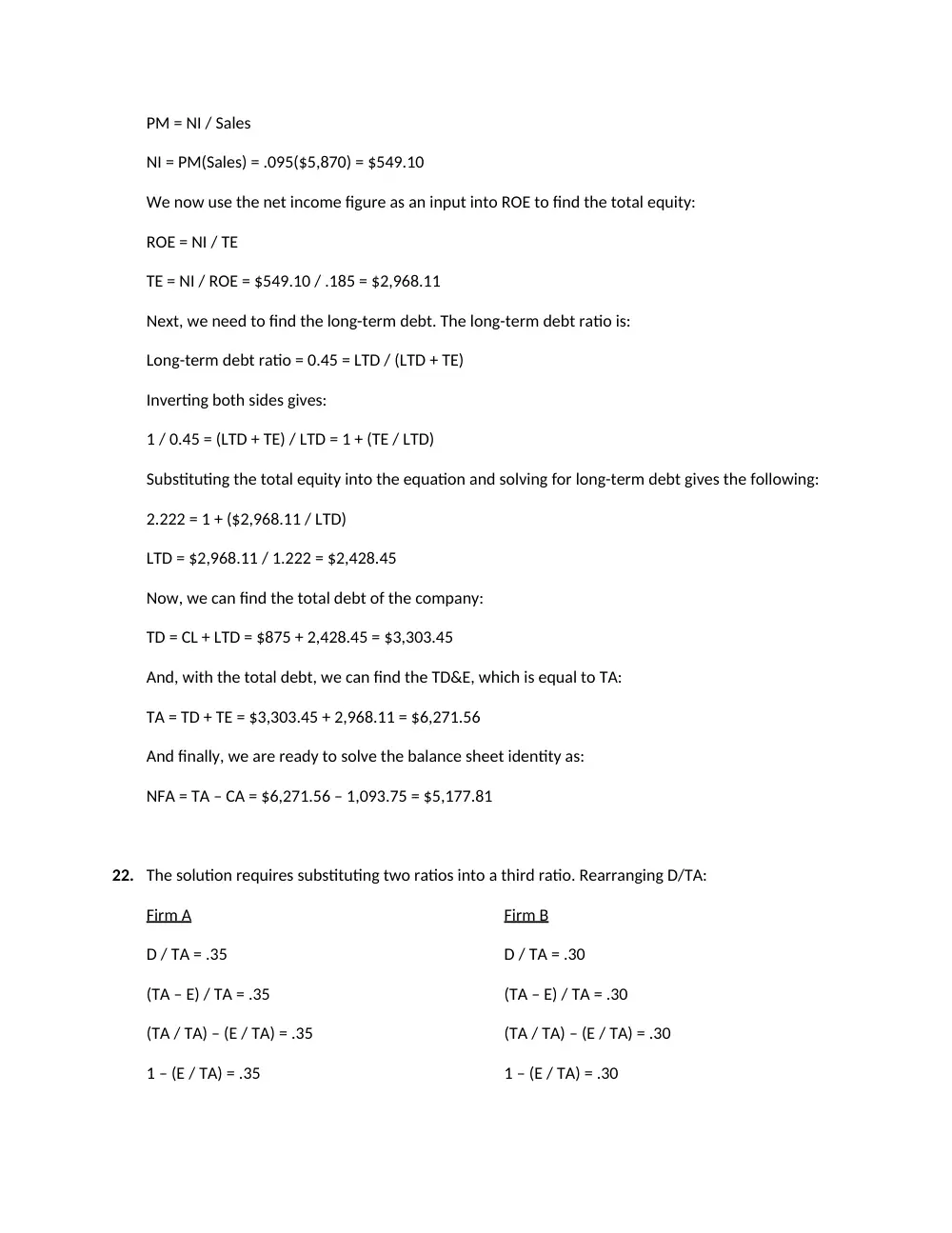
PM = NI / Sales
NI = PM(Sales) = .095($5,870) = $549.10
We now use the net income figure as an input into ROE to find the total equity:
ROE = NI / TE
TE = NI / ROE = $549.10 / .185 = $2,968.11
Next, we need to find the long-term debt. The long-term debt ratio is:
Long-term debt ratio = 0.45 = LTD / (LTD + TE)
Inverting both sides gives:
1 / 0.45 = (LTD + TE) / LTD = 1 + (TE / LTD)
Substituting the total equity into the equation and solving for long-term debt gives the following:
2.222 = 1 + ($2,968.11 / LTD)
LTD = $2,968.11 / 1.222 = $2,428.45
Now, we can find the total debt of the company:
TD = CL + LTD = $875 + 2,428.45 = $3,303.45
And, with the total debt, we can find the TD&E, which is equal to TA:
TA = TD + TE = $3,303.45 + 2,968.11 = $6,271.56
And finally, we are ready to solve the balance sheet identity as:
NFA = TA – CA = $6,271.56 – 1,093.75 = $5,177.81
22. The solution requires substituting two ratios into a third ratio. Rearranging D/TA:
Firm A
Firm B
D / TA = .35
D / TA = .30
(TA – E) / TA = .35
(TA – E) / TA = .30
(TA / TA) – (E / TA) = .35
(TA / TA) – (E / TA) = .30
1 – (E / TA) = .35
1 – (E / TA) = .30
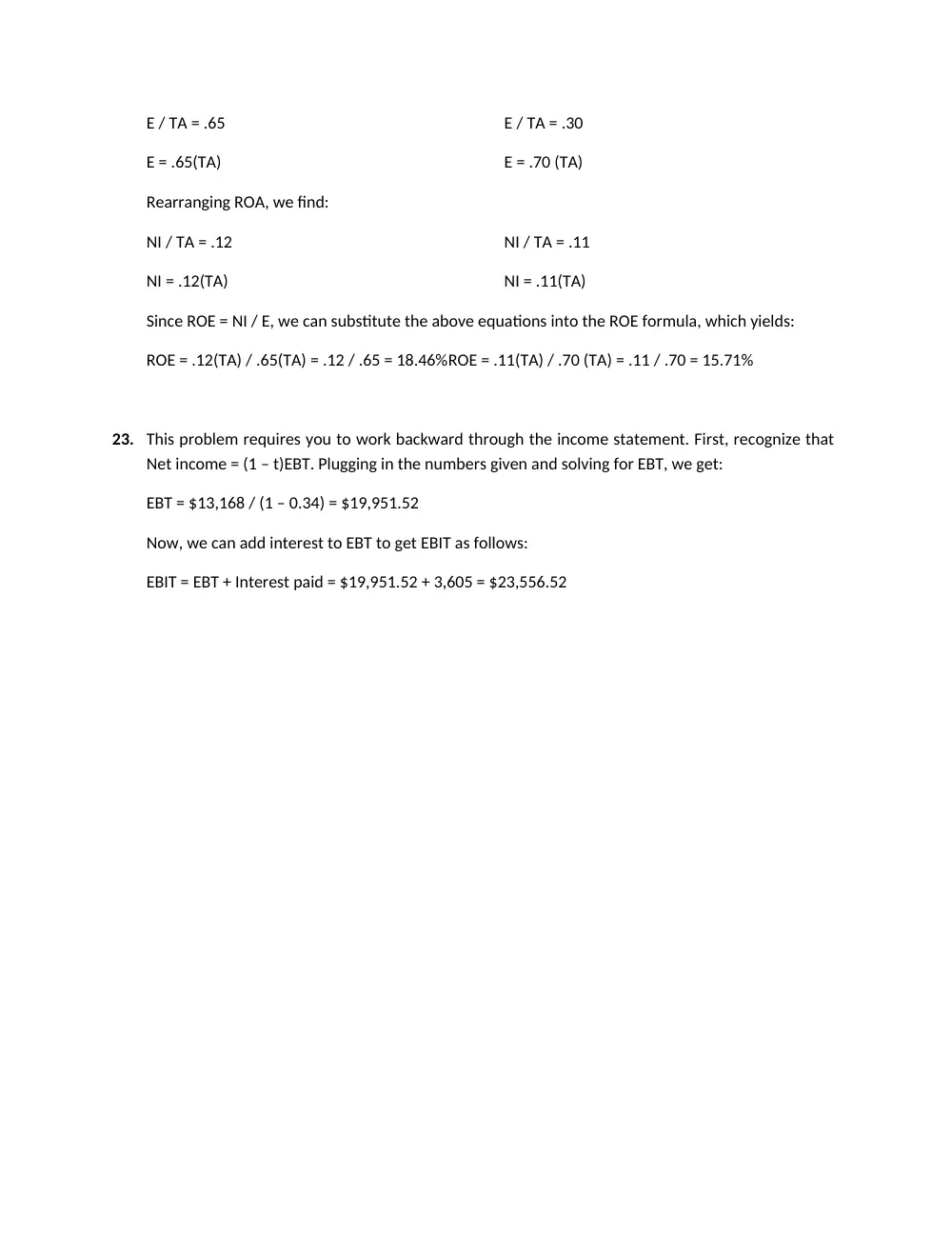
E / TA = .65
E / TA = .30
E = .65(TA)
E = .70 (TA)
Rearranging ROA, we find:
NI / TA = .12
NI / TA = .11
NI = .12(TA)
NI = .11(TA)
Since ROE = NI / E, we can substitute the above equations into the ROE formula, which yields:
ROE = .12(TA) / .65(TA) = .12 / .65 = 18.46%ROE = .11(TA) / .70 (TA) = .11 / .70 = 15.71%
23. This problem requires you to work backward through the income statement. First, recognize that
Net income = (1 – t)EBT. Plugging in the numbers given and solving for EBT, we get:
EBT = $13,168 / (1 – 0.34) = $19,951.52
Now, we can add interest to EBT to get EBIT as follows:
EBIT = EBT + Interest paid = $19,951.52 + 3,605 = $23,556.52
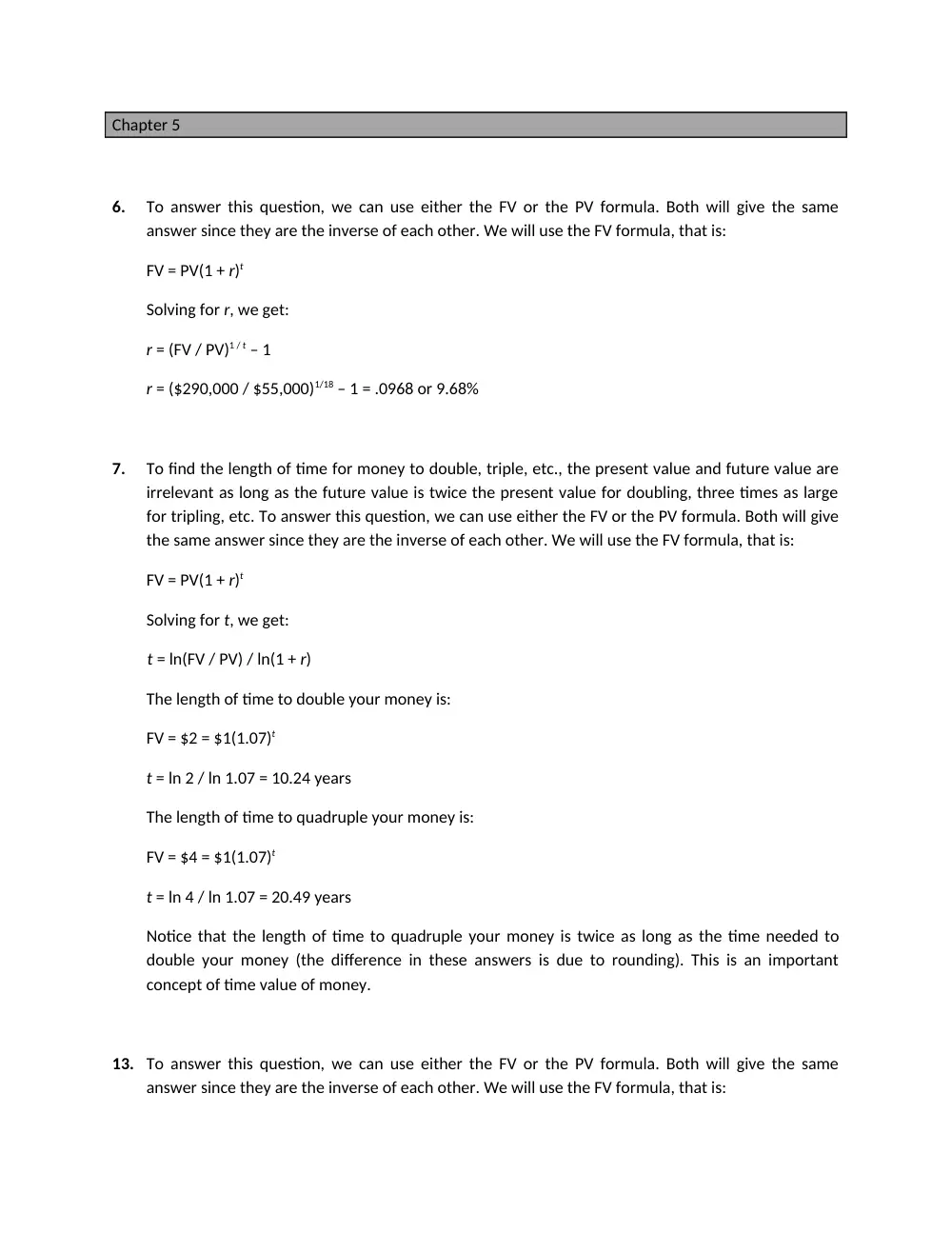
Chapter 5
6.
To answer this question, we can use either the FV or the PV formula. Both will give the same
answer since they are the inverse of each other. We will use the FV formula, that is:
FV = PV(1 + r)t
Solving for r, we get:
r = (FV / PV)1 / t – 1
r = ($290,000 / $55,000)1/18 – 1 = .0968 or 9.68%
7.
To find the length of time for money to double, triple, etc., the present value and future value are
irrelevant as long as the future value is twice the present value for doubling, three times as large
for tripling, etc. To answer this question, we can use either the FV or the PV formula. Both will give
the same answer since they are the inverse of each other. We will use the FV formula, that is:
FV = PV(1 + r)t
Solving for t, we get:
t = ln(FV / PV) / ln(1 + r)
The length of time to double your money is:
FV = $2 = $1(1.07)t
t = ln 2 / ln 1.07 = 10.24 years
The length of time to quadruple your money is:
FV = $4 = $1(1.07)t
t = ln 4 / ln 1.07 = 20.49 years
Notice that the length of time to quadruple your money is twice as long as the time needed to
double your money (the difference in these answers is due to rounding). This is an important
concept of time value of money.
13. To answer this question, we can use either the FV or the PV formula. Both will give the same
answer since they are the inverse of each other. We will use the FV formula, that is:
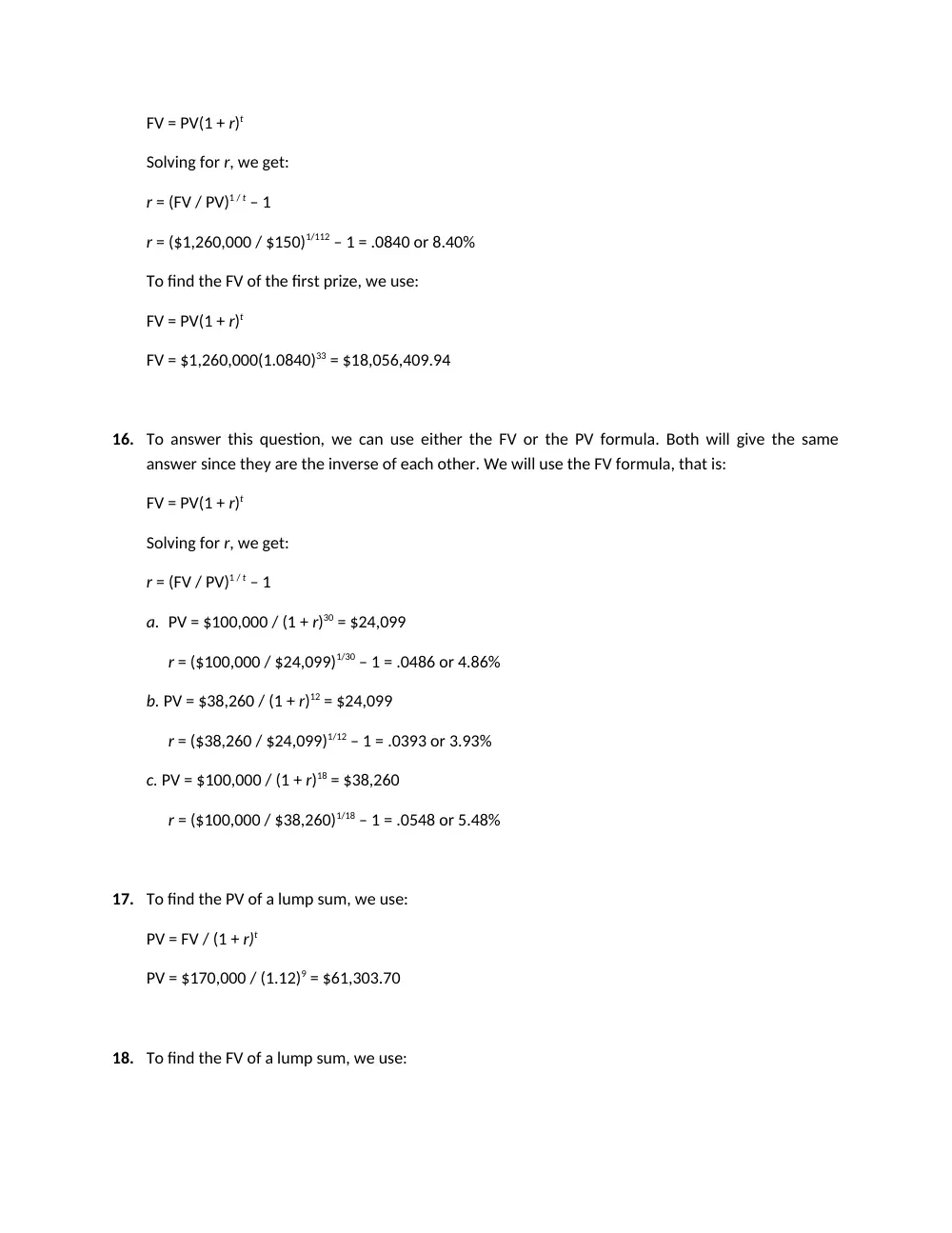
FV = PV(1 + r)t
Solving for r, we get:
r = (FV / PV)1 / t – 1
r = ($1,260,000 / $150)1/112 – 1 = .0840 or 8.40%
To find the FV of the first prize, we use:
FV = PV(1 + r)t
FV = $1,260,000(1.0840)33 = $18,056,409.94
16. To answer this question, we can use either the FV or the PV formula. Both will give the same
answer since they are the inverse of each other. We will use the FV formula, that is:
FV = PV(1 + r)t
Solving for r, we get:
r = (FV / PV)1 / t – 1
a. PV = $100,000 / (1 + r)30 = $24,099
r = ($100,000 / $24,099)1/30 – 1 = .0486 or 4.86%
b. PV = $38,260 / (1 + r)12 = $24,099
r = ($38,260 / $24,099)1/12 – 1 = .0393 or 3.93%
c. PV = $100,000 / (1 + r)18 = $38,260
r = ($100,000 / $38,260)1/18 – 1 = .0548 or 5.48%
17. To find the PV of a lump sum, we use:
PV = FV / (1 + r)t
PV = $170,000 / (1.12)9 = $61,303.70
18. To find the FV of a lump sum, we use:
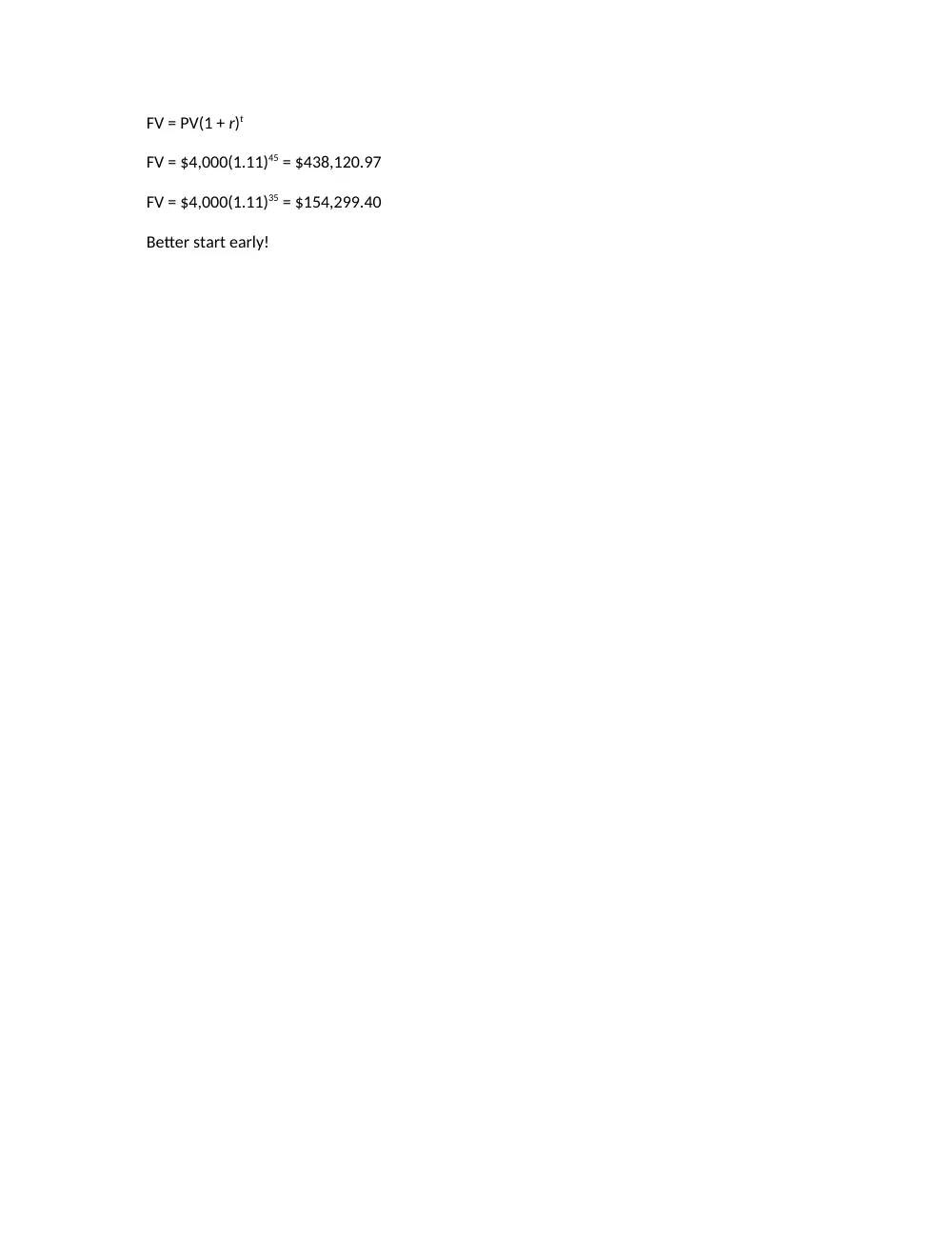
FV = PV(1 + r)t
FV = $4,000(1.11)45 = $438,120.97
FV = $4,000(1.11)35 = $154,299.40
Better start early!
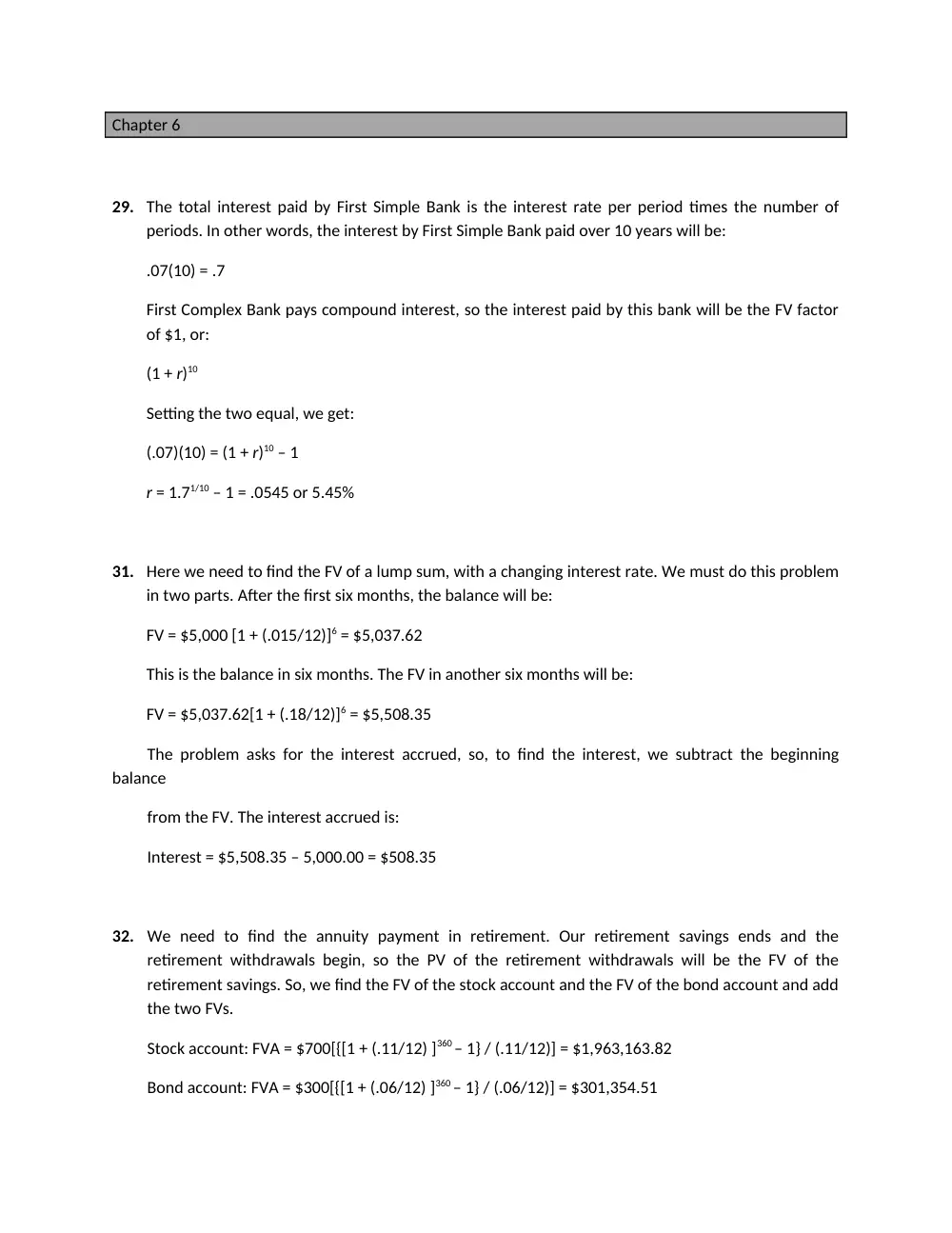
Chapter 6
29. The total interest paid by First Simple Bank is the interest rate per period times the number of
periods. In other words, the interest by First Simple Bank paid over 10 years will be:
.07(10) = .7
First Complex Bank pays compound interest, so the interest paid by this bank will be the FV factor
of $1, or:
(1 + r)10
Setting the two equal, we get:
(.07)(10) = (1 + r)10 – 1
r = 1.71/10 – 1 = .0545 or 5.45%
31. Here we need to find the FV of a lump sum, with a changing interest rate. We must do this problem
in two parts. After the first six months, the balance will be:
FV = $5,000 [1 + (.015/12)]6 = $5,037.62
This is the balance in six months. The FV in another six months will be:
FV = $5,037.62[1 + (.18/12)]6 = $5,508.35
The problem asks for the interest accrued, so, to find the interest, we subtract the beginning
balance
from the FV. The interest accrued is:
Interest = $5,508.35 – 5,000.00 = $508.35
32. We need to find the annuity payment in retirement. Our retirement savings ends and the
retirement withdrawals begin, so the PV of the retirement withdrawals will be the FV of the
retirement savings. So, we find the FV of the stock account and the FV of the bond account and add
the two FVs.
Stock account: FVA = $700[{[1 + (.11/12) ]360 – 1} / (.11/12)] = $1,963,163.82
Bond account: FVA = $300[{[1 + (.06/12) ]360 – 1} / (.06/12)] = $301,354.51
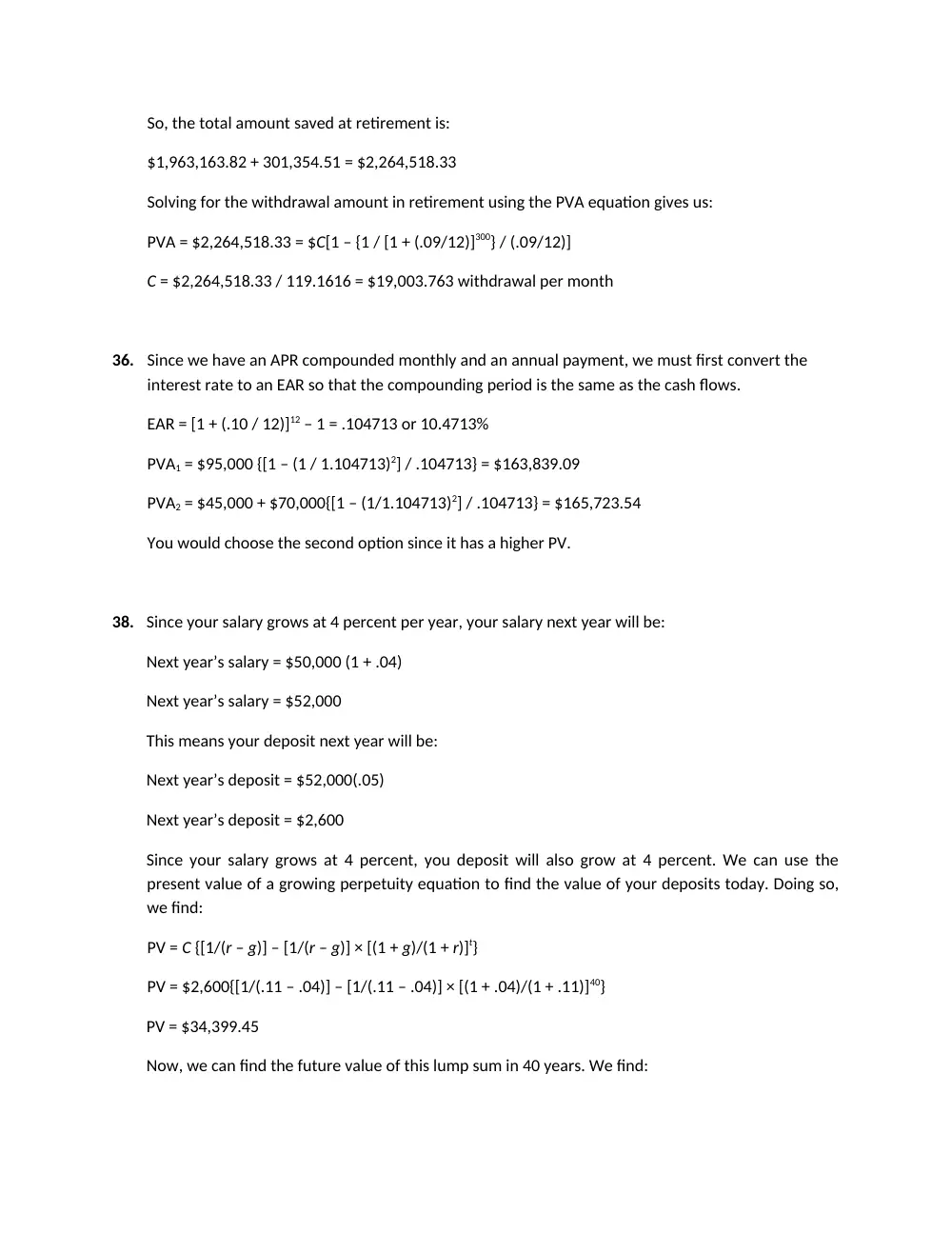
So, the total amount saved at retirement is:
$1,963,163.82 + 301,354.51 = $2,264,518.33
Solving for the withdrawal amount in retirement using the PVA equation gives us:
PVA = $2,264,518.33 = $C[1 – {1 / [1 + (.09/12)]300} / (.09/12)]
C = $2,264,518.33 / 119.1616 = $19,003.763 withdrawal per month
36. Since we have an APR compounded monthly and an annual payment, we must first convert the
interest rate to an EAR so that the compounding period is the same as the cash flows.
EAR = [1 + (.10 / 12)]12 – 1 = .104713 or 10.4713%
PVA1 = $95,000 {[1 – (1 / 1.104713)2] / .104713} = $163,839.09
PVA2 = $45,000 + $70,000{[1 – (1/1.104713)2] / .104713} = $165,723.54
You would choose the second option since it has a higher PV.
38. Since your salary grows at 4 percent per year, your salary next year will be:
Next year’s salary = $50,000 (1 + .04)
Next year’s salary = $52,000
This means your deposit next year will be:
Next year’s deposit = $52,000(.05)
Next year’s deposit = $2,600
Since your salary grows at 4 percent, you deposit will also grow at 4 percent. We can use the
present value of a growing perpetuity equation to find the value of your deposits today. Doing so,
we find:
PV = C {[1/(r – g)] – [1/(r – g)] × [(1 + g)/(1 + r)]t}
PV = $2,600{[1/(.11 – .04)] – [1/(.11 – .04)] × [(1 + .04)/(1 + .11)]40}
PV = $34,399.45
Now, we can find the future value of this lump sum in 40 years. We find:
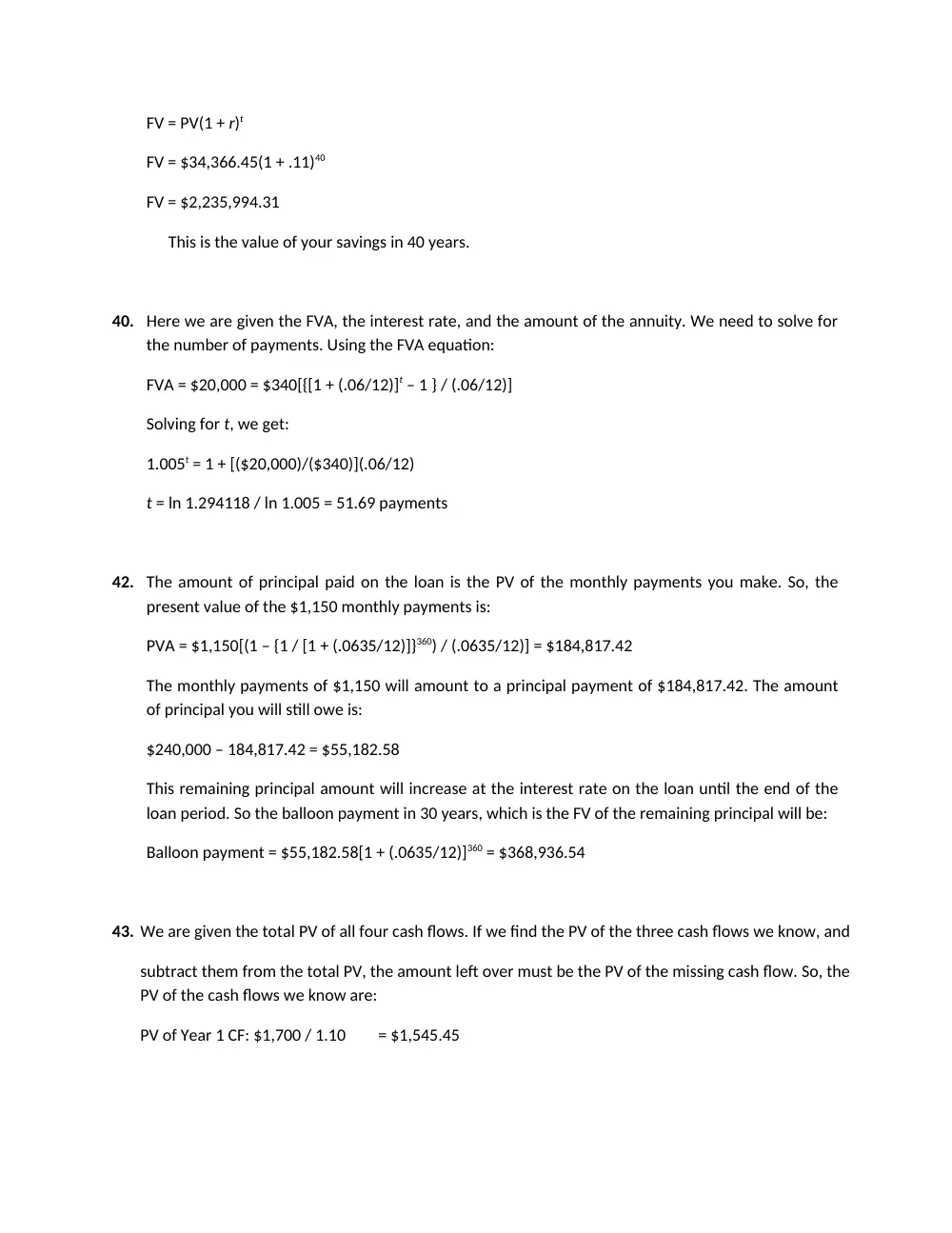
FV = PV(1 + r)t
FV = $34,366.45(1 + .11)40
FV = $2,235,994.31
This is the value of your savings in 40 years.
40. Here we are given the FVA, the interest rate, and the amount of the annuity. We need to solve for
the number of payments. Using the FVA equation:
FVA = $20,000 = $340[{[1 + (.06/12)]t – 1 } / (.06/12)]
Solving for t, we get:
1.005t = 1 + [($20,000)/($340)](.06/12)
t = ln 1.294118 / ln 1.005 = 51.69 payments
42. The amount of principal paid on the loan is the PV of the monthly payments you make. So, the
present value of the $1,150 monthly payments is:
PVA = $1,150[(1 – {1 / [1 + (.0635/12)]}360) / (.0635/12)] = $184,817.42
The monthly payments of $1,150 will amount to a principal payment of $184,817.42. The amount
of principal you will still owe is:
$240,000 – 184,817.42 = $55,182.58
This remaining principal amount will increase at the interest rate on the loan until the end of the
loan period. So the balloon payment in 30 years, which is the FV of the remaining principal will be:
Balloon payment = $55,182.58[1 + (.0635/12)]360 = $368,936.54
43. We are given the total PV of all four cash flows. If we find the PV of the three cash flows we know, and
subtract them from the total PV, the amount left over must be the PV of the missing cash flow. So, the
PV of the cash flows we know are:
PV of Year 1 CF: $1,700 / 1.10
= $1,545.45
PV of Year 3 CF: $2,100 / 1.103
= $1,577.76
PV of Year 4 CF: $2,800 / 1.104
= $1,912.44
So, the PV of the missing CF is:
$6,550 – 1,545.45 – 1,577.76 – 1,912.44 = $1,514.35
The question asks for the value of the cash flow in Year 2, so we must find the future value of this
amount. The value of the missing CF is:
$1,514.35(1.10)2 = $1,832.36
48. This question is asking for the present value of an annuity, but the interest rate changes during the
life of the annuity. We need to find the present value of the cash flows for the last eight years first.
The PV of these cash flows is:
PVA2 = $1,500 [{1 – 1 / [1 + (.07/12)]96} / (.07/12)] = $110,021.35
Note that this is the PV of this annuity exactly seven years from today. Now we can discount this
lump sum to today. The value of this cash flow today is:
PV = $110,021.35 / [1 + (.11/12)]84 = $51,120.33
Now we need to find the PV of the annuity for the first seven years. The value of these cash flows
today is:
PVA1 = $1,500 [{1 – 1 / [1 + (.11/12)]84} / (.11/12)] = $87,604.36
The value of the cash flows today is the sum of these two cash flows, so:
PV = $51,120.33 + 87,604.36 = $138,724.68
51. To find the APR and EAR, we need to use the actual cash flows of the loan. In other words, the
interest rate quoted in the problem is only relevant to determine the total interest under the terms
given. The interest rate for the cash flows of the loan is:
PVA = $25,000 = $2,416.67{(1 – [1 / (1 + r)]12 ) / r }
Again, we cannot solve this equation for r, so we need to solve this equation on a financial
calculator, using a spreadsheet, or by trial and error. Using a spreadsheet, we find:
r = 2.361% per month
So the APR is:
APR = 12(2.361%) = 28.33%
And the EAR is:
EAR = (1.02361)12 – 1 = .3231 or 32.31%
To answer this question, we should find the PV of both options, and compare them. Since we are
purchasing the car, the lowest PV is the best option. The PV of the leasing is simply the PV of the
lease payments, plus the $99. The interest rate we would use for the leasing option is the same as
the interest rate of the loan. The PV of leasing is:
PV = $99 + $450{1 – [1 / (1 + .07/12)12(3)]} / (.07/12) = $14,672.91
The PV of purchasing the car is the current price of the car minus the PV of the resale price. The PV
of the resale price is:
PV = $23,000 / [1 + (.07/12)]12(3) = $18,654.82
The PV of the decision to purchase is:
$32,000 – 18,654.82 = $13,345.18
In this case, it is cheaper to buy the car than leasing it since the PV of the purchase cash flows is
lower. To find the breakeven resale price, we need to find the resale price that makes the PV of the
two options the same. In other words, the PV of the decision to buy should be:
$32,000 – PV of resale price = $14,672.91
PV of resale price = $17,327.09
The resale price that would make the PV of the lease versus buy decision is the FV of this value, so:
Breakeven resale price = $17,327.09[1 + (.07/12)]12(3) = $21,363.01
61. Here we have cash flows that would have occurred in the past and cash flows that would occur in
the future. We need to bring both cash flows to today. Before we calculate the value of the cash
flows today, we must adjust the interest rate so we have the effective monthly interest rate.
Finding the APR with monthly compounding and dividing by 12 will give us the effective monthly
rate. The APR with monthly compounding is:
APR = 12[(1.08)1/12 – 1] = .0772 or 7.72%
To find the value today of the back pay from two years ago, we will find the FV of the annuity, and
then find the FV of the lump sum. Doing so gives us:
FVA = ($47,000/12) [{[ 1 + (.0772/12)]12 – 1} / (.0772/12)] = $48,699.39
FV = $48,699.39(1.08) = $52,595.34
Notice we found the FV of the annuity with the effective monthly rate, and then found the FV of
the lump sum with the EAR. Alternatively, we could have found the FV of the lump sum with the
effective monthly rate as long as we used 12 periods. The answer would be the same either way.
Now, we need to find the value today of last year’s back pay:
FVA = ($50,000/12) [{[ 1 + (.0772/12)]12 – 1} / (.0772/12)] = $51,807.86
Next, we find the value today of the five year’s future salary:
PVA = ($55,000/12){[{1 – {1 / [1 + (.0772/12)]12(5)}] / (.0772/12)}= $227,539.14
The value today of the jury award is the sum of salaries, plus the compensation for pain and
suffering, and court costs. The award should be for the amount of:
Award = $52,595.34 + 51,807.86 + 227,539.14 + 100,000 + 20,000 = $451,942.34
As the plaintiff, you would prefer a lower interest rate. In this problem, we are calculating both the
PV and FV of annuities. A lower interest rate will decrease the FVA, but increase the PVA. So, by a
lower interest rate, we are lowering the value of the back pay. But, we are also increasing the PV of
the future salary. Since the future salary is larger and has a longer time, this is the more important
cash flow to the plaintiff.
65. Be careful of interest rate quotations. The actual interest rate of a loan is determined by the cash
flows. Here, we are told that the PV of the loan is $1,000, and the payments are $41.15 per month
for three years, so the interest rate on the loan is:
PVA = $1,000 = $41.15[{1 – [1 / (1 + r)]36 } / r ]
Solving for r with a spreadsheet, on a financial calculator, or by trial and error, gives:
r = 2.30% per month
APR = 12(2.30%) = 27.61%
EAR = (1 + .0230)12 – 1 = 31.39%
It’s called add-on interest because the interest amount of the loan is added to the principal amount
of the loan before the loan payments are calculated.
66. Here we are solving a two-step time value of money problem. Each question asks for a different
possible cash flow to fund the same retirement plan. Each savings possibility has the same FV, that
is, the PV of the retirement spending when your friend is ready to retire. The amount needed when
your friend is ready to retire is:
PVA = $105,000{[1 – (1/1.07)20] / .07} = $1,112,371.50
This amount is the same for all three parts of this question.
a. If your friend makes equal annual deposits into the account, this is an annuity with the FVA
equal to the amount needed in retirement. The required savings each year will be:
FVA = $1,112,371.50 = C[(1.0730 – 1) / .07]
C = $11,776.01
b. Here we need to find a lump sum savings amount. Using the FV for a lump sum equation, we
get:
FV = $1,112,371.50 = PV(1.07)30
PV = $146,129.04
c. In this problem, we have a lump sum savings in addition to an annual deposit. Since we already
know the value needed at retirement, we can subtract the value of the lump sum savings at
retirement to find out how much your friend is short. Doing so gives us:
FV of trust fund deposit = $150,000(1.07)10 = $295,072.70
So, the amount your friend still needs at retirement is:
FV = $1,112,371.50 – 295,072.70 = $817,298.80
Using the FVA equation, and solving for the payment, we get:
$817,298.80 = C[(1.07 30 – 1) / .07]
C = $8,652.25
This is the total annual contribution, but your friend’s employer will contribute $1,500 per year,
so your friend must contribute:
Friend's contribution = $8,652.25 – 1,500 = $7,152.25
Chapter 7
3.
The price of any bond is the PV of the interest payment, plus the PV of the par value. Notice this
problem assumes an annual coupon. The price of the bond will be:
P = $75({1 – [1/(1 + .0875)]10 } / .0875) + $1,000[1 / (1 + .0875)10] = $918.89
We would like to introduce shorthand notation here. Rather than write (or type, as the case may
be) the entire equation for the PV of a lump sum, or the PVA equation, it is common to abbreviate
the equations as:
PVIFR,t = 1 / (1 + r)t
which stands for Present Value Interest Factor
PVIFAR,t = ({1 – [1/(1 + r)]t } / r )
which stands for Present Value Interest Factor of an Annuity
These abbreviations are short hand notation for the equations in which the interest rate and the
number of periods are substituted into the equation and solved. We will use this shorthand
notation in remainder of the solutions key.
5.
Here we need to find the coupon rate of the bond. All we need to do is to set up the bond pricing
equation and solve for the coupon payment as follows:
P = $1,045 = C(PVIFA7.5%,13) + $1,000(PVIF7.5%,36)
Solving for the coupon payment, we get:
C = $80.54
The coupon payment is the coupon rate times par value. Using this relationship, we get:
Coupon rate = $80.54 / $1,000 = .0805 or 8.05%
7.
Here we are finding the YTM of a semiannual coupon bond. The bond price equation is:
P = $1,050 = $42(PVIFAR%,20) + $1,000(PVIFR%,20)
Since we cannot solve the equation directly for R, using a spreadsheet, a financial calculator, or trial
and error, we find:
R = 3.837%
Since the coupon payments are semiannual, this is the semiannual interest rate. The YTM is the
APR of the bond, so:
YTM = 2
3.837% = 7.67%
15. Here we are finding the YTM of semiannual coupon bonds for various maturity lengths. The bond
price equation is:
P = C(PVIFAR%,t) + $1,000(PVIFR%,t)
X:
P0 = $80(PVIFA6%,13) + $1,000(PVIF6%,13)
= $1,177.05
P1 = $80(PVIFA6%,12) + $1,000(PVIF6%,12)
= $1,167.68
P3 = $80(PVIFA6%,10) + $1,000(PVIF6%,10)
= $1,147.20
P8 = $80(PVIFA6%,5) + $1,000(PVIF6%,5)
= $1,084.25
P12 = $80(PVIFA6%,1) + $1,000(PVIF6%,1)
= $1,018.87
P13
= $1,000
Y:
P0 = $60(PVIFA8%,13) + $1,000(PVIF8%,13)
= $841.92
P1 = $60(PVIFA8%,12) + $1,000(PVIF8%,12)
= $849.28
P3 = $60(PVIFA8%,10) + $1,000(PVIF8%,10)
= $865.80
P8 = $60(PVIFA8%,5) + $1,000(PVIF8%,5)
= $920.15
P12 = $60(PVIFA8%,1) + $1,000(PVIF8%,1)
= $981.48
P13
= $1,000
All else held equal, the premium over par value for a premium bond declines as maturity
approaches, and the discount from par value for a discount bond declines as maturity approaches.
This is called “pull to par.” In both cases, the largest percentage price changes occur at the shortest
maturity lengths.
Also, notice that the price of each bond when no time is left to maturity is the par value, even
though the purchaser would receive the par value plus the coupon payment immediately. This is
because we calculate the clean price of the bond.
16. Any bond that sells at par has a YTM equal to the coupon rate. Both bonds sell at par, so the initial
YTM on both bonds is the coupon rate, 9 percent. If the YTM suddenly rises to 11 percent:
PSam
= $45(PVIFA5.5%,6) + $1,000(PVIF5.5%,6)
= $950.04
PDave
= $45(PVIFA5.5%,40) + $1,000(PVIF5.5%,40)
= $839.54
The percentage change in price is calculated as:
Percentage change in price = (New price – Original price) / Original price
PSam%
= ($950.04 – 1,000) / $1,000 = – 5.00%
PDave%
= ($839.54 – 1,000) / $1,000 = – 16.05%
If the YTM suddenly falls to 7 percent:
PSam
= $45(PVIFA3.5%,6) + $1,000(PVIF3.5%,6)
= $1,053.29
PDave
= $45(PVIFA3.5%,40) + $1,000(PVIF3.5%,40)
= $1,213.55
PSam%
= ($1,053.29 – 1,000) / $1,000 = + 5.33%
PDave%
= ($1,213.55 – 1,000) / $1,000 = + 21.36%
All else the same, the longer the maturity of a bond, the greater is its price sensitivity to changes in
interest rates.
19. The company should set the coupon rate on its new bonds equal to the required return. The
required return can be observed in the market by finding the YTM on the outstanding bonds of the
company. So, the YTM on the bonds currently sold in the market is:
P = $930 = $40(PVIFAR%,40) + $1,000(PVIFR%,40)
Using a spreadsheet, financial calculator, or trial and error we find:
R = 4.373%
This is the semiannual interest rate, so the YTM is:
YTM = 2 4.373% = 8.75%
22. To find the number of years to maturity for the bond, we need to find the price of the bond. Since
we already have the coupon rate, we can use the bond price equation, and solve for the number of
years to maturity. We are given the current yield of the bond, so we can calculate the price as:
Current yield = .0755 = $80/P0
P0 = $80/.0755 = $1,059.60
Now that we have the price of the bond, the bond price equation is:
P = $1,059.60 = $80[(1 – (1/1.072)t ) / .072 ] + $1,000/1.072t
We can solve this equation for t as follows:
$1,059.60(1.072)t = $1,111.11(1.072)t – 1,111.11 + 1,000
111.11 = 51.51(1.072)t
2.1570 = 1.072t
t = log 2.1570 / log 1.072 = 11.06 11 years
The bond has 11 years to maturity.
31. The price of any bond (or financial instrument) is the PV of the future cash flows. Even though Bond
M makes different coupons payments, to find the price of the bond, we just find the PV of the cash
flows. The PV of the cash flows for Bond M is:
PM
= $1,100(PVIFA3.5%,16)(PVIF3.5%,12) + $1,400(PVIFA3.5%,12)(PVIF3.5%,28) + $20,000(PVIF3.5%,40)
PM
= $19,018.78
Notice that for the coupon payments of $1,400, we found the PVA for the coupon payments, and
then discounted the lump sum back to today.
Bond N is a zero coupon bond with a $20,000 par value, therefore, the price of the bond is the PV
of the par, or:
PN
= $20,000(PVIF3.5%,40) = $5,051.45
Chapter 8
1.
The constant dividend growth model is:
Pt = Dt × (1 + g) / (R – g)
So the price of the stock today is:
P0 = D0 (1 + g) / (R – g) = $1.95 (1.06) / (.11 – .06) = $41.34
The dividend at year 4 is the dividend today times the FVIF for the growth rate in dividends and
four years, so:
P3 = D3 (1 + g) / (R – g) = D0 (1 + g)4 / (R – g) = $1.95 (1.06)4 / (.11 – .06) = $49.24
We can do the same thing to find the dividend in Year 16, which gives us the price in Year 15, so:
P15 = D15 (1 + g) / (R – g) = D0 (1 + g)16 / (R – g) = $1.95 (1.06)16 / (.11 – .06) = $99.07
There is another feature of the constant dividend growth model: The stock price grows at the
dividend growth rate. So, if we know the stock price today, we can find the future value for any
time in the future we want to calculate the stock price. In this problem, we want to know the stock
price in three years, and we have already calculated the stock price today. The stock price in three
years will be:
P3 = P0(1 + g)3 = $41.34(1 + .06)3 = $49.24
And the stock price in 15 years will be:
P15 = P0(1 + g)15 = $41.34(1 + .06)15 = $99.07
5.
The required return of a stock is made up of two parts: The dividend yield and the capital gains
yield. So, the required return of this stock is:
R = Dividend yield + Capital gains yield = .063 + .052 = .1150 or 11.50%
7.
The price of any financial instrument is the PV of the future cash flows. The future dividends of this
stock are an annuity for 11 years, so the price of the stock is the PVA, which will be:
P0 = $9.75(PVIFA10%,11) = $63.33
8.
The price a share of preferred stock is the dividend divided by the required return. This is the same
equation as the constant growth model, with a dividend growth rate of zero percent. Remember,
most preferred stock pays a fixed dividend, so the growth rate is zero. Using this equation, we find
the price per share of the preferred stock is:
R = D/P0 = $5.50/$108 = .0509 or 5.09%
10. This stock has a constant growth rate of dividends, but the required return changes twice. To find
the value of the stock today, we will begin by finding the price of the stock at Year 6, when both the
dividend growth rate and the required return are stable forever. The price of the stock in Year 6 will
be the dividend in Year 7, divided by the required return minus the growth rate in dividends. So:
P6 = D6 (1 + g) / (R – g) = D0 (1 + g)7 / (R – g) = $3.50 (1.05)7 / (.10 – .05) = $98.50
Now we can find the price of the stock in Year 3. We need to find the price here since the required
return changes at that time. The price of the stock in Year 3 is the PV of the dividends in Years 4, 5,
and 6, plus the PV of the stock price in Year 6. The price of the stock in Year 3 is:
P3 = $3.50(1.05)4 / 1.12 + $3.50(1.05)5 / 1.122 + $3.50(1.05)6 / 1.123 + $98.50 / 1.123
P3
= $80.81
Finally, we can find the price of the stock today. The price today will be the PV of the dividends in
Years 1, 2, and 3, plus the PV of the stock in Year 3. The price of the stock today is:
P0 = $3.50(1.05) / 1.14 + $3.50(1.05)2 / (1.14)2 + $3.50(1.05)3 / (1.14)3 + $80.81 / (1.14)3
P0 = $63.47
12. The price of a stock is the PV of the future dividends. This stock is paying four dividends, so the
price of the stock is the PV of these dividends using the required return. The price of the stock is:
P0 = $10 / 1.11 + $14 / 1.112 + $18 / 1.113 + $22 / 1.114 + $26 / 1.115 = $63.45
14. With supernormal dividends, we find the price of the stock when the dividends level off at a
constant growth rate, and then find the PV of the futures stock price, plus the PV of all dividends
during the supernormal growth period. The stock begins constant growth in Year 4, so we can find
the price of the stock in Year 3, one year before the constant dividend growth begins as:
P3 = D3 (1 + g) / (R – g) = D0 (1 + g1)3 (1 + g2) / (R – g)
P3 = $1.80(1.30)3(1.06) / (.13 – .06)
P3 = $59.88
The price of the stock today is the PV of the first three dividends, plus the PV of the Year 3 stock
price. The price of the stock today will be:
P0 = $1.80(1.30) / 1.13 + $1.80(1.30)2 / 1.132 + $1.80(1.30)3 / 1.133 + $59.88 / 1.133
P0 = $48.70
We could also use the two-stage dividend growth model for this problem, which is:
P0 = [D0(1 + g1)/(R – g1)]{1 – [(1 + g1)/(1 + R)]T}+ [(1 + g1)/(1 + R)]T[D0(1 + g1)/(R – g1)]
P0 = [$1.80(1.30)/(.13 – .30)][1 – (1.30/1.13)3] + [(1 + .30)/(1 + .13)]3[$1.80(1.06)/(.13 – .06)]
P0 = $48.70
16. The constant growth model can be applied even if the dividends are declining by a constant
percentage, just make sure to recognize the negative growth. So, the price of the stock today will
be:
P0 = D0 (1 + g) / (R – g)
P0 = $10.46(1 – .04) / [(.115 – (–.04)]
P0 = $64.78
21. We can use the two-stage dividend growth model for this problem, which is:
P0 = [D0(1 + g1)/(R – g1)]{1 – [(1 + g1)/(1 + R)]T}+ [(1 + g1)/(1 + R)]T[D0(1 + g2)/(R – g2)]
P0 = [$1.74(1.25)/(.12 – .25)][1 – (1.25/1.12)11] + [(1.25)/(1.12)]11[$1.74(1.06)/(.12 – .06)]
P0 = $142.14
25. Here we want to find the required return that makes the PV of the dividends equal to the current
stock price. The equation for the stock price is:
P = $2.45(1.20)/(1 + R) + $2.45(1.20)(1.15)/(1 + R)2 + $2.45(1.20)(1.15)(1.10)/(1 + R)3
+ [$2.45(1.20)(1.15)(1.10)(1.05)/(R – .05)]/(1 + R)3 = $63.82
We need to find the roots of this equation. Using spreadsheet, trial and error, or a calculator with a
root solving function, we find that:
R = 10.24%
Chapter 9
3.
Project A has cash flows of $19,000 in Year 1, so the cash flows are short by $21,000 of recapturing
the initial investment, so the payback for Project A is:
Payback = 1 + ($21,000 / $25,000) = 1.84 years
Project B has cash flows of:
Cash flows = $14,000 + 17,000 + 24,000 = $55,000
during this first three years. The cash flows are still short by $5,000 of recapturing the initial
investment, so the payback for Project B is:
B:
Payback = 3 + ($5,000 / $270,000) = 3.019 years
Using the payback criterion and a cutoff of 3 years, accept project A and reject project B.
5.
R = 0%:
3 + ($2,