
GEOL 102 Final, Spring 2000
American University of Beirut · Environmental Physical Geography · 3 pages

More GEOL 102 files
- Final · Fall 2005Final examView
- Final Previous · Fall 2003Final examView
- Final · Fall 1999Final examView
- Final · Spring 1999Final examView
- Problems Topic 6 · Spring 2012ProblemsView
- Exam 1 Previous with Answers · Fall 2003Exam · with solutionView
- Exam 1 Previous with Answers · Fall 2003Exam · with solutionView
- Exam 2 Previous · Fall 2003ExamView
Show the text of this final exam
f
reeves
American University of Beirut
Environmental Physical Geography
Geology 102
Final Exam
June, 10", 2000
Student’s name:
Part I
Choose the best answer (4 pts each, total 48 pts):
1. On the Fahrenheit scale, the water boils at:
273 degrees
212 degrees
32 degrees
minus 459.4 degrees
. The minerals made of metals combined with chlorine, fluorine and iodine are:
halides
sulfides
carbonates
sulfates
. The proportion of water vapor present in a parcel of air relative to the maximum amount
of water vapor that air could hold at the same temperature is:
relative humidity
specific humidity
mixing ratio
dew point
. The climate type with at least one month greater than 10°C and the coldest month
between 18°C and 0°C is:
mesothermal
tropical
microthermal
polar
. The study of the width of the annual growth rings of the trees is:
varves
dendrochronology
cryosphere
isotopes
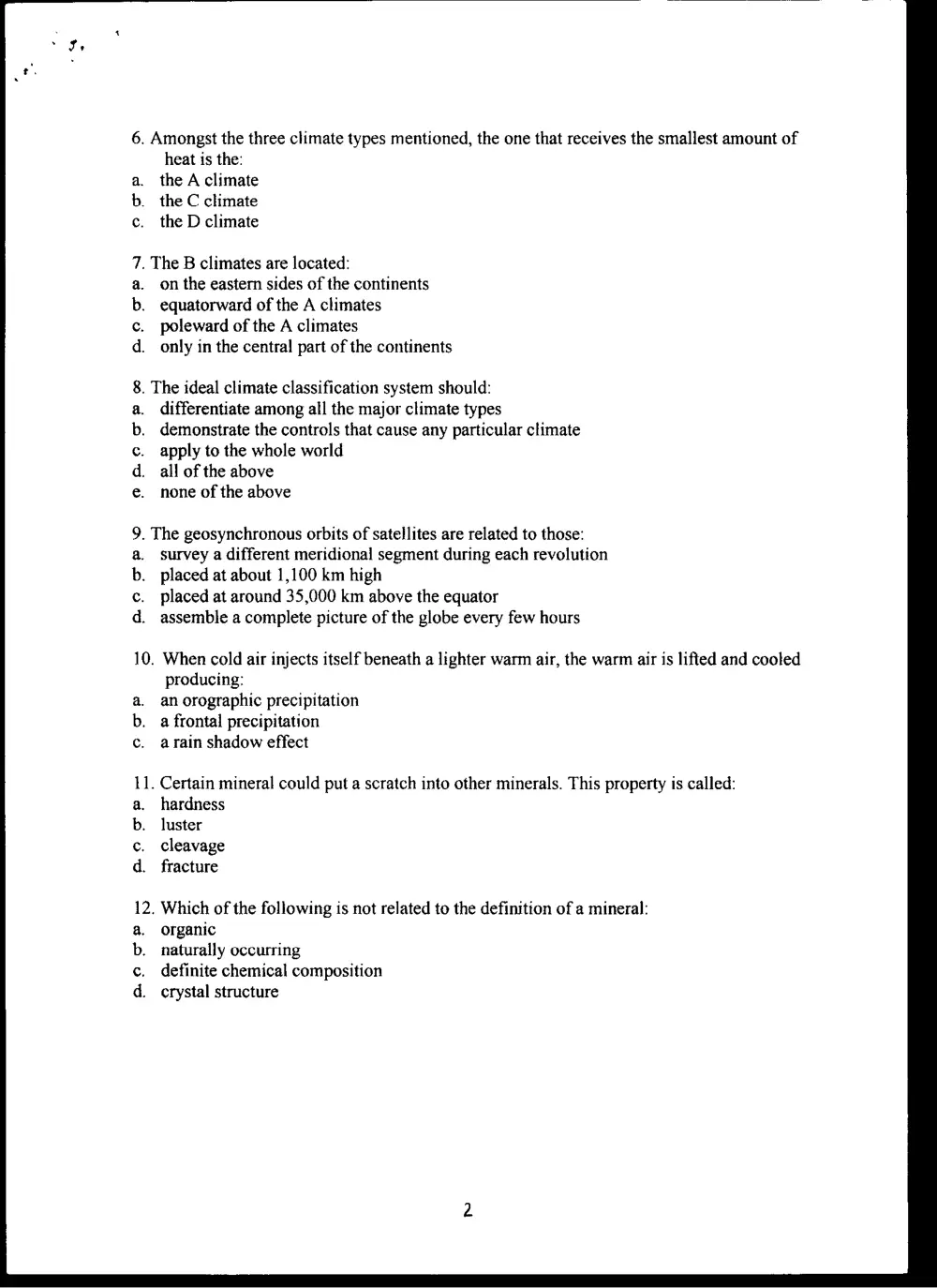
6. Amongst the three climate types mentioned, the one that receives the smallest amount of
heat is the:
the A climate
the C climate
the D climate
. The B climates are located:
on the eastern sides of the continents
equatorward of the A climates
poleward of the A climates
only in the central part of the continents
. The ideal climate classification system should:
differentiate among all the major climate types
demonstrate the controls that cause any particular climate
apply to the whole world
all of the above
none of the above
. The geosynchronous orbits of satellites are related to those:
survey a different meridional segment during each revolution
placed at about 1,100 km high
placed at around 35,000 km above the equator
assemble a complete picture of the globe every few hours
. When cold air injects itself beneath a lighter warm air, the warm air is lifted and cooled
producing:
an orographic precipitation
a frontal precipitation
a rain shadow effect
1. Certain mineral could put a scratch into other minerals. This property is called:
hardness
luster
cleavage
fracture
. Which of the following is not related to the definition of a mineral:
organic
naturally occurring
definite chemical composition
crystal structure
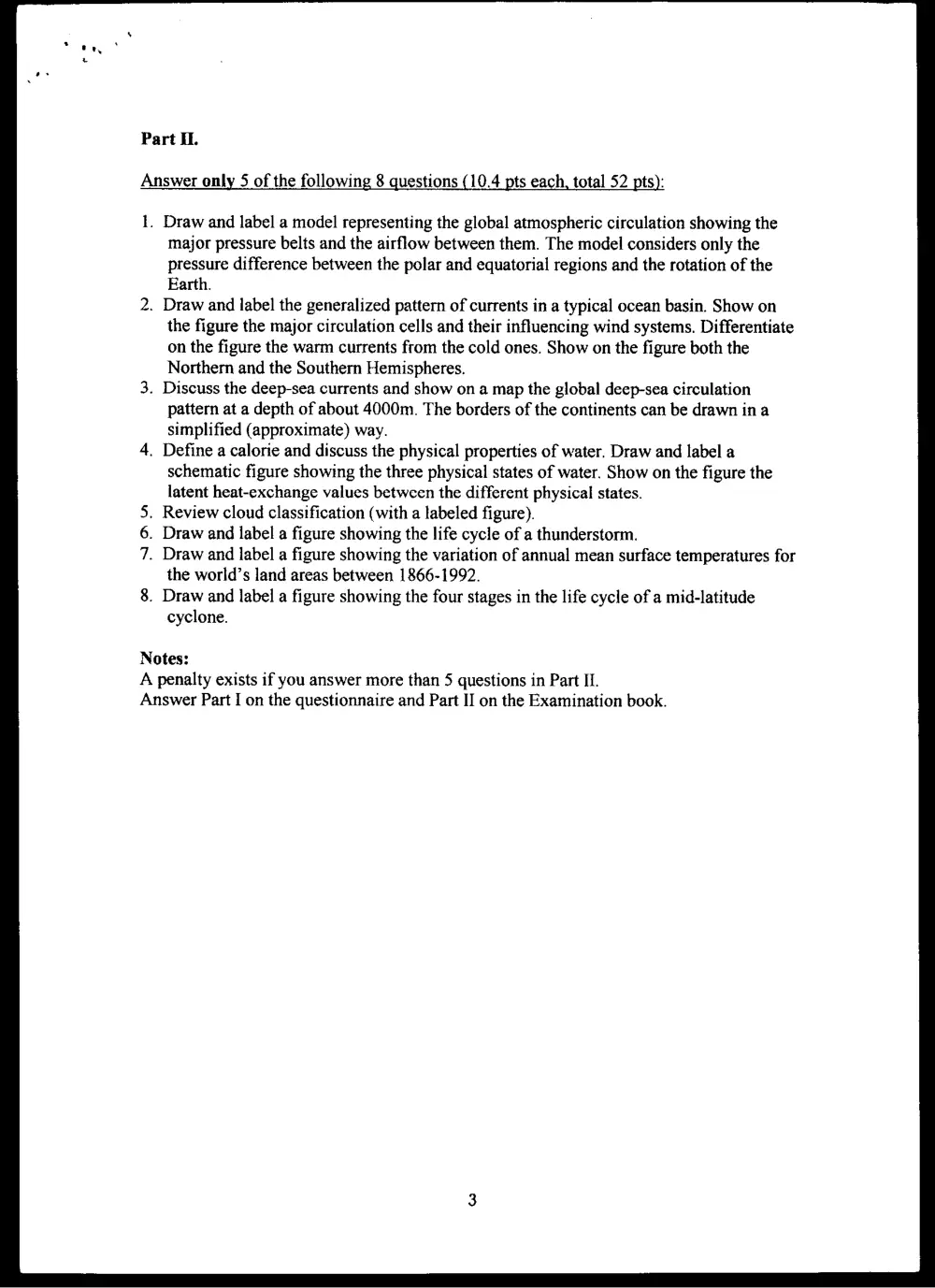
Part I.
Answer only 5 of the following 8 questions (10.4 pts each, total 52 pts):
1. Draw and label a model representing the global atmospheric circulation showing the
major pressure belts and the airflow between them. The model considers only the
pressure difference between the polar and equatorial regions and the rotation of the
Earth.
. Draw and label the generalized pattern of currents in a typical ocean basin. Show on
the figure the major circulation cells and their influencing wind systems. Differentiate
on the figure the warm currents from the cold ones. Show on the figure both the
Northern and the Southern Hemispheres.
. Discuss the deep-sea currents and show on a map the global deep-sea circulation
pattern at a depth of about 4000m. The borders of the continents can be drawn ina
simplified (approximate) way.
. Define a calorie and discuss the physical properties of water. Draw and label a
schematic figure showing the three physical states of water. Show on the figure the
latent heat-exchange values betwcen the different physical states.
. Review cloud classification (with a labeled figure).
. Draw and label a figure showing the life cycle of a thunderstorm.
. Draw and label a figure showing the variation of annual mean surface temperatures for
the world’s land areas between 1866-1992.
. Draw and label a figure showing the four stages in the life cycle of a mid-latitude
cyclone.
Notes:
A penalty exists if you answer more than 5 questions in Part II.
Answer Part I on the questionnaire and Part II on the Examination book.