
GEOL 211 Final, Spring 1998
American University of Beirut · Crystallography and Physical Mineralogy · 2 pages

More GEOL 211 files
Show the text of this final exam
* Pe icay CSIVERSIT
hIBRAR Y
er re teed
mae | _
a
The American University of Beirut
Final Examination
Crystallography/Mineralogy (211) June 23, 1998
Department of Geology Time: 2 hours
Dr. A.M. Abdel-Rahman Exam rules apply
Part I
Answer all questions in Part I
(MARKS )
(20) 1. (a) Describe the so-called "Biopyriboles", and give
a mineralogical example.
(b) How do pyroxenoids differ from pyroxenes; name
a pyroxenoid mineral, and give its composition.
(c) Zeolites have been used for a number of
applications; Discuss one of these
applications, with emphasis on the role of
substitution.
(d) Give the general formula of a dioctahedral mica,
and of a trioctahedral mica, and give the
coordination number of the various structural
sites in the formulae.
(e) Given below is a diagrammatic sketch of the
structure of chlorite. Describe this structure
in detail.
Tale
layer
Brucite-like
layer
Concisely describe the structure of the three
polymorphs of Al,Sio,, with special reference to Al-
coordination polyhedra and structural sites. Comment
on the importance of these minerals for petrologists
(use diagrams along with text to illustrate your
answer).
Give the exact chemical formula for each of the
following minerals.
Aragonite Leucite
Microcline : Ilmenite
Enstatite muscovite
Anthophyllite Almandine
Cristobalite ! j}) Fayalite
To which crystal! system does each of these point
groups belong:
mm2, 422, 23, 2/m, 432, 3/m 3/m 3/m, 6/m, 2
(a) List all the crystal systems, and give a mineral
example for each system.
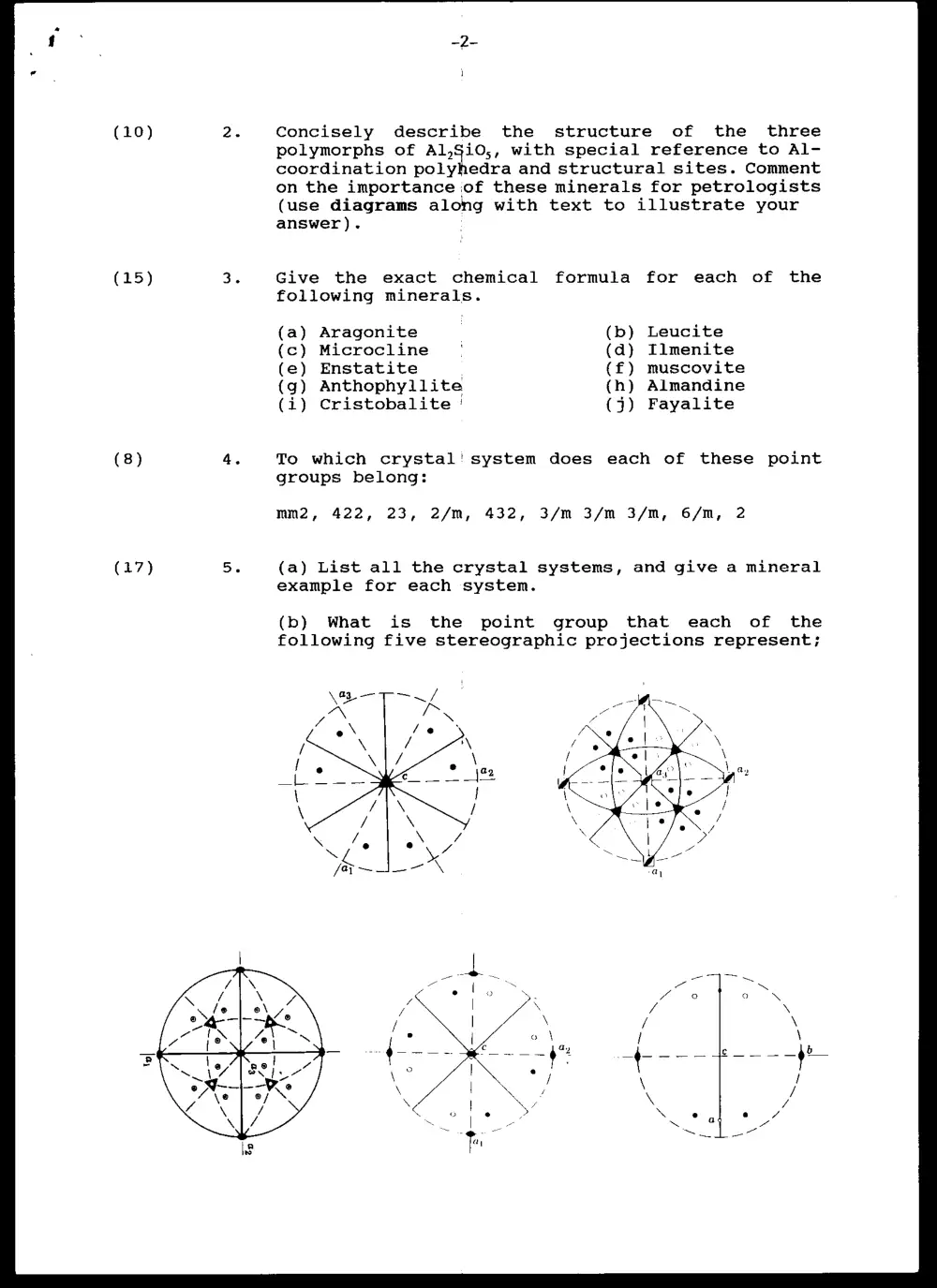
(b) What is the point group that each of the
following five stereographic projections represent;
\a—pos/
aN