
GEOL 211 Final, Spring 2000
American University of Beirut · Crystallography and Physical Mineralogy · 2 pages
More GEOL 211 files
Show the text of this final exam
The American University of Beirut oN /
Final Examination ’
Crystallography/Mineralogy (211) June 12, 2000
Department of Geology Time: 2 hours
A. M. Abdel-Rahman Exam rules apply
Part I
Answer all questions in Part I
(MARKS)
(15) 1. Concisely define (or describe) the following terms and
give examples when applicable:
(a) Trapezohedron (b) Unit face
(c) Bravais lattices (d) space group
(e) Twinning (£) Biopyriboles
(10) 2. Write an essay on the "Native elements (or minerals)":
make sure to describe their classification, giving
the mineral names, and their chemical formulae.
(20) 3. (a) To which crystal system does each of these
point groups belong:
2, 4/m, 2mm, 2/m3, 32, 23, 432, 6
(b) Give a mineralogical example for each of the
following crystal systems: Hexagonal rhombohedral,
isometric, triclinic, and orthorhombic.
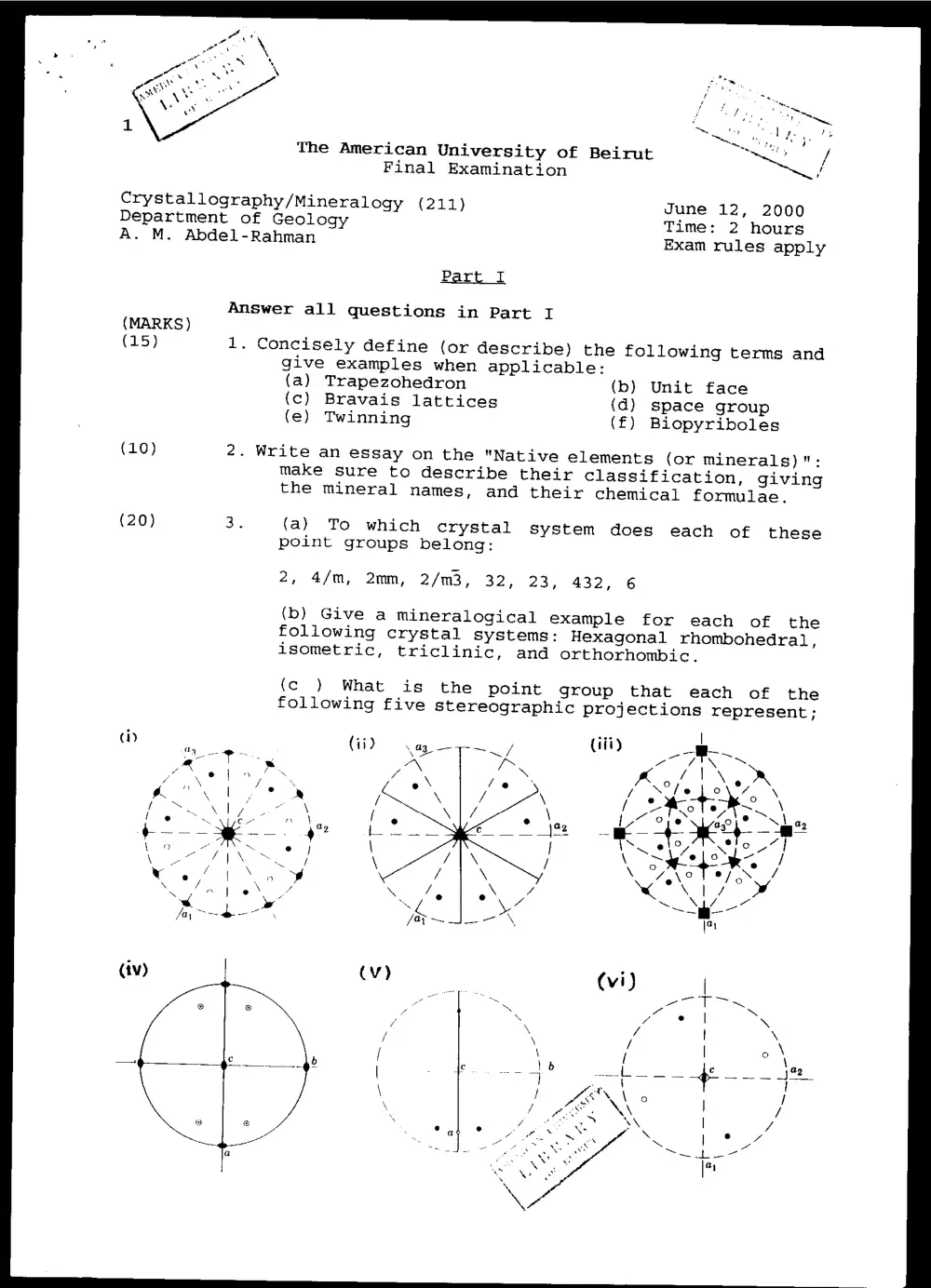
(c ) What is the point group that each of the
following five stereographic projections represent;
(i) _— (ii)
(20)
(20)
(20)
(a) Describe the structure and the occurrence of
these minerals, and give their chemical composition;
i) olivine, ii) tremolite, and iii) biotite.
(b) List the various types of twinning.
(c) Write an essay on the geochemical classification
of elements (provide examples), and its significance
in mineralogy.
Answer only Two out of three questions in Part II.
5. Pyroxene is an important silicate mineral group that
is commonly present in many rock types. Describe in
detail the classification of the pyroxene mineral
group, giving the mineral names and the exact
chemical formulae.
6. Describe in detail the classification of the feldspar
mineral group, with special emphasis on the general
formulae, and the types of feldspars present, giving
mineralogical examples, with their chemical
compositions (listing the An content when
applicable) for each of the classification
categories (use diagrams whenever possible).
Comment on the nature of substitution within this
mineral group. Comment on the temperature conditions
of their formation.
7. Briefly describe the classification of the garnet
mineral group, giving the mineral names and the
exact chemical formulae. Use the general formula to
describe the coordination polyhedra of the various
cations. Comment on the substitution among these
minerals (use diagrams to further illustrate your
answer), and comment on their occurrence.
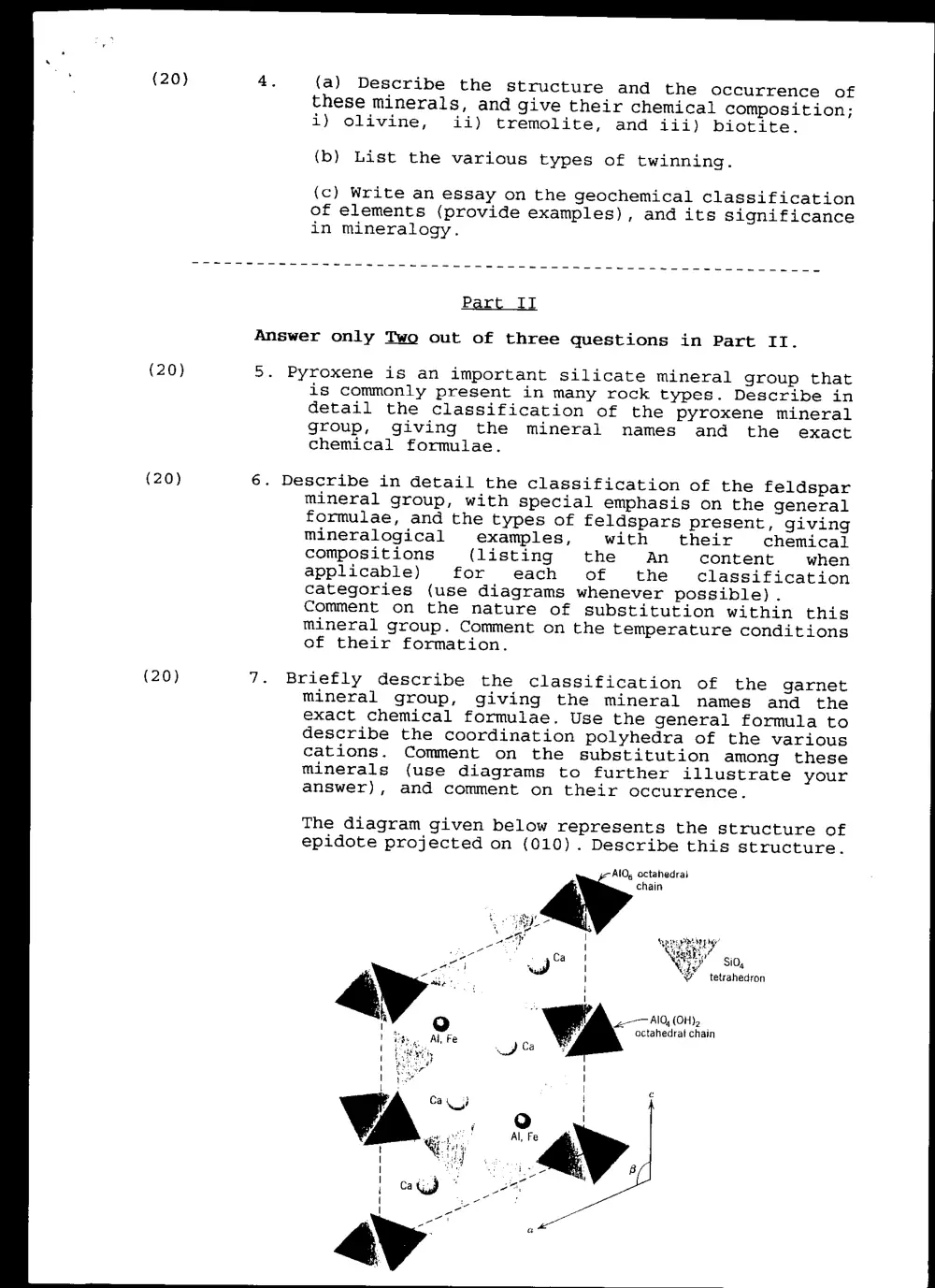
The diagram given below represents the structure of
epidote projected on (010). Describe this structure.
AlO, octahedral
chain
ae H ore
\
x? '
De hep hy’
”
SiO,
‘~~ tetrahedron
~ e- AIO, (OH)g
octahedrat chain
ar Ca ey
i}
t
1
1
|
|
4
i
1