
GEOL 213 Final, Fall 2005
American University of Beirut · Structural Geology · 9 pages



More GEOL 213 files
Show the text of this final exam
1
The American University of Beirut
Department of Geology
Structural Geology (Geol 213)
Fall 2005-2006: Final Examination
Dr. Maya El-Kibbi
Time: 2 hours
Name: ………………………..
Pledge: ……………………...
ID: ……………………………
Exam rules apply.
ALL DIAGRAMS SHOULD BE FULLY LABELED.
I. Short answers (5 pts each)
1. - What does the strain ellipsoid represent?
- Write the components of the strain tensor in a matrix form.
2. - Give the stress-strain equations for different stress types.
- Name all variables and parameters.
3. Briefly compare cylindrical and conical folds.
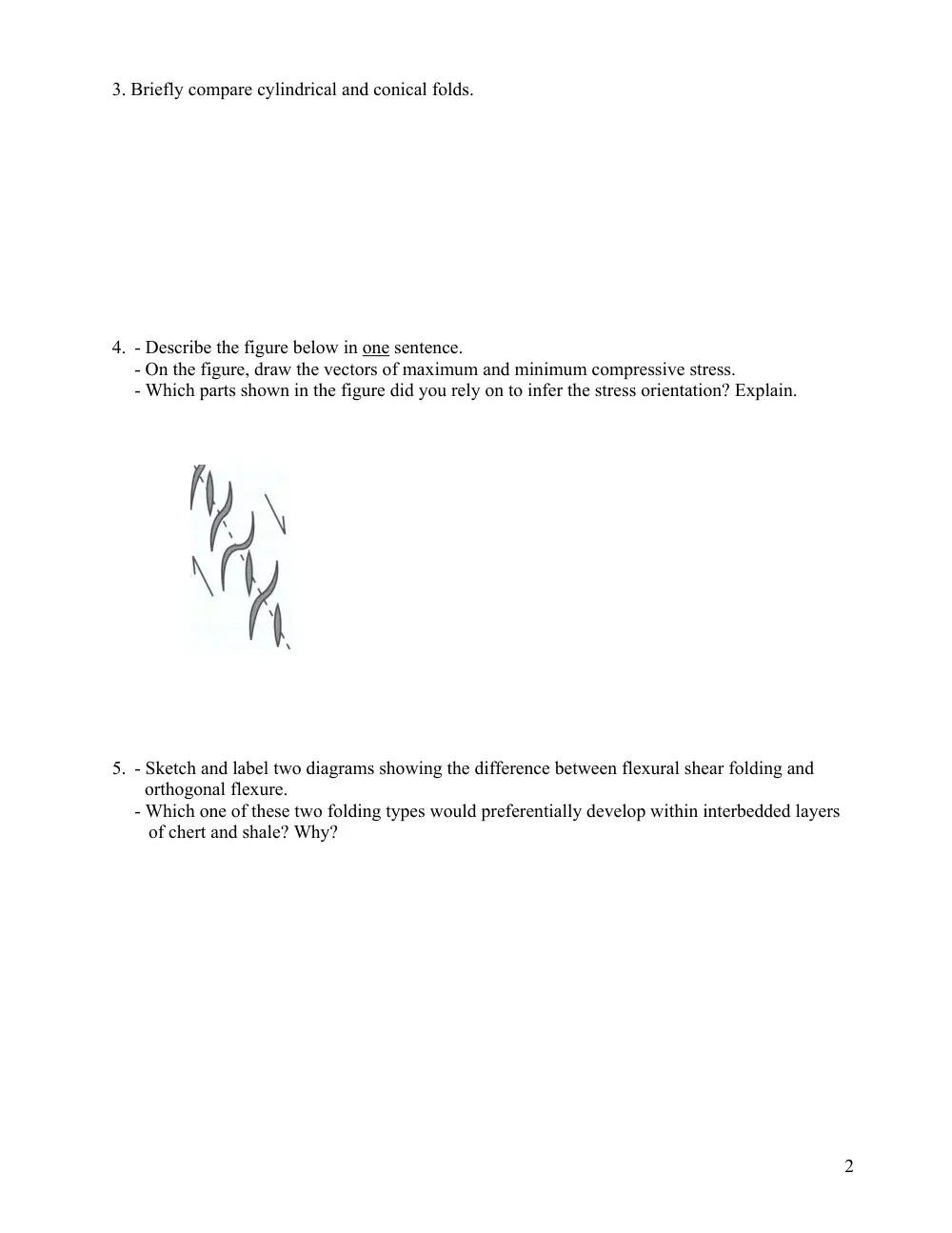
4. - Describe the figure below in one sentence.
- On the figure, draw the vectors of maximum and minimum compressive stress.
- Which parts shown in the figure did you rely on to infer the stress orientation? Explain.
5. - Sketch and label two diagrams showing the difference between flexural shear folding and
orthogonal flexure.
- Which one of these two folding types would preferentially develop within interbedded layers
of chert and shale? Why?
2
3
6. - Explain why strike-slip faults tend to be vertical based on Anderson’s theory of faulting.
- Draw a sketch to illustrate your answer.
7. - Briefly compare parallel folds and similar folds.
- Draw a sketch to illustrate your comparison (show the dip isogons).
8. - Draw and label a sketch showing S-C tectonites.
- In which structural environment do they develop?
4
9. How are pull-apart basins formed?
10. - Sketch a listric growth fault.
- Why is the petroleum industry interested in such fault types?
II. Answer all questions. (8 pts each)
1. Using a diagram, explain how, in ductile shear zones, the sense of shear can be inferred from
sigma-type porphyroclast tail morphology.
5
2. - Draw one labeled sketch showing the fracture envelopes for tension fracture, brittle shear
fracture, and ductile shear failure. (Don’t forget to label the axes).
- Write the equation for each envelope (i.e., criterion).
- Give the names of the shear fracture criterion and the ductile failure criterion.
3. Consider the figure below. Angle |θ2| in absolute value is equal to 60o.
-
Draw the pair of principal coordinate axes to orient yourself properly with respect to the
axes.
-
Draw and label the associated Mohr circle and plot on it the normal to the fracture plane F.
-
Briefly explain the steps to represent the fracture plane on the Mohr circle.
-
Draw the corresponding fracture envelope on the Mohr circle.
-
Give the associated stress tensor in terms of principal stresses.
-
Rank the principal stresses according to magnitude.
6
4. Consider the simplified map of the Mid-Atlantic Ridge and related diagram below:
- Draw and label the expected focal mechanism solutions for two earthquakes whose epicenters lie
at (R) and (T).
- Draw and label a sideview section of the focal sphere for each earthquake showing the actual
fault plane and the auxiliary plane. (You may look at the diagram above for additional help).
7
8
5. Explain why shear fractures do not preferentially develop parallel to conjugate planes of
maximum shear stress.
III. Short essay question. Choose only one question. (10 pts)
1. Combine your knowledge on confining pressure, differential stress, and shear displacement
to explain why, in many cases, seismic events tend to occur episodically.
2. Using five labeled diagrams, describe the process of shear fracturing in compression, based
on the Griffith theory of fracturing,
9
Stereographic Projection (100 pts)
Question 1 (50 pts)
A bedding plane strikes N24E and dips 79 SE.
Determine the apparent dip of this bedding plane, if it is exposed in a vertical cross-section striking
N40E.
Question 2 (50 pts)
Strike and dip data of bedding planes were collected over cylindrically folded layers.
(Strike is measured clockwise from N).
Strike
Dip
024
62 SE
011
50 SE
270
45 N
253
59 NW
1. Draw the stereographic projections of the bedding planes.
2. Find the trend and plunge of the cylindrical fold axis.
GOOD LUCK!