
GEOL 213 Final, Spring 1997
American University of Beirut · Structural Geology · 9 pages


More GEOL 213 files
Show the text of this final exam
Geology 213 Final Exam Spring 1997.
Exam rules apply
Time allowed: 2 hours
Section A (60 marks)
Answer this section on the sheet provided. Note that three marks will be given fora
correct answer and one mark will be deducted for an incorrect answer.
1. An object 20cm long and oriented 350° is deformed such that in its finite state it is
25cm long and oriented 300°. Which of the following Is true.
a. e=0.05,$ =0.5, A=5.0, ¥=50
b. e e=0. 15.8 =1.15, A = 132. ¥=-24
c. € = 0.25, S=1.25, A = 1.56, J= -1.19
de = 1.25, A= 1.56, =1.19
e 6, A= 36, 8 = -50
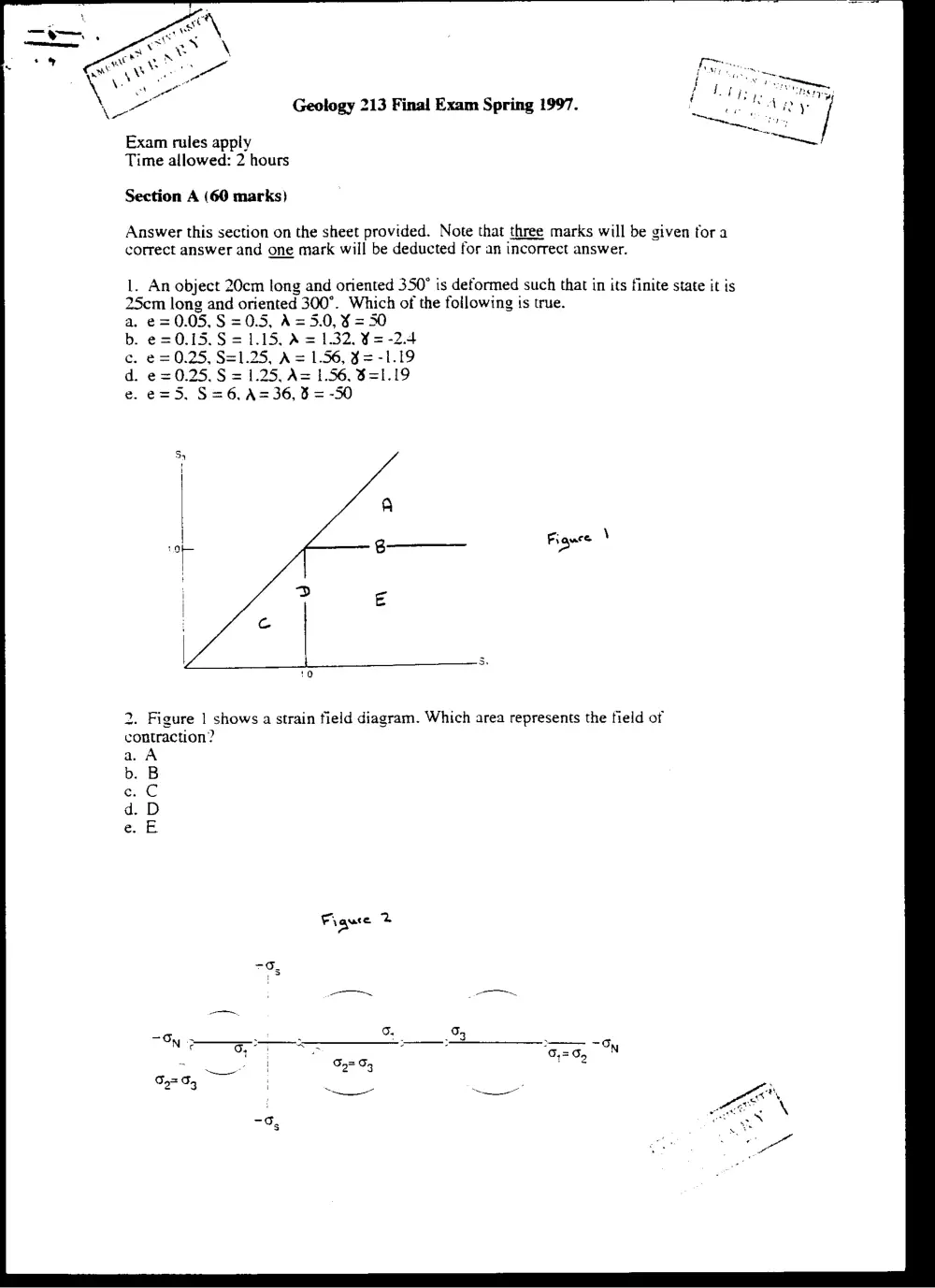
2. Figure | shows a strain field diagram. Which area represents the field of
contraction?
A
B
.C
.D
E
. Figure 2 is a Mohr stress diagram representing
. Differential stress
. Hydrostatic stress
. Uniaxial stress
. Axial stress
. Triaxial stress
‘-
Dillerennat Sisass (in MPa)
9 y
8 8
en | vc
3
TT
4 3 5
Straw (%)
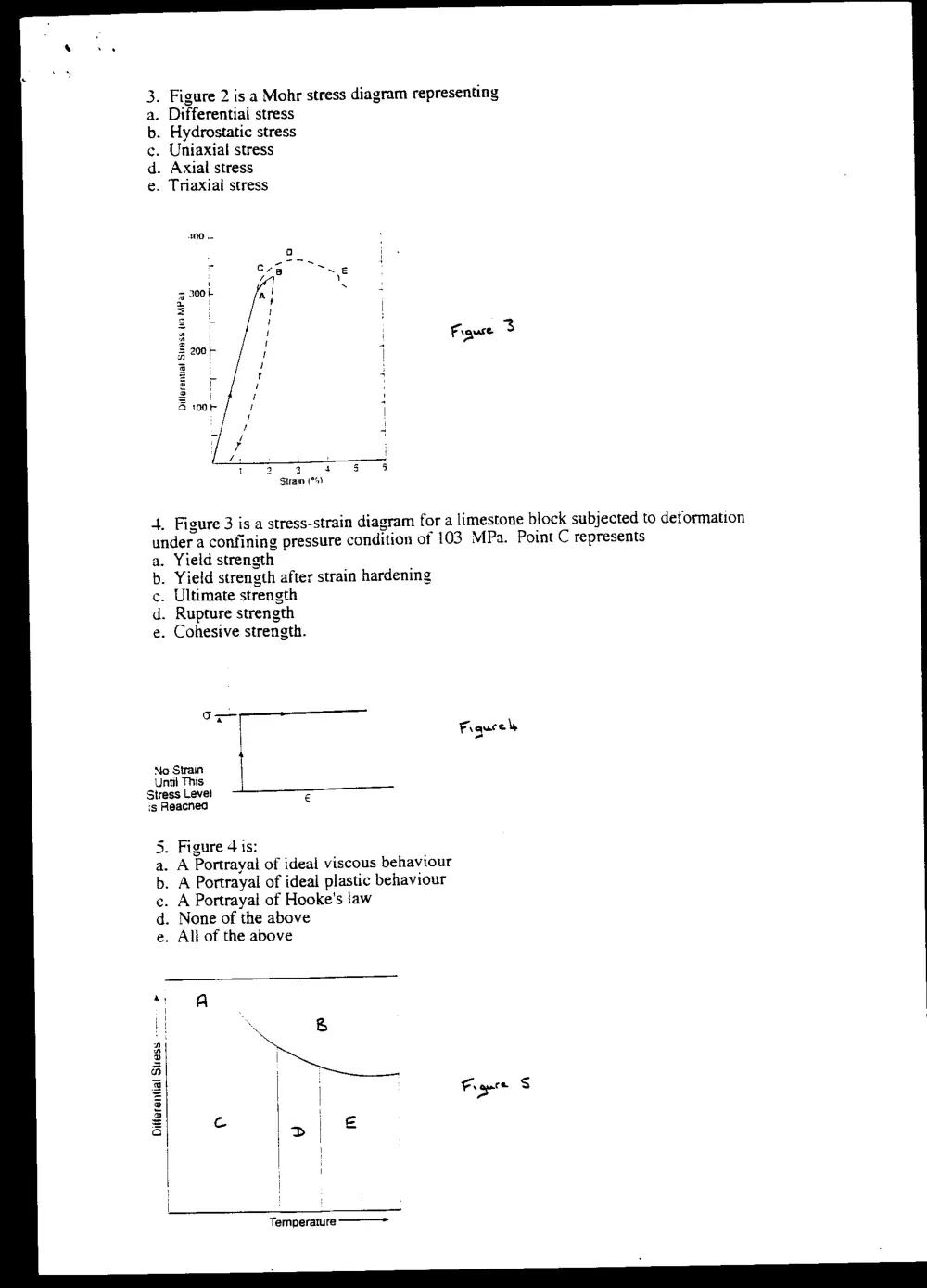
4. Figure 3 is a stress-strain diagram for a limestone block subjected to deformation
under a confining pressure condition of 103 MPa. Point C represents
. Yield strength
. Yield strength after strain hardening
. Ultimate strength
. Rupture strength
. Cohesive strength.
No Strain
Until This
Stress Level
is Reacned
Figure 4 is:
A Portrayal of ideal viscous behaviour
A Portrayal of ideal plastic behaviour
A Portrayal of Hooke's law
None of the above
All of the above
SAOTP MN
Differential Strass --
Temperature ————*
6. Figure 5 is a simplified deformation map. Which of the following statements is
true
Area A represents dissolution creep and mechanical twinning
Area B represents dislocation creep
Area E represents volume diffusion creep
Statements a and b are both correct
Statements b and c are both correct.
oP
oe
Screw dislocations are
Oriented perpendicular to the direction of slip
Oriented parallel to the direction of slip
Oriented obliquely to the direction ot slip
Oriented either perpendicular or parallel to the direction of slip
Oriented either parallel or oblique to the direction of slip
SPs
wag
Boundary migration recrystallization is favoured by
Low temperatures and high pore fluid pressures
The presence of impurities
Moderate to high temperatures and the presence of pore fluid
A varied grain size and a varied mineralogy
None of the above.
FRE TP
©
Which of the following statements regarding the Mohr failure envelope are true.
1. 60 = cohesive strength
2. To = tensile strength
3. OC = critical shear stress required for faulting
4. DP = angle of internal friction
5. @ = angle between the jracture surface and the direction of greatest
principal stress
. Only 1 is true
. | and 2 are both true, 3,4 and 5 are false
. 1,2 and4 are true, 3 and 5 are false
1, 2,3 and 5 are true and + is false
. All of the statements are true
lO. The law that describes deformational behavior above the brittle-ductile transition
is called:
. Coulomb criterion
. Mohr - Coulomb criterion
. Van Mises criterion
. Griffith criterion
. Byerlee criterion
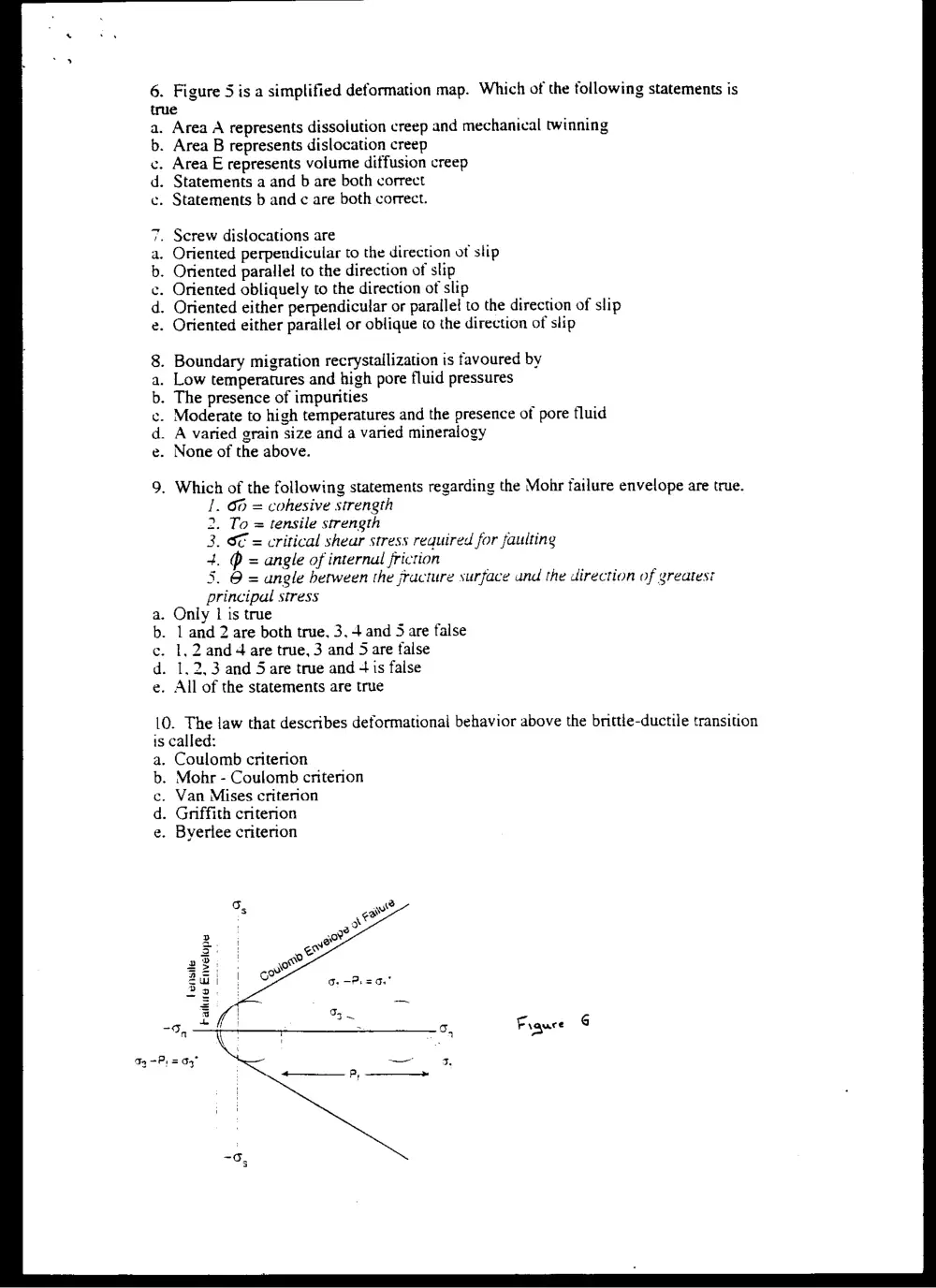
Ll. Figure 6 shows a Coulomb failure envelope. To begin with OT and 63 are both
compressive with low differential stress, but when the pore fluid pressure is raised the
result is:
a. Nothing
b. The stress circle crashes into the tensile failure envelope and the rock breaks by
mode | failure.
c. The stress circle crashes into the parabolic failure envelope and the rock breaks
through transitional tensile failure.
d. The stress circle crashes into the parabolic failure envelope and breaks according
to Coulomb's law of failure in the compressive field.
e. The stress circle crashes into the frictional sliding envelope and breaks through
transitional tensile behaviour.
12. Which of the following statements about fault rocks is true.
1. A gouge is a fine grained (clast < 0.1mm) clayey fault rock formed under
relatively low temperature and low pressure conditions.
2. A megabreccia comprises > 70% clast (>0.5m) and < 30% matrix. It
forms in area of low confining pressure andlor high fluid pressure.
3. A pseudotachylite in a "metamorphic" fault rock comprising angular
grains (< ()./mm) set in u finer matrix. They form under conditions of high
strain rate and medium confining pressure.
a. Only | is true
b. { and 2 are true. 3 is false
c. 1 and 3 are true, 2 is false
d. 2 and 3 are true, | is false
e. 1,2 and 3 are true.
13. A duplex is composed of four horses. A is at the bottom and D at the top.
A is Sm long and has slipped 6m
B is 10m long and has slipped 15m
C is 7m long and has slipped 6m
D is 15 long and has slipped 12m
The form of the duplex is:
a. A hinterland dipping duplex
b. An antiformal stack
c. A foreland dipping duplex
d. A combination of a hinterland dipping duplex and an antiformal stack
e. A combination of a hinterland dipping duplex and a foreland dipping duplex.
a +
i4. Figure 7 shows a series of strata that have been faulted. Which of the following
statements is true.
1. Horizon a has undergone post depositional deformation
2. Horizon a forms a roll-over anticline in the hangingwall of the fault
3. Horizons B and C are both syntectonic
4+. Diagram 7h shows positive structural inversion
. Diagram 7b shows negative structural inversion
5
a. 1, 2.3 and 4+ are true. 5 is false
b. 1.2.3 and 5 are true, 4 is false
c. 2,3, and 5 are true, | and + are false
d. 1, 2, and 4 are true, 3 and 5 are false
e. 1,2, and 3 are true, 4 and 5 are false
15. Simple buckling of a single layer is best described mathematically in terms of
a. Dominant wavelength, thickness of stiff layer. elastic modulus of stiff layer. elastic
modulus of confining medium
b. Dominant wavelength, thickness of stiff layer. Young's modulus of stiff layer.
Young's modulus of confining medium
c. Dominant wavelength. thickness of stiff layer. coefficient of viscosity of stiff
layer, coefficient of viscosity of confining medium.
d. Dominant wavelength, thickness of stiff layer. Poisson's ratio of stiff layer.
Poisson's ratio of confining medium and strain.
e. Dominant wavelength, thickness of stiff layer. coefficient of viscosity of stiff
layer, coefficient of viecosity of confining medium and the stretch in two direction
within the plane of layering
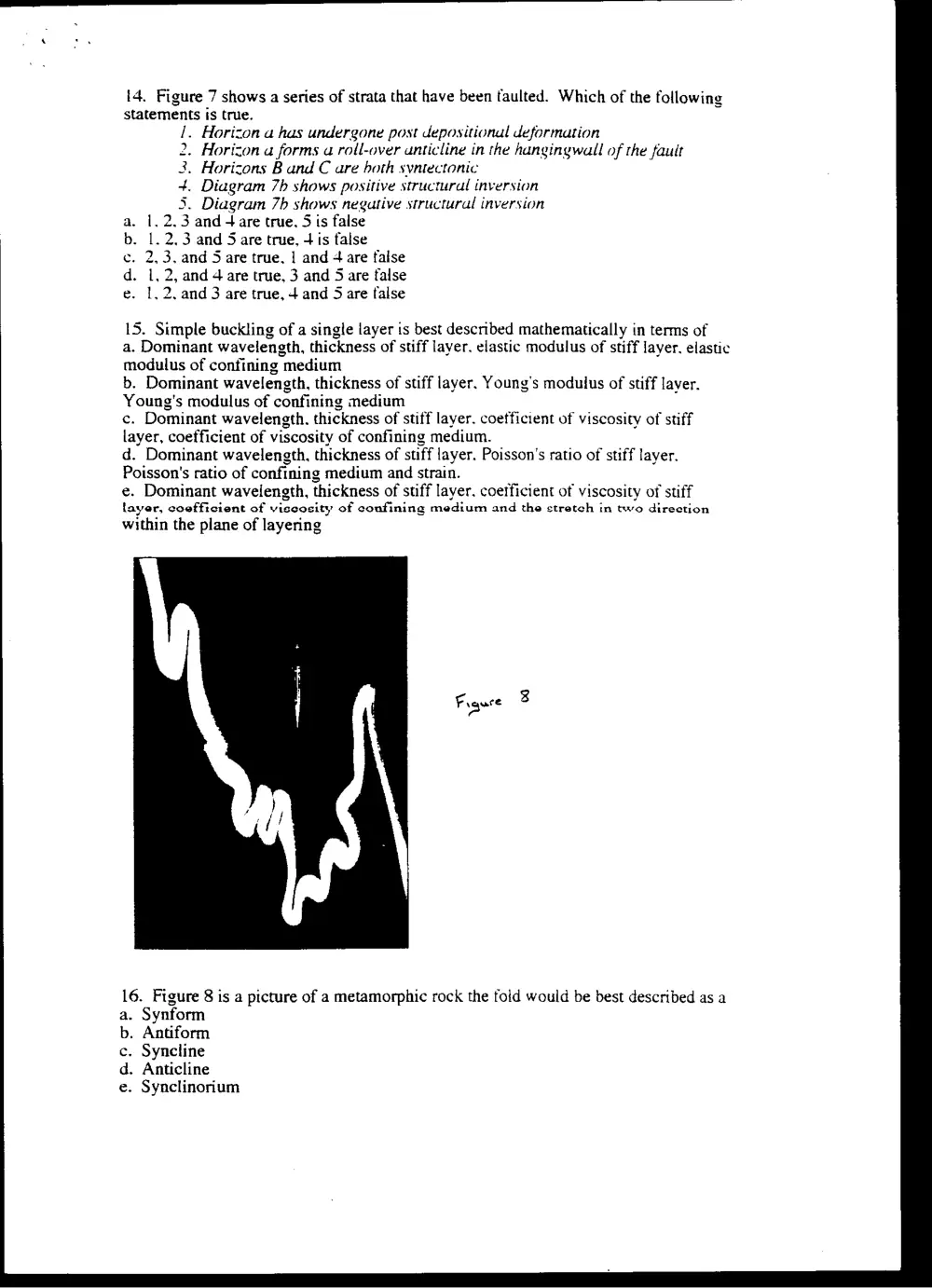
16. Figure 8 is a picture of a metamorphic rock the fold would be best described as a
a. Synform
b. Antiform
c. Syncline
d. Anticline
e. Synclinorium
17. Which of the following statements about L tectonites is true
1. They are the product of flattening
. They form when S| > S2 = S3
. They form when an original sphere turns into a triaxial ellipsoid
. They are exemplified by pencil structure
| and 2 are true. 3 and 4 are false
{ and 2 are false, 3 and 4 are true
1 and 3 are true, 2 and + are false
| and 3 are false. 2 and + are true
1, 2,3 and 4 are true.
18. Which of the following statements about cleavages is true.
1. Cleavage is divided into domains, microlithon domains und cleavage
domains
2. Cleavage is divided into M domains and QF domains
3. M domains are the same as microlithon domains
4. QF domains are the sume as cleavage domains
5. QF domains represent the original host rock
and 2 are true, 3, 4 and 5 are false
. 2. and 3 are true, 4 and 5 are false
. 2.3 and 5 are true, 4 is false
. 2.4 and 5 are true, 3 is false
. 2. and 5 are true 3 and 4 are false
Anuthenc
Synthenc
Shear Sand
' j
Mica Fish ‘Sgn Trail” Foliation
fF
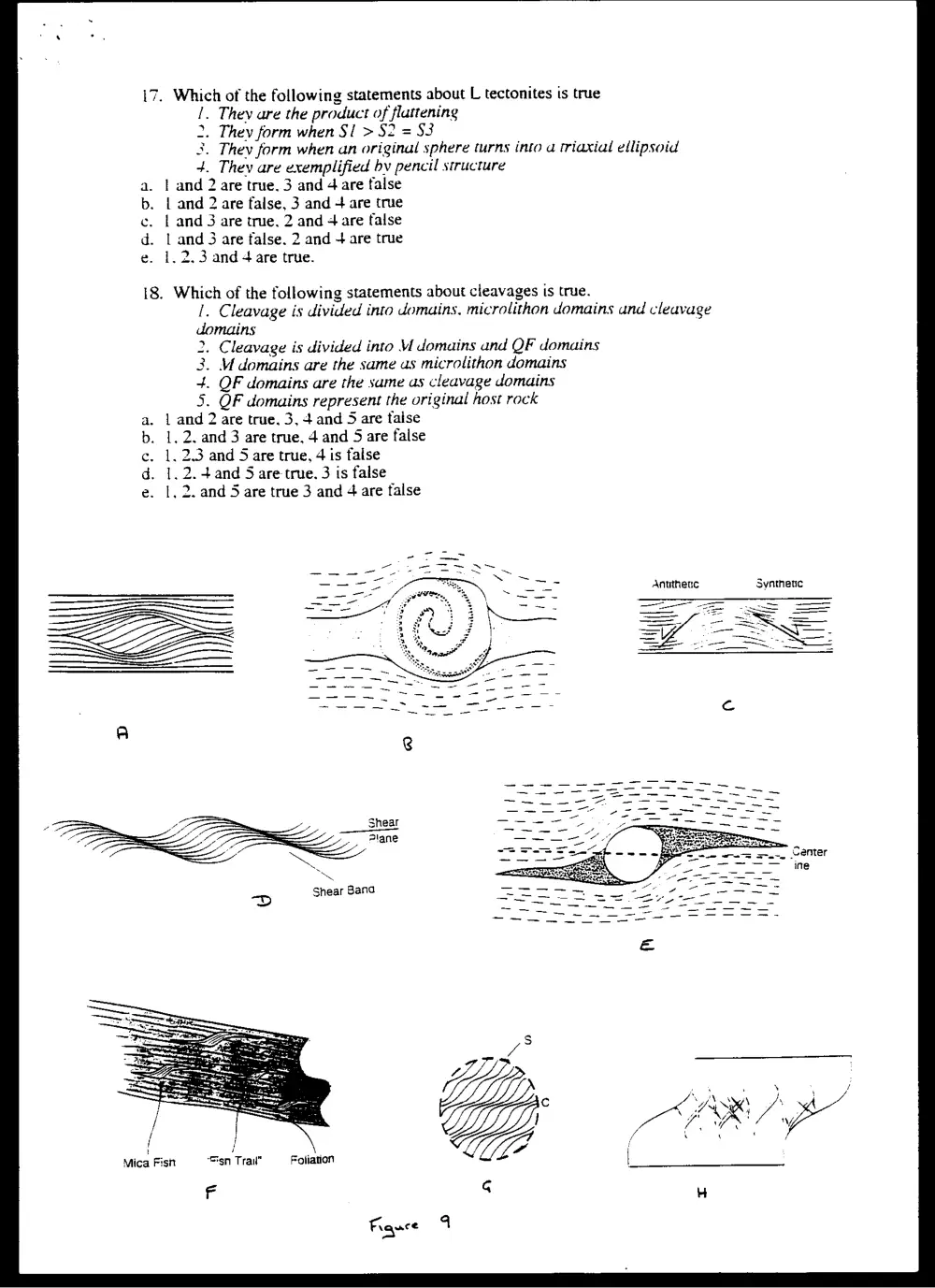
19. Figure 9 is a composite showing different shear criteria. The sense of offset in
each case is:
a. All are dextral
b. All are sinistral
c. A.B, C and D are dextral. E. F. G and H are sinistral
d. A, B.C and D are sinistral, E. F. G and H are dextral
e. A.C. F and H are dextral. B. D. E and G are sinistral.
20. Figure 10 shows a strain ellipse divided into four sectors A. B, C and D.
a. The strain ellipse is a result of progressive pure shear. A represents instantaneous
and finite shortening, B represents finite shortening but instantaneous extension. C
represents finite and instantaneous extension. D represents finite and instantaneous
extension following an initial period of shortening.
b. The strain ellipse is a result of progressive pure shear. A represents finite
shortening but instantaneous extension, B represents instantaneous and finite
shortening, C represents finite and instantaneous extension following an initial period
of extension. D represents finite and instantaneous extension
c. The strain ellipse is a result of progressive simple shear. 4 Tepresents
instantaneous and finite shortening, B represents finite shortening but instantaneous
extension, C represents finite and instantaneous extension. D represents finite and
instantaneous extension following an initial period of shortening.
d. The strain ellipse is a result of progressive simple shear. A represents finite
shortening but instantaneous extension, B represents instantaneous and finite
shortening, C represents finite and instantaneous extension following an initial period
of extension. D represents finite and instantaneous extension.
e. The strain ellipse is a result of progressive simple shear. A represents
instantaneous and finite shortening, B represents finite shortening but instantaneous
extension, C represents finite and instantaneous extension following an initial period
of extension, D represents finite and instantaneous extension.
Section B (20 marks)
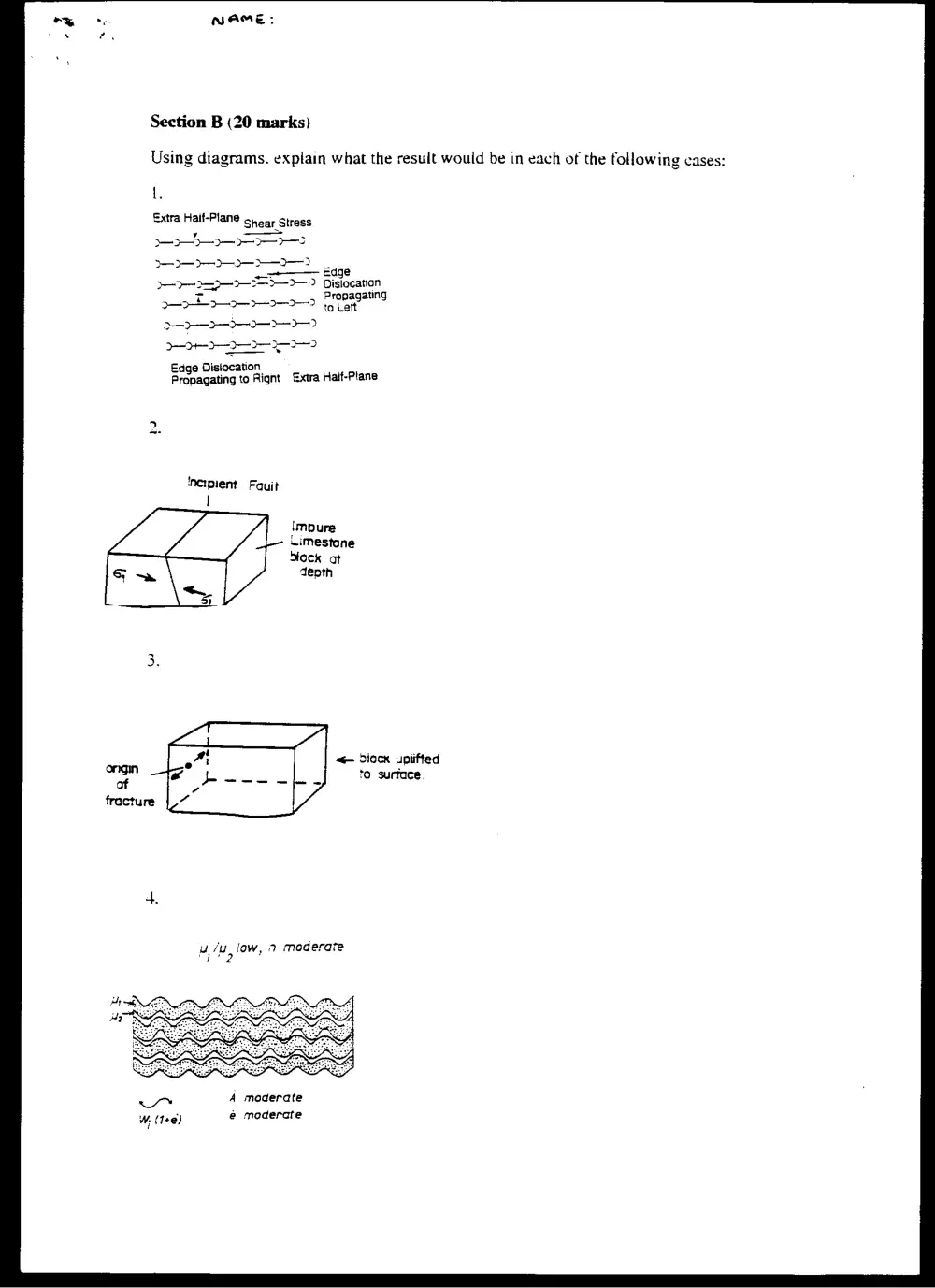
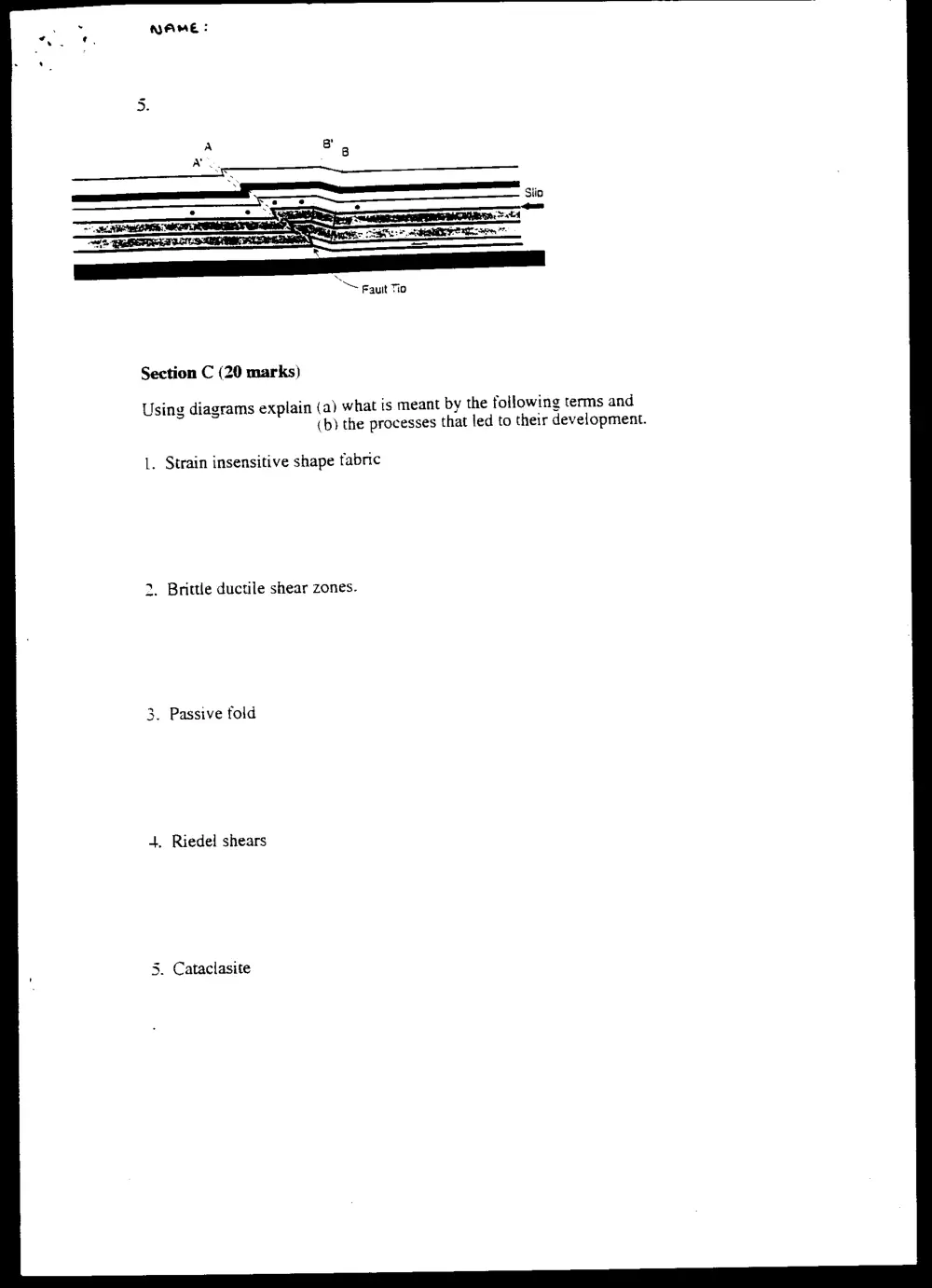
Using diagrams. explain what the result would be in each of the following cases:
1,
Extra Half-Plane Shear Stress
Se ey np nS Dr
3) 2?
rt Edge
p22? Dislocation
Propagatin
Qa? tg ne g
pan ne oe eee ae)
JHE
=
Edge Dislocation
Propagating to Rignt xtra Haif-Plane
neipient Fauit
i
Impure
Limestone
Steck at
depth
— lock upiifted
to surface.
i] MM, low, 2 moderate
uf)
rw) A moderate
Ww, {tee] @ moderate
Section C (20 marks)
Using diagrams explain (a) what is meant by the following terms and
(b) the processes that led to their development.
L. Strain insensitive shape fabric
. Brittle ductile shear zones.
. Passive fold
. Riedel shears
5. Cataclasite