
GEOL 222 Final, Fall 2005
American University of Beirut · Sedimentology · 6 pages



More GEOL 222 files
Show the text of this final exam
1
AMERICAN UNIVERSITY OF BEIRUT
DEPARTMENT OF GEOLOGY
FINAL EXAMINATION
Sedimentology (Geol 222)
February 2, 2006
Dr. Fadi Nader
8:00 am
Exam rules apply
Time: 2 hours
PART I: PRACTICAL QUESTIONS
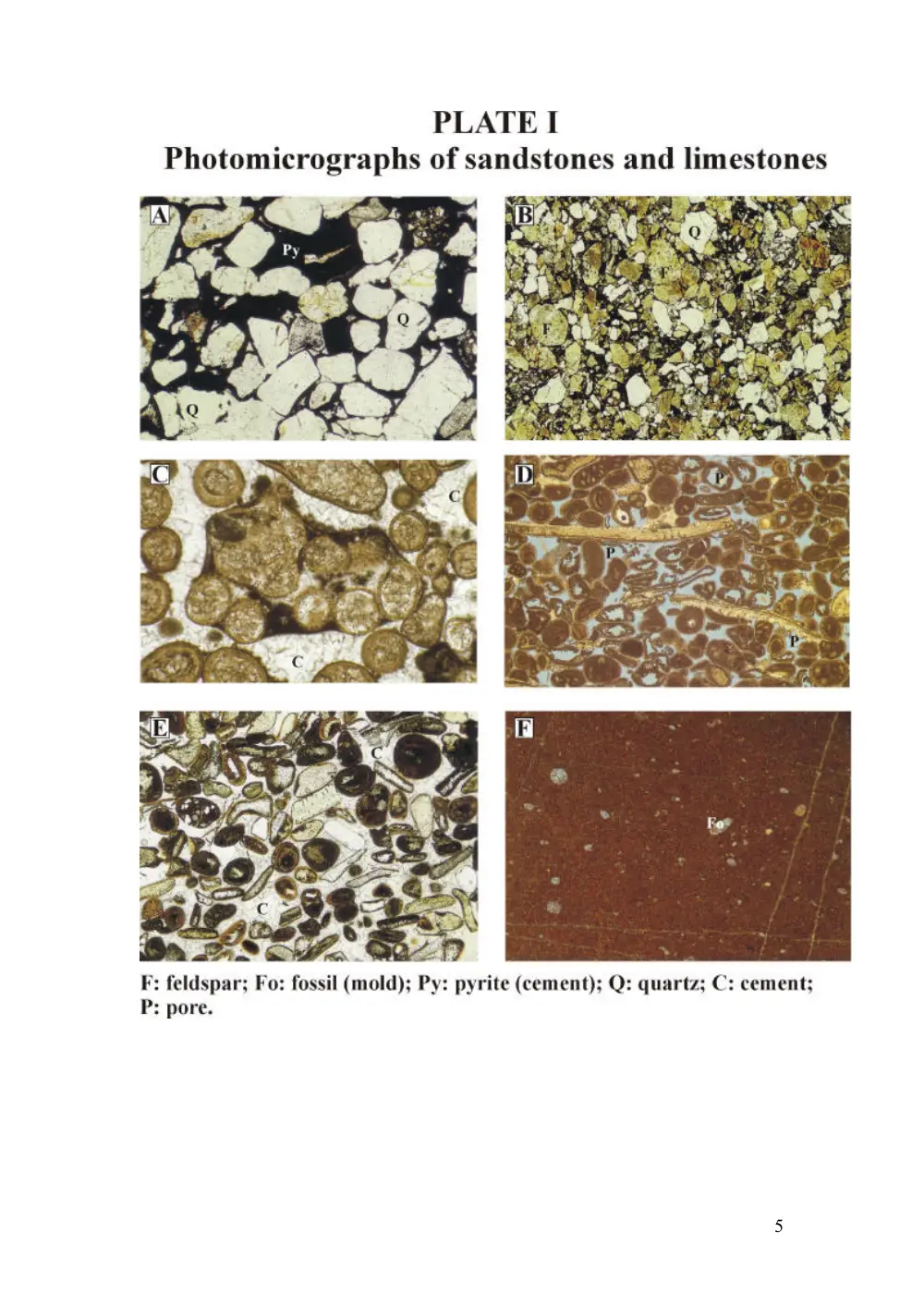
1. Rock classification (20 points):
Name the rocks represented by the photomicrographs (A to F) shown on Plate
I (page 5), according to the rock texture and the nature of constituents.
•
• For limestones, giv
classification
s classification table on page 6).
Name also the porosity type(s) and amount(s) where appropriate.
* The percentage estimation chart is on page 6.
PART II: DEFINITIONS & SHORT ANSWERS
2. Define seven out of the ten following terms (20 points):
Bounding surface [dunes]
Accumulation surface [dunes]
Alluvial fan
Sorting
Dissipative shorelines
Cheniers
Eustatic sea-level change
Hummocky cross-stratification (HSC)
Turbidites
Sabkha
3. Short answers (20 points):
a. List the various laboratory steps followed during a sieving experiment:
b. Once channels are initiated in an alluvial setting, they may expand and
shift position through a combination of:
c. List the FOUR mechanisms of transport/deposition in an alluvial
environment:
2
d. Name four different types of paleosols (usually, paleosols are
recognized on the basis of organic, textural and stratigraphic features):
e. The anatomy of a dune (in section) consists of the following features
(you may draw a small sketch):
f. Dune development could be inhibited by (factors):
g. Where rivers flow into a basin, the effluent behavior and consequent
depositional patterns (sediment delivery to the basin) depend upon:
h. Define the three distinct zones of a delta-profile:
i. List the major components of carbonate sediments:
j. What are the three most common marine evaporite minerals and their
respective seawater concentration thresholds required for precipitation?
BONUS QUESTION ☺
☺ :
k. Speleothems (cave formations) were grouped into three main
categories (White, 1976). These categories are:
3
PART III: DIAGRAMS/ FIGURES QUESTIONS
4. Add a figure-caption/title to the following diagram and discuss it briefly
in less than 10 lines (10 points):
5. Add a figure-caption/title to
the
following
composite
figure
including
(5A;
right) and (5B; below) and
discuss it briefly in less than
10 lines (10 points):
5A �
5B
4
PART IV: DISCUSSION QUESTIONS
6. Answer one of the two following questions (20p):
a. Discuss
special sedimentological environment. To answer this
question you need to: 1) d
e
; 2) describe the different zones
within an estuary; and 3) explain the classification of estuaries based on the
dominant processes. *** Make use of the figures (6A) and (6B).
6A
6B
b. Discuss the relationship between sea-level changes and carbonate production/
accumulation (i)? Define the different types of carbonate platforms (ii). Do
these platforms behave similarly during sea-level changes (justify your
answer; iii) ***Make use of the following figures (6C and 6D).
6C
6D
GOOD LUCK
5
6